논문 해설
Towards interpreting any residual stream direction by scaling activation inversion
활성화 역전 확장을 통한 임의의 잔차 스트림 방향 해석을 향하여
- 연구 문제 잔차 스트림 방향을 해석하려면 그 방향을 강하게 활성화하는 텍스트가 필요하지만, 코퍼스 검색으로 찾은 예시는 코퍼스의 내용과 활성화 강도에 제한됩니다.
- 연구 방법 MAEM은 방향을 입력받아 텍스트를 생성하도록 SFT 후 RL로 학습되며, 생성 텍스트를 주체 모델에 통과시킨 최대 코사인을 보상으로 씁니다.
방향을 설명하는 기존 방법의 한계
잔차 스트림의 방향을 해석할 때 흔히 쓰는 방법은 그 방향을 강하게 활성화하는 텍스트를 찾는 것입니다. 기존에는 대규모 코퍼스를 스캔해 가장 강하게 활성화되는 윈도우를 고르는 방식이 주로 쓰였습니다. 이 방식은 코퍼스가 담고 있는 텍스트에만 의존하므로, 찾을 수 있는 예시가 코퍼스 안에 있는 내용으로 제한됩니다. 또한 코퍼스 텍스트는 활성화를 최적화하도록 만들어진 것이 아니어서, 가장 좋은 예시라도 대상 방향을 약하게만 활성화하거나 다른 내용에 관한 텍스트일 수 있습니다. 저자들은 이 문제를 풀기 위해 방향 v만 주어졌을 때 주체 모델이 v에 대응한다고 판단할 텍스트 x를 직접 생성할 수 있는지를 질문합니다.
MAEM의 학습 목표와 구조
MAEM은 주체 모델 M의 가중치로 초기화된 언어 모델 π_θ입니다. 입력으로 잔차 스트림 방향 v를 받아 텍스트 x를 생성하며, 생성된 x를 동결된 주체 모델에 통과시켜 얻은 토큰별 활성화 h_t(x) 중 최대 코사인 유사도 s(v, x)=max_t cos(v, h_t(x))를 보상으로 사용합니다. 방향은 자리표시 토큰 뒤의 잔차에 노름을 맞추어 더하는 방식으로 주입되며, 생성된 텍스트는 주입 없이 주체 모델에서 채점됩니다. 학습은 먼저 방향과 짧은 문맥 텍스트의 쌍으로 음의 로그우도를 최소화하는 지도 fine-tuning(SFT)을 수행하고, 이후 SFT 체크포인트에서 시작해 RL로 위 코사인 보상을 최대화합니다.
RL 보상은 생성 텍스트의 마지막 16개 토큰에 대해 계산되며, KL 항 없이 짧은 길이 패널티만 사용합니다.
보류된 활성화 역전 충실도 평가
MAEM의 평가는 보류된 Ultra-FineWeb 잔차 512개를 대상으로 합니다. 각 대상마다 최대 64토큰 예시 64개를 생성하고, best-of-k에 따라 k=1, 8, 64를 보고합니다. 점수는 평균을 뺀 중심화 코사인입니다.
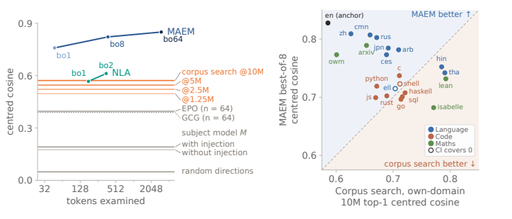
Figure 2 :(left) Held-out text activations.MAEM best-of-k, corpus search top-1 (gains 0.0251 per doubling); NLA (best-of-2 of four exemplars); EPO and GCG (n= 64each); the untrained base at best-of-8 with and without injectingv; random directions.(right) Generalisation across 21 unseen domains and languages.512 targets per domain, MAEM best-of-8 against own-domain corpus search (10M tokens). Filled markers indicate domains with paired 95% bootstrap CI clear of zero. The English anchor shown for reference. (See Appendices C and D.) We report thecentred scores µ(v, x): the score of Equation 1 with a fixed corpus mean activationµ subtracted fromvand from everyh t(x), reducing the influence of the shared component of residual activations on the score. For each target, we generate 64 MAEM exemplars of at most 64 tokens each and report best-of-kfork= 1,8, and64.Corpus searchselects the 64-token window (stride 32) containing the token with the highest cosine tovof a 10M-token sample of the checkpoint’s training ranges. Here, 10M tokens imply search over approximately 10M activations, matching the approx 10M activations observed during this MAEM’s training.
원문 · CC BY 4.0 · Celeste De Schamphelaere, Juan J. Vazquez, Ari Spiesberger, Tomáš Gavenčiak, Gavin Leech, Euan Ong, Jiahai Feng · Towards interpreting any residual stream direction by scaling activation inversion · 원문 그림 인용 · 원본 PDF 4쪽에서 그림 영역을 추출했습니다.일반화와 해석 가능성 과제의 결과
논문은 영어 웹 텍스트로만 학습한 MAEM이 21개의 보지 않은 언어와 도메인에서도 평가되었다고 보고합니다. 이 중 12개 도메인에서는 대상 도메인 자체의 10M 토큰 코퍼스 top-1 검색보다 높은 점수를 얻었습니다. 해석 과제에서는 스티어링 벡터 식별에서 MAEM 텍스트가 AxBench에서 95.8%, BiPO에서 83.7%를 기록해 NLA(92.8%, 85.7%)와 비슷한 수준이고 J-lens와 코퍼스 검색보다 높다고 보고합니다. 작업 공간 과제에서는 MAEM이 단어 규칙으로 NLA보다 적게 이름을 맞혔고, SAE 특징 활성화에서는 best-of-8 샘플이 특징의 89%를 발화시켰습니다. 자동 해석 실험에서는 MAEM 예시가 코퍼스 윈도우보다 설명 품질이 낮고 NLA 예시와 비슷하다고 보고합니다.
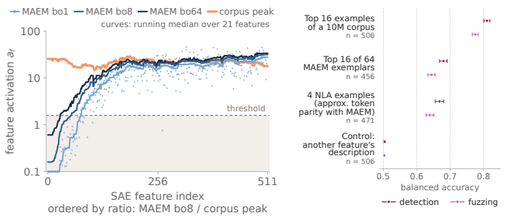
Figure 6 :(left) Peak SAE activation per feature.512 features of the 131k-feature SAE, ordered by the ratio of the best-of-8 MAEM activation vs 10M-token corpus top activation. The best-of-8 MAEM exemplar fires (activation above the SAE thresholdτ) 89% of features, reaches 0.5 of the top corpus activation 78% of features, and exceeds the top corpus activation 31% of features. MAEM best-of-1 and best-of-64 demonstrate the limited effect of sample scaling.(right) Automated in- terpretation of SAE features.Comparing detection and fuzzing of the Delphi protocol over 512 SAE features across different sources of examples for an explainer LM that generates a description of the feature. Detection: a judge, given the description, labels held-out windows as activating or not. Fuzzing: the judge picks the correctly marked activating tokens.512−nfeatures were refused by the explainer (Claude Sonnet 5). See Table 18; protocol in Appendix H.
원문 · CC BY 4.0 · Celeste De Schamphelaere, Juan J. Vazquez, Ari Spiesberger, Tomáš Gavenčiak, Gavin Leech, Euan Ong, Jiahai Feng · Towards interpreting any residual stream direction by scaling activation inversion · 원문 그림 인용 · 원본 PDF 9쪽에서 그림 영역을 추출했습니다.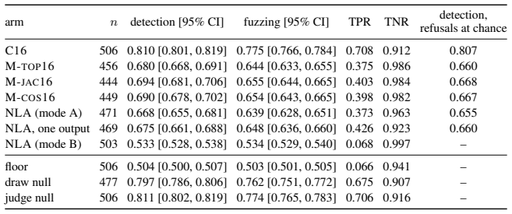
Table 18 : Every arm: balanced accuracy with 95% bootstrap CI over thenfeatures scorable on detection (fuzzingnis lower only for NLA modes A and B), chance 0.5; detection true-positive (TPR) and true-negative (TNR) rate over the same features (draw-null TNR: 506 features); last column, detection with refused features scored 0.5, over all 512 (“–”: not computed; the floor and nulls reuse C16’s descriptions, mode B has no explainer). Arms in Appendix H.3.
원문 · CC BY 4.0 · Celeste De Schamphelaere, Juan J. Vazquez, Ari Spiesberger, Tomáš Gavenčiak, Gavin Leech, Euan Ong, Jiahai Feng · Towards interpreting any residual stream direction by scaling activation inversion · 원문 그림 인용 · 원본 PDF 37쪽에서 그림 영역을 추출했습니다.실패 특징과 다양성의 한계
저자들은 MAEM이 SAE 특징의 약 11%를 최적 8개 샘플에서도 활성화하지 못한다고 보고합니다. 실패는 드문 특징과 위치 특징에 집중되는 경향이 있으며, 목록이나 표와 관련된 특징에서 높게 나타납니다. 또한 MAEM 샘플은 Vendi 점수 기준으로 코퍼스 검색보다 다양성이 낮아, MAEM 예시로 만든 설명은 활성화 윈도우 일부만 설명하는 한계가 있습니다. 보고된 실험은 하나의 주체 모델과 하나의 SAE 설정에서 이루어졌으며, SFT와 RL을 같은 연산량에서 비교하지 않았습니다. 따라서 이 결과는 현재 설정에서 확인된 범위로 읽어야 하며, 다른 모델이나 설정으로 그대로 일반화되지 않습니다.
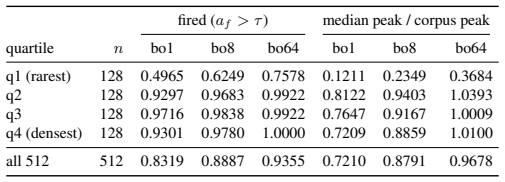
Table 16 : Activation of MAEM exemplars by quartile of corpus activation density (q1 rarest) and pooled. Fired: the probability that the best ofkdraws exceedsτ, averaged over the row’s features. Ratio: the median over those features of the expected best-of-kpeak divided by the corpus peak af,C.
원문 · CC BY 4.0 · Celeste De Schamphelaere, Juan J. Vazquez, Ari Spiesberger, Tomáš Gavenčiak, Gavin Leech, Euan Ong, Jiahai Feng · Towards interpreting any residual stream direction by scaling activation inversion · 원문 그림 인용 · 원본 PDF 34쪽에서 그림 영역을 추출했습니다.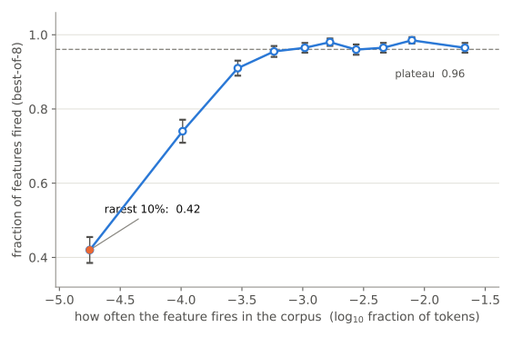
Figure 9 : Fraction of features the MAEM fires at least once in8rollouts, by decile of corpus firing rate, uniform draw (n= 1,998). The drop is confined to the bottom fifth; above it the rate is flat. Error bars are standard errors.
원문 · CC BY 4.0 · Celeste De Schamphelaere, Juan J. Vazquez, Ari Spiesberger, Tomáš Gavenčiak, Gavin Leech, Euan Ong, Jiahai Feng · Towards interpreting any residual stream direction by scaling activation inversion · 원문 그림 인용 · 원본 PDF 46쪽에서 그림 영역을 추출했습니다.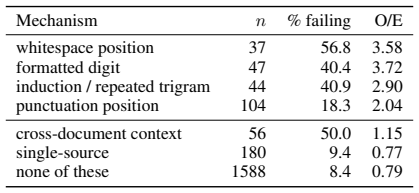
Table 26 : Uniform draw. O/E is observed over expected failures given the11.6%base rate. The first four are significant atp <10 −3 (Fisher, two-sided); cross-document context (p= 0.30) and single-source (p= 0.19) are not. A feature may carry more than one label.
원문 · CC BY 4.0 · Celeste De Schamphelaere, Juan J. Vazquez, Ari Spiesberger, Tomáš Gavenčiak, Gavin Leech, Euan Ong, Jiahai Feng · Towards interpreting any residual stream direction by scaling activation inversion · 원문 그림 인용 · 원본 PDF 46쪽에서 그림 영역을 추출했습니다.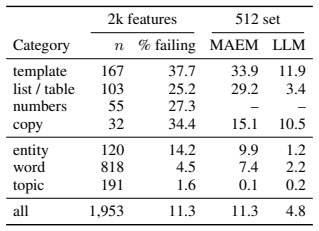
Table 27 : % of features where no rollout clearsτ, by blind-labelled category; features that never fire in the corpus are excluded. Right: best-of-8on the 512 set, from the direction (MAEM) or from16 corpus windows (LLM); –:n <5.
원문 · CC BY 4.0 · Celeste De Schamphelaere, Juan J. Vazquez, Ari Spiesberger, Tomáš Gavenčiak, Gavin Leech, Euan Ong, Jiahai Feng · Towards interpreting any residual stream direction by scaling activation inversion · 원문 그림 인용 · 원본 PDF 47쪽에서 그림 영역을 추출했습니다.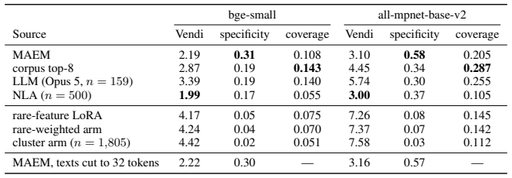
Table 30 : Diversity in meaning, both embedders; medians over features,k= 8. Bold marks the extreme of each column among the sources above the first rule: the MAEM is the most specific, NLA and the MAEM the least spread, and the corpus top-8 covers the feature’s other windows best. NLA’s coverage is not comparable, since it writes descriptions of text rather than text like the corpus windows. Below the rule are the three rare-feature training runs, all read on features they were not trained on: each is spread only because it is barely specific. On the LLM’s159features alone the MAEM’s Vendi is2.32(bge-small) and its raw coverage0.591against the LLM’s0.664.
원문 · CC BY 4.0 · Celeste De Schamphelaere, Juan J. Vazquez, Ari Spiesberger, Tomáš Gavenčiak, Gavin Leech, Euan Ong, Jiahai Feng · Towards interpreting any residual stream direction by scaling activation inversion · 원문 그림 인용 · 원본 PDF 49쪽에서 그림 영역을 추출했습니다.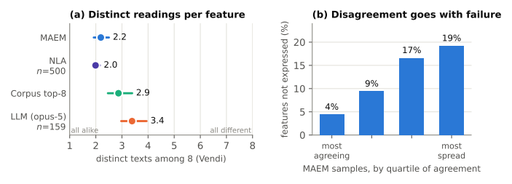
Figure 10 :(a)Distinct texts among eight samples per feature (Vendi score over bge-small embed- dings): median and interquartile range over the 131k-SAE 2k set. NLA covers500features, the LLM159.(b)Share of features the MAEM fails to fire (below10%of corpus peak, best-of-8), by quartile of agreement among its samples.
원문 · CC BY 4.0 · Celeste De Schamphelaere, Juan J. Vazquez, Ari Spiesberger, Tomáš Gavenčiak, Gavin Leech, Euan Ong, Jiahai Feng · Towards interpreting any residual stream direction by scaling activation inversion · 원문 그림 인용 · 원본 PDF 49쪽에서 그림 영역을 추출했습니다.논문 정보
- 저자
- Celeste De Schamphelaere, Juan J. Vazquez, Ari Spiesberger, Tomáš Gavenčiak, Gavin Leech, Euan Ong, Jiahai Feng
- 학회·저널
- arXiv · 프리프린트
- 최초 공개일
- 2026년 11월 5일
- 등록일
- 2026년 11월 7일
- 수정일
- 2026년 11월 5일
- 버전
- v1
- arXiv
- 2611.08465
- 분류
- cs.LG · cs.AI
- 원문 이용 조건
- CC BY 4.0
- 제공 범위
- 논문 정보, 해설, 허용된 원문 그림
AI 해설은 논문 원문과 별개의 설명이며 오류가 있을 수 있습니다. 원문과 그림은 각 출처의 이용 조건과 따로 표시된 권리를 따릅니다.
초록
To interpret a direction in a language model's residual stream, we can look for text that strongly activates it. But when such text is found by scanning a corpus, it is limited to what that corpus contains. We develop Maximally-Activating Example Metamodels (MAEMs), language models which map residual stream directions from a subject model to text exemplars that strongly activate those directions. Our objective is to maximise the cosine similarity of a supplied residual stream direction with the activations of the text generated by the MAEM. This label-free RL objective helps to scale MAEMs on diverse sources of residual stream directions. Empirically, we find the resultant metamodel produces informative exemplars: a Qwen3.6-27B MAEM inverts held-out activations better than corpus search or a natural-language autoencoder (NLA), beats corpus search (at 10M tokens) on a majority of held-out languages/domains, and activates 89% of held-out SAE features. It also identifies concepts behind steering vectors about as well as NLAs, recovers the payloads of LoRA backdoors more often than corpus search, and can even verbalise some model workspace inner monologue. Unlike explanations produced by other metamodels (e.g. NLAs), MAEM exemplars can be verified with a forward pass on the subject model, making the MAEM objective a grounded alternative for scaling the training of metamodels.
원문 인용
Celeste De Schamphelaere, Juan J. Vazquez, Ari Spiesberger, Tomáš Gavenčiak, Gavin Leech, Euan Ong, Jiahai Feng (2026). Towards interpreting any residual stream direction by scaling activation inversion. arXiv:2611.08465v1. https://arxiv.org/abs/2611.08465v1
BibTeX
@misc{schamphelaere2026towards,
  title = {{Towards interpreting any residual stream direction by scaling activation inversion}},
  author = {Celeste De Schamphelaere and Juan J. Vazquez and Ari Spiesberger and Tomáš Gavenčiak and Gavin Leech and Euan Ong and Jiahai Feng},
  year = {2026},
  eprint = {2611.08465},
  archivePrefix = {arXiv},
  url = {https://arxiv.org/abs/2611.08465v1}
}