논문 해설
Mind the Band: The Hidden Frequency Variable in Geometric RoPE
RoPE 주파수 대역이 성능 순위를 바꿈
- 연구 문제 기존 기하 RoPE 구현은 주파수 대역을 물려받은 기본값에 맡겨 두어, 방법끼리의 비교가 설정에 따라 뒤집힐 수 있습니다.
- 연구 방법 저자들은 주파수 대역을 독립 변수로 떼어 이미지 좌표 단위로 바꿔 보고, 넓은 대역에서는 고주파의 깊이 기울기만 막아 봅니다.
- 주요 결과 RayRoPE는 RealEstate10K에서 최강 기준선보다 1.2dB 낮았고, 고주파 깊이 기울기를 막으면 잃은 PSNR의 대부분을 되찾았습니다.
기존 구현이 주파수 대역을 물려받는 문제
기하 RoPE는 카메라 기하를 어텐션에 넣기 위해 토큰 특징을 뷰잉 레이, 깊이, 재투영된 이미지 좌표에 따라 회전시킵니다. 각 좌표는 여러 주파수로 회전하며, 이 주파수들의 집합을 주파수 대역이라고 부릅니다. 기존 구현은 이 대역을 별도로 정하지 않고 2D RoPE의 최고 주파수를 그대로 쓰거나, 어텐션 헤드 차원이 커질수록 주파수 범위가 지수적으로 늘어나는 규칙을 물려받습니다. 저자들은 이렇게 표준화되지 않은 설정이 벤치마크 순위를 뒤집을 수 있다고 봅니다. 헤드 크기만 바꾸고 모델 폭을 고정해도 같은 역전이 나타납니다. 그래서 이 연구는 대역 자체를 독립 변수로 떼어 놓고 그 영향을 체계적으로 확인하는 데 초점을 둡니다.
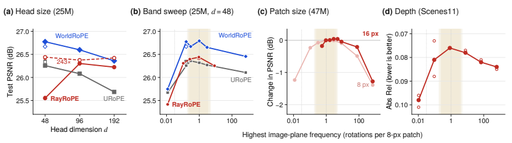
Figure 4 .Performance across head sizes and maximum frequencies(open markers: extra seeds; shading: RayRoPE’s plateau). (a) Vary- ing head count in the 25M model on RealEstate10K; holding RayRoPE at243×(dashed) removes its head-size dependence. (b) Sweeping the top image-plane frequency at fixedω 0. (c, d) Single-ray RayRoPE with 16- vs. 8-px patches (47M) (c) and on two-view depth (d).
원문 · CC BY 4.0 · Seonghyun Jin, Youngmin Kim, Jong Chul Ye · Mind the Band: The Hidden Frequency Variable in Geometric RoPE · 원문 그림 인용 · 원본 PDF 5쪽에서 그림 영역을 추출했습니다.투영 기반 RoPE에서 대역이 달라지는 이유
RayRoPE 같은 투영 기반 방법은 소스 뷰의 토큰이 가진 3D 뷰잉 레이를 대상 뷰에 투영합니다. 같은 뷰 안에서는 레이 위의 모든 점이 토큰 자신의 픽셀로 되돌아오므로 이미지 좌표는 깊이에 의존하지 않습니다. 반면 교차 뷰에서는 투영 위치가 연속적이어서 한 패치 안의 작은 차이까지 구분해야 합니다. 기존 2D RoPE는 패치 인덱스 격자에 맞춰 최고 주파수를 약 0.16 rotations per patch로 두지만, 이 값은 연속 좌표에서는 부족할 수 있습니다. RayRoPE는 최저 주파수 ω0을 고정하고 각 단계마다 3배씩 키우는 규칙 ωk = ω0·3^k를 쓰므로, 헤드 차원 d가 커질수록 범위 3^(n-1)이 지수적으로 커집니다.
예를 들어 세 레이를 쓰는 기본 설정은 d=48에서 3배 범위만 얻지만 d=144에서는 243배 범위를 얻습니다. 이 규칙은 저자들이 보기에 헤드 크기에 따라 공간 스케일을 암묵적으로 정하는 셈입니다.
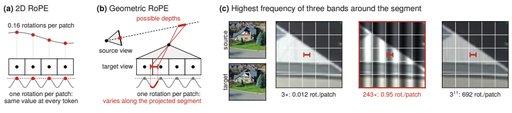
Figure 2 .From discrete patch indices to continuous projected segments.(a) In 2D RoPE, tokens sit at integer patch centers, where a frequency of one rotation per patch gives every token the same phase. (b) Across cameras, geometric RoPE projects a token’s 3D viewing ray into the other view: the reprojected position is continuous, and unknown depth spreads it along a segment. (c) Target crop around the projected segment (0.45patches, red) for a±15%depth interval of the marked source pixel, overlaid with the top frequency of three bands: 3×barely varies across patches,243×separates sub-patch offsets, and3 11 turns∼300times inside the segment (drawn77×coarser).
원문 · CC BY 4.0 · Seonghyun Jin, Youngmin Kim, Jong Chul Ye · Mind the Band: The Hidden Frequency Variable in Geometric RoPE · 원문 그림 인용 · 원본 PDF 2쪽에서 그림 영역을 추출했습니다.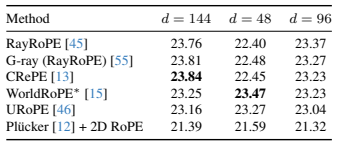
Table 2 .Novel view synthesis on ScanNet++(fisheye test PSNR) across head dimensionsd= 144,48,and96(width 1152 at d= 144, 768 otherwise), corresponding to ranges of243×,3×, and27×under Eq. (1) for the first three rows (G-ray on its Ray- RoPE host). ∗Image-plane coordinates only; baseline details in supplement.
원문 · CC BY 4.0 · Seonghyun Jin, Youngmin Kim, Jong Chul Ye · Mind the Band: The Hidden Frequency Variable in Geometric RoPE · 원문 그림 인용 · 원본 PDF 6쪽에서 그림 영역을 추출했습니다.대역을 고정하거나 바꾸어 본 실험
저자들은 모델 폭을 고정하고 헤드 수만 바꾸어 RayRoPE의 기본 규칙과 고정 범위를 비교했습니다. 기본 규칙에서는 25M 모델의 PSNR이 헤드 수에 따라 크게 움직였지만, 범위를 243배로 고정하자 PSNR이 0.06dB 이내에서 평평하게 유지되었습니다. 즉 겉보기의 헤드 크기 민감성은 실제로 대역 민감성이었다는 뜻입니다. 대역을 독립적으로 바꾸기 위해 최저 주파수는 고정하고 단계 비율로 최고 주파수를 조절했습니다. 47M 모델에서는 3^11 범위가 PSNR을 23.56에서 25.41dB까지 떨어뜨렸지만, 같은 열두 주파수를 243배로 재배치하자 26.61dB와 26.66dB가 나왔습니다. 이는 중간 주파수가 충분해야 넓은 범위가 도움이 된다는 점을 보여 줍니다.
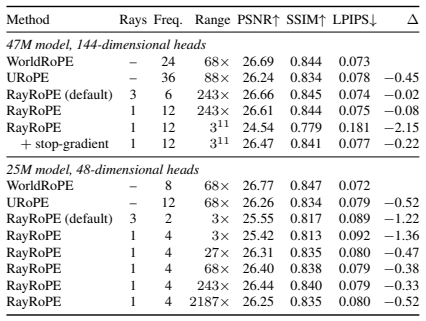
Table 1 .Novel view synthesis on RealEstate10K.“Default”: re- leased three-ray RayRoPE at eachd; SSIM [42], LPIPS [54].∆: paired PSNR gap to WorldRoPE (±0.03dB 95% bootstrap; sup- plement); “+stop-gradient” blocks high-frequency depth gradi- ents (Sec. 5.3). Additional runs of the last three 47M rows score 26.66dB (243×),23.56–25.41dB (3 11), and26.52dB (+stop- gradient; supplement).
원문 · CC BY 4.0 · Seonghyun Jin, Youngmin Kim, Jong Chul Ye · Mind the Band: The Hidden Frequency Variable in Geometric RoPE · 원문 그림 인용 · 원본 PDF 4쪽에서 그림 영역을 추출했습니다.좁은 대역과 넓은 대역이 실패하는 원리
좁은 대역에서는 이웃 패치가 거의 같은 회전을 받아 어텐션이 지역적 위치 대비를 잃고, 그 결과 렌더링이 흐려집니다. 넓은 대역의 실패는 순전파와 역전파가 다르게 작동하기 때문입니다. 예측 깊이 구간 위에서 회전을 균등하게 평균하면 순전파에서는 고주파가 1/ω로 감쇠하지만, 구간 중심 μ에 대해 미분하면 ω가 앞으로 나와 1/ω 감쇠가 상쇄되고 구간 양 끝점의 변화만 남습니다. 그래서 순전파에서는 거의 영향이 없어 보이는 고주파가 깊이 예측으로는 크고 빠르게 진동하는 기울기를 보냅니다. 저자들은 이 기울기가 넓은 대역의 붕괴를 만든다고 해석합니다. 반면 가우시안 창은 순전파에서 초지수적으로 감쇠해 이런 상쇄가 일어나지 않는다고 설명합니다.
이 설명은 미분 식과 감쇠 조건에서 나온 것이며, 이를 학습 전체 동역학으로 확장한 것은 아닙니다.
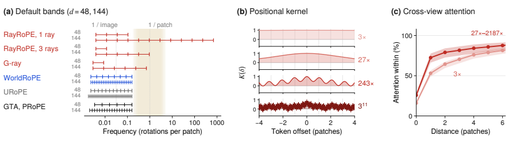
Figure 3 .Default frequency bands and spatial selectivity.(a) Image-plane bands assigned by each released rule atd= 48and144(G- ray shown with its RayRoPE host; shading: RayRoPE’s plateau). (b) Unweighted positional kernelK(δ)(Eq. (2)) across patch offsets for four frequency ranges. (c) Fraction of cross-view attention within a given distance of verified correspondences in 25M RayRoPE models (mean, min–max over four3×and six wider-band models).
원문 · CC BY 4.0 · Seonghyun Jin, Youngmin Kim, Jong Chul Ye · Mind the Band: The Hidden Frequency Variable in Geometric RoPE · 원문 그림 인용 · 원본 PDF 4쪽에서 그림 영역을 추출했습니다.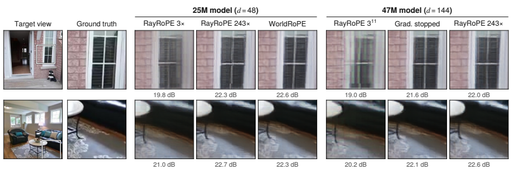
Figure 5 .Qualitative comparison on RealEstate10K(full-view PSNR below each crop). Narrowing RayRoPE’s band to3×blurs fine detail, whereas widening it to3 11 introduces colored streaks and blurred texture that disappear when high-frequency depth gradients are stopped.
원문 · CC BY 4.0 · Seonghyun Jin, Youngmin Kim, Jong Chul Ye · Mind the Band: The Hidden Frequency Variable in Geometric RoPE · 원문 그림 인용 · 원본 PDF 6쪽에서 그림 영역을 추출했습니다.남은 범위
이 실험은 주로 피드포워드 novel view synthesis와 중간 규모 모델에서의 posed two-view depth estimation에 집중되어 있습니다. 또 기울기 분석은 단일 및 쌍 계수의 도함수 상한을 보여 주는 것이며, 학습 전체 동역학을 설명하지는 않습니다.
논문 정보
- 저자
- Seonghyun Jin, Youngmin Kim, Jong Chul Ye
- 학회·저널
- arXiv · 프리프린트
- 최초 공개일
- 2026년 11월 24일
- 등록일
- 2026년 11월 25일
- 수정일
- 2026년 11월 24일
- 버전
- v1
- arXiv
- 2611.32171
- 분류
- cs.CV · cs.AI
- 원문 이용 조건
- CC BY 4.0
- 제공 범위
- 논문 정보, 해설, 허용된 원문 그림
AI 해설은 논문 원문과 별개의 설명이며 오류가 있을 수 있습니다. 원문과 그림은 각 출처의 이용 조건과 따로 표시된 권리를 따릅니다.
초록
Geometric rotary position encodings (RoPE) incorporate 3D camera geometry into multi-view attention by rotating token features according to viewing rays, depths, and reprojected image coordinates. Each coordinate is rotated across a progression of frequencies--its frequency band--yet existing implementations leave this band to inherited defaults, either retaining standard 2D RoPE's top frequency or letting the frequency span grow exponentially with the attention head dimension. We show that this unstandardized setting can reverse benchmark rankings. In novel view synthesis on RealEstate10K, RayRoPE matches the strongest baseline in the 47M model (144-channel heads), yet trails by 1.2 dB in the 25M model (48-channel heads), and exhibits the same reversal when varying head size alone at fixed model width. Populating a 243x range with four frequencies instead of the 3x default at 48 channels recovers 0.9 dB of that gap. Across view synthesis and two-view depth estimation, overly narrow bands consistently blur correspondence, whereas all three projection-based encodings perform reliably when their top frequency lies within 0.3--3 rotations per 8-pixel patch (10--90 rotations across 256x256 RealEstate10K). At the opposite extreme, overly wide bands degrade RayRoPE through a forward-backward asymmetry: averaging rotations over a predicted depth interval damps high frequencies in the forward pass, yet leaves their gradients with respect to predicted depth undamped. Blocking only those high-frequency depth gradients recovers 90--93% of the lost PSNR, showing that forward smoothing does not guarantee backward stability. Guided by this analysis, we distill practical guidelines--setting bands in image coordinates, populating spans in small heads, and avoiding unconditional same-view damping--and advocate reporting and matching frequency bands in future multi-view benchmarks.
원문 인용
Seonghyun Jin, Youngmin Kim, Jong Chul Ye (2026). Mind the Band: The Hidden Frequency Variable in Geometric RoPE. arXiv:2611.32171v1. https://arxiv.org/abs/2611.32171v1
BibTeX
@misc{jin2026mind,
  title = {{Mind the Band: The Hidden Frequency Variable in Geometric RoPE}},
  author = {Seonghyun Jin and Youngmin Kim and Jong Chul Ye},
  year = {2026},
  eprint = {2611.32171},
  archivePrefix = {arXiv},
  url = {https://arxiv.org/abs/2611.32171v1}
}