논문 해설
Self-Supervised Learning for Text Recognition: A Critical Survey
텍스트 인식을 위한 자기지도 학습: 비판적 서베이
- 연구 문제 텍스트 인식은 레이블 데이터 의존도가 높아, 레이블 없는 데이터로 표현을 학습하는 자기지도 학습을 적용하는 연구가 늘었지만 방법들이 독립적으로 제안되어 비교가 어렵습니다.
- 연구 방법 논문은 TR용 SSL 방법을 판별적·생성적·하이브리드 범주로 분류하고, 대조 학습과 MIM 등의 대표 방법을 정리합니다.
- 주요 결과 STR 벤치마크에서 SSL 방법들의 WAcc가 향상되었지만, pre-training과 fine-tuning 데이터의 차이로 직접 비교에는 한계가 있습니다.
텍스트 인식에서 SSL이 필요한 이유
텍스트 인식(TR)은 이미지에서 문자열을 복원하는 과제이며, 자연 장면의 STR과 손글씨의 HTR로 나뉩니다. 이 분야의 딥러닝 모델은 많은 양의 레이블 데이터나 합성 데이터에 의존하는데, 실제 데이터에 레이블을 붙이는 일은 많은 비용이 듭니다. 이 논문은 레이블 없는 데이터에서 감독 신호를 만드는 자기지도 학습(SSL)을 TR에 적용한 방법들을 정리합니다.

Fig. 3 : Encoder-decoder pipeline for TR. The encoder f (·) produces the sequence of features represen- tations r, while the decoder d(·) produces the sequence of predicted symbols ˆ s.
원문 · CC BY 4.0 · Carlos Penarrubia, Jose J. Valero-Mas, Jorge Calvo-Zaragoza · Self-Supervised Learning for Text Recognition: A Critical Survey · 원문 그림 인용 · 원본 PDF 5쪽에서 그림 영역을 추출했습니다.SSL은 분류 등 이미지 과제에서 먼저 발전했지만, TR은 출력이 단일 범주가 아니라 문자 시퀀스라는 점 때문에 늦게 탐색되었습니다. 원문은 TR에 적용된 첫 SSL 방법을 2021년의 SeqCLR로 제시합니다. 이후 방법이 여러 방향으로 독립적으로 제안되면서, 서로 다른 데이터와 평가 조건 때문에 방법 간 비교가 어려워졌습니다.
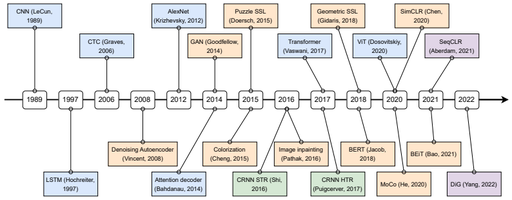
Fig. 1 : Timeline with relevant contributions within the context of this survey, including milestones related to Deep Learning (blue boxes), Text Recognition (green boxes), Self-Supervised Learning (orange boxes), and Self-Supervised Learning in Text Recognition (purple boxes).
원문 · CC BY 4.0 · Carlos Penarrubia, Jose J. Valero-Mas, Jorge Calvo-Zaragoza · Self-Supervised Learning for Text Recognition: A Critical Survey · 원문 그림 인용 · 원본 PDF 2쪽에서 그림 영역을 추출했습니다.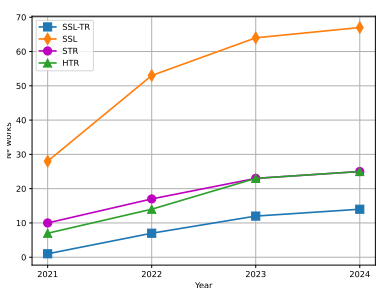
Fig. 2 : Cumulative number of methodological contributions for SSL, HTR, STR and SSL-TR (from the first SSL-TR method (Aberdam et al, 2021)).
원문 · CC BY 4.0 · Carlos Penarrubia, Jose J. Valero-Mas, Jorge Calvo-Zaragoza · Self-Supervised Learning for Text Recognition: A Critical Survey · 원문 그림 인용 · 원본 PDF 3쪽에서 그림 영역을 추출했습니다.대조 학습과 생성적 방법의 구성
논문은 SSL 방법을 판별적 방법과 생성적 방법으로 나누어 설명합니다. 대조 학습은 같은 입력의 양성 쌍 표현을 가깝게, 다른 샘플의 음성 쌍을 멀게 만드는 판별적 방법이며, 원문은 이를 InfoNCE 손실로 설명합니다. 이 손실은 양성 쌍의 유사도를 음성 샘플 집합의 유사도 합으로 나눈 로그 비율을 줄이는 형태입니다.
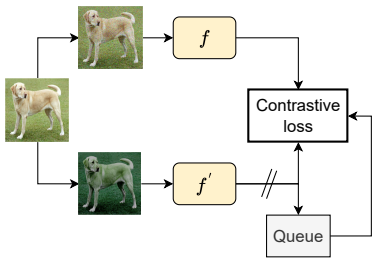
Fig. 4 : Example of a common contrastive learn- ing framework (MoCo (He et al, 2020)) where two augmented views from the same image are created and the negative views are taken from a collected queue.
원문 · CC BY 4.0 · Carlos Penarrubia, Jose J. Valero-Mas, Jorge Calvo-Zaragoza · Self-Supervised Learning for Text Recognition: A Critical Survey · 원문 그림 인용 · 원본 PDF 6쪽에서 그림 영역을 추출했습니다.TR에 적용된 SeqCLR은 SimCLR을 CRNN 인코더 pre-training에 적용하고, 인스턴스 매핑으로 프레임, 부분단어, 단어 중 대조 손실의 단위를 정합니다. 생성적 방법인 MIM은 가려진 패치를 예측하며, Text-DIAE는 마스킹, 블러, 잡음 등 열화를 적용한 입력을 픽셀 수준에서 복원합니다. DiG는 SimMIM과 MoCo v3를 가중합으로 결합하는 하이브리드 방법입니다.
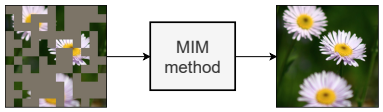
Fig. 15 : MIM framework that consists in predict- ing the masked patches of an input image.
원문 · CC BY 4.0 · Carlos Penarrubia, Jose J. Valero-Mas, Jorge Calvo-Zaragoza · Self-Supervised Learning for Text Recognition: A Critical Survey · 원문 그림 인용 · 원본 PDF 13쪽에서 그림 영역을 추출했습니다.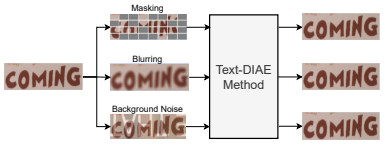
Fig. 16 : Diagram of the Text-DIAE method (Souibgui et al, 2023), which focuses on recon- structing the degraded input images.
원문 · CC BY 4.0 · Carlos Penarrubia, Jose J. Valero-Mas, Jorge Calvo-Zaragoza · Self-Supervised Learning for Text Recognition: A Critical Survey · 원문 그림 인용 · 원본 PDF 13쪽에서 그림 영역을 추출했습니다.STR 벤치마크 비교와 데이터 설정의 주의점
원문은 STR의 6개 공통 벤치마크에서 Word Accuracy(WAcc)를 비교합니다. 이때 각 방법의 모델은 합성 데이터로 미세조정된 결과를 기준으로 표 6에 제시되며, 평균 WAcc는 SSM Small에서 93.8, CCD Base에서 94.0으로 보고됩니다. 이 수치들은 원문의 Fine-tuning evaluation 프로토콜 아래의 인용 결과입니다.
그러나 저자들은 방법마다 pre-training 데이터와 fine-tuning 데이터의 크기가 다르다는 점을 지적합니다. 예를 들어 SeqCLR과 SimAN은 8M의 합성 데이터를 사용하는 반면, DiG나 CCD 등은 더 큰 데이터를 사용합니다. 따라서 이 점수 차이를 방법 자체의 우열로만 읽으면 안 되며, 데이터 설정을 함께 고려해야 합니다.
비교의 한계와 남은 과제
저자는 SSL-STR 방법을 직접 비교할 때 pre-training 데이터, 모델 크기, fine-tuning 데이터의 차이가 결과를 왜곡할 수 있다고 지적합니다. 또한 STR의 기존 벤치마크 성능이 포화에 가까워 보여, Union14M-Benchmark 같은 더 어려운 데이터셋의 필요성을 제기합니다.
HTR에서는 검증 설정에 더 큰 불확실성이 있습니다. 원문은 HTR 평가에서 데이터 분할과 pre-training 설정이 표준화되지 않았다는 점, 그리고 단어 수준 평가가 줄 단위 평가와 다르다는 점을 지적합니다. 이 한계는 방법이 효과가 없다는 증명이 아니라, 현재 비교가 공정한 기준으로 확정되지 않았다는 뜻입니다.
논문 정보
- 저자
- Carlos Penarrubia, Jose J. Valero-Mas, Jorge Calvo-Zaragoza
- 학회·저널
- arXiv · 프리프린트
- 최초 공개일
- 2024년 7월 29일
- 등록일
- 2026년 11월 6일
- 수정일
- 2025년 6월 5일
- 버전
- v2
- arXiv
- 2407.19889
- DOI
- 10.1007/s11263-025-02487-3
- 분류
- cs.CV
- 원문 이용 조건
- CC BY 4.0
- 제공 범위
- 논문 정보, 해설, 허용된 원문 그림
AI 해설은 논문 원문과 별개의 설명이며 오류가 있을 수 있습니다. 원문과 그림은 각 출처의 이용 조건과 따로 표시된 권리를 따릅니다.
초록
Text Recognition (TR) refers to the research area that focuses on retrieving textual information from images, a topic that has seen significant advancements in the last decade due to the use of Deep Neural Networks (DNN). However, these solutions often necessitate vast amounts of manually labeled or synthetic data. Addressing this challenge, Self-Supervised Learning (SSL) has gained attention by utilizing large datasets of unlabeled data to train DNN, thereby generating meaningful and robust representations. Although SSL was initially overlooked in TR because of its unique characteristics, recent years have witnessed a surge in the development of SSL methods specifically for this field. This rapid development, however, has led to many methods being explored independently, without taking previous efforts in methodology or comparison into account, thereby hindering progress in the field of research. This paper, therefore, seeks to consolidate the use of SSL in the field of TR, offering a critical and comprehensive overview of the current state of the art. We will review and analyze the existing methods, compare their results, and highlight inconsistencies in the current literature. This thorough analysis aims to provide general insights into the field, propose standardizations, identify new research directions, and foster its proper development.
원문 인용
Carlos Penarrubia, Jose J. Valero-Mas, Jorge Calvo-Zaragoza (2024). Self-Supervised Learning for Text Recognition: A Critical Survey. arXiv:2407.19889v2. https://doi.org/10.1007/s11263-025-02487-3
BibTeX
@article{penarrubia2024self,
  title = {{Self-Supervised Learning for Text Recognition: A Critical Survey}},
  author = {Carlos Penarrubia and Jose J. Valero-Mas and Jorge Calvo-Zaragoza},
  year = {2024},
  eprint = {2407.19889},
  archivePrefix = {arXiv},
  doi = {10.1007/s11263-025-02487-3},
  url = {https://arxiv.org/abs/2407.19889v2}
}