논문 해설
Physics-informed Dyna-Style Model-Based Deep Reinforcement Learning for Dynamic Control
동적 제어를 위한 물리 정보 기반 Dyna 스타일 모델 기반 심층 강화학습
- 연구 문제 모델 기반 강화학습은 환경 모델의 편향 때문에 샘플 효율의 이점을 충분히 얻지 못하는 경우가 많습니다.
- 연구 방법 PiMBRL은 지배 방정식과 물리 손실을 전이 모델 학습에 결합하고, 실제 및 모델 생성 샘플로 TD3 기반 액터-크리틱을 최적화합니다.
- 주요 결과 Cart-Pole, Burgers, KS 제어 과제에서 PiMBRL은 비교 기준선보다 적은 실제 상호작용으로 지정한 성능 수준에 도달했습니다.
모델 기반 강화학습의 모델 편향 문제
모델 기반 강화학습(MBRL)은 환경의 예측 모델을 학습해 가상 경험을 만들기 때문에 실제 상호작용 횟수를 줄일 수 있다고 알려져 있습니다. 그러나 이 방식의 성능은 학습된 모델의 품질에 크게 좌우되며, 데이터 분포 밖에서는 예측 정확도가 떨어질 수 있습니다. 이 모델 편향은 긴 rollout에서 복합 오차로 더 커집니다. 이 논문은 지배 방정식과 물리 제약을 학습 과정에 넣어 이 문제를 줄이고, 데이터가 부족한 동적 제어에서 샘플 효율을 높이는 것을 목표로 합니다. 연구 범위는 Cart-Pole, Pendulum, Burgers 방정식, Kuramoto-Sivashinsky(KS) 방정식 제어 과제입니다.
PiMBRL의 Dyna형 구조와 학습 흐름
제안 방법인 PiMBRL은 Dyna형 MBRL 구조에서 실제 환경 샘플을 실제 리플레이 버퍼에 저장하고, 이 샘플로 전이 모델과 액터-크리틱 에이전트를 함께 학습합니다. 전이 모델은 상태와 행동을 입력받아 다음 상태를 예측하는 순환 구조이며, 합성곱 인코더, LSTM 블록, MLP 디코더로 구성됩니다. 데이터 손실 L_D는 모델 예측 ũ(t+1)과 실제 레이블 데이터 사이의 L2 불일치를 평균한 값입니다. 물리 손실 L_E는 중간 시간 단계의 상태를 포함해 지배 방정식의 잔차를 평균한 값으로 정의되며, 경계 조건은 구조적으로 강하게 부과되고 지배 방정식은 손실을 통해 약하게 부과된다고 설명됩니다. 데이터 손실이 임계값 λ 아래에 들어오면 모델로 가상 샘플을 생성해 상상 리플레이 버퍼에 저장하고, 이 샘플을 실제 샘플과 함께 TD3 기반 정책과 가치 네트워크 갱신에 사용합니다.
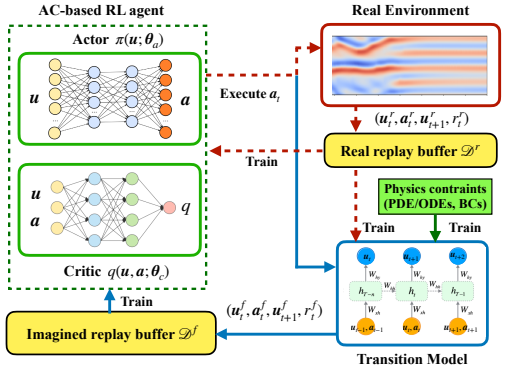
Figure 2 : Schematics of Dyna-style physics-informed model-based actor-critic algorithm.
원문 · CC BY 4.0 · Xin-Yang Liu, Jian-Xun Wang · Physics-informed Dyna-Style Model-Based Deep Reinforcement Learning for Dynamic Control · 원문 그림 인용 · 원본 PDF 6쪽에서 그림 영역을 추출했습니다.환경별 샘플 효율 비교
Cart-Pole 실험에서 PiMBRL은 약 3000 time steps 이후 total return 200에 도달하며, 같은 수준의 성능에 도달하는 데 MBRL 대비 45.2%, MFRL 대비 9.7%의 시간 단계만 사용했다고 보고됩니다. 이 학습곡선은 100개의 무작위 테스트 에피소드 평균 return을 보여 줍니다. Burgers 방정식 제어에서는 PiMBRL이 MBRL의 약 65%, MFRL의 46.7%에 해당하는 시간 단계만으로 제어 목표에 도달합니다. KS 방정식에서는 PiMBRL이 MFRL이 평균 return -55에 도달하는 데 필요한 시간 단계의 30.2%를 사용합니다. 이 KS 결과에서는 평균 return -55 이후 model-free fine-tuning을 적용했으며, 충분한 학습 시간 후 PiMBRL과 MFRL 곡선이 수렴할 것이라고 저자들은 해석합니다.
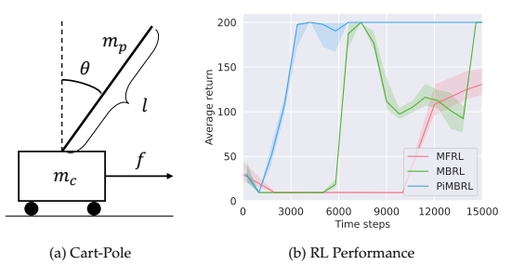
Figure 4 : (a) Schematic diagram of the Cart-Pole environment. (b) Performance curve of PiMBRL versus standard model-free TD3 (MFRL) and dyna-like model-based TD3 (MBRL) in Cart-Pole environment. The solid lines indicate averaged returns of 100 randomly selected test episodes, while the shaded area represents the return distribution of all test samples.
원문 · CC BY 4.0 · Xin-Yang Liu, Jian-Xun Wang · Physics-informed Dyna-Style Model-Based Deep Reinforcement Learning for Dynamic Control · 원문 그림 인용 · 원본 PDF 10쪽에서 그림 영역을 추출했습니다.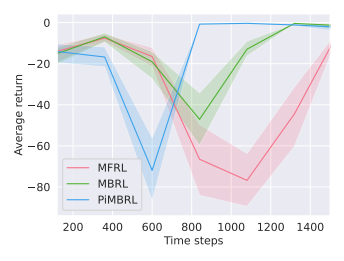
Figure 8 : Performance curve of PiMBRL versus standard MFRL and MBRL in the Burgers’ equation environment. The solid lines indicate averaged returns of 100 test episodes, while the shaded area represents the return distribution of all test samples.
원문 · CC BY 4.0 · Xin-Yang Liu, Jian-Xun Wang · Physics-informed Dyna-Style Model-Based Deep Reinforcement Learning for Dynamic Control · 원문 그림 인용 · 원본 PDF 14쪽에서 그림 영역을 추출했습니다.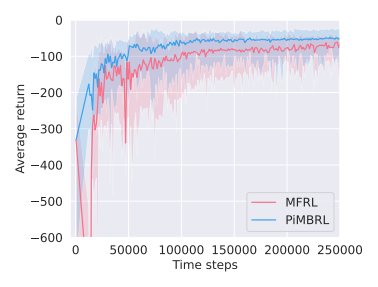
Figure 10 : Performance curve of PiMBRL versus MFRL and MBRL in KS equation environment. Solid lines shows the average return of all the test episodes while the shaded area represents the distribution range of the 200 test episodes
원문 · CC BY 4.0 · Xin-Yang Liu, Jian-Xun Wang · Physics-informed Dyna-Style Model-Based Deep Reinforcement Learning for Dynamic Control · 원문 그림 인용 · 원본 PDF 15쪽에서 그림 영역을 추출했습니다.적용 범위와 해석상의 한계
Pendulum 실험에서 PiMBRL은 MFRL보다 샘플 효율이 높았지만, MBRL과 비교했을 때 뚜렷한 우위는 나타나지 않았습니다. 저자들은 상태 공간이 작아 모델 학습이 쉬운 점과, 속도 제한으로 인해 물리 손실이 항상 만족되지 않는 점을 이유로 들어 해석합니다. KS 실험에서 데이터만으로 학습한 MBRL 모델은 임계값 0.01을 만족하지 못해 MBRL 곡선이 MFRL 곡선과 같게 보고됩니다. 따라서 이 결과는 해당 설정에서 데이터 기반 모델이 임계값을 넘지 못한 경우를 뜻하며, 모든 MBRL 방법의 실패로 일반화할 수 없습니다. 또한 rollout 길이 120처럼 긴 예측은 KS 환경에서 실제 상태와 크게 벗어나 후반 성능 향상을 제한합니다.
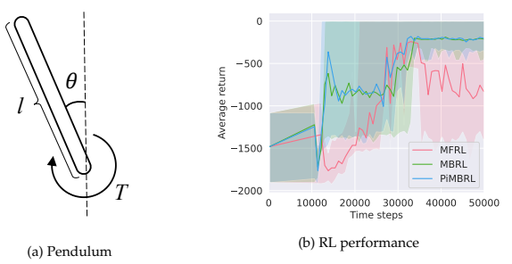
Figure 5 : (a) Schematic diagram of pendulum environment. (b) Performance curve of PiMBRL versus standard model-free TD3 (MFRL) and dyna-like model-based TD3 (MBRL) in the pendulum environment. The solid lines indicate averaged returns of 100 randomly selected test episodes, while the shaded area represents the return distribution of all test samples.
원문 · CC BY 4.0 · Xin-Yang Liu, Jian-Xun Wang · Physics-informed Dyna-Style Model-Based Deep Reinforcement Learning for Dynamic Control · 원문 그림 인용 · 원본 PDF 11쪽에서 그림 영역을 추출했습니다.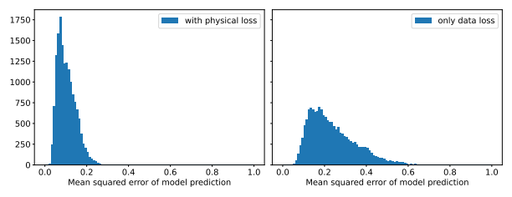
Figure 11 : Histograms of the prediction errors (MSE) of the transition models for the KS system, (left) trained with physics-informed loss in PiMBRL, and (right) trained with the data loss only in MBRL. Both are trained on the same real buffer with 105 time steps stored.
원문 · CC BY 4.0 · Xin-Yang Liu, Jian-Xun Wang · Physics-informed Dyna-Style Model-Based Deep Reinforcement Learning for Dynamic Control · 원문 그림 인용 · 원본 PDF 16쪽에서 그림 영역을 추출했습니다.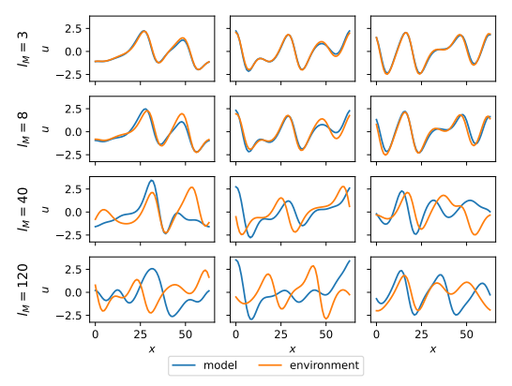
Figure 12 : Model predicted snapshots of the KS environment with different rollout lengths compared with the true environment at three randomly selected initials.
원문 · CC BY 4.0 · Xin-Yang Liu, Jian-Xun Wang · Physics-informed Dyna-Style Model-Based Deep Reinforcement Learning for Dynamic Control · 원문 그림 인용 · 원본 PDF 16쪽에서 그림 영역을 추출했습니다.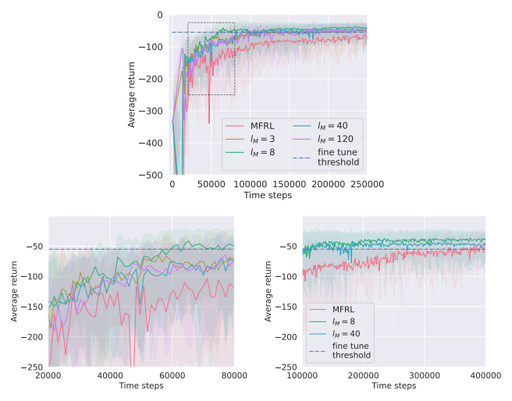
Figure 13 : Performance curves of PiMBRL with four different model rollout lengths compared with MFRL base line. (Left bottom) Zoom-in view of the dashed box. (right bottom) Zoom-in view of the range between 1× 10⁵ to 4× 10⁵ time steps.
원문 · CC BY 4.0 · Xin-Yang Liu, Jian-Xun Wang · Physics-informed Dyna-Style Model-Based Deep Reinforcement Learning for Dynamic Control · 원문 그림 인용 · 원본 PDF 17쪽에서 그림 영역을 추출했습니다.논문 정보
- 저자
- Xin-Yang Liu, Jian-Xun Wang
- 학회·저널
- arXiv · 프리프린트
- 최초 공개일
- 2021년 7월 31일
- 등록일
- 2026년 11월 6일
- 수정일
- 2021년 7월 31일
- 버전
- v1
- arXiv
- 2108.00128
- DOI
- 10.1098/rspa.2021.0618
- 분류
- cs.LG · math.OC
- 원문 이용 조건
- CC BY 4.0
- 제공 범위
- 논문 정보, 해설, 허용된 원문 그림
AI 해설은 논문 원문과 별개의 설명이며 오류가 있을 수 있습니다. 원문과 그림은 각 출처의 이용 조건과 따로 표시된 권리를 따릅니다.
초록
Model-based reinforcement learning (MBRL) is believed to have much higher sample efficiency compared to model-free algorithms by learning a predictive model of the environment. However, the performance of MBRL highly relies on the quality of the learned model, which is usually built in a black-box manner and may have poor predictive accuracy outside of the data distribution. The deficiencies of the learned model may prevent the policy from being fully optimized. Although some uncertainty analysis-based remedies have been proposed to alleviate this issue, model bias still poses a great challenge for MBRL. In this work, we propose to leverage the prior knowledge of underlying physics of the environment, where the governing laws are (partially) known. In particular, we developed a physics-informed MBRL framework, where governing equations and physical constraints are utilized to inform the model learning and policy search. By incorporating the prior information of the environment, the quality of the learned model can be notably improved, while the required interactions with the environment are significantly reduced, leading to better sample efficiency and learning performance. The effectiveness and merit have been demonstrated over a handful of classic control problems, where the environments are governed by canonical ordinary/partial differential equations.
원문 인용
Xin-Yang Liu, Jian-Xun Wang (2021). Physics-informed Dyna-Style Model-Based Deep Reinforcement Learning for Dynamic Control. arXiv:2108.00128v1. https://doi.org/10.1098/rspa.2021.0618
BibTeX
@article{liu2021physics,
  title = {{Physics-informed Dyna-Style Model-Based Deep Reinforcement Learning for Dynamic Control}},
  author = {Xin-Yang Liu and Jian-Xun Wang},
  year = {2021},
  eprint = {2108.00128},
  archivePrefix = {arXiv},
  doi = {10.1098/rspa.2021.0618},
  url = {https://arxiv.org/abs/2108.00128v1}
}