논문 해설
Robotic Reward Models in the Foundation-Model Era
파운데이션 모델 시대의 로봇 보상 모델
- 연구 문제 기존 로봇 평가는 작업마다 보상을 설계해야 해서 비용이 크며, 출력이 답하는 질문이 제각각인 RRM을 한 기준으로 비교하기 어렵습니다.
- 주요 결과 가장 강한 최종 점수는 실행 전체를 선택과 필터링에 충분할 만큼 잘 순위 매겼지만, 밀집 크레딧은 작업 상태보다 실행 진행을 더 따랐습니다.
작업마다 다시 짜는 보상과 RRM의 등장
로봇 학습에서는 정책을 개선하거나 데이터를 고르거나 실행을 모니터링할 때마다 작업이 수행되었는지를 판단해야 합니다. 전통적인 방식은 작업마다 성공 조건과 보상 항을 손으로 설계했기 때문에 작업이 늘수록 비용이 커집니다. 로봇 보상 모델(RRM)은 기반 모델을 표현, 감독, 판단 중 하나로 써서 작업 명세에 조건부인 평가자를 하나의 재사용 가능한 형태로 만들려 합니다. 이 논문은 이런 평가자들이 성공 확률, 완료율, 선호 효용, 기대 반환처럼 서로 다른 질문에 답한다는 점을 출발점으로 삼습니다. 같은 보상이라는 이름 아래 출력이 다른 질문을 뜻하므로, 기존 평가가 실제로 무엇을 검증했는지 따져 볼 필요가 있습니다.
네이티브 출력 기준의 다섯 계열
이 논문은 RRM을 모델이 변환 전에 직접 반환하는 값, 즉 네이티브 출력이 답하는 질문으로 분류합니다. 결과 계열은 성공 여부를 답하는 Outcome, 전체 과제 기준의 진행도를 답하는 Absolute Progress, 두 대상의 우열을 답하는 Relative, 단계나 남은 시간, 기대 반환을 답하는 Temporal Value, 여러 질문을 합치는 Hybrid입니다. 입력 조건인 작업 명세와 증거 인터페이스는 기록하지만 계열을 정하지는 않습니다. 따라서 같은 스칼라 값도 시각적 호환성인지, 진행도인지, 선호 효용인지에 따라 다른 계열에 배정됩니다. 이 구분은 평가 시험을 설계하는 기준이 됩니다.
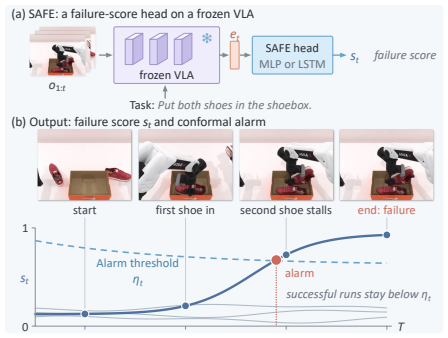
Fig. 3 . SAFE [34], a representative Outcome model. (a) A light head on a frozen VLA maps its featurese t to a running failure scores t. (b)s t rises as the second shoe stalls and crosses the conformal thresholdη t, which raises the alarm before the execution fails.
원문 · CC BY 4.0 · Guoqiang Liang, Yiqi Lin, Shangchen Zhou, Wenzheng Zeng, Yanzhe Chen, Zechen Bai, Mike Zheng Shou · Robotic Reward Models in the Foundation-Model Era · 원문 그림 인용 · 원본 PDF 4쪽에서 그림 영역을 추출했습니다.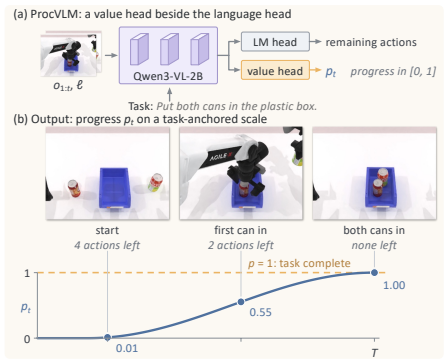
Fig. 4 . ProcVLM [56], a representative Absolute Progress model. (a) Given observationso 1:t and instructionℓ, the language-model head first generates the remaining actions, and the value head then reads this generated procedure to output progressp t ∈[0,1]. (b)p t rises as fewer actions remain and reaches the anchorp= 1when both cans are in the box.
원문 · CC BY 4.0 · Guoqiang Liang, Yiqi Lin, Shangchen Zhou, Wenzheng Zeng, Yanzhe Chen, Zechen Bai, Mike Zheng Shou · Robotic Reward Models in the Foundation-Model Era · 원문 그림 인용 · 원본 PDF 5쪽에서 그림 영역을 추출했습니다.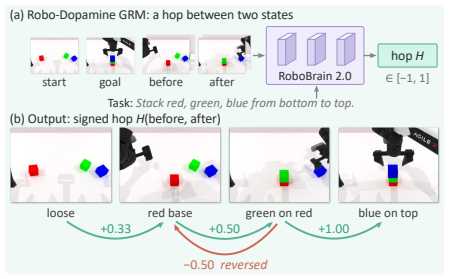
Fig. 5 . The Robo-Dopamine GRM [9], a representative Relative model. (a) Given start and goal states, the GRM compares a before and an after state and returns a signed hopH∈[−1,1]. (b) Hops are scaled to the distance that remains or to the progress made, so chained hops keep progress in[0,1]; removing the green block gives−0.50.
원문 · CC BY 4.0 · Guoqiang Liang, Yiqi Lin, Shangchen Zhou, Wenzheng Zeng, Yanzhe Chen, Zechen Bai, Mike Zheng Shou · Robotic Reward Models in the Foundation-Model Era · 원문 그림 인용 · 원본 PDF 6쪽에서 그림 영역을 추출했습니다.RRM-Bench-1K의 대조 스위트
기존 벤치마크는 자연스러운 실행에서 모은 실패가 적고, 단서와 작업 크레딧이 어긋난 경우를 충분히 담지 못합니다. RRM-Bench-1K는 실제 로봇 폐루프 실행 1,117개 영상을 모으고, 작업 상태 라벨과 카메라 증거 라벨을 붙였습니다. 네 대조 스위트는 움직임과 효과의 분리(A), 제약 위반(B), 달성 후 상실(C), 결정적 뷰 부재(D)를 시험합니다. 각 스위트는 절대 목표값이 아니라 쌍 사이의 순서나 기권을 정답으로 둡니다. 예를 들어 (C)에서는 상실 후 크레딧이 철회되어야 하고, (D)에서는 증거가 부족하면 기권하거나 불확실성을 넓혀야 합니다.
종점 선택과 잘못된 크레딧
종점 판단은 최종 점수가 가장 높은 실행을 고르는 능력으로 측정했습니다. 실험 결과 가장 강한 최종 점수는 실행 전체를 선택과 필터링에 충분할 만큼 잘 순위 매겼습니다. 반면 실패 실행이 완전 완료 실행의 중앙값 최종 점수에 도달하는 비율인 false credit은 평가자마다 크게 달랐습니다. 저자들은 밀집 크레딧이 작업 상태보다 실행의 진행을 더 따른다고 해석합니다. 이 해석은 가장 강한 종점 점수가 곧 올바른 밀집 보상이라는 뜻이 아니므로 두 능력을 나눠 읽어야 합니다.
결정적 뷰를 가린 조건
결정적 뷰를 가린 V와 P/X 조건에서 같은 전이의 Macro-F1을 비교했습니다. 대부분의 평가자는 결정적 증거를 가리면 Macro-F1이 낮아졌습니다. 또 작업 증거가 전혀 없는 뷰에서 많은 Pair 방식 평가자가 여전히 진행을 보고했고, 평가된 인터페이스 중 증거 불충분을 보고할 수 있는 것은 없었습니다. 다중 뷰 실험에서 Robo-Dopamine 계열은 추가 카메라로 이득을 얻었지만, 주 카메라를 바꾸면 예측 방향이 달라졌으므로 결과를 카메라 세트의 고유 속성으로 보기 어렵습니다.
남은 문제
논문은 현재 평가자가 작업 상태 하강을 안정적으로 추적하지 못한다고 보고합니다. 일부 모델은 출력이 변하지 않고, 다른 모델은 허위 하강을 자주 예측하며, 드물게 하강을 예측하는 모델은 상실의 대부분을 놓칩니다. 또 VOC는 시간 순서를 보상하므로 경과 시간만 읽는 통제도 높은 값을 받습니다. 따라서 VOC를 작업 상태 추적의 증거로 쓰기 어렵습니다. 이 결과는 RRM-Bench-1K의 실행과 평가된 27개 평가자에 대한 것이며, 다른 로봇 플랫폼이나 모든 RRM 설계로 확대할 수 없습니다.
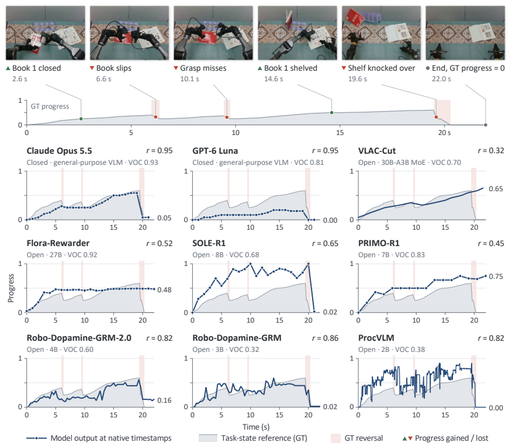
Fig. 9 . Reward profiles of nine evaluators on one execution of put the books back. The task-state reference (GT, gray) drops to zero when the robot knocks the shelf over at 19.6 s; red bands mark its reversals, andris each model’s Pearson correlation with it.
원문 · CC BY 4.0 · Guoqiang Liang, Yiqi Lin, Shangchen Zhou, Wenzheng Zeng, Yanzhe Chen, Zechen Bai, Mike Zheng Shou · Robotic Reward Models in the Foundation-Model Era · 원문 그림 인용 · 원본 PDF 14쪽에서 그림 영역을 추출했습니다.논문 정보
- 저자
- Guoqiang Liang, Yiqi Lin, Shangchen Zhou, Wenzheng Zeng, Yanzhe Chen, Zechen Bai, Mike Zheng Shou
- 학회·저널
- arXiv · 프리프린트
- 최초 공개일
- 2026년 11월 16일
- 등록일
- 2026년 11월 17일
- 수정일
- 2026년 11월 16일
- 버전
- v1
- arXiv
- 2611.20741
- 분류
- cs.RO · cs.CV
- 원문 이용 조건
- CC BY 4.0
- 제공 범위
- 논문 정보, 해설, 허용된 원문 그림
AI 해설은 논문 원문과 별개의 설명이며 오류가 있을 수 있습니다. 원문과 그림은 각 출처의 이용 조건과 따로 표시된 권리를 따릅니다.
초록
Robotic reward models (RRMs) use foundation models to replace per-task reward engineering with reusable, task-conditioned evaluation. Yet under one name, their outputs answer different questions, from whether a task succeeded to which execution is better. This survey organizes 114 methods into five semantic families by the question their native outputs answer: Outcome, Absolute Progress, Relative, Temporal Value, and Hybrid. Within this taxonomy, we review how model design determines what an evaluator can judge, how raw experience becomes supervision, and how existing evaluation practice tests the result. The review exposes a gap: agreement with demonstration order and downstream policy gains do not show whether a reward tracks task fulfillment. We therefore introduce RRM-Bench-1K, 1,117 real-robot videos of closed-loop executions with task-state and camera-evidence labels, and four contrast suites that separate the credited condition from its usual cues. A unified study of 27 evaluators shows that the strongest final scores rank whole executions well enough for selection and filtering. Dense credit, however, follows the progression of an execution more closely than its task state, and no evaluator signals when the decisive view is missing. How much fidelity a reward model needs therefore depends on the decision it drives. We outline directions from real-failure supervision to metrics that separate task state from chronology, and open-source RRM-Hub, a toolbox in which 14 existing RRMs can be readily applied and new evaluators tested on the same capabilities.
원문 인용
Guoqiang Liang, Yiqi Lin, Shangchen Zhou, Wenzheng Zeng, Yanzhe Chen, Zechen Bai, Mike Zheng Shou (2026). Robotic Reward Models in the Foundation-Model Era. arXiv:2611.20741v1. https://arxiv.org/abs/2611.20741v1
BibTeX
@misc{liang2026robotic,
  title = {{Robotic Reward Models in the Foundation-Model Era}},
  author = {Guoqiang Liang and Yiqi Lin and Shangchen Zhou and Wenzheng Zeng and Yanzhe Chen and Zechen Bai and Mike Zheng Shou},
  year = {2026},
  eprint = {2611.20741},
  archivePrefix = {arXiv},
  url = {https://arxiv.org/abs/2611.20741v1}
}