논문 해설
DeepMoCap: Deep Optical Motion Capture Using Multiple Depth Sensors and Retro-Reflectors
DeepMoCap: 다중 깊이 센서와 재귀반사체를 이용한 딥러닝 광학 모션 캡처
- 연구 문제 기존 광학 모션 캡처는 정밀하지만 비용, 설치, 후처리 부담이 큽니다. DeepMoCap은 재귀반사 반사체와 다중 IR-D 센서로 이 부담을 줄이려고 합니다.
- 연구 방법 여러 IR-D 프레임에서 컬러화된 깊이와 3D 광학 흐름을 만들고, 두 스트림을 받는 다단계 FCN으로 반사체 신뢰도 맵과 벡터장을 예측합니다. 이후 비최대 억제와 그리디 추론으로 2D 위치를 얻고 3D로 융합합니다.
- 주요 결과 DMC2.5D에서 제안 FCN의 전체 mAP는 93.73%로 비교 방법보다 높았습니다. DMC3D에서 3D PCK(α3D=20 cm)는 92.25%로 Fusion++ 88.75%보다 높게 보고되었습니다.
문제 설정과 기존 광학 모션 캡처의 한계
전통적인 광학 모션 캡처는 정밀하지만 장비 비용이 높고, 설치에 전문 인력이 필요하며, 마커 라벨링과 추적 등 후처리 시간이 많이 듭니다. 이 논문은 이러한 부담을 줄이기 위해 단일 인물을 대상으로 하는 마커 기반 방법인 DeepMoCap을 제안합니다. DeepMoCap은 구형 마커 대신 재귀반사 스트랩과 패치를 신체에 붙이고, 여러 대의 시간·공간 정렬된 IR-D 센서로 이를 관측합니다. 따라서 핵심 문제는 반사체를 프레임마다 자동으로 찾아 식별하고, 그 2D 위치를 3D 광학 데이터로 바꾸어 모션 캡처까지 연결하는 것입니다.
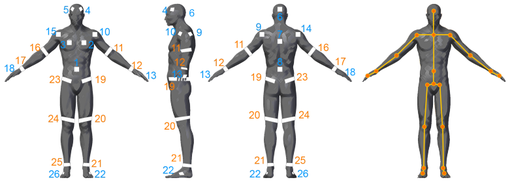
Figure 2 . Proposed reflector-set placement. Reflective straps (orange) and patches (blue) placement on the subject’s body.
원문 · CC BY 4.0 · Anargyros Chatzitofis, Dimitrios Zarpalas, Stefanos Kollias, Petros Daras · DeepMoCap: Deep Optical Motion Capture Using Multiple Depth Sensors and Retro-Reflectors · 원문 그림 인용 · 원본 PDF 6쪽에서 그림 영역을 추출했습니다.반사체 관측에서 3D 광학 데이터까지의 처리 흐름
입력은 여러 IR-D 센서에서 얻은 적외선 영상과 깊이 영상입니다. 반사체 영역은 적외선 영상에서 이진 임계값으로 추출되며, 깊이 영상에서는 반사 때문에 해당 영역의 값이 0이 됩니다. 이후 여러 IR-D 프레임 쌍에서 3D 광학 흐름을 계산하고, 깊이 영상을 컬러화한 뒤 반사체 마스크를 빼서 두 입력 스트림을 만듭니다. FCN은 이 두 스트림을 받아 반사체별 신뢰도 맵 S와 광학 흐름 벡터장 L을 예측합니다. 신뢰도 맵에서는 비최대 억제로 위치를 찾고, 광학 흐름 신뢰도 E_L은 두 프레임 사이 예측 위치를 잇는 선분을 따라 벡터장을 적분해 계산합니다. 최종 신뢰도는 E_R = E_S + w_L·E_L이며 w_L = (1−E_S)입니다.
따라서 신뢰도 맵 값이 낮을수록 광학 흐름 신뢰도의 영향이 커집니다. 2D 위치는 깊이 중앙값을 이용해 3D로 매핑되고, 여러 뷰의 3D 점은 신뢰도 가중 평균으로 융합됩니다.
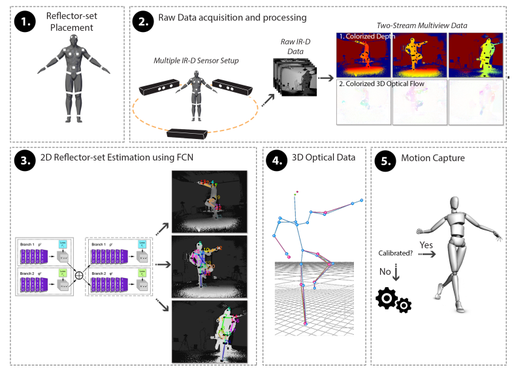
Figure 1 . DeepMoCap pipeline overview. After the placement of the reflectors on the subject’s body (1), spatio-temporally aligned IR-D streams are acquired and processed (2) to feed the FCN with colorized depth and 3D optical flow images (3). The FCN outcome, i.e., the multi-view 2D reflector-set estimates, is fused to extract the 3D optical data (4) and, finally, yield the subject’s 3D pose for motion capture (5).
원문 · CC BY 4.0 · Anargyros Chatzitofis, Dimitrios Zarpalas, Stefanos Kollias, Petros Daras · DeepMoCap: Deep Optical Motion Capture Using Multiple Depth Sensors and Retro-Reflectors · 원문 그림 인용 · 원본 PDF 5쪽에서 그림 영역을 추출했습니다.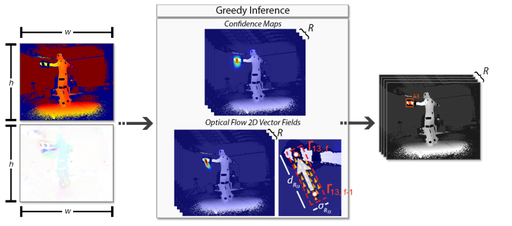
Figure 5 . Overall 2D reflector-set estimation from confidence maps and optical flow 2D vector fields. The 2D location for R13 reflector is estimated taking into account its predicted heat map and optical flow between the predictions r13, f−1 and r13, f .
원문 · CC BY 4.0 · Anargyros Chatzitofis, Dimitrios Zarpalas, Stefanos Kollias, Petros Daras · DeepMoCap: Deep Optical Motion Capture Using Multiple Depth Sensors and Retro-Reflectors · 원문 그림 인용 · 원본 PDF 8쪽에서 그림 영역을 추출했습니다.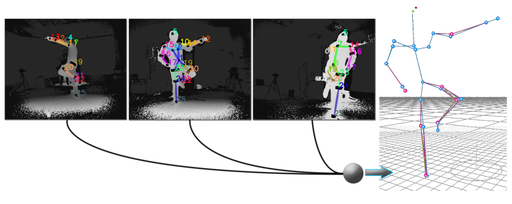
Figure 8 . Multiple 2D reflector-set estimates ( left) are spatially mapped in a global 3D Cartesian coordinate system, resulting in 3D optical data extraction (right).
원문 · CC BY 4.0 · Anargyros Chatzitofis, Dimitrios Zarpalas, Stefanos Kollias, Petros Daras · DeepMoCap: Deep Optical Motion Capture Using Multiple Depth Sensors and Retro-Reflectors · 원문 그림 인용 · 원본 PDF 12쪽에서 그림 영역을 추출했습니다.두 입력 스트림과 다단계 FCN의 학습 구조
제안 FCN은 깊이 스트림과 광학 흐름 스트림을 각각 VGG-19의 처음 10개 층으로 처리한 뒤, 두 특징 맵을 연결하여 초기 단계에서 융합합니다. 첫 단계는 융합된 특징 F만 받아 신뢰도 맵과 벡터장을 예측합니다. 이후 단계는 F와 이전 단계의 예측값을 함께 받아 예측을 정제합니다. 원문에서 단계 수 T는 6으로 설정되었으며, 이는 검증 데이터에서 T=3과 T=6을 비교한 결과에 따른 것입니다. 각 단계의 신뢰도 맵과 벡터장에는 L2 손실을 적용해 중간 감독을 주며, 전체 손실은 단계별 손실의 합입니다. 이 구조는 CPM 계열의 다단계 정제를 두 스트림과 시간적 벡터장으로 확장한 것입니다. 신뢰도 맵과 벡터장은 학습 중 주석으로 생성되며, 학습 대상은 FCN 자체의 예측 분기입니다.
DMC2.5D에서 2D 반사체 추정 평가
2D 반사체 추정은 DMC2.5D에서 PCK 임계값 α=0.05로 평가되었습니다. 비교 대상은 Wei et al.의 CPM[16], Cao et al.의 Part Affinity Field 기반 방법[14], 그리고 광학 흐름 입력을 추가한 [14] + 3D OF입니다. 이 비교 방법들은 원문에서 반사체 설정에 맞게 재학습되었습니다. 제안 FCN은 전체 반사체 중 21/26, 즉 80.7%에서 가장 높은 AP를 보였습니다. 전체 mAP는 제안 방법 93.73%, [16] 92.16%, [14] 92.79%, [14]+3D OF 92.84%입니다. 끝단 반사체를 제외하면 제안 방법은 96.77%로 나타났습니다.
이 결과는 DMC2.5D 평가 조건에서 얻은 것이며, 모든 방법에서 끝단 반사체의 예측은 다른 반사체보다 약하게 보고되었습니다.
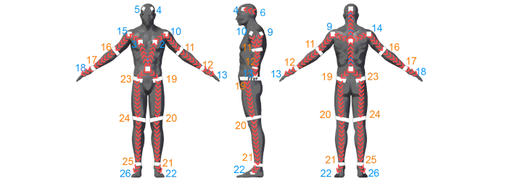
Figure 11 . The red arrows illustrate the directional associations between the reflectors to adapt the Part Affinity Fields, as proposed in [14]. The orange and blue colored labels indicate the reflective straps and patches, respectively.
원문 · CC BY 4.0 · Anargyros Chatzitofis, Dimitrios Zarpalas, Stefanos Kollias, Petros Daras · DeepMoCap: Deep Optical Motion Capture Using Multiple Depth Sensors and Retro-Reflectors · 원문 그림 인용 · 원본 PDF 16쪽에서 그림 영역을 추출했습니다.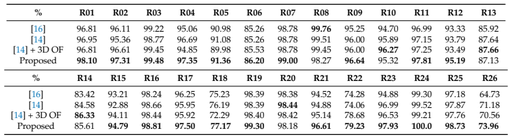
Table 2 . AP for PCK withα = 0.05, for each of the 26 reflectors. The proposed FCN method outperforms the rest of the methods for the 80.7% of the reflectors (i.e., 21 out of 26).
원문 · CC BY 4.0 · Anargyros Chatzitofis, Dimitrios Zarpalas, Stefanos Kollias, Petros Daras · DeepMoCap: Deep Optical Motion Capture Using Multiple Depth Sensors and Retro-Reflectors · 원문 그림 인용 · 원본 PDF 17쪽에서 그림 영역을 추출했습니다.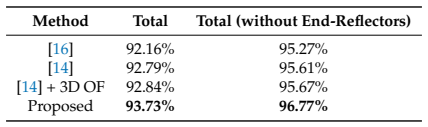
Table 3 . mAP for PCK with α = 0.05, with and without end-reflectors.
원문 · CC BY 4.0 · Anargyros Chatzitofis, Dimitrios Zarpalas, Stefanos Kollias, Petros Daras · DeepMoCap: Deep Optical Motion Capture Using Multiple Depth Sensors and Retro-Reflectors · 원문 그림 인용 · 원본 PDF 17쪽에서 그림 영역을 추출했습니다.DMC3D에서 3D 모션 캡처 평가와 세부 결과
3D 모션 캡처는 DMC3D에서 12개 관절에 대해 MAE, RMSE, 3D PCK(α3D=20 cm)로 평가되었습니다. 비교 대상은 Best Kinect, Fusion, Fusion++이며, 이 중 Fusion++은 ground truth 초기화와 루트 위치를 사용하는 관성 융합 방법입니다. 제안 방법의 총 MAE는 9.02 cm, RMSE는 10.06 cm, 3D PCK는 92.25%입니다. 같은 조건의 다른 방법은 Fusion++ 88.75%, Fusion 85.93%, Best Kinect 83.37%입니다. 임계값을 바꾼 결과에서 α3D=5 cm의 3D PCK는 32.25%, α3D=10 cm는 63.27%로, 다음 최고 방법의 16.38%, 54.36%보다 높게 나타났습니다.
운동별로는 12/15개 운동에서 우수했으며, 복잡한 Alternate side reaches와 Kick-box kicking에서는 Fusion++보다 각각 4.84%와 8.33% 높았습니다. 다만 Side-steps에서는 Fusion++보다 낮았고, 원문은 이를 손 위치로 인한 반사체 영역 병합과 연결해 설명합니다.
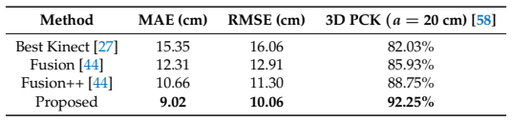
Table 6 . Comparative evaluation of the motion capture results of the respective methods, presenting total MAE, RMSE and 3D PCK (α3D = 20 cm) metrics.
원문 · CC BY 4.0 · Anargyros Chatzitofis, Dimitrios Zarpalas, Stefanos Kollias, Petros Daras · DeepMoCap: Deep Optical Motion Capture Using Multiple Depth Sensors and Retro-Reflectors · 원문 그림 인용 · 원본 PDF 19쪽에서 그림 영역을 추출했습니다.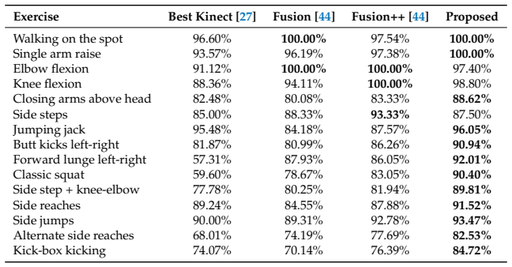
Table 7 . Comparative evaluation per exercise using 3D PCK, α3D = 20 cm metric.
원문 · CC BY 4.0 · Anargyros Chatzitofis, Dimitrios Zarpalas, Stefanos Kollias, Petros Daras · DeepMoCap: Deep Optical Motion Capture Using Multiple Depth Sensors and Retro-Reflectors · 원문 그림 인용 · 원본 PDF 20쪽에서 그림 영역을 추출했습니다.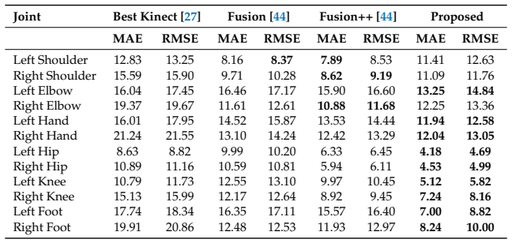
Table 8 . Experimental results of the respective motion capture methods using (MAE) and (RMSE) metrics per joint (in cm).
원문 · CC BY 4.0 · Anargyros Chatzitofis, Dimitrios Zarpalas, Stefanos Kollias, Petros Daras · DeepMoCap: Deep Optical Motion Capture Using Multiple Depth Sensors and Retro-Reflectors · 원문 그림 인용 · 원본 PDF 21쪽에서 그림 영역을 추출했습니다.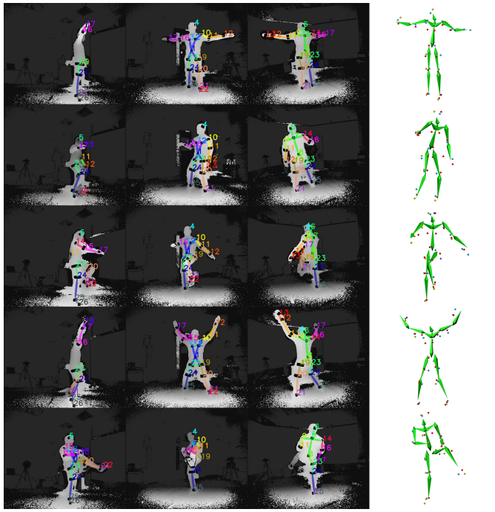
Figure 15 . Five samples of the method results are illustrated in rows. At the left side of the figure, the multi-view input along with the FCN reflector-set estimates are presented, while, at the right side, their corresponding 3D optical and motion capture outcomes are shown.
원문 · CC BY 4.0 · Anargyros Chatzitofis, Dimitrios Zarpalas, Stefanos Kollias, Petros Daras · DeepMoCap: Deep Optical Motion Capture Using Multiple Depth Sensors and Retro-Reflectors · 원문 그림 인용 · 원본 PDF 22쪽에서 그림 영역을 추출했습니다.실행 성능과 측정 조건
성능 분석은 약 6×10^3개의 3-view 쌍 시퀀스에서 측정되었으며, 단일 NVIDIA GeForce Titan X GPU에서 수행되었습니다. 원시 데이터 전처리는 샘플당 약 100 ms, FCN 예측은 샘플당 약 174 ms가 걸렸습니다. 이 결과로 2D 반사체 추정은 약 6 frames per second, 약 100 ms 지연으로 보고되었습니다. 모션 추적 단계는 10 ms 미만이 필요한 실시간 수준으로 보고되며, 3-view 입력 368×444에서 모션 캡처는 약 2 Hz로 보고되었습니다. 이 수치는 해당 GPU와 입력 크기에서 측정한 결과이므로 다른 하드웨어나 입력 조건으로 일반화하지 않아야 합니다.
적용 범위와 한계
이 방법은 단일 인물을 위한 방법으로 개발되었으며, PAF 분기는 최종 반사체 추정에 쓰이지 않습니다. 저자들은 주요 한계로 측면 시점의 캡처와, 반사체를 가리거나 병합하는 매우 복잡한 자세를 꼽습니다. 이 한계는 센서 수를 늘리면 줄일 수 있지만 비용과 복잡도가 함께 증가합니다. 또한 다중 인물, 실외 환경, 더 많은 자유도는 향후 연구 과제로 제시되었습니다. 원문의 결과는 DMC2.5D와 DMC3D의 특정 설정에서 얻은 것이므로, 실시간성이나 다른 환경의 성능은 본 논문의 직접 검증 범위 밖입니다.
논문 정보
- 저자
- Anargyros Chatzitofis, Dimitrios Zarpalas, Stefanos Kollias, Petros Daras
- 학회·저널
- arXiv · 프리프린트
- 최초 공개일
- 2021년 10월 14일
- 등록일
- 2026년 11월 6일
- 수정일
- 2021년 10월 14일
- 버전
- v1
- arXiv
- 2110.07283
- DOI
- 10.3390/s19020282
- 분류
- cs.CV · cs.AI · cs.LG
- 원문 이용 조건
- CC BY 4.0
- 제공 범위
- 논문 정보, 해설, 허용된 원문 그림
AI 해설은 논문 원문과 별개의 설명이며 오류가 있을 수 있습니다. 원문과 그림은 각 출처의 이용 조건과 따로 표시된 권리를 따릅니다.
초록
In this paper, a marker-based, single-person optical motion capture method (DeepMoCap) is proposed using multiple spatio-temporally aligned infrared-depth sensors and retro-reflective straps and patches (reflectors). DeepMoCap explores motion capture by automatically localizing and labeling reflectors on depth images and, subsequently, on 3D space. Introducing a non-parametric representation to encode the temporal correlation among pairs of colorized depthmaps and 3D optical flow frames, a multi-stage Fully Convolutional Network (FCN) architecture is proposed to jointly learn reflector locations and their temporal dependency among sequential frames. The extracted reflector 2D locations are spatially mapped in 3D space, resulting in robust 3D optical data extraction. The subject's motion is efficiently captured by applying a template-based fitting technique on the extracted optical data. Two datasets have been created and made publicly available for evaluation purposes; one comprising multi-view depth and 3D optical flow annotated images (DMC2.5D), and a second, consisting of spatio-temporally aligned multi-view depth images along with skeleton, inertial and ground truth MoCap data (DMC3D). The FCN model outperforms its competitors on the DMC2.5D dataset using 2D Percentage of Correct Keypoints (PCK) metric, while the motion capture outcome is evaluated against RGB-D and inertial data fusion approaches on DMC3D, outperforming the next best method by 4.5% in total 3D PCK accuracy.
원문 인용
Anargyros Chatzitofis, Dimitrios Zarpalas, Stefanos Kollias, Petros Daras (2021). DeepMoCap: Deep Optical Motion Capture Using Multiple Depth Sensors and Retro-Reflectors. arXiv:2110.07283v1. https://doi.org/10.3390/s19020282
BibTeX
@article{chatzitofis2021deepmocap,
  title = {{DeepMoCap: Deep Optical Motion Capture Using Multiple Depth Sensors and Retro-Reflectors}},
  author = {Anargyros Chatzitofis and Dimitrios Zarpalas and Stefanos Kollias and Petros Daras},
  year = {2021},
  eprint = {2110.07283},
  archivePrefix = {arXiv},
  doi = {10.3390/s19020282},
  url = {https://arxiv.org/abs/2110.07283v1}
}