논문 해설
Graph-based Visual-Semantic Entanglement Network for Zero-shot Image Recognition
제로샷 이미지 인식을 위한 그래프 기반 시각-의미 얽힘 네트워크
- 연구 문제 제로샷 학습에서 시각 특징 안의 속성 간 의미 관계가 기존 매핑에서 충분히 쓰이지 않는다는 문제를 다룹니다.
- 연구 방법 CNN 시각 파이프라인과 속성 지식 그래프 위의 GCN 파이프라인을 얽어, 특징 맵을 GCN에 넣고 게이트로 다시 CNN에 돌려주는 구조를 제안합니다.
- 주요 결과 AwA2, CUB, SUN의 제안 분할 CZSL에서 GVSE-101이 기본 귀납 설정의 주요 결과를 보고하지만, SUN 표준 분할에서는 HPL보다 낮습니다.
연구가 겨냥한 문제
제로샷 학습(ZSL)은 학습 때 보지 못한 범주를 속성(attribute)으로 이어 인식하는 과제입니다. CNN 기반 ZSL 모델은 강한 시각 표현을 제공하지만, 시각 특징을 속성 공간으로 옮기는 매핑이 주로 몇 개의 완전연결층에 맡겨져 있습니다. 이 구조에서는 시각 특징 안에 있는 속성 사이의 의미 관계가 충분히 모델링되지 않습니다. 논문은 이 공백을 시각 특징과 의미 관계를 함께 모델링하는 구조로 메우려 합니다. 저자들은 이 문제가 편향과 모호성을 키운다고 해석합니다.
CNN과 GCN을 얽은 이중 파이프라인
GVSE 네트워크는 CNN 파이프라인과 GCN 파이프라인을 병렬로 둡니다. CNN 파이프라인은 입력 이미지의 시각 임베딩을 만들고, GCN 파이프라인은 CNN 블록마다 나온 특징 맵을 입력받아 속성 지식 그래프 위에서 의미 관계를 모델링합니다. 두 방향의 상호작용이 있습니다. CNN에서 GCN으로는 특징 맵을 reshape하여 넣고, GCN에서 CNN으로는 GCN 출력에 시그모이드 게이트를 만들어 CNN 특징에 원소별로 곱합니다. 이 게이트 식은 \(\tilde{X}^{(l)} = \sigma_{out}(f_G^{(l)}, W_{out}^{(l)}) \otimes X^{(l)}\)이며, 여기서 ⊗는 원소별 곱셈입니다.
GCN 블록은 그래프 합성곱 층을 두 개 포함하고, 블록을 직렬로 이으면서 그래디언트 소실을 줄이기 위해 residual 연결을 둡니다. 저자들은 이 구조가 기존의 직렬 배치와 달리 시각 특징의 각 계층에 의미 모델링을 나누어 적용하는 설계라고 설명합니다.
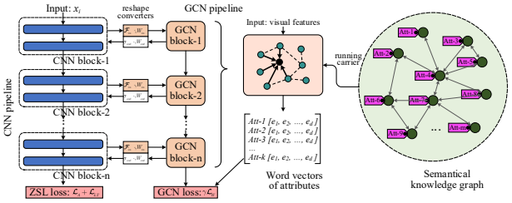
Fig. 3 : Overview framework of the GVSE network. The leftmost area is the CNN pipeline, which performs visual modeling for the images. The middle shows the GCN pipeline, which models the implicit semantic relationships in visual features. The reshape converters regular the dimension of visual feature input and semantic information feedback, which are used to support dual-pipe interaction. The rightmost area is the semantic knowledge graph, the vertexes of which refer to the attributes. It is the "running carrier" for GCN pipeline: the graph convolution algorithm is running based on the semantic knowledge graph.
원문 · CC BY 4.0 · Yang Hu, Guihua Wen, Adriane Chapman, Pei Yang, Mingnan Luo, Yingxue Xu, Dan Dai, Wendy Hall · Graph-based Visual-Semantic Entanglement Network for Zero-shot Image Recognition · 원문 그림 인용 · 원본 PDF 4쪽에서 그림 영역을 추출했습니다.PMI로 만드는 속성 지식 그래프
GCN이 실행될 그래프는 학습 전에 오프라인으로 만듭니다. 그래프의 노드는 속성이고, 간선은 속성 쌍의 점별 상호정보량(PMI)으로 정합니다. 원문 식은 \(PMI(v_i,v_j)=N\left(\log \frac{p(v_i,v_j)}{p(v_i)p(v_j)}\right)\)이며, 여기서 N은 [0, 1] 범위로 정규화하는 함수입니다. 동시 출현 확률 \(p(v_i,v_j)\)는 두 속성을 모두 가진 범주 수를 전체 범주 수로 나눈 비율입니다. 간선은 PMI가 임계값 δ보다 크면 \(l_{i,j}=1\)로 놓고, 그렇지 않으면 0으로 둡니다. 원문은 δ=0.75를 기본값으로 사용하며, 0.25와 0.50과 비교했을 때 세 데이터셋 모두에서 최고 결과를 보였다고 보고합니다.
속성 단어 벡터 회귀와 손실 함수
GCN 파이프라인의 최종 출력은 속성 단어 벡터에 맞추도록 회귀됩니다. 각 범주를 속성의 집합으로 보는 말뭉치에서 단어 임베딩을 학습하고, 범주의 속성 벡터를 목표로 평균제곱오차 LW를 계산합니다. 분류 쪽 손실은 softmax 교차 엔트로피 LA이며, 사람이 정의한 속성 공간을 보완하는 latent attributes에는 triplet loss LLT를 씁니다. 전체 손실은 \(L=L_A+L_{LT}+\gamma L_W\)이고 γ는 0.5로 설정됩니다. 최적화는 역전파와 Adam 옵티마이저로 수행됩니다. 원문은 이 세 항을 함께 학습하는 설정을 제시하며, 각 항의 기여는 뒤의 절제 실험에서 따로 확인합니다.
SRF 병합과 ZSL 예측
CNN의 마지막 특징은 전역 평균 풀링으로 시각 임베딩 θ(x)가 됩니다. 여기에 GCN 블록 출력들을 풀링한 값을 이어 붙여 θ(x)+를 만듭니다. 이 병합 특징을 Semantic Relational Features(SRF)라고 부릅니다. SRF는 GCN 블록으로 역전파를 돕고, latent attributes에 더 많은 의미 정보를 줍니다. 예측에서는 속성 투영 \(\phi(x_i)=F_\phi(\theta(x_i)^+,W_\phi)\)와 범주의 속성 분포 φ(y)의 내적으로 점수를 만들고, 최고 점수 범주를 고릅니다. latent attributes를 쓰면 \(\phi_{lat}\)의 내적 항을 더합니다.
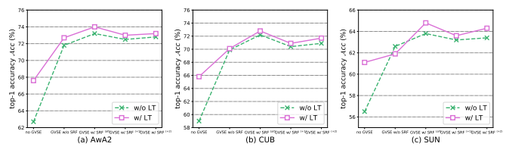
Fig. 9 : Performance of different methods on AwA2, CUB, and SUN datasets with proposed split (PS) (%) in the inductive setting of CZSL tasks. Here, no GVSE indicates baseline model with inductive ResNet QFSL [ 7], and different settings of STF are compared. Moreover, SRF(all) denotes that the semantic features from all GCN blocks are merged with the visual embedding, and SRF(+1) and SRF(+2) indicate that only the last one or two GCN blocks are considered.
원문 · CC BY 4.0 · Yang Hu, Guihua Wen, Adriane Chapman, Pei Yang, Mingnan Luo, Yingxue Xu, Dan Dai, Wendy Hall · Graph-based Visual-Semantic Entanglement Network for Zero-shot Image Recognition · 원문 그림 인용 · 원본 PDF 10쪽에서 그림 영역을 추출했습니다.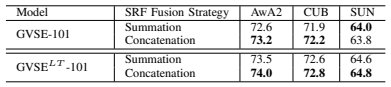
원문 그림 TABLE VIII: Comparison results on proposed split (PS) (%) with different SRF fusion strategies. The GVSE-101 and GVSELT -101 are used as the Embedding Subnet.
원문 · CC BY 4.0 · Yang Hu, Guihua Wen, Adriane Chapman, Pei Yang, Mingnan Luo, Yingxue Xu, Dan Dai, Wendy Hall · Graph-based Visual-Semantic Entanglement Network for Zero-shot Image Recognition · 원문 그림 인용 · 원본 PDF 10쪽에서 그림 영역을 추출했습니다.CZSL 비교와 주요 결과
제안 방법은 AwA2, CUB, SUN에서 제로샷 분류(CZSL) 정확도로 비교됩니다. 기본 귀납 설정의 GVSE-101은 제안 분할(PS)에서 AwA2 73.2, CUB 72.2, SUN 63.8의 top-1 정확도를 기록합니다. 같은 백본 설정에서 GCN을 FC 인코더나 Direct 구조로 바꾼 표 III 비교에서도 GCN 설정이 세 데이터셋 모두 높았습니다. 표 II에서 GVSE 행의 ±값은 여러 실행의 변동으로 보고되며, 백본 깊이(18, 50, 101층)에 따라 결과가 함께 제시됩니다. 전이 설정에서는 GVSE-101 + T가 AwA2 PS 83.7, CUB PS 79.4, SUN PS 63.8을 기록하며, 이 결과도 해당 전이 프레임워크의 설정에서만 읽어야 합니다.
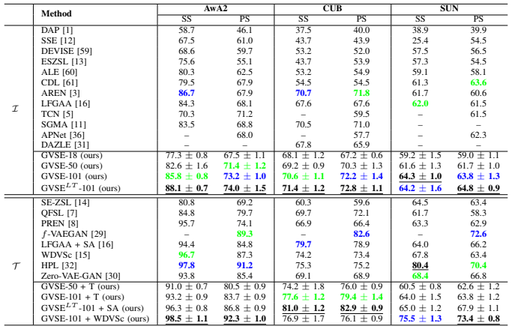
원문 그림 TABLE II: Comparisons under the CZSL setting (%). For each dataset, the best, the second-best, and the third-best performances are marked in bold, blue, and green font respectively for both the inductive and transductive methods. For GVSE-18, GVSE-50, and GVSE-101, the visual embedding subnet is ResNet with 18, 50, and 101 layers. Both standard split (SS) and proposed split (PS) are considered [18]. The notations: I denotes inductive ZSL methods, and T denotes transductive ZSL methods.
원문 · CC BY 4.0 · Yang Hu, Guihua Wen, Adriane Chapman, Pei Yang, Mingnan Luo, Yingxue Xu, Dan Dai, Wendy Hall · Graph-based Visual-Semantic Entanglement Network for Zero-shot Image Recognition · 원문 그림 인용 · 원본 PDF 7쪽에서 그림 영역을 추출했습니다.SUN 표준 분할의 불리한 결과
모든 조건에서 최고 성능이 나온 것은 아닙니다. SUN 표준 분할(SS)의 CZSL 비교에서 GVSE-101은 HPL보다 낮은 결과로 보고됩니다. 저자들은 전이 설정에서 HPL과 f-VAEGAN이 더 판별적인 프로토타입 공간과 현실적인 전이 특징을 제공하기 때문이라고 해석합니다. 이 해석은 저자의 설명이며, 본 논문이 그 원인을 별도로 분해하여 증명한 것은 아닙니다.
의미 모델링 도구와 그래프 유형의 절제
의미 모델링 도구 비교에서 Direct 구조는 GCN 파이프라인을 제거하고 CNN 블록 특징을 합쳐 완전연결 인코더로 모델링합니다. FC 인코더 설정은 GCN의 그래프 합성곱 층을 같은 차원의 완전연결 층으로 바꿉니다. ResNet-101 백본의 PS 결과에서 GCN은 Direct와 FC 인코더보다 높았습니다. 그래프 유형 비교에서는 범주 유사도 기반 그래프와 인스턴스 k-NN 그래프가 속성 공존 기반 그래프보다 낮았습니다. 또한 같은 속성 공존 그래프에서도 직렬 전개보다 이중 파이프라인 전개가 더 높았습니다. 이 결과는 ResNet-101과 CZSL PS 조건에서 얻은 것입니다.
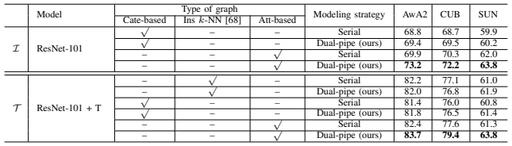
원문 그림 TABLE V: Ablation results ( %) with different types of semantic graph and different types of graph modeling strategies. For semantic graph type: 1. Category similarity graph (Cate-based); 2. Instance k-NN graph from reference [ 68] (Ins k-NN); 3. Attribute co-occurrence graph in the proposed approach (Att-based). For semantic modeling strategy: 1. Serial mode follow the visual modeling (Serial); 2. The proposed dual-pipeline entanglement structure (Dual-pipe). Accuracy ( ACC) in CZSL with proposed split (PS) is recorded. Results are recorded on datasets: AwA2, CUB, SUN.
원문 · CC BY 4.0 · Yang Hu, Guihua Wen, Adriane Chapman, Pei Yang, Mingnan Luo, Yingxue Xu, Dan Dai, Wendy Hall · Graph-based Visual-Semantic Entanglement Network for Zero-shot Image Recognition · 원문 그림 인용 · 원본 PDF 9쪽에서 그림 영역을 추출했습니다.일반화 ZSL 설정의 결과
일반화 ZSL(GZSL)은 seen과 unseen 범주를 함께 탐색 공간으로 씁니다. 평가는 seen 정확도 ACC_S, unseen 정확도 ACC_U, 그리고 H = 2×ACC_S×ACC_U/(ACC_S+ACC_U)로 보고합니다. 전이 설정에서 GVSE-101 + T는 AwA2, CUB, SUN에서 조화평균 H를 각각 79.7, 73.9, 45.2로 기록합니다. 귀납 설정에서는 AwA2와 SUN에서 GVSE-101이 TCN보다 낮게 보고됩니다. 저자들은 TCN이 학습 중 unseen 샘플에 접근하지 않더라도 unseen 범주의 풍부한 설명 의미를 활용한다고 해석합니다.
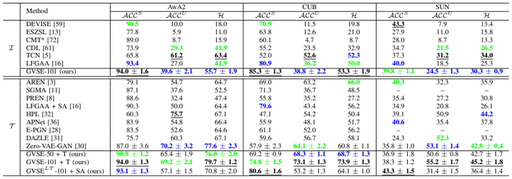
원문 그림 TABLE IX: Comparisons in the GZSL setting (%). For each dataset, the best, the second best, and the third best results are marked in bold, blue, and green fonts respectively.I: inductive ZSL methods, and T : transductive ZSL methods.
원문 · CC BY 4.0 · Yang Hu, Guihua Wen, Adriane Chapman, Pei Yang, Mingnan Luo, Yingxue Xu, Dan Dai, Wendy Hall · Graph-based Visual-Semantic Entanglement Network for Zero-shot Image Recognition · 원문 그림 인용 · 원본 PDF 11쪽에서 그림 영역을 추출했습니다.적용 범위와 남은 질문
본 논문의 결과는 ResNet 백본과 AwA2, CUB, SUN이라는 ZSL 벤치마크, 그리고 제안된 PMI 기반 속성 그래프 설정에서 얻은 것입니다. 그래프 생성에는 PMI 임계값 δ가 필요하며, 실험에서는 δ를 세 값으로만 비교했습니다. SUN 표준 분할의 비교 결과도 이 방법이 모든 조건에서 최고라는 근거가 되지 않습니다. 저자들은 향후 연구로 더 개방적인 의미 지식 그래프 구성과 동적 그래프 모델링을 제시합니다.
논문 정보
- 저자
- Yang Hu, Guihua Wen, Adriane Chapman, Pei Yang, Mingnan Luo, Yingxue Xu, Dan Dai, Wendy Hall
- 학회·저널
- arXiv · 프리프린트
- 최초 공개일
- 2020년 6월 8일
- 등록일
- 2026년 11월 6일
- 수정일
- 2021년 6월 12일
- 버전
- v2
- arXiv
- 2006.04648
- DOI
- 10.1109/tmm.2021.3082292
- 분류
- cs.CV · cs.LG · eess.IV
- 원문 이용 조건
- CC BY 4.0
- 제공 범위
- 논문 정보, 해설, 허용된 원문 그림
AI 해설은 논문 원문과 별개의 설명이며 오류가 있을 수 있습니다. 원문과 그림은 각 출처의 이용 조건과 따로 표시된 권리를 따릅니다.
초록
Zero-shot learning uses semantic attributes to connect the search space of unseen objects. In recent years, although the deep convolutional network brings powerful visual modeling capabilities to the ZSL task, its visual features have severe pattern inertia and lack of representation of semantic relationships, which leads to severe bias and ambiguity. In response to this, we propose the Graph-based Visual-Semantic Entanglement Network to conduct graph modeling of visual features, which is mapped to semantic attributes by using a knowledge graph, it contains several novel designs: 1. it establishes a multi-path entangled network with the convolutional neural network (CNN) and the graph convolutional network (GCN), which input the visual features from CNN to GCN to model the implicit semantic relations, then GCN feedback the graph modeled information to CNN features; 2. it uses attribute word vectors as the target for the graph semantic modeling of GCN, which forms a self-consistent regression for graph modeling and supervise GCN to learn more personalized attribute relations; 3. it fuses and supplements the hierarchical visual-semantic features refined by graph modeling into visual embedding. Our method outperforms state-of-the-art approaches on multiple representative ZSL datasets: AwA2, CUB, and SUN by promoting the semantic linkage modelling of visual features.
원문 인용
Yang Hu, Guihua Wen, Adriane Chapman, Pei Yang, Mingnan Luo, Yingxue Xu, Dan Dai, Wendy Hall (2020). Graph-based Visual-Semantic Entanglement Network for Zero-shot Image Recognition. arXiv:2006.04648v2. https://doi.org/10.1109/tmm.2021.3082292
BibTeX
@article{hu2020graph,
  title = {{Graph-based Visual-Semantic Entanglement Network for Zero-shot Image Recognition}},
  author = {Yang Hu and Guihua Wen and Adriane Chapman and Pei Yang and Mingnan Luo and Yingxue Xu and Dan Dai and Wendy Hall},
  year = {2020},
  eprint = {2006.04648},
  archivePrefix = {arXiv},
  doi = {10.1109/tmm.2021.3082292},
  url = {https://arxiv.org/abs/2006.04648v2}
}