논문 해설
Assessing the Chemical Intelligence of Large Language Models
대규모 언어 모델의 화학 지능 평가
- 연구 문제 대규모 언어 모델이 외부 도구 없이 분자 구조를 직접 해석하고 화학 추론을 수행할 수 있는지가 불분명했습니다.
- 연구 방법 816개 질문으로 구성된 ChemIQ 벤치마크를 만들고, 추론 수준을 달리한 여러 LLM을 단답형 과제에서 평가합니다.
- 주요 결과 추론 모델은 가장 높은 추론 모드에서 50%에서 57%의 정답률을 보였고, 비추론 모델은 3%에서 7%였습니다. 다만 최고 성능에서도 신뢰성 있는 수행에는 아직 미치지 못했습니다.
분자 구조를 직접 다루는 LLM의 과제
기존 화학 벤치마크는 대부분 객관식 문항으로 구성되어 있어 소거법으로 풀리는 경우가 많았습니다. 또한 분자를 SMILES 문자열로 주고 구조를 해석하게 하는 과제는 비추론 모델에서 거의 성과가 없었습니다. 이 논문은 외부 도구 없이 대규모 언어 모델이 분자 구조를 직접 해석할 수 있는지를 확인하기 위해 ChemIQ라는 816개 질문의 단답형 벤치마크를 구성합니다. ChemIQ는 분자 이해에 집중하고, 질문을 알고리즘으로 생성하여 데이터 유출을 줄일 수 있도록 설계되었습니다.
ChemIQ 질문 구성과 과제 범주
ChemIQ는 분자 해석, 화학 개념 번역, 화학 추론의 세 역량을 평가하도록 구성됩니다. 탄소 세기, 고리 세기, 최단 경로, 원자 대응, SMILES에서 IUPAC 이름 생성, Free-Wilson 유형의 구조-활성 관계 질문, 반응 생성물 예측, NMR 구조 해석이 포함됩니다. 분자는 SMILES로 표현되며 주로 ZINC 데이터셋의 약물 유사 분자에서 샘플링되었습니다. 일부 과제는 정규 SMILES와 무작위 SMILES를 함께 사용하여 원자 번호 매기기가 성능에 미치는 영향을 비교할 수 있게 합니다.
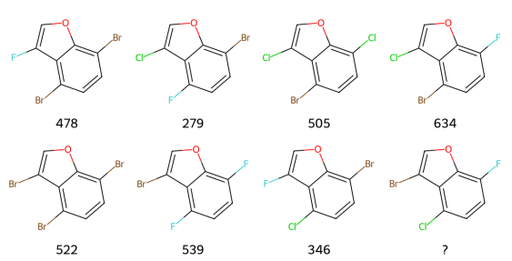
Figure 5 : Example Free-Wilson analysis question. Molecules were constructed by attaching three halogens at three positions on a benzene scaffold. Each substituent at each position was assigned a random integer value, and the total score was calculated as the sum of these individual values. The task is to determine the score of the unknown molecule. The answer can be found in Table 18.
원문 · CC BY 4.0 · Nicholas T. Runcie, Charlotte M. Deane, Fergus Imrie · Assessing the Chemical Intelligence of Large Language Models · 원문 그림 인용 · 원본 PDF 10쪽에서 그림 영역을 추출했습니다.추론 예산에 따른 평가 설계
연구진은 o3-mini를 low, medium, high 추론 수준으로, Gemini Pro 2.5를 여러 추론 예산으로 실행하여 같은 모델의 추론량 변화에 따른 성능을 비교합니다. 비추론 기준으로 GPT-4o와 DeepSeek-V3-0324를 사용하고, DeepSeek-R1-0528을 추론 모델로 둡니다. 성공률은 질문별 정답 비율로 정의되며 인접한 모델 쌍은 one-tailed McNemar test로 비교합니다. 과제별 정답 판정은 정확 일치 또는 OPSIN 파싱 기준을 사용합니다.
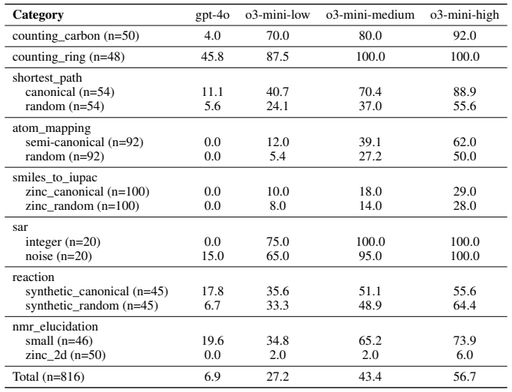
Table 3 : Success rates (%) for OpenAI models on the ChemIQ benchmark. GPT-4o is a non-reasoning model; o3-mini is a reasoning model with low, medium, and high indicating the thinking budget for the model.
원문 · CC BY 4.0 · Nicholas T. Runcie, Charlotte M. Deane, Fergus Imrie · Assessing the Chemical Intelligence of Large Language Models · 원문 그림 인용 · 원본 PDF 24쪽에서 그림 영역을 추출했습니다.추론 수준에 따른 전체 성능과 2D NMR 결과
추론 모델인 o3-mini, Gemini Pro 2.5, DeepSeek R1은 가장 높은 추론 모드에서 816개 질문 중 50%에서 57%를 맞혔고, 비추론 모델은 3%에서 7%였습니다. 이 결과는 추론 수준이 높을수록 성공률이 증가하는 경향을 보여 줍니다. 다만 Gemini Pro 2.5는 가장 높은 세 추론 예산에서 성능이 거의 늘지 않았습니다. 2D NMR 구조 해석에서는 Gemini Pro 2.5가 ZINC에서 샘플링한 50개 분자 중 10개를 맞혔으며, 그중 하나는 25개 중원자 구조였습니다. 저자들은 전체 최고 성능도 57%에 그쳐 아직 신뢰성 있게 수행하지는 못한다고 해석합니다.
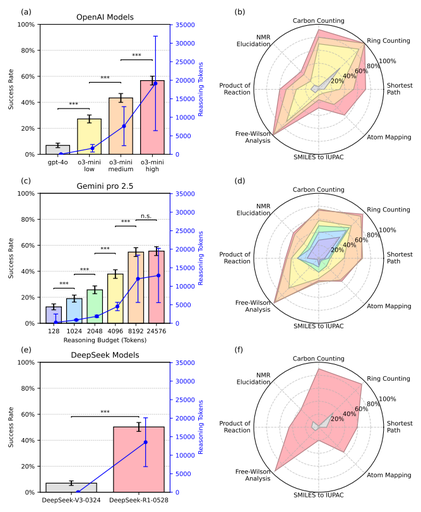
Figure 2 : Summary of model performance. Results show a trend that increased reasoning correlates with higher success rates. A summary of question prompts is provided in Figure 1, and full prompts with reasoning excerpts are listed in Appendix B. (a,c,e) Average success rates across all benchmark questions and the average number of reasoning tokens used per question. Vertical error bars show 95% confidence interval. Adjacent bars were compared using a one-tailed McNemar test. Significance levels are denoted as: ∗p < 0.05, ∗∗p < 0.01, and ∗∗∗p < 0.001. (b,d,f) Radar plots showing performance by question category. (a,b) OpenAI models GPT-4o (non-reasoning) and o3-mini (reasoning) (c,d) Google Gemini Pro 2.5 with varying reasoning budgets (e,f) DeepSeek models DeepSeek-V3-0324 (non-reasoning) and DeepSeek-R1-0528 (reasoning).
원문 · CC BY 4.0 · Nicholas T. Runcie, Charlotte M. Deane, Fergus Imrie · Assessing the Chemical Intelligence of Large Language Models · 원문 그림 인용 · 원본 PDF 5쪽에서 그림 영역을 추출했습니다.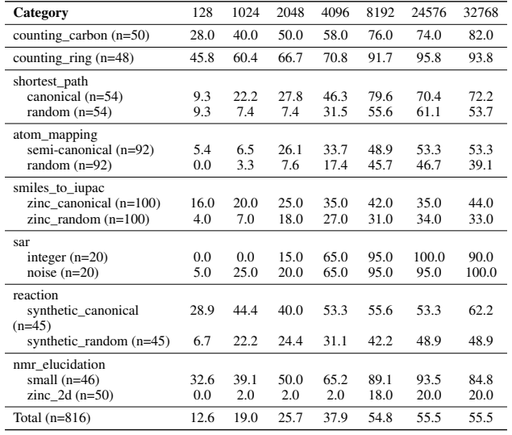
Table 4 : Success rates (%) for Google Gemini Pro 2.5 on the ChemIQ benchmark. Gemini Pro 2.5 is a reasoning model; header is the thinking budget used for the model run.
원문 · CC BY 4.0 · Nicholas T. Runcie, Charlotte M. Deane, Fergus Imrie · Assessing the Chemical Intelligence of Large Language Models · 원문 그림 인용 · 원본 PDF 25쪽에서 그림 영역을 추출했습니다.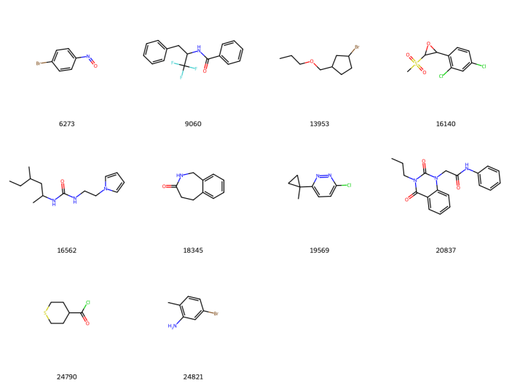
Figure 10 : 2D NMR structures solved by Gemini Pro 2.5 (reasoning token budget of 32768). Molecules were sampled from ZINC. An example prompt is given in 21. The caption for each molecule is the number of reasoning tokens used by the model to solve the question.
원문 · CC BY 4.0 · Nicholas T. Runcie, Charlotte M. Deane, Fergus Imrie · Assessing the Chemical Intelligence of Large Language Models · 원문 그림 인용 · 원본 PDF 44쪽에서 그림 영역을 추출했습니다.SMILES 무작위화와 분자 해석 과제
탄소 세기와 고리 세기에서 o3-mini 모델은 추론 수준이 높을수록 정확도가 올라갔습니다. 최단 경로 과제에서 o3-mini-high는 정규 SMILES에서 88.9%를 기록했지만 무작위 SMILES에서는 55.6%로 낮아졌습니다. 원자 대응 과제에서도 무작위 SMILES 성능이 낮았습니다. 이는 모델이 분자 그래프 전체를 파싱하기보다 문자열 패턴에 의존할 수 있음을 시사하지만, 저자들은 이를 추정적 해석으로 제시합니다.
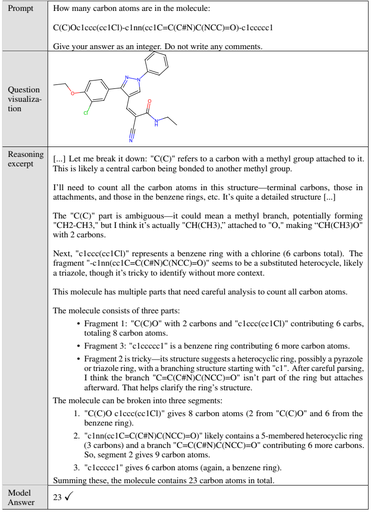
Table 13 : Excerpt from o3-mini-high of an example carbon counting question.
원문 · CC BY 4.0 · Nicholas T. Runcie, Charlotte M. Deane, Fergus Imrie · Assessing the Chemical Intelligence of Large Language Models · 원문 그림 인용 · 원본 PDF 33쪽에서 그림 영역을 추출했습니다.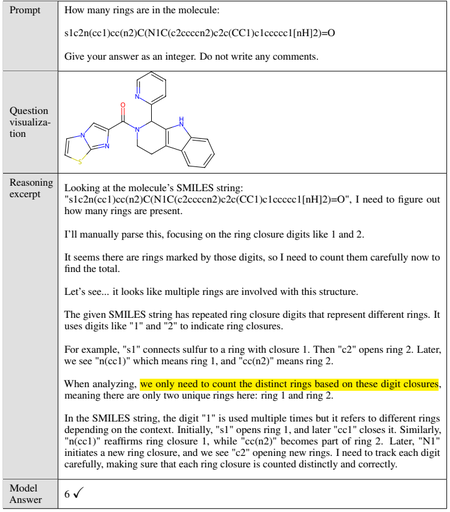
Table 14 : Excerpt from o3-mini-high of an example ring counting question. The highlighted text shows that the model recognizes the solution only requires analyzing the ring closure numbers, as opposed to parsing the entire SMILES string.
원문 · CC BY 4.0 · Nicholas T. Runcie, Charlotte M. Deane, Fergus Imrie · Assessing the Chemical Intelligence of Large Language Models · 원문 그림 인용 · 원본 PDF 34쪽에서 그림 영역을 추출했습니다.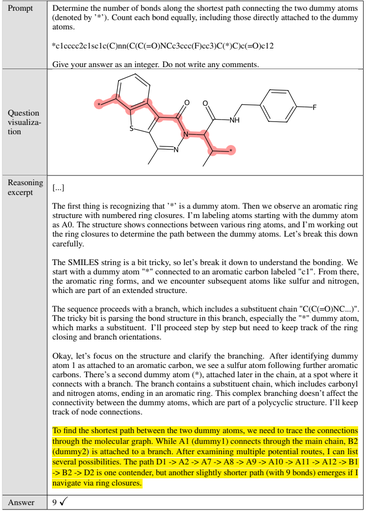
Table 15 : Excerpt from o3-mini-high of an example shortest path question using canonical SMILES. Highlighted text suggest the model parsed the SMILES string to a graph represents and then performed a graph search to find the shortest path.
원문 · CC BY 4.0 · Nicholas T. Runcie, Charlotte M. Deane, Fergus Imrie · Assessing the Chemical Intelligence of Large Language Models · 원문 그림 인용 · 원본 PDF 35쪽에서 그림 영역을 추출했습니다.모델 한계와 실험 제약
DeepSeek R1은 답안 형식을 자주 지키지 못했고, 정규표현식 기반 파서를 적용하자 정확도가 24%에서 50%로 올랐다고 보고됩니다. OpenAI o3-mini는 API 오류가 일부 질문, 특히 어려운 2D NMR 질문에서 자주 발생했습니다. Gemini Pro 2.5는 설정된 추론 예산을 자주 넘었습니다. 또한 높은 추론 예산에서의 정체는 모델이 토큰을 비효율적으로 쓴 결과라기보다 더 많은 토큰을 쓰지 않은 선택일 수 있다고 저자들은 해석합니다. 20개 초과 중원자 구조에서는 정확도가 낮아 약물 크기 분자 해석의 한계가 남습니다.
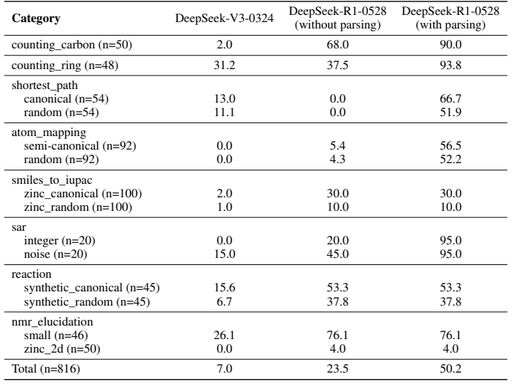
Table 5 : Success rates (%) for DeepSeek models on the ChemIQ benchmark. DeepSeek-V3-0324 is a non-reasoning model and DeepSeek-R1-0528 is a reasoning model. The DeepSeek R1 model often failed to write the answer in the format described in the prompt: a parser was written to extract the intended answer, resulting in improved performance. The “without parsing” is the performance of the model from the output only, and “with parsing” is the performance following algorithmic parsing of the answer from the output text.
원문 · CC BY 4.0 · Nicholas T. Runcie, Charlotte M. Deane, Fergus Imrie · Assessing the Chemical Intelligence of Large Language Models · 원문 그림 인용 · 원본 PDF 26쪽에서 그림 영역을 추출했습니다.논문 정보
- 저자
- Nicholas T. Runcie, Charlotte M. Deane, Fergus Imrie
- 학회·저널
- arXiv · 프리프린트
- 최초 공개일
- 2025년 5월 12일
- 등록일
- 2026년 11월 6일
- 수정일
- 2025년 7월 10일
- 버전
- v2
- arXiv
- 2505.07735
- 분류
- cs.LG
- 원문 이용 조건
- CC BY 4.0
- 제공 범위
- 논문 정보, 해설, 허용된 원문 그림
AI 해설은 논문 원문과 별개의 설명이며 오류가 있을 수 있습니다. 원문과 그림은 각 출처의 이용 조건과 따로 표시된 권리를 따릅니다.
초록
Large Language Models are versatile, general-purpose tools with a wide range of applications. Recently, the advent of "reasoning models" has led to substantial improvements in their abilities in advanced problem-solving domains such as mathematics and software engineering. In this work, we assessed the ability of reasoning models to perform chemistry tasks directly, without any assistance from external tools. We created a novel benchmark, called ChemIQ, consisting of 816 questions assessing core concepts in organic chemistry, focused on molecular comprehension and chemical reasoning. Unlike previous benchmarks, which primarily use multiple choice formats, our approach requires models to construct short-answer responses, more closely reflecting real-world applications. The reasoning models, OpenAI's o3-mini, Google's Gemini Pro 2.5, and DeepSeek R1, answered 50%-57% of questions correctly in the highest reasoning modes, with higher reasoning levels significantly increasing performance on all tasks. These models substantially outperformed the non-reasoning models which achieved only 3%-7% accuracy. We found that Large Language Models can now convert SMILES strings to IUPAC names, a task earlier models were unable to perform. Additionally, we show that the latest reasoning models can elucidate structures from 1D and 2D 1H and 13C NMR data, with Gemini Pro 2.5 correctly generating SMILES strings for around 90% of molecules containing up to 10 heavy atoms, and in one case solving a structure comprising 25 heavy atoms. For each task, we found evidence that the reasoning process mirrors that of a human chemist. Our results demonstrate that the latest reasoning models can, in some cases, perform advanced chemical reasoning.
원문 인용
Nicholas T. Runcie, Charlotte M. Deane, Fergus Imrie (2025). Assessing the Chemical Intelligence of Large Language Models. arXiv:2505.07735v2. https://arxiv.org/abs/2505.07735v2
BibTeX
@misc{runcie2025assessing,
  title = {{Assessing the Chemical Intelligence of Large Language Models}},
  author = {Nicholas T. Runcie and Charlotte M. Deane and Fergus Imrie},
  year = {2025},
  eprint = {2505.07735},
  archivePrefix = {arXiv},
  url = {https://arxiv.org/abs/2505.07735v2}
}