논문 해설
EEGEyeNet: a Simultaneous Electroencephalography and Eye-tracking Dataset and Benchmark for Eye Movement Prediction
EEGEyeNet: 안구 운동 예측을 위한 뇌전도와 안구 추적 동시 데이터셋 및 벤치마크
- 연구 문제 EEG 기반 시선 추정은 동시 기록 데이터 부족으로 진전이 느리며, 이 논문은 대규모 데이터셋과 세 과제 벤치마크로 이를 다룹니다.
- 연구 방법 356명의 EEG-안구 추적 데이터를 최소·최대 전처리로 제공하고, 고전 기계학습과 딥러닝 모델을 세 과제에서 비교합니다.
- 주요 결과 Left-right 과제는 대부분 모델이 높은 정확도를 보였고, 절대 위치 과제에서는 CNN이 70.2 mm의 기준 성능을 기록했습니다.
EEG로 시선을 추정하려는 이유와 데이터 부족
시선 추적(eye tracking)은 행동과학, 보조기술, 사용자 경험 등에서 쓰이며 신경질환 평가에도 활용될 수 있습니다. EEG는 비침습적이고 상대적으로 저비용이며 높은 시간 해상도를 제공하므로, 안구 추적 장비 없이도 시선 위치 정보를 얻을 수 있다면 장비나 전문 인력이 부족한 연구와 임상 환경에서 활용 범위가 넓어집니다.
그러나 EEG와 안구 추적을 동시에 기록한 데이터는 장비와 전문성이 모두 필요하여 수집이 어렵고 비용도 큽니다. 기계학습과 딥러닝 기반의 EEG 시선 추정은 많은 주석 데이터를 필요로 하므로 이 데이터 부족이 분야의 진전을 늦추는 주요 장벽입니다. 이 논문은 이 간극을 메우기 위해 대규모 동시 기록 데이터셋 EEGEyeNet과 세 과제로 구성된 벤치마크를 제시합니다.
데이터셋 구축과 전처리
EEGEyeNet은 건강한 성인 356명에게서 128채널 EEG와 적외선 비디오 기반 안구 추적(EyeLink 1000 Plus)을 동시에 기록한 데이터입니다. 두 신호는 모두 500 Hz로 기록되었고 전처리 후 2 ms 이내의 동기화 오차를 확보했다고 보고됩니다. 참가자는 연령이 18세에서 80세 사이이며 세 가지 실험 패러다임인 Pro- and Antisaccade, Large Grid, Visual Symbol Search로 기록되었습니다.
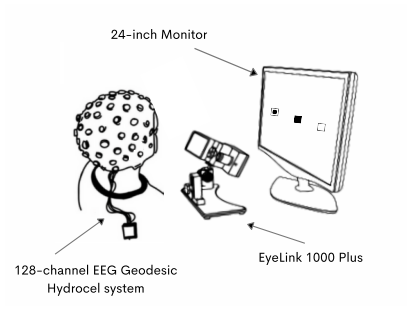
Figure 1 : Recording Setup
원문 · CC BY 4.0 · Ard Kastrati, Martyna Beata Płomecka, Damián Pascual, Lukas Wolf, Victor Gillioz, Roger Wattenhofer, Nicolas Langer · EEGEyeNet: a Simultaneous Electroencephalography and Eye-tracking Dataset and Benchmark for Eye Movement Prediction · 원문 그림 인용 · 원본 PDF 3쪽에서 그림 영역을 추출했습니다.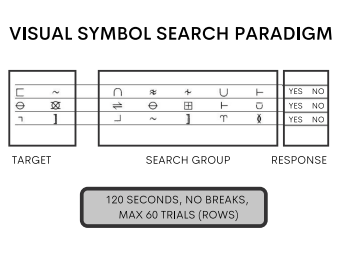
Figure 4 : Visual Symbol Search. Three rep- resentative trials of the VSS task. For each row, the first two symbols are target symbols, the next five correspond to the search group, and the response check boxes are labeled as response.
원문 · CC BY 4.0 · Ard Kastrati, Martyna Beata Płomecka, Damián Pascual, Lukas Wolf, Victor Gillioz, Roger Wattenhofer, Nicolas Langer · EEGEyeNet: a Simultaneous Electroencephalography and Eye-tracking Dataset and Benchmark for Eye Movement Prediction · 원문 그림 인용 · 원본 PDF 5쪽에서 그림 영역을 추출했습니다.전처리는 두 가지 방식으로 제공됩니다. 최소 전처리는 불량 전극을 탐지해 보간하고 40 Hz 고역 통과 및 0.5 Hz 저역 통과 필터를 적용하며 안구 아티팩트를 남깁니다. 최대 전처리는 ICA와 ICLabel을 사용해 근육, 심장, 안구, 선 잡음 등 인공 성분을 제거하여 신경생리 정보만 남기려는 방식입니다. 벤치마크는 최소 전처리 데이터만 사용하며, 이 선택은 안구 아티팩트가 시선 추정에 도움이 된다는 설계 판단에 근거합니다.
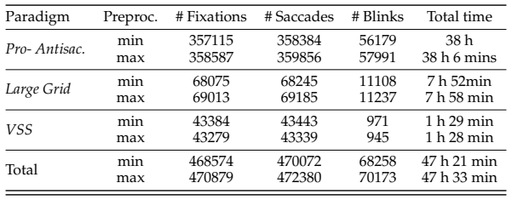
Table 2 : Overview of EEGEyeNet Dataset. Number of eye-tracking events (fixations, saccades, blinks) for the EEGEyeNet experimental paradigms. The difference in the number of eye events between the two preprocessing versions is due to fact that in the minimal preprocessing more events are identified as artifacts and removed from the sample.
원문 · CC BY 4.0 · Ard Kastrati, Martyna Beata Płomecka, Damián Pascual, Lukas Wolf, Victor Gillioz, Roger Wattenhofer, Nicolas Langer · EEGEyeNet: a Simultaneous Electroencephalography and Eye-tracking Dataset and Benchmark for Eye Movement Prediction · 원문 그림 인용 · 원본 PDF 6쪽에서 그림 영역을 추출했습니다.세 과제의 구성과 평가 지표
벤치마크는 난이도가 높아지는 세 과제로 구성됩니다. Left-right 과제는 Pro-and Antisaccade 패러다임의 prosaccade 시행에서 수평 방향의 도약을 판별하는 이진 분류입니다. 평가 지표는 정확도이며 다수 클래스에 의한 무작위 기준선은 52.3%입니다.
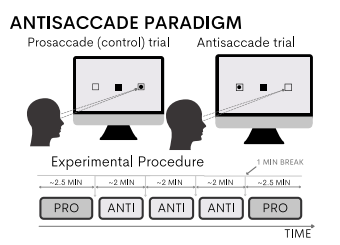
Figure 2 : Pro- and Antisaccade. Schematic view of the experimental setup and gaze be- havior during a prosaccade (left) and antisac- cade (right) trial.
원문 · CC BY 4.0 · Ard Kastrati, Martyna Beata Płomecka, Damián Pascual, Lukas Wolf, Victor Gillioz, Roger Wattenhofer, Nicolas Langer · EEGEyeNet: a Simultaneous Electroencephalography and Eye-tracking Dataset and Benchmark for Eye Movement Prediction · 원문 그림 인용 · 원본 PDF 4쪽에서 그림 영역을 추출했습니다.Angle/Amplitude 과제는 Large Grid 패러다임에서 도약의 각도와 진폭을 회귀로 추정합니다. 각도는 라디안, 진폭은 밀리미터 단위의 RMSE로 평가되며 평균 기반 기준선은 각도 1.90 라디안, 진폭 74.7 mm입니다. Absolute Position 과제는 한 번의 응시가 포함된 1초 샘플에서 화면 XY 좌표를 추정하며, 실제 위치와 추정 위치 사이의 유클리드 거리(mm)로 평가하고 기준선은 123.3 mm입니다. 데이터는 참가자 단위로 70%, 15%, 15%의 훈련·검증·테스트 세트로 나뉘어 한 참가자의 데이터가 여러 세트에 걸치지 않습니다.
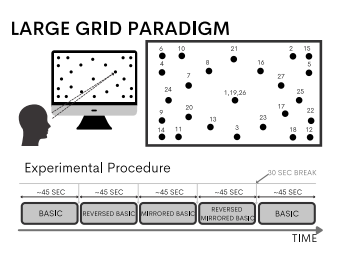
Figure 3 : Large Grid. Schematic view of the experimental setup and stimuli location on the screen.
원문 · CC BY 4.0 · Ard Kastrati, Martyna Beata Płomecka, Damián Pascual, Lukas Wolf, Victor Gillioz, Roger Wattenhofer, Nicolas Langer · EEGEyeNet: a Simultaneous Electroencephalography and Eye-tracking Dataset and Benchmark for Eye Movement Prediction · 원문 그림 인용 · 원본 PDF 5쪽에서 그림 영역을 추출했습니다.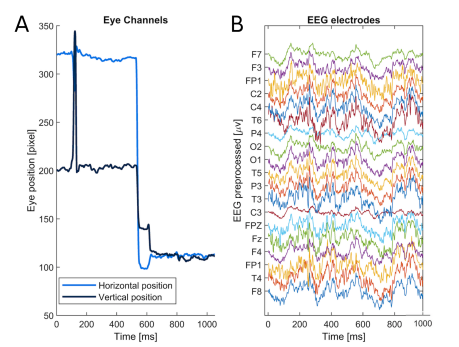
Figure 5 : Each sample of EEG data has a shape of 500 × 128, i.e., 500 time points for each of the 128 EEG channels. On the left side (A) we can see gaze data (along XY-axes) of the one-second sample. On the right side (B) we can see a subset of the preprocessed EEG data (electrodes matching the 10–20 systems were chosen).
원문 · CC BY 4.0 · Ard Kastrati, Martyna Beata Płomecka, Damián Pascual, Lukas Wolf, Victor Gillioz, Roger Wattenhofer, Nicolas Langer · EEGEyeNet: a Simultaneous Electroencephalography and Eye-tracking Dataset and Benchmark for Eye Movement Prediction · 원문 그림 인용 · 원본 PDF 6쪽에서 그림 영역을 추출했습니다.
Table 3 : Benchmark Data. Detail of the data split for each task of the proposed benchmark.
원문 · CC BY 4.0 · Ard Kastrati, Martyna Beata Płomecka, Damián Pascual, Lukas Wolf, Victor Gillioz, Roger Wattenhofer, Nicolas Langer · EEGEyeNet: a Simultaneous Electroencephalography and Eye-tracking Dataset and Benchmark for Eye Movement Prediction · 원문 그림 인용 · 원본 PDF 7쪽에서 그림 영역을 추출했습니다.고전 기계학습과 딥러닝 기준 모델
고전 기계학습 모델은 원시 신호가 아니라 특징에서 학습합니다. 알파 대역 8-13 Hz 통과 필터를 적용한 뒤 Hilbert 변환으로 위상과 진폭을 추출하고, 이 특징으로 Gaussian Naive Bayes, Linear SVC, RBF SVC/SVR, 여러 회귀 모델, KNN, Random Forest, Gradient Boost, AdaBoost, XGBoost를 학습합니다.
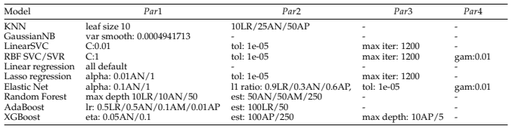
Table 5 : Hyperparameters of classical machine learning models. LR - Left/Right task, AN - Angle task, AM - Amplitude task, and AP - Absolute Position task.
원문 · CC BY 4.0 · Ard Kastrati, Martyna Beata Płomecka, Damián Pascual, Lukas Wolf, Victor Gillioz, Roger Wattenhofer, Nicolas Langer · EEGEyeNet: a Simultaneous Electroencephalography and Eye-tracking Dataset and Benchmark for Eye Movement Prediction · 원문 그림 인용 · 원본 PDF 19쪽에서 그림 영역을 추출했습니다.딥러닝 모델로는 표준 1차원 CNN, 피라미드형 CNN, EEGNet, InceptionTime, Xception을 평가합니다. Left-Right는 이진 교차 엔트로피, 나머지 두 과제는 평균제곱오차 손실을 사용하며 Adam 최적화기와 검증 세트 기반 조기 종료를 적용합니다. 학습률 1e-4는 Left-Right 검증 세트에서 고른 값이 나머지 과제에도 같이 쓰였습니다. 각 실험은 5회 반복하여 평균과 표준편차를 보고합니다.
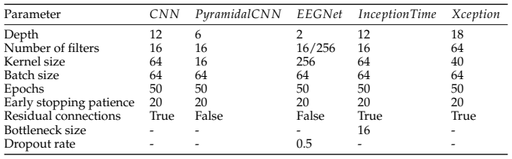
Table 6 : Hyperparameters of the deep learning models. EEGNet uses two different amounts of filters in its two blocks.
원문 · CC BY 4.0 · Ard Kastrati, Martyna Beata Płomecka, Damián Pascual, Lukas Wolf, Victor Gillioz, Roger Wattenhofer, Nicolas Langer · EEGEyeNet: a Simultaneous Electroencephalography and Eye-tracking Dataset and Benchmark for Eye Movement Prediction · 원문 그림 인용 · 원본 PDF 20쪽에서 그림 영역을 추출했습니다.벤치마크 결과와 과제별 차이
Left-right 과제에서 고전 모델은 높은 성능을 보였습니다. 트리 기반 모델은 96%를 넘었고 모든 딥러닝 모델은 98% 이상의 정확도를 보였으며 InceptionTime은 97.9%였습니다. 따라서 이 과제는 세 과제 중 가장 쉬운 과제로 읽힙니다.
Angle/Amplitude 과제에서는 Random Forest 등 고전 모델이 기준선보다 약간 낫지만 차이가 크지 않았습니다. 딥러닝 모델 중 단순한 CNN(각도 RMSE 0.33 라디안, 진폭 32 mm)과 PyramidalCNN이 가장 좋았습니다. Absolute Position 과제에서는 고전 모델이 기준선 근처에 머물렀고, 딥러닝 모델은 약 70에서 80 mm 범위의 거리 오차를 보였습니다. 그중 CNN이 70.2 mm로 이 과제의 기준 성능을 설정했습니다.
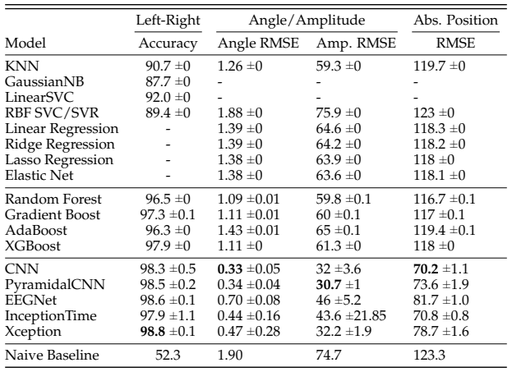
Table 4 : Results. Mean and standard deviation of 5 runs of the considered models on the three benchmark tasks. Angle is measured in radians, Amplitude and Abs. Position in mm.
원문 · CC BY 4.0 · Ard Kastrati, Martyna Beata Płomecka, Damián Pascual, Lukas Wolf, Victor Gillioz, Roger Wattenhofer, Nicolas Langer · EEGEyeNet: a Simultaneous Electroencephalography and Eye-tracking Dataset and Benchmark for Eye Movement Prediction · 원문 그림 인용 · 원본 PDF 9쪽에서 그림 영역을 추출했습니다.최대 전처리 데이터와 ZuCo 2.0 비교
최대 전처리 데이터에서 같은 실험을 수행하면 모든 모델의 성능이 최소 전처리 데이터보다 낮아졌습니다. 다만 Left-right에서 딥러닝 모델은 86%를 넘는 정확도를 보여 안구 정보를 제거한 뒤에도 시선 방향 정보가 일부 남아 있음을 시사합니다. 각도 과제는 CNN이 기준선보다 약간 낫지만 진폭 과제는 대부분 모델이 기준선 수준이었습니다. 이 결과는 최대 전처리 데이터에 대한 보조 실험이며 벤치마크의 주 설정과 구분해야 합니다.
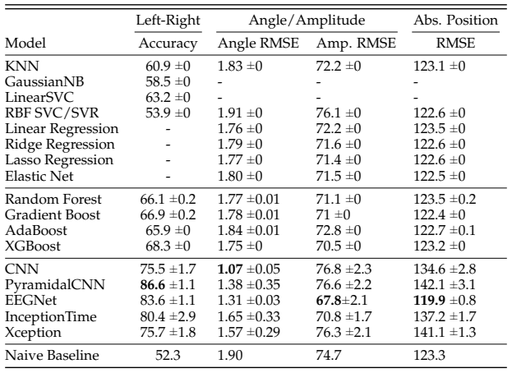
Table 7 : Data maximally preprocessed, 5 runs per DL model, Adam optimizer with learning rate 1e-4, early stopping patience 20. Angle is measured in radians, Amplitude and Abs. Position in mm.
원문 · CC BY 4.0 · Ard Kastrati, Martyna Beata Płomecka, Damián Pascual, Lukas Wolf, Victor Gillioz, Roger Wattenhofer, Nicolas Langer · EEGEyeNet: a Simultaneous Electroencephalography and Eye-tracking Dataset and Benchmark for Eye Movement Prediction · 원문 그림 인용 · 원본 PDF 20쪽에서 그림 영역을 추출했습니다.ZuCo 2.0 데이터셋에서도 같은 파이프라인을 적용했으나 방향성 분포와 기록 설정이 달라 Left-right 과제는 사용하지 않았습니다. 이 데이터셋에서는 모델들이 기준선에 가까운 성능을 보였으며, 저자들은 이를 기록 설정과 전처리 차이의 결과로 해석합니다.
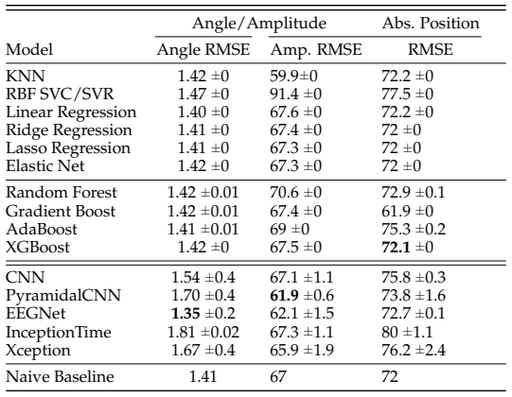
Table 8 : Results of Angle/Amplitude and Absolute Position tasks on the ZuCo dataset. Same hyperparameters as for experiments on our dataset. Angle is measured in radians, Amplitude and Abs. Position in mm.
원문 · CC BY 4.0 · Ard Kastrati, Martyna Beata Płomecka, Damián Pascual, Lukas Wolf, Victor Gillioz, Roger Wattenhofer, Nicolas Langer · EEGEyeNet: a Simultaneous Electroencephalography and Eye-tracking Dataset and Benchmark for Eye Movement Prediction · 원문 그림 인용 · 원본 PDF 22쪽에서 그림 영역을 추출했습니다.한계와 적용 범위
저자들은 Large Grid 패러다임의 참가자 수가 상대적으로 적다는 점과 벤치마크의 테스트 세트가 공개되어 있다는 점을 현재 한계로 밝힙니다. 이에 따라 향후 더 많은 데이터를 기록하고 테스트 세트를 숨긴 자동 평가 서비스를 구축하겠다고 계획합니다.
이 결과는 최소 전처리 EEG와 세 과제, 제시된 모델 설정에서 얻은 기준선입니다. 절대 위치 추정의 기준 성능은 CNN의 70.2 mm이며 저자들은 이 오차가 이상적 성능과 거리가 있다고 설명합니다. 이전 샘플만 사용하는 순차 모델은 이 논문에서 실험하지 않았으므로 그 효과는 확인되지 않았습니다.
논문 정보
- 저자
- Ard Kastrati, Martyna Beata Płomecka, Damián Pascual, Lukas Wolf, Victor Gillioz, Roger Wattenhofer, Nicolas Langer
- 학회·저널
- arXiv · 프리프린트
- 최초 공개일
- 2021년 11월 6일
- 등록일
- 2026년 11월 5일
- 수정일
- 2021년 11월 10일
- 버전
- v2
- arXiv
- 2111.05100
- 분류
- eess.SP · cs.CV · cs.LG
- 원문 이용 조건
- CC BY 4.0
- 제공 범위
- 논문 정보, 해설, 허용된 원문 그림
AI 해설은 논문 원문과 별개의 설명이며 오류가 있을 수 있습니다. 원문과 그림은 각 출처의 이용 조건과 따로 표시된 권리를 따릅니다.
초록
We present a new dataset and benchmark with the goal of advancing research in the intersection of brain activities and eye movements. Our dataset, EEGEyeNet, consists of simultaneous Electroencephalography (EEG) and Eye-tracking (ET) recordings from 356 different subjects collected from three different experimental paradigms. Using this dataset, we also propose a benchmark to evaluate gaze prediction from EEG measurements. The benchmark consists of three tasks with an increasing level of difficulty: left-right, angle-amplitude and absolute position. We run extensive experiments on this benchmark in order to provide solid baselines, both based on classical machine learning models and on large neural networks. We release our complete code and data and provide a simple and easy-to-use interface to evaluate new methods.
원문 인용
Ard Kastrati, Martyna Beata Płomecka, Damián Pascual, Lukas Wolf, Victor Gillioz, Roger Wattenhofer, Nicolas Langer (2021). EEGEyeNet: a Simultaneous Electroencephalography and Eye-tracking Dataset and Benchmark for Eye Movement Prediction. arXiv:2111.05100v2. https://arxiv.org/abs/2111.05100v2
BibTeX
@misc{kastrati2021eegeyenet,
  title = {{EEGEyeNet: a Simultaneous Electroencephalography and Eye-tracking Dataset and Benchmark for Eye Movement Prediction}},
  author = {Ard Kastrati and Martyna Beata Płomecka and Damián Pascual and Lukas Wolf and Victor Gillioz and Roger Wattenhofer and Nicolas Langer},
  year = {2021},
  eprint = {2111.05100},
  archivePrefix = {arXiv},
  url = {https://arxiv.org/abs/2111.05100v2}
}