논문 해설
An end-to-end framework for uncertainty-aware validation of generative models
생성 모델의 불확실성 인식 검증을 위한 종단간 프레임워크
- 연구 문제 유한한 학습 표본으로 적합된 생성 모델은 충분히 큰 시험 표본에서 점 귀무가설 검정에 의해 기각됩니다.
- 연구 방법 SIGMA는 가우시안 혼합 모델의 적합 불확실성을 접선 공간의 점수 함수로 기술하고, 이를 프로파일된 복합 귀무가설 검정에 넣습니다.
- 주요 결과 2차원 장난감 모델에서 부트스트랩 보정 복합 귀무가설은 N_test=2N_train까지 보정을 유지하며, 4차원 제트 임베딩의 K=256 모델에서는 N_test=N_train/5까지 보정을 유지합니다.
점 귀무가설 검정의 한계
생성 모델은 물리 분석에서 배경 밀도를 추정하는 데 쓰이지만, 학습 표본 크기 N_train으로 적합된 모델은 참 분포와 정확히 일치하지 않습니다. 기존의 적합도 검정은 적합된 모델을 정확한 밀도로 간주하는 점 귀무가설(point-null)을 검정하므로, 시험 표본 N_test가 충분히 커지면 추정 오차를 감지하여 모델을 기각합니다. 이 논문은 이 문제를 적합 불확실성을 검정에 전파하여 다룹니다. 이를 위해 점 귀무가설을 적합 불확실성을 포함한 복합 귀무가설(composite-null)로 확장합니다.
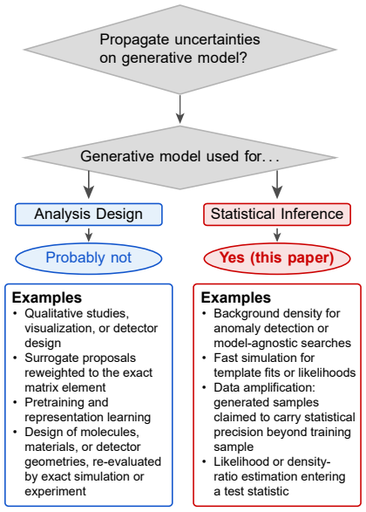
FIG. 1 .When uncertainty quantification matters.Rep- resentative uses of generative models in the physical sciences, classified by whether the error of the fit should be propagated into a quantitative claim. For the uses on the left (blue), a wrong model costs efficiency or statistical power but not va- lidity of the claim, and qualitative validation suffices. For the uses on the right (red), the fitted density is the reference model of a statistical inference: its error is indistinguishable from a signal, so it must be propagated into the test (Sec. IV).
원문 · CC BY 4.0 · Giada Badaracco, Sean Benevedes, Christina Reissel, Philip Harris, Gaia Grosso · An end-to-end framework for uncertainty-aware validation of generative models · 원문 그림 인용 · 원본 PDF 2쪽에서 그림 영역을 추출했습니다.핵심 질문은 생성 모델의 적합 오차를 통계 검정 안에서 프로파일링하면, N_test가 N_train보다 큰 영역에서도 명목 위양성률을 유지할 수 있는지입니다. 원문은 이 한계를 모델 편향과 통계적 불확실성으로 나누며, 본 논문은 후자인 적합의 통계적 불확실성을 다룹니다.
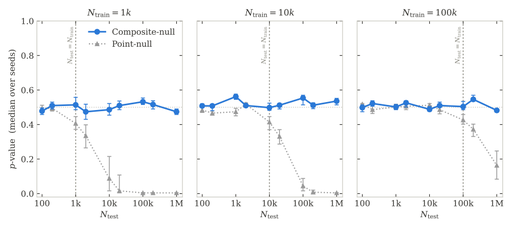
FIG. 2 .Impact of fit uncertainties on goodness-of-fit tests of generative models.A GaussianN(µ, σ) is fitted by maximum likelihood toN train samples drawn fromN(0,1), withN train = 103, 10 4 and 10 5 (left to right). The fitted model is then tested onN test fresh samples from the ground truth, using either the point-null (gray), which takes the fit as exact, or the Gaussian composite-null (blue), which includes the fit uncertainties. For eachN train, the fit is repeated with 10 independent training samples and each fit is tested on 100 test samples. Markers show the medianp-value across trainings, and error bars show the 68% spread of the per-training medians. If the tested null hypothesis holds,p-values are uniformly distributed with median 0.5 (horizontal dotted line). Although the model family contains the ground truth, the fitted model never coincides with it exactly. The point-null, which ignores this estimation error, is therefore eventually rejected onceN test ≳N train (vertical dashed line). The composite-null accounts for it and remains satisfied up to the largest test size probed,N test = 10 6, i.e. between 10 and 10 3 times the training-set size.
원문 · CC BY 4.0 · Giada Badaracco, Sean Benevedes, Christina Reissel, Philip Harris, Gaia Grosso · An end-to-end framework for uncertainty-aware validation of generative models · 원문 그림 인용 · 원본 PDF 4쪽에서 그림 영역을 추출했습니다.가우시안 혼합 모델과 접선 공간의 불확실성
SIGMA는 밀도 모델로 K개의 성분을 가진 가우시안 혼합 모델을 사용합니다. 가중치는 소프트맥스 로짓으로, 공분산은 log-대각 촐레스키 인자로 매개변수화되어 모든 모수가 실수 공간 전체를 가집니다. 이 매개변수화에서 모든 모수 값은 유효한 밀도를 정의하므로, 가우시안 요동이 모델 족을 벗어나지 않습니다.
학습 표본에 대한 최대우도 적합은 EM 알고리즘으로 수행되며, 최적 적합 θ̂ 주변에서 로그 밀도를 선형화합니다. 점수 함수 ψ(x)는 θ=θ̂에서 계산한 ∂log p_θ/∂θ이며, 이 점수 함수는 적합 뒤 고정된 함수가 됩니다. 참조 표본 R_0에서 추정한 피셔 정보 F̂로 공분산을 근사하고, 작은 고유값 방향은 버린 뒤 표준화 좌표 v로 모수 이동을 측정합니다. 표준화 점수 특징 Φ(x)=W^T ψ(x)는 기대값 0, 공분산 I_M/N_train을 가집니다.
검정 귀무가설은 p_θ̂를 v에 대해 지수형으로 기울인 g_v(x)=p_θ̂(x)exp(v^TΦ(x))/Z(v,0)의 족입니다. 대안 가설은 여기에 가우시안 커널 사전 k̃_j의 지수형 기울임을 더한 h_{v,α}입니다. 검정 통계량은 v를 프로파일링하고 α를 최대화하는 프로파일 우도비 t_comp이며, 점 귀무가설 통계량 t_point는 v=0으로 고정합니다.
Gaussian prescription과 부트스트랩 보정
검정 통계량의 귀무 분포는 의사실험으로 얻습니다. Gaussian prescription은 z∼N(0,I_M)를 뽑아 θ_b=θ̂+Wz로 설정하고, 그 GMM에서 의사 데이터를 생성합니다. 이 방식은 적합 추정량이 가우시안이고 점근 조건이 성립할 때 신뢰할 수 있지만, 재적합이 필요 없어 비용이 낮습니다.
부트스트랩 보정은 p_θ̂에서 N_train 크기의 학습 표본을 다시 뽑고 EM을 새로운 k-평균 초기화에서 재실행합니다. 재적합된 모델로 참조 집합, 피셔 정보, 표준화, 커널 사전을 모두 다시 구성한 뒤 시험 표본에서 통계량을 계산합니다. 이 방식은 데이터 변동과 최적화 변동을 함께 포착하며, 가우시안 근사가 맞지 않는 다중 모드 적합에서도 작동할 수 있습니다. 대신 각 의사실험마다 전체 모델 재적합이 필요합니다.
저자들은 부트스트랩 보정이 p_0에서 학습한 적합의 분산과 p_θ̂에서 학습한 적합의 분산이 비슷하다는 가정에 의존한다고 설명합니다.
2차원 장난감 모델의 보정 결과
2차원 장난감 모델은 한 특징이 이봉 가우시안 혼합이고 다른 특징이 왜곡된 스큐-정규 분포인 해석적 기준 분포입니다. N_train=10^5 표본으로 K=16, 32, 64, 128 GMM을 적합하고, 점 귀무가설과 두 복합 귀무가설의 중앙 p-value를 N_test에 따라 비교합니다.
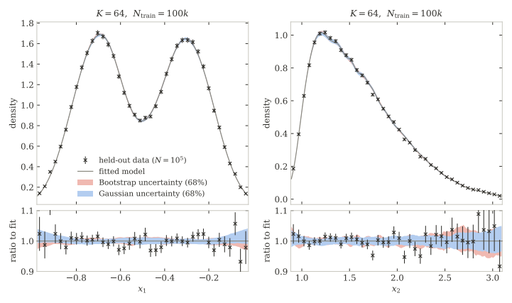
FIG. 4 .The marginal distribution of the two features in the 2D toy problem. The black crosses show the binned density evaluated with 10 5 held-out events. The solid line shows the marginals of a GMM withK= 64 components fit to Ntrain = 100,000 events, and the colorful envelopes are uncertainties corresponding to the calibration prescriptions of Sec. IV D. Specifically, the blue envelope corresponds to the propagated Gaussian uncertainties on the best-fit parameters, and the red envelope is obtained as the 0.16 and 0.84 quantiles of the refit models obtained using a parametric bootstrap.
원문 · CC BY 4.0 · Giada Badaracco, Sean Benevedes, Christina Reissel, Philip Harris, Gaia Grosso · An end-to-end framework for uncertainty-aware validation of generative models · 원문 그림 인용 · 원본 PDF 9쪽에서 그림 영역을 추출했습니다.점 귀무가설의 중앙 p-value는 N_test가 N_train/10 근처에서 악화되기 시작하고, N_test=N_train에서 0으로 붕괴합니다. Gaussian prescription 복합 귀무가설은 약 N_train/5까지 보정을 유지하지만 N_test=2N_train에서는 0.2 미만으로 떨어집니다. 부트스트랩 보정 복합 귀무가설은 모든 K에서 N_test=2N_train까지 보정을 유지합니다. 이 결과는 점 귀무가설이 충분하지 않으며, 최적화 변동과 비가우시안 산포를 포착하는 부트스트랩 보정이 N_test ≳ N_train 영역에서 필요함을 보여 줍니다.
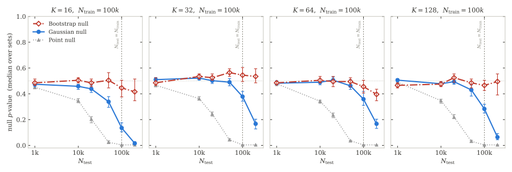
FIG. 5 .Closure test for the 2D toy problem.Median nullp-value for the three goodness-of-fit tests of Sec. IV C versus test-set sizeN test, forK= 16,32,64,128 (left to right) at fixedN train = 105. A calibrated test gives medianp= 0.5 (horizontal dotted line); the vertical dashed line marksN test =N train. Error bars are 68% confidence intervals on the median.
원문 · CC BY 4.0 · Giada Badaracco, Sean Benevedes, Christina Reissel, Philip Harris, Gaia Grosso · An end-to-end framework for uncertainty-aware validation of generative models · 원문 그림 인용 · 원본 PDF 10쪽에서 그림 영역을 추출했습니다.4차원 제트 임베딩의 QCD 배경 결과
4차원 제트 임베딩은 JetClass의 QCD 다중 제트를 포함해 SupCon 목표로 학습된 표현입니다. K=128, 256, 512의 GMM을 N_train=10^5로 적합하고, 점 귀무가설, Gaussian prescription 복합 귀무가설, 부트스트랩 보정 복합 귀무가설의 중앙 p-value를 비교합니다.
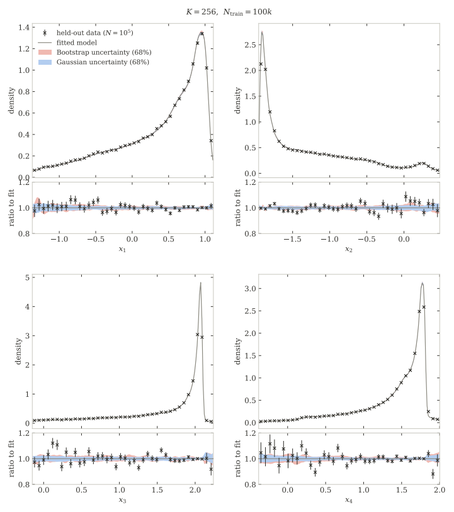
FIG. 8 .The marginal distribution of the four features in the 4D particle jets problem.The black crosses show the binned density evaluated with 10 5 held-out events. The solid line shows the marginals of a GMM withK= 256 components fit toN train = 100,000 events, and the colorful envelopes are uncertainties corresponding to the calibration prescriptions of Sec. IV D. Specifically, the blue envelope corresponds to the propagated Gaussian uncertainties on the best-fit parameters, and the red envelope is obtained as the 0.16 and 0.84 quantiles of the refit models obtained using a parametric bootstrap.
원문 · CC BY 4.0 · Giada Badaracco, Sean Benevedes, Christina Reissel, Philip Harris, Gaia Grosso · An end-to-end framework for uncertainty-aware validation of generative models · 원문 그림 인용 · 원본 PDF 12쪽에서 그림 영역을 추출했습니다.점 귀무가설은 N_test ∼ N_train/10 이전부터 악화됩니다. Gaussian prescription은 K≥256에서 N_test ∼ N_train/10까지 보정을 개선하고, 부트스트랩 보정은 K≥256에서 N_test=N_train/5까지 보정을 유지합니다. 다만 큰 N_test에서는 보정이 완전하지는 않지만 악화 정도가 줄어듭니다. K=128 모델은 다른 두 모델보다 나쁘며, 저자들은 이를 성분 수 부족에 따른 모형 편향의 해석으로 제시합니다. K=256과 512에서 가우시안과 부트스트랩 차이가 커지는 점은 점근 가정의 붕괴로 해석됩니다.
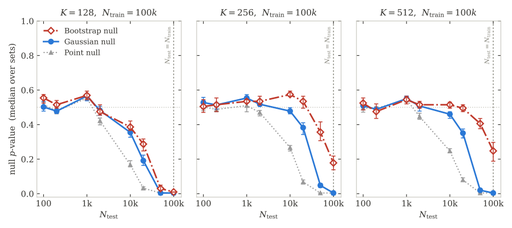
FIG. 9 .Closure test for the 4D particle jets problem.Median nullp-value for the three goodness-of-fit tests of Sec. IV C versus test-set sizeN test, forK= 128,256,512 (left to right) at fixedN train = 10 5. A calibrated test gives medianp= 0.5 (horizontal dotted line); the vertical dashed line marksN test =N train. Error bars are 68% confidence intervals on the median.
원문 · CC BY 4.0 · Giada Badaracco, Sean Benevedes, Christina Reissel, Philip Harris, Gaia Grosso · An end-to-end framework for uncertainty-aware validation of generative models · 원문 그림 인용 · 원본 PDF 13쪽에서 그림 영역을 추출했습니다.적용 범위와 한계
SIGMA는 가우시안 혼합 모델의 파라미터 수가 차원에 따라 빠르게 증가하므로 저차원 공간에 적합합니다. 원문은 고차원 데이터의 경우 요약 통계량으로 압축한 뒤 적용하는 것을 제안합니다. 또한 SIGMA는 통계적 변동만 다루며, 충분히 강력한 검정은 모델 편향으로 인해 충분히 큰 N_test에서 모델을 기각할 수 있습니다. 모델 선택 항목인 K와 Λ_max는 경험적으로 골라야 하며, 이를 확인하려면 보유 표본에서 보정 검사가 필요합니다. 부트스트랩 보정은 각 의사실험마다 재적합을 요구하므로 비용이 큽니다.
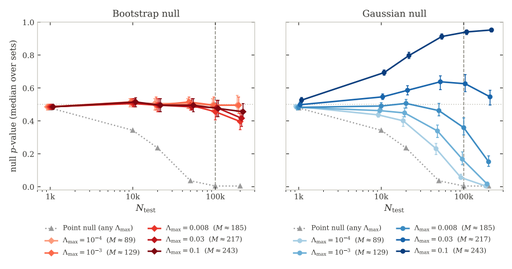
FIG. 14 . Λ max scan for the 2D case study .Median testp-value versusN test forK= 64 SIGMA with the bootstrap (left) and Gaussian (right) calibration prescription. The bootstrap calibration is largely robust to Λ max, while the results for the Gaussian calibration vary strongly with Λ max. Each shade corresponds to a different value of Λ max, and the point null is independent of this hyperparameter.
원문 · CC BY 4.0 · Giada Badaracco, Sean Benevedes, Christina Reissel, Philip Harris, Gaia Grosso · An end-to-end framework for uncertainty-aware validation of generative models · 원문 그림 인용 · 원본 PDF 23쪽에서 그림 영역을 추출했습니다.정규화 흐름 앙상블 부록에서는 가중치 불확실성만 전파하는 방식이 4차원 임베딩에서 점 귀무가설과 구분되지 않았습니다. 이 결과는 앙상블 가중치 공분산이 고정된 구성원의 재가중만 포착하여 생기는 한계로 해석됩니다. 이 부록 실험에서는 부트스트랩 보정을 수행하지 않았습니다.
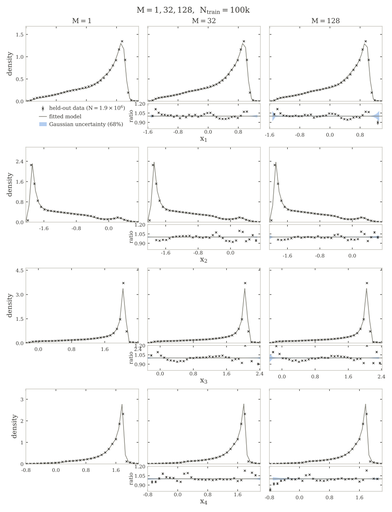
FIG. 11 . Four-dimensional jet embedding: fitted marginals ofx 1–x4 (rows) forM= 1,32,128 flows (columns), constructed as in Fig. 10; held-out dataN= 1.9×10 6. The fitted marginals deviate from the data around the sharp peaks, while the weight-uncertainty band remains negligible at everyM, so the propagated uncertainty does not cover the discrepancy.
원문 · CC BY 4.0 · Giada Badaracco, Sean Benevedes, Christina Reissel, Philip Harris, Gaia Grosso · An end-to-end framework for uncertainty-aware validation of generative models · 원문 그림 인용 · 원본 PDF 21쪽에서 그림 영역을 추출했습니다.논문 정보
- 저자
- Giada Badaracco, Sean Benevedes, Christina Reissel, Philip Harris, Gaia Grosso
- 학회·저널
- arXiv · 프리프린트
- 최초 공개일
- 2026년 10월 27일
- 등록일
- 2026년 11월 1일
- 수정일
- 2026년 10월 27일
- 버전
- v1
- arXiv
- 2610.37398
- 분류
- stat.ML · cs.LG · hep-ex · hep-ph
- 원문 이용 조건
- CC BY 4.0
- 제공 범위
- 논문 정보, 해설, 허용된 원문 그림
AI 해설은 논문 원문과 별개의 설명이며 오류가 있을 수 있습니다. 원문과 그림은 각 출처의 이용 조건과 따로 표시된 권리를 따릅니다.
초록
Density estimation with generative models is a common task in the physical sciences, for example in background estimation in particle physics. Existing machine learning techniques, however, lack methods to quantify uncertainties that can be propagated into a statistical test. That limits the validation of generative models to standard goodness-of-fit tests, in which the generative model is treated as exact (point-null hypothesis). But a model fitted to a finite training set is never exact, so if its uncertainties are neglected, any sufficiently powerful goodness-of-fit test will eventually reject it once the test set is large enough to resolve this estimation error. We propose SIGMA, an end-to-end framework combining density estimation with principled uncertainty quantification. We use Gaussian mixture models, for which uncertainties are tractable, and further construct a new goodness-of-fit test in which these uncertainties are profiled as nuisance parameters to account for the statistical error of the fit, promoting the conventional point-null test to a composite one. A rejection then signals genuine mismodeling rather than a test set large enough to resolve the error of the fit, provided the propagated uncertainties faithfully cover that error. We demonstrate the framework on a controlled two-dimensional toy model and on a collider physics benchmark modeling the QCD background process. With uncertainties included, the same model can be trusted on test sets up to an order of magnitude larger than the standard test allows. Our work thus provides a statistically grounded basis for a robust use of generative models in the physical sciences.
원문 인용
Giada Badaracco, Sean Benevedes, Christina Reissel, Philip Harris, Gaia Grosso (2026). An end-to-end framework for uncertainty-aware validation of generative models. arXiv:2610.37398v1. https://arxiv.org/abs/2610.37398v1
BibTeX
@misc{badaracco2026framework,
  title = {{An end-to-end framework for uncertainty-aware validation of generative models}},
  author = {Giada Badaracco and Sean Benevedes and Christina Reissel and Philip Harris and Gaia Grosso},
  year = {2026},
  eprint = {2610.37398},
  archivePrefix = {arXiv},
  url = {https://arxiv.org/abs/2610.37398v1}
}