논문 해설
MEG-XL: Data-Efficient Brain-to-Text via Long-Context Pre-Training
MEG-XL: 장문맥 pre-training을 통한 데이터 효율적인 뇌-텍스트 변환
- 연구 문제 마비 환자처럼 긴 학습 기록을 제공하기 어려운 임상 뇌-텍스트 해독에서는 적은 피험자 데이터로 일반화하는 pre-training이 중요합니다. MEG-XL은 2.5분 MEG 문맥으로 사전학습해 이 문제를 다룹니다.
- 연구 방법 MEG-XL은 동결된 BioCodec 토크나이저로 MEG 채널을 RVQ 토큰으로 바꾸고, criss-cross 트랜스포머에서 3초 블록 마스크 예측으로 학습합니다.
- 주요 결과 MEG-XL은 얕은 데이터 조건에서 지도학습 최신 방법과 기반 모델들을 앞서며, pre-training 문맥이 길수록 표현과 zero-shot 마스크 예측이 개선됩니다.
임상 뇌-텍스트 해석의 데이터 부족 문제
마비 환자는 긴 학습용 기록을 제공하기 어렵기 때문에, 임상용 뇌-텍스트 해독기는 적은 피험자 데이터로 일반화해야 합니다. 기존 pre-training은 피험자 간 통계적 사전 지식을 학습해 데이터 효율을 높일 수 있지만, 많은 방법이 수 초 정도의 짧은 문맥으로만 사전학습합니다. 저자들은 자연스러운 음성이 분 단위로 펼쳐지므로 이 짧은 문맥이 장거리 신경 구조를 놓친다고 주장합니다. 이 논문은 비침습 MEG에서 2.5분 문맥을 사용하는 pre-training이 단어 디코딩의 데이터 효율을 높이는지를 다룹니다.
MEG-XL의 토큰화와 마스크 예측 구조
MEG-XL은 각 MEG 채널을 동결된 BioCodec 토크나이저로 독립적으로 처리해 Q=6 잔차 벡터 양자화 레벨의 이산 토큰으로 바꿉니다. 이 토큰은 pre-training의 예측 목표가 됩니다. 입력 임베딩은 레벨별 코드북 벡터를 이어 붙이고 모델 차원으로 투영한 뒤, Gaussian Fourier 특징으로 센서 위치와 방향, 센서 종류 임베딩을 더해 구성합니다. 트랜스포머는 특징 차원을 반으로 나누어 시간 어텐션과 공간 어텐션을 병렬로 적용하는 criss-cross 구조입니다. 이렇게 하면 전체 어텐션의 이차 비용을 줄이면서 긴 시간 문맥을 모델링할 수 있습니다.
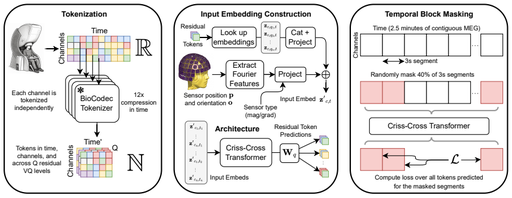
Figure 2 .Overview of the MEG-XL pre-training framework.(Left) A frozen BioCodec tokenizer independently encodes each MEG channel into discrete tokens across Q=6 residual quantization levels, providing prediction targets for self-supervised learning. (Middle) Token embeddings, which are concatenated across quantization levels and projected, are combined with sensor position, orientation, and type embeddings, then processed by a criss-cross transformer. A projection head maps transformer embeddings back to Q residual tokens. (Right) In pre-training, we randomly mask contiguous 3-second blocks uniformly across all sensors, forcing the model to predict masked tokens from temporal context rather than interpolating across channels, until 40% of tokens are masked.
원문 · CC BY 4.0 · Dulhan Jayalath, Oiwi Parker Jones · MEG-XL: Data-Efficient Brain-to-Text via Long-Context Pre-Training · 원문 그림 인용 · 원본 PDF 4쪽에서 그림 영역을 추출했습니다.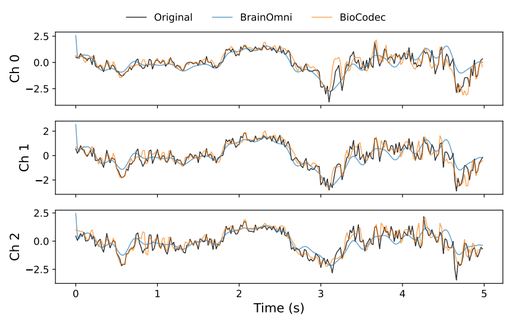
Figure 8 .BioCodec vs BrainTokenizer (originating from BrainOmni). BioCodec reconstructs signals with lower reconstruction error (MSE of 0.41 vs 0.69). The plot shows a preprocessed 5-second sample taken from the MOUS dataset at 50Hz across three channels.
원문 · CC BY 4.0 · Dulhan Jayalath, Oiwi Parker Jones · MEG-XL: Data-Efficient Brain-to-Text via Long-Context Pre-Training · 원문 그림 인용 · 원본 PDF 18쪽에서 그림 영역을 추출했습니다.pre-training은 시간 블록 마스킹으로 수행됩니다. 3초 블록을 모든 센서에 같은 시점으로 가려 전체 시퀀스의 40%를 마스크하고, 마스크된 위치의 RVQ 토큰을 교차 엔트로피로 예측합니다. 저자들은 채널 간 보간을 막고 긴 시간 관계를 학습하도록 이렇게 설계했다고 설명합니다.
단어 디코딩 과제와 비교 설정
사전학습된 모델은 end-to-end로 미세조정되어 문맥적 단어 디코딩에 사용됩니다. 50개 단어 시퀀스에서 각 단어 시작 0.5초 전부터 3초 창을 이어 붙여 150초 입력을 만들고, MLP 헤드가 T5 단어 임베딩을 예측하면 최근접 이웃 검색으로 단어를 찾습니다. 평가 지표는 고정된 검색 어휘에서 계산한 top-10 균형 정확도입니다.
평가 데이터는 27명이 각 2시간씩 청취한 MEG-MASC, 3명이 각 10시간씩 청취한 Armeni, 한 피험자가 52시간 청취한 LibriBrain입니다. 비교 대상은 d’Ascoli et al. (2025)의 지도학습 방법과 여섯 기반 모델입니다. 기반 모델 비교는 13%와 100% 학습 데이터 조건에서 수행되었고, 표의 불확실성은 세 시드의 표준 오차입니다.
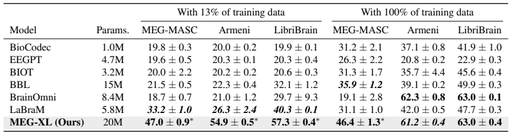
Table 1 .Comparison to Foundation Models.We end-to-end fine-tune all models for word decoding, with individual details on fine-tuning provided in Appendix A.3. The quoted uncertainty is the standard error of the mean over three seeds. Best results are indicated inboldand second-best inbold-italic. Results with ∗ indicate the best result beats the second-best withp < .05(with Welch’st-test).
원문 · CC BY 4.0 · Dulhan Jayalath, Oiwi Parker Jones · MEG-XL: Data-Efficient Brain-to-Text via Long-Context Pre-Training · 원문 그림 인용 · 원본 PDF 5쪽에서 그림 영역을 추출했습니다.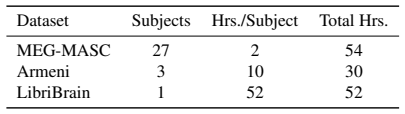
Table 2 .Evaluation datasets.The three datasets span different regimes: shallow multi-subject (MEG-MASC), deep single-subject (LibriBrain), and somewhere in-between (Armeni).
원문 · CC BY 4.0 · Dulhan Jayalath, Oiwi Parker Jones · MEG-XL: Data-Efficient Brain-to-Text via Long-Context Pre-Training · 원문 그림 인용 · 원본 PDF 5쪽에서 그림 영역을 추출했습니다.데이터 양에 따른 결과
학습 데이터 양을 바꾸며 MEG-XL과 d’Ascoli et al. (2025)의 지도학습 방법을 비교하면, MEG-XL은 얕은 다중 피험자 데이터에서 우세합니다. MEG-MASC에서는 여러 지점에서 25% 이상 향상되고 54시간 전체 구간에서 이점이 유지된다고 보고됩니다. Armeni에서는 약 15시간까지 지도학습보다 약 10% 높은 정확도를 보입니다. 반면 깊은 단일 피험자 데이터인 LibriBrain에서는 약 2.5시간 이후 지도학습 방법이 앞섭니다. 무작위 초기화 MEG-XL과의 비교는 성능 이득이 아키텍처만이 아니라 사전학습된 사전 지식에서 온다는 대조군입니다.
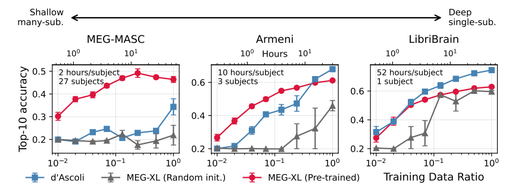
Figure 3 .Pre-training enables generalisation with less subject data.We compare MEG-XL to the state-of-the-art supervised method (d’Ascoli et al., 2025) and a baseline trained from scratch (MEG-XL with random init.) across varying amounts of fine-tuning data. MEG-XL consistently outperforms its randomly initialised counterpart, confirming that the gains stem from learned priors rather than architecture alone. On Armeni and MEG-MASC, where per-subject data is shallower, MEG-XL outperforms d’Ascoli et al. (2025) throughout most of the data range. On LibriBrain, a deep single-subject dataset, both methods perform similarly until approximately 2.5 hours of training data, after which their supervised method pulls ahead. This suggests pre-training may substitute for subject-specific data as when recordings are scarce, learned priors help. In rare cases where recordings are abundant, learning from scratch eventually wins.
원문 · CC BY 4.0 · Dulhan Jayalath, Oiwi Parker Jones · MEG-XL: Data-Efficient Brain-to-Text via Long-Context Pre-Training · 원문 그림 인용 · 원본 PDF 6쪽에서 그림 영역을 추출했습니다.pre-training 문맥 길이와 표현 품질
pre-training 문맥을 늘리면서 백본을 고정하고 선형 프로브로 단어 임베딩을 예측하면, 더 긴 pre-training 문맥이 더 나은 표현을 보입니다. 이 실험에서 full context 조건은 모든 모델에 150초 입력을 주어 표현 품질을 분리하고, matched context 조건은 입력을 pre-training 길이로 제한합니다. 두 선의 차이가 작다는 점은 추론 시 문맥이 pre-training에서 쓰이지 않은 능력을 자동으로 제공하지 않는다는 저자의 해석으로 이어집니다. 개선은 약 100초 이후 체감이 줄어든다고 보고됩니다. 선형 프로브 학습에는 학습 데이터의 7%를 사용합니다.
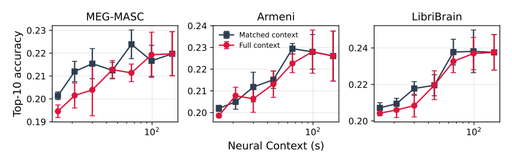
Figure 4 .Linear probing shows that models pre-trained with more context generalise better to word decoding.We pre-train models with increasing context, fixed masking percentage, and constant optimisation steps, then evaluate the strength of their representations with linear probes (frozen backbone). We compare two conditions:full context, where all models see 150s of input to isolate representation quality, andmatched context, where the input is restricted to the pre-training length. The lack of divergence between the lines suggests models cannot leverage inference context that exceeds their pre-training context. We train the linear probes with 7% of the training data. We could not expand further than 150s due to GPU memory limits. Token-matched pre-training shows similar trends (Appendix D).
원문 · CC BY 4.0 · Dulhan Jayalath, Oiwi Parker Jones · MEG-XL: Data-Efficient Brain-to-Text via Long-Context Pre-Training · 원문 그림 인용 · 원본 PDF 7쪽에서 그림 영역을 추출했습니다.마스크 예측과 주의 패턴 해석
같은 pre-training 문맥 확장은 unseen 데이터셋에서 중앙 3초를 가린 zero-shot 마스크 예측에도 적용되었습니다. 이 평가에서 개선은 150초까지 이어지며, 저자들은 이를 단어 디코딩 선형 프로빙의 포화와 구분해 과제마다 필요한 문맥 정보가 다르다는 해석을 제시합니다. 주의 분석에서는 긴 문맥으로 사전학습한 모델이 초기 층에서 국소적으로 주의하고 깊은 층에서 점차 먼 시점을 통합하며, 주의 엔트로피가 낮아진다고 보고됩니다. 이 분석은 주의 패턴의 관찰이며, 그 패턴이 곧 과제 성능의 원인이라는 증명은 아닙니다.
적용 범위와 남은 제약
본 논문은 perceived speech를 기준으로 하며, 50단어 어휘에서 평가했다는 점에서 적용 범위가 제한됩니다. 원문은 어휘가 커질수록 성능이 감소한다고 보고하며, 부록의 top-250 검색 결과에서도 같은 경향이 나타납니다. 또한 깊은 단일 피험자 데이터에서는 지도학습 방법이 더 나은 결과를 보이므로, pre-training의 이점은 피험자 데이터가 얕은 상황에 더 가깝습니다.
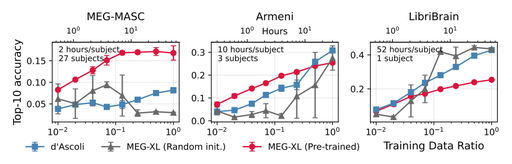
Figure 6 .Generalisation Across Training Data Regimes (Top 250 Words as Retrieval Set).Results in the main paper use top-50 word retrieval sets. As expected, trends with top-250 word retrieval remain the same with the larger vocabulary leading to degraded performance across all methods. See the caption in Figure 3 for details.
원문 · CC BY 4.0 · Dulhan Jayalath, Oiwi Parker Jones · MEG-XL: Data-Efficient Brain-to-Text via Long-Context Pre-Training · 원문 그림 인용 · 원본 PDF 14쪽에서 그림 영역을 추출했습니다.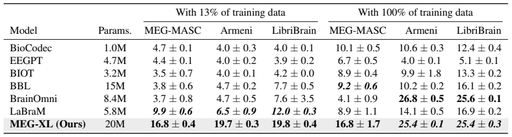
Table 4 .Comparison to Foundation Models (Top 250 Words as Retrieval Set).See the caption in Table 1 for details.
원문 · CC BY 4.0 · Dulhan Jayalath, Oiwi Parker Jones · MEG-XL: Data-Efficient Brain-to-Text via Long-Context Pre-Training · 원문 그림 인용 · 원본 PDF 16쪽에서 그림 영역을 추출했습니다.100Hz 재표본화로 Nyquist 기준을 맞춘 실험에서는 GPU 메모리 제약 때문에 문맥을 75초로 줄여야 했고, 이 설정의 정확도는 50Hz 설정보다 낮게 보고됩니다. 따라서 임상 적용은 아직 먼 단계이며, 상상 발화와 환자 집단으로의 확장은 원문에서 남은 과제로 제시됩니다.

Table 5 .Nyquist-compliant resampling results.Resampling to 100Hz avoids aliasing by respecting the Nyquist criterion (resampling frequency≥2×low-pass filter frequency). However, it requires reducing context length to 75s due to GPU VRAM constraints.
원문 · CC BY 4.0 · Dulhan Jayalath, Oiwi Parker Jones · MEG-XL: Data-Efficient Brain-to-Text via Long-Context Pre-Training · 원문 그림 인용 · 원본 PDF 16쪽에서 그림 영역을 추출했습니다.논문 정보
- 저자
- Dulhan Jayalath, Oiwi Parker Jones
- 학회·저널
- arXiv · 프리프린트
- 최초 공개일
- 2026년 2월 2일
- 등록일
- 2026년 10월 29일
- 수정일
- 2026년 5월 9일
- 버전
- v2
- arXiv
- 2602.02494
- 분류
- cs.LG · q-bio.NC
- 원문 이용 조건
- CC BY 4.0
- 제공 범위
- 논문 정보, 해설, 허용된 원문 그림
AI 해설은 논문 원문과 별개의 설명이며 오류가 있을 수 있습니다. 원문과 그림은 각 출처의 이용 조건과 따로 표시된 권리를 따릅니다.
초록
Clinical brain-to-text interfaces are designed for paralysed patients who cannot provide extensive training recordings. Pre-training improves data-efficient generalisation by learning statistical priors across subjects, but these priors critically depend on context. While natural speech might unfold gradually over minutes, most methods pre-train with only a few seconds of context. Thus, we propose MEG-XL, a model pre-trained with 2.5 minutes of MEG context per sample, 5-300x longer than prior work, and equivalent to 191k tokens, capturing extended neural context. Fine-tuning on the task of word decoding from brain data, MEG-XL matches supervised performance with a fraction of the data (e.g. 1hr vs 50hrs) and outperforms brain foundation models. We find that models pre-trained with longer contexts learn representations that transfer better to word decoding. Our results indicate that long-context pre-training helps exploit extended neural context that other methods unnecessarily discard. Code, model weights, and instructions are available at https://github.com/neural-processing-lab/MEG-XL .
원문 인용
Dulhan Jayalath, Oiwi Parker Jones (2026). MEG-XL: Data-Efficient Brain-to-Text via Long-Context Pre-Training. arXiv:2602.02494v2. https://arxiv.org/abs/2602.02494v2
BibTeX
@misc{jayalath2026data,
  title = {{MEG-XL: Data-Efficient Brain-to-Text via Long-Context Pre-Training}},
  author = {Dulhan Jayalath and Oiwi Parker Jones},
  year = {2026},
  eprint = {2602.02494},
  archivePrefix = {arXiv},
  url = {https://arxiv.org/abs/2602.02494v2}
}