논문 해설
Privately Fine-Tuned LLMs Preserve Temporal Dynamics in Tabular Data
차분 프라이버시로 미세 조정된 LLM은 표 형식 데이터의 시간적 동역학을 보존한다
- 연구 문제 사용자 단위 시계열 표를 기존 행 기반 주변분포 방법으로 합성하면 시간적 순서가 손상되고 차원이 커지는 문제가 있습니다.
- 연구 방법 사용자 표를 직렬화하여 DP-SGD와 LoRA로 미세조정한 Gemma 3 모델이 행을 자기회귀적으로 생성하는 PATH를 제안합니다.
- 주요 결과 MIMIC-IV에서 ε=2.0일 때 PATH(Gemma 4B)의 TDCR은 AIM의 0.736보다 낮은 0.289입니다.
사용자 단위 시계열 표를 합성하는 어려움
전자건강기록처럼 한 사용자가 여러 행의 순서열로 이루어진 표를 가지는 데이터는 기존의 독립동일분포(i.i.d.) 행 가정과 맞지 않습니다. 기존 주변분포 기반 개인 전용 합성 방법을 이런 데이터에 적용하려면 사용자 표를 고정 길이 벡터로 평탄화해야 하며, 이 과정에서 차원이 크게 늘고 인접 시점 사이의 순서 정보가 잘 보존되지 않습니다. 이 절은 이러한 문제 설정과 평탄화의 한계를 설명합니다. 사용자 단위 개인 정보 보호에서 개인의 전체 표가 하나의 인접 단위로 취급됩니다.
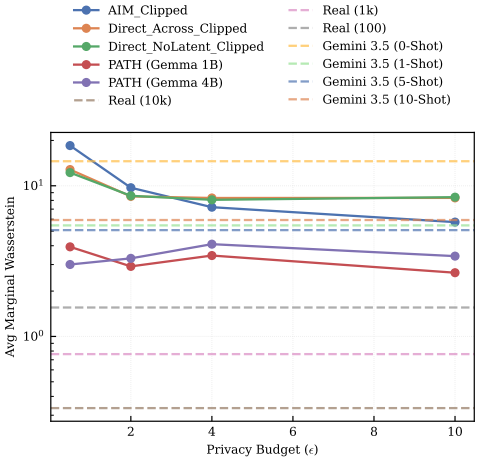
Figure 12 :Preservation of univariate marginals.Despite being an autoregressive model, Gemma 4B (bottom lines) surprisingly outperforms marginal-based mechanisms on column-wise fidelity, maintaining Wasserstein distances below 4.0 across all budgets. The flattened marginal baselines struggle here, likely due to the high dimensionality introduced by padding all trajectories to a fixed length, which dilutes the privacy budget available for individual column measurements.
원문 · CC BY 4.0 · Rosenblatt, Lucas, Liu, Peihan, McKenna, Ryan, Ponomareva, Natalia · Privately Fine-Tuned LLMs Preserve Temporal Dynamics in Tabular Data · 원문 그림 인용 · 원본 PDF 32쪽에서 그림 영역을 추출했습니다.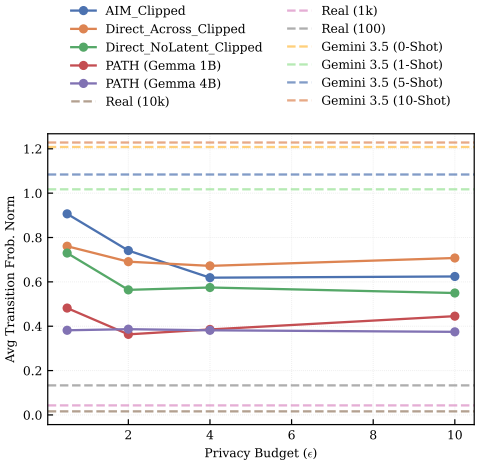
Figure 13 :Temporal dynamics preservation.This metric measures the error in the conditional probability of state transitions (e.g., P(vital t |vital t−1)). The Gemma family (1B and 4B) consistently yields lower error rates (≈0.38−0.48 ) compared to AIM and Direct mechanisms ( >0.60 ). This confirms that the LLM’s autoregressive objective naturally aligns with the task of preserving sequential dependencies, whereas marginal methods struggle to capture these time-variant correlations.
원문 · CC BY 4.0 · Rosenblatt, Lucas, Liu, Peihan, McKenna, Ryan, Ponomareva, Natalia · Privately Fine-Tuned LLMs Preserve Temporal Dynamics in Tabular Data · 원문 그림 인용 · 원본 PDF 33쪽에서 그림 영역을 추출했습니다.PATH의 직렬화와 DP fine-tuning
PATH는 각 사용자의 표를 스키마 정의와 행 구분 토큰을 포함한 토큰 시퀀스로 직렬화하고, pre-training Gemma 3 모델을 LoRA와 DP-SGD로 미세조정합니다. 학습 예시는 사용자별 문맥과 이어지는 행의 쌍으로 만들고, 각 사용자는 에포크마다 정확히 하나의 예시를 기여하도록 강제됩니다. 생성 시에는 스키마와 이전에 생성된 행을 조건으로 다음 행을 한 번에 하나씩 만듭니다. 생성된 후보는 Gecko 임베딩 공간에서 개인 전용 투표로 최종 선택됩니다.
MIMIC-IV에서의 비교 결과
MIMIC-IV 활력 징후 데이터에서 ε=2.0일 때 AIM의 TDCR은 0.736이고 PATH(Gemma 4B)의 TDCR은 0.289입니다. 같은 실험에서 AIM은 평탄화된 데이터에 적용되었습니다. 비공개 Gemini 2.5 Flash-Lite의 10-shot 프롬프팅은 MAUVE 0.269에 머물렀습니다. 이 수치들은 특정 데이터셋과 설정에서의 결과이며, 다른 데이터나 과제로 일반화하려면 별도의 확인이 필요합니다.
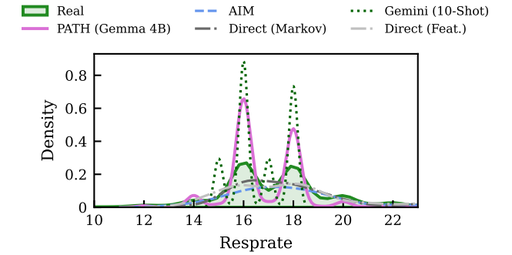
Figure 4 :Univariate Density Analysis (Respiratory Rate, MIMIC-IV).We compare the marginal density of respiratory rate distributions across methods at ε= 2.0 . While marginal-based baselines (AIM, Direct) achieve reasonable Wasserstein scores by broadly covering the support, they suffer from quantization smoothing and noise artifacts that obscure the data’s natural shape. In contrast, PATH closely tracks the sharp modal peaks and specific skew of the real distribution (shaded green), demonstrating thatPATHcan preserve fine-grained univariate trends.
원문 · CC BY 4.0 · Rosenblatt, Lucas, Liu, Peihan, McKenna, Ryan, Ponomareva, Natalia · Privately Fine-Tuned LLMs Preserve Temporal Dynamics in Tabular Data · 원문 그림 인용 · 원본 PDF 8쪽에서 그림 영역을 추출했습니다.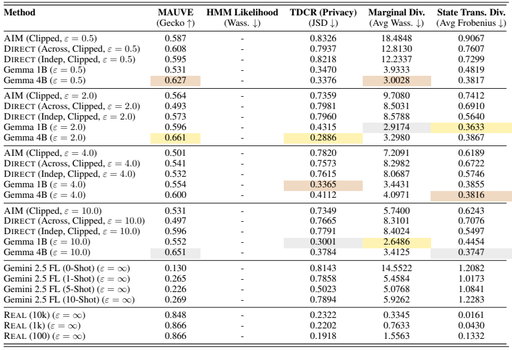
Table 8 Comprehensive Summary of Metrics on MIMIC-IV .We report the performance ofPATH (Gemma 1B/4B) against marginal baselines and non-private reference points across four privacy regimes. Beyond the results already reported in the main body of the paper, we observe a distinct degradation pattern in the marginal baselines: AIM’s marginal divergence explodes at ε= 0.5 (18.48), whereas PATH remains remarkably stable (≈3.0 ), suggesting the LLM’s pre-trained priors provide robustness when the privacy signal is weak. Additionally, comparing the “Real (100)” subsample to our synthetic results reveals that for distributional metrics like TDCR, our privately fine-tuned models (≈0.28−0.40) are approaching the natural variance observed between small subsamples of real data (≈0.19).
원문 · CC BY 4.0 · Rosenblatt, Lucas, Liu, Peihan, McKenna, Ryan, Ponomareva, Natalia · Privately Fine-Tuned LLMs Preserve Temporal Dynamics in Tabular Data · 원문 그림 인용 · 원본 PDF 23쪽에서 그림 영역을 추출했습니다.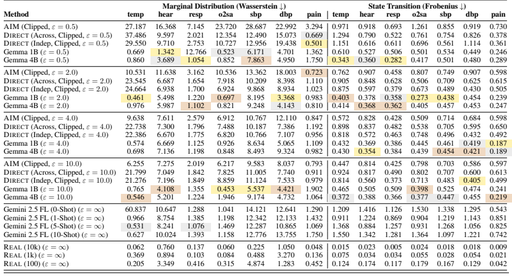
Table 9 Feature-wise Breakdown of Marginal and Temporal Fidelity (MIMIC-IV).This table decomposes the aggregate scores into per-feature Wasserstein and Frobenius errors. PATH maintains low transition errors acrossall features. Note that while AIM struggles with transition dynamics generally, it is particularly poor at capturing the stability of ordinal features likepain, wherePATH(Gemma 4B) reduces the error by over 50%.
원문 · CC BY 4.0 · Rosenblatt, Lucas, Liu, Peihan, McKenna, Ryan, Ponomareva, Natalia · Privately Fine-Tuned LLMs Preserve Temporal Dynamics in Tabular Data · 원문 그림 인용 · 원본 PDF 24쪽에서 그림 영역을 추출했습니다.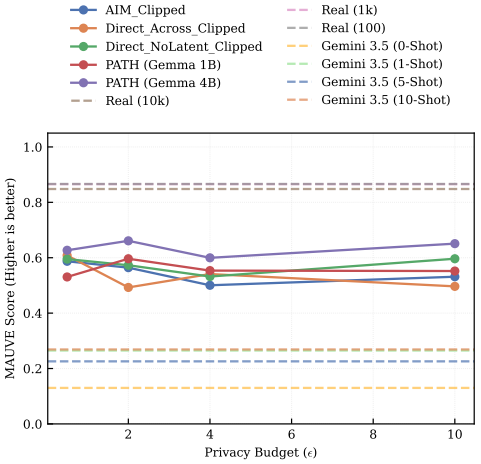
Figure 10 :Distributional fidelity on MIMIC-IV .The Gemma 4B model (top blue line) consistently achieves the highest MAUVE scores across all privacy budgets, peaking at0.690 for ε= 10 . Notably, private fine-tuning significantly outperforms the non-private Gemini 2.5 FL baselines (dashed horizontal lines), which fail to exceed 0.30 even with 10-shot prompting. This illustrates that parameter-efficient fine-tuning is far more effective than in-context learning for capturing the complex manifold of clinical trajectories.
원문 · CC BY 4.0 · Rosenblatt, Lucas, Liu, Peihan, McKenna, Ryan, Ponomareva, Natalia · Privately Fine-Tuned LLMs Preserve Temporal Dynamics in Tabular Data · 원문 그림 인용 · 원본 PDF 30쪽에서 그림 영역을 추출했습니다.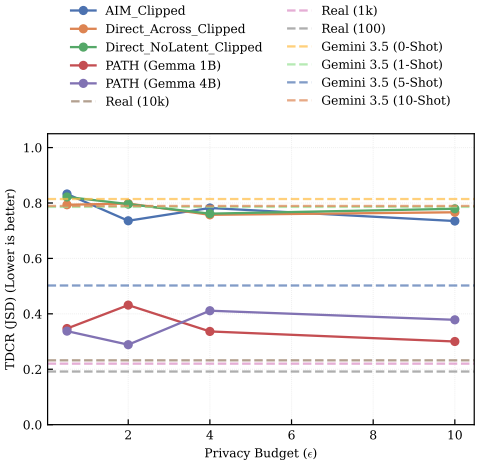
Figure 11 :Distance to closest record analysis.A lower TDCR score indicates generated tables are structurally similar to real user trajectories without being identical. The marginal-based baselines (AIM and Direct) exhibit high error rates (>14.0 ) that degrade sharply as ε decreases, reflecting the failure of “flattening” strategies to model user-level coherence. In contrast, Gemma 4B maintains a low, stable distance ( ≈3.9 to 7.1) even at ε= 0.5 , demonstrating superior robustness to noise.
원문 · CC BY 4.0 · Rosenblatt, Lucas, Liu, Peihan, McKenna, Ryan, Ponomareva, Natalia · Privately Fine-Tuned LLMs Preserve Temporal Dynamics in Tabular Data · 원문 그림 인용 · 원본 PDF 31쪽에서 그림 영역을 추출했습니다.합성 HMM 데이터의 예외와 해석
합성 HMM 데이터에서는 주변분포 기반 기준선이 Gemma 기반 방법보다 높은 MAUVE를 보였습니다. 저자들은 이 데이터가 잘 정의된 구조를 가져 PGM 기반 기준선에 유리했기 때문이라고 해석합니다. 이 해석은 저자의 가설이며, 이 실험에서 얻은 결과가 모든 데이터에서 PATH의 우위를 뜻하지 않는다는 점을 함께 읽어야 합니다.
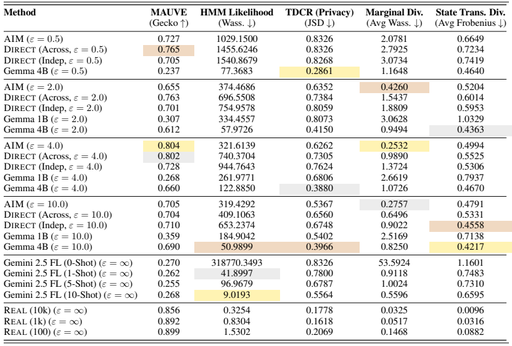
Table 10 Comprehensive Summary of Metrics on Synthetic HMM Data.This table highlights the utility trade-off between marginal precision and temporal logic. Unsurprisingly,AIM achieves the lowest univariate marginal divergence scores (≈0.25 at ε= 4.0 ). However, AIM’s HMM Likelihood scores remain prohibitively high (>300 ), indicating the generation of impossible trajectories. We also observe a significant performance gap between Gemma 1B and 4B here that is wider than in the MIMIC experiments; the 1B model struggles to capture the latent HMM states (Likelihood 261.9 vs. 122.8 at ε= 4.0 ). This is likely because, for the MIMIC and 311 type data, the 1B model has analogous examples from its training data. As this data is fully synthetic with nonsense column names, processing it relies solely on the models reasoning ability coupled with its ability to generalize a prior over tabular data to unseen/unfamiliar domains.
원문 · CC BY 4.0 · Rosenblatt, Lucas, Liu, Peihan, McKenna, Ryan, Ponomareva, Natalia · Privately Fine-Tuned LLMs Preserve Temporal Dynamics in Tabular Data · 원문 그림 인용 · 원본 PDF 25쪽에서 그림 영역을 추출했습니다.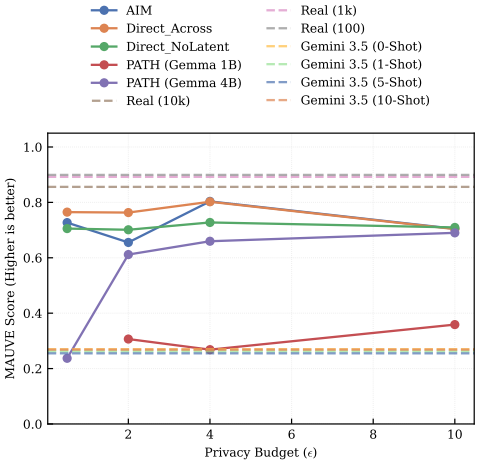
Figure 15 :Distributional fidelity on Synthetic data.In this controlled setting, the marginal-based AIM algorithm (top lines) outperforms the LLM-based approaches, achieving MAUVE scores between 0.72 and 0.79. This reversal suggests that for simpler, strictly structured data where the manifold is well-defined by independent components, marginal measurements can be more efficient than learning the distribution via next-token prediction.
원문 · CC BY 4.0 · Rosenblatt, Lucas, Liu, Peihan, McKenna, Ryan, Ponomareva, Natalia · Privately Fine-Tuned LLMs Preserve Temporal Dynamics in Tabular Data · 원문 그림 인용 · 원본 PDF 35쪽에서 그림 영역을 추출했습니다.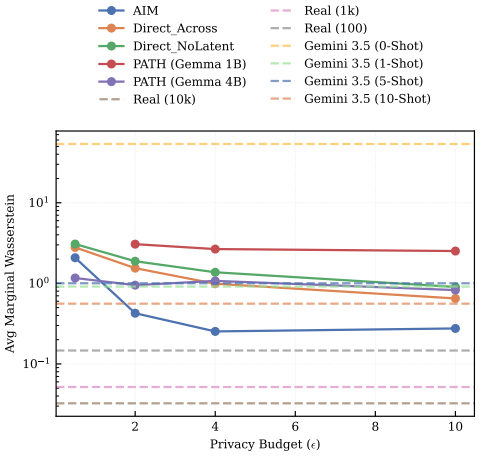
Figure 18 :Column-wise accuracy.Consistent with the MAUVE results for this dataset, AIM achieves the lowest Marginal Distance (≈0.23−0.26 for ε≥4 ), beating Gemma 4B (≈0.8−1.1 ). This confirms that when the data generation process is simple and columns have strong independent signals, marginal-based mechanisms utilize the privacy budget more efficiently for univariate statistics.
원문 · CC BY 4.0 · Rosenblatt, Lucas, Liu, Peihan, McKenna, Ryan, Ponomareva, Natalia · Privately Fine-Tuned LLMs Preserve Temporal Dynamics in Tabular Data · 원문 그림 인용 · 원본 PDF 38쪽에서 그림 영역을 추출했습니다.논문 정보
- 저자
- Rosenblatt, Lucas, Liu, Peihan, McKenna, Ryan, Ponomareva, Natalia
- 학회·저널
- arXiv · 프리프린트
- 최초 공개일
- 2026년 2월 2일
- 등록일
- 2026년 10월 30일
- 수정일
- 2026년 2월 2일
- 버전
- v1
- arXiv
- 2602.02766
- 원문 이용 조건
- CC BY 4.0
- 제공 범위
- 논문 정보, 해설, 허용된 원문 그림
AI 해설은 논문 원문과 별개의 설명이며 오류가 있을 수 있습니다. 원문과 그림은 각 출처의 이용 조건과 따로 표시된 권리를 따릅니다.
초록
Research on differentially private synthetic tabular data has largely focused on independent and identically distributed rows where each record corresponds to a unique individual. This perspective neglects the temporal complexity in longitudinal datasets, such as electronic health records, where a user contributes an entire (sub) table of sequential events. While practitioners might attempt to model such data by flattening user histories into high-dimensional vectors for use with standard marginal-based mechanisms, we demonstrate that this strategy is insufficient. Flattening fails to preserve temporal coherence even when it maintains valid marginal distributions. We introduce PATH, a novel generative framework that treats the full table as the unit of synthesis and leverages the autoregressive capabilities of privately fine-tuned large language models. Extensive evaluations show that PATH effectively captures long-range dependencies that traditional methods miss. Empirically, our method reduces the distributional distance to real trajectories by over 60% and reduces state transition errors by nearly 50% compared to leading marginal mechanisms while achieving similar marginal fidelity.
원문 인용
Rosenblatt, Lucas, Liu, Peihan, McKenna, Ryan, Ponomareva, Natalia (2026). Privately Fine-Tuned LLMs Preserve Temporal Dynamics in Tabular Data. arXiv:2602.02766v1. https://arxiv.org/abs/2602.02766v1
BibTeX
@misc{lucas2026privately,
  title = {{Privately Fine-Tuned LLMs Preserve Temporal Dynamics in Tabular Data}},
  author = {Rosenblatt, Lucas and Liu, Peihan and McKenna, Ryan and Ponomareva, Natalia},
  year = {2026},
  eprint = {2602.02766},
  archivePrefix = {arXiv},
  url = {https://arxiv.org/abs/2602.02766v1}
}