논문 해설
Sparse Spectral Training and Inference on Euclidean and Hyperbolic Neural Networks
유클리드 및 쌍곡 신경망에서의 희소 스펙트럴 학습과 추론
- 연구 문제 기존 저랭크 방법은 pre-training에서 저랭크 부분공간 제약과 병합 후 saddle point 문제로 full-rank 학습과 차이가 납니다.
- 연구 방법 SST는 가중치를 SVD로 분해해 모든 특이값을 매 step 갱신하고, 다항 샘플링으로 고른 특이벡터만 갱신하며, 주기적으로 re-SVD를 수행합니다.
- 주요 결과 실험한 기계 번역과 언어 모델 설정에서 SST는 다른 저랭크 방법보다 높은 BLEU 또는 낮은 perplexity를 보였고, LLaMA-1.3B에서 perplexity gap을 97.4% 줄였습니다.
pre-training 메모리 절감의 한계
대규모 언어 모델을 처음부터 학습하는 일은 모든 파라미터를 갱신하는 full-rank 학습에 큰 GPU 메모리를 요구합니다. LoRA는 학습 가능한 저랭크 행렬 BA를 더해 갱신량 ΔW를 표현하여 메모리를 줄이지만, 저랭크 부분공간으로 갱신을 제한하므로 pre-training처럼 σi가 무시할 수 없는 상황에서는 full-rank 수준의 성능을 맞추기 어렵다고 설명됩니다. ReLoRA와 COLA, PLoRA는 저랭크 행렬을 주기적으로 기본 가중치에 병합하여 이 제약을 완화하지만, 병합 직후 저랭크 행렬의 gradient가 0에 가까워지는 saddle point 문제가 남습니다. 이 논문은 이러한 배경에서 메모리를 줄이면서도 full-rank 학습의 학습 동역학에 더 가깝게 머무는 방법을 다룹니다.
SST의 SVD 기반 분해와 특이값 갱신
Sparse Spectral Training(SST)은 선형층의 가중치 W를 SVD로 분해하여 U, Σ, V^T를 full rank로 사용하고, 원래 가중치 W는 네트워크에서 제거합니다. 이때 출력은 h = UΣV^Tx로 계산됩니다. 학습 중에는 Σ의 모든 특이값을 매 step 갱신하며, 갱신식은 Σ_{t+1} = max(Σ_t − η∇L_Σ, 0)입니다. 이 식에서 max 함수는 특이값을 0 이상으로 유지하는 하한 역할을 합니다. U와 V^T는 전부 갱신하지 않고, 특이값 크기에 가중된 다항 샘플링으로 r개의 인덱스를 골라 해당 열만 갱신합니다. 갱신된 열은 단위 노름으로 정규화되어 크기 정보는 Σ에 남습니다.
저자들은 이 구조가 랭크 r 부분공간으로 갱신을 제한하지 않으면서도 매 step의 갱신 범위를 줄이는 선택이라고 설명합니다.
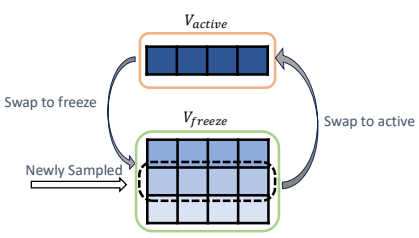
Figure 3 : Illustration of the memory-efficient implemen- tation for SST. After each sampling step, the sampled vec- tors are swapped with the active vectors from the previous iteration.
원문 · CC BY 4.0 · Jialin Zhao, Yingtao Zhang, Xinghang Li, Huaping Liu, Carlo Vittorio Cannistraci · Sparse Spectral Training and Inference on Euclidean and Hyperbolic Neural Networks · 원문 그림 인용 · 원본 PDF 6쪽에서 그림 영역을 추출했습니다.주기적 re-SVD와 직교성 유지
U와 V^T의 열은 학습이 진행될수록 직교성이 약해질 수 있으므로, SST는 일정 주기마다 UΣV^T를 다시 SVD로 분해합니다. 이 재분해는 새 라운드의 초기값을 만들며, 저자들은 이를 통해 학습이 저랭크 부분공간으로 퇴화하는 것을 막는다고 설명합니다. 반복 단위는 두 가지입니다. 샘플링으로 인덱스를 고르는 단위는 iteration이고, 재분해를 수행하는 단위는 round입니다. 구현에서 T3는 iteration 간격을, T2는 라운드당 iteration 수를 정하며 T2는 d/r로 계산됩니다.
gradient 동역학과 saddle point 완화
ReLoRA*에서는 병합 뒤 B가 0으로 재초기화되므로 ∂L/∂A = 0^T ∂L/∂W = 0이 되어 각 iteration 초기에 학습이 느려집니다. 원문은 이를 saddle point 문제로 설명합니다. 이 현상을 확인하기 위해 저자들은 Transformer, dimension 64, r=8, IWSLT’14 설정에서 처음 2000 step의 gradient Frobenius norm을 비교했습니다. SST와 ReLoRA*의 iteration 간격은 모두 200입니다. 측정된 상관계수는 SST와 full-rank 사이 0.85, ReLoRA*와 full-rank 사이 0.58입니다. 이 결과는 해당 설정에서 SST의 gradient norm 곡선이 full-rank 곡선에 더 가깝다는 관찰이며, 다른 모델이나 학습 길이에서 같은 일반성을 보였다는 뜻은 아닙니다.
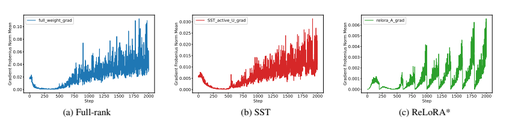
Figure 2 : ReLoRA* suffers saddle point issue at each restart. This plot depicts the average Frobenius Norm of gradients of: (a) all weight matrices in full-rank training; (b) all sampled U in SST; (c) all A in ReLoRA*, in first 2000 steps. All methods are trained on Transformer with dimension = 64, r = 8 on IWSLT’14. Both SST and ReLoRA* set iteration interval to 200. When the average Frobenius Norm of gradients approaches zero, it indicates that a saddle point issue happens. Figure (c) shows that ReLoRA* suffers saddle point issue periodically at the beginning of each iteration. The correlation between SST and full-rank gradient norm along the steps is 0.85, whereas the correlation between ReLoRA* and full-rank is 0.58. This demonstrates that the gradient curve of SST more closely approximate the gradient curve of full-rank training, compared with ReLoRA*.
원문 · CC BY 4.0 · Jialin Zhao, Yingtao Zhang, Xinghang Li, Huaping Liu, Carlo Vittorio Cannistraci · Sparse Spectral Training and Inference on Euclidean and Hyperbolic Neural Networks · 원문 그림 인용 · 원본 PDF 5쪽에서 그림 영역을 추출했습니다.기계 번역에서의 BLEU 비교
기계 번역 실험은 IWSLT’14 English-to-German 데이터셋에서 Euclidean Transformer와 hyperbolic Transformer를 대상으로 수행되었으며, 평가 지표는 BLEU입니다. Euclidean Transformer에서 SST는 다른 저랭크 방법보다 일관되게 높은 BLEU를 보였고, 저자들은 full-rank 대비 BLEU gap을 평균 66.7% 줄였다고 보고합니다. 이 평균은 Euclidean Transformer에 대한 값이며 hyperbolic Transformer의 결과와 합산하지 않습니다. hyperbolic Transformer에서는 일부 저랭크 설정이 NaN loss로 BLEU 0을 기록했고, SST는 학습이 안정적으로 유지되었다고 보고됩니다.
Multi30K와 IWSLT’17 결과는 별도 표로 제시되며 dimension 512, r=32 설정입니다.
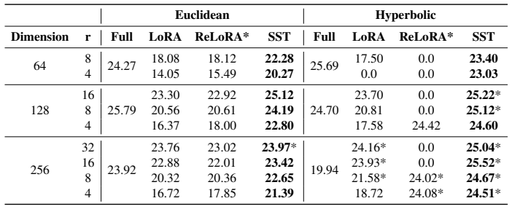
Table 1 : BLEU scores on IWSLT’14 for Euclidean and hyperbolic Transformers.Values in bold indicate the highest performance among low-rank methods. Values marked with an “*” exceed the performance of their full-rank counterparts. Some BLEU scores are zero because that training resulted in NaN losses. Notably, SST consistently outperforms other low-rank methods. Furthermore, the hyperbolic Transformer trained by SST shows improved performance over the full-rank hyperbolic Transformer, particularly as the dimension size increases.
원문 · CC BY 4.0 · Jialin Zhao, Yingtao Zhang, Xinghang Li, Huaping Liu, Carlo Vittorio Cannistraci · Sparse Spectral Training and Inference on Euclidean and Hyperbolic Neural Networks · 원문 그림 인용 · 원본 PDF 7쪽에서 그림 영역을 추출했습니다.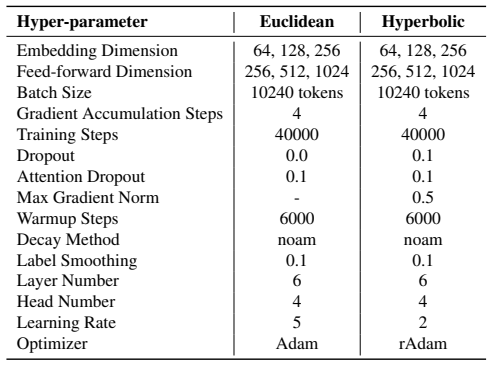
Table 8 : Hyperparameters on IWSLT’14 for Euclidean and hyperbolic Transformer.
원문 · CC BY 4.0 · Jialin Zhao, Yingtao Zhang, Xinghang Li, Huaping Liu, Carlo Vittorio Cannistraci · Sparse Spectral Training and Inference on Euclidean and Hyperbolic Neural Networks · 원문 그림 인용 · 원본 PDF 16쪽에서 그림 영역을 추출했습니다.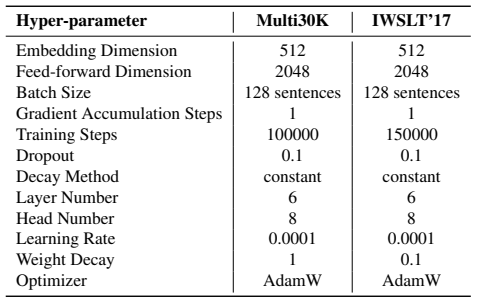
Table 9 : Hyperparameters on Multi30K and IWSLT’17 for vanilla Transformer.
원문 · CC BY 4.0 · Jialin Zhao, Yingtao Zhang, Xinghang Li, Huaping Liu, Carlo Vittorio Cannistraci · Sparse Spectral Training and Inference on Euclidean and Hyperbolic Neural Networks · 원문 그림 인용 · 원본 PDF 17쪽에서 그림 영역을 추출했습니다.OpenWebText 언어 모델의 perplexity 비교
언어 모델 실험은 OPT-125M, OPT-350M, OPT-1.3B, LLaMA-130M, LLaMA-1.3B를 OpenWebText에서 사전학습하며 수행되었습니다. 지표는 validation perplexity이고, perplexity gap은 저랭크 방법의 perplexity에서 full-rank 학습의 perplexity를 뺀 차이로 정의됩니다. 저자들은 LLaMA-1.3B에서 SST가 이 gap을 97.4% 줄였다고 보고합니다. OPT-1.3B의 최종 비교에서 SST는 validation perplexity 22.31을, full-rank 학습은 15.10을 기록했습니다. 따라서 OPT-1.3B에서 SST가 full-rank보다 낮은 perplexity를 보였다고 읽으면 안 되며, 이 모델에서 SST는 full-rank와의 차이를 줄였다는 관찰로 읽어야 합니다.
또 effective step 비교에서 같은 effective step의 full-rank perplexity는 34.05로 보고되며, 이 값은 같은 실험의 다른 비교 기준입니다.
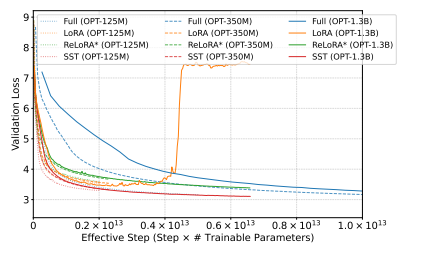
Figure 4 : Comparison of performance on effective steps between SST and full-Rank training. Effective steps are calculated as the product of the number of trainable parame- ters and the number of steps taken. All methods and model sizes utilize the same number of tokens in each step.
원문 · CC BY 4.0 · Jialin Zhao, Yingtao Zhang, Xinghang Li, Huaping Liu, Carlo Vittorio Cannistraci · Sparse Spectral Training and Inference on Euclidean and Hyperbolic Neural Networks · 원문 그림 인용 · 원본 PDF 8쪽에서 그림 영역을 추출했습니다.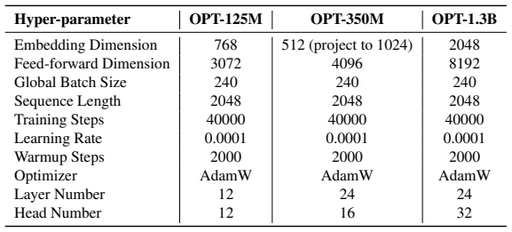
Table 10 : Hyperparameters for OPT Models
원문 · CC BY 4.0 · Jialin Zhao, Yingtao Zhang, Xinghang Li, Huaping Liu, Carlo Vittorio Cannistraci · Sparse Spectral Training and Inference on Euclidean and Hyperbolic Neural Networks · 원문 그림 인용 · 원본 PDF 17쪽에서 그림 영역을 추출했습니다.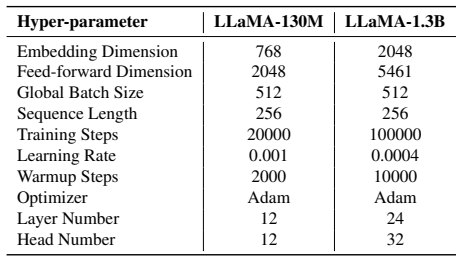
Table 11 : Hyperparameters for LLaMA Models
원문 · CC BY 4.0 · Jialin Zhao, Yingtao Zhang, Xinghang Li, Huaping Liu, Carlo Vittorio Cannistraci · Sparse Spectral Training and Inference on Euclidean and Hyperbolic Neural Networks · 원문 그림 인용 · 원본 PDF 18쪽에서 그림 영역을 추출했습니다.샘플링 방식과 GaLore 비교
샘플링 절제 실험은 vanilla Transformer, 모델 dimension 64, r=8, IWSLT’14 설정에서 수행되었습니다. MULTINOMIAL은 BLEU 22.28, UNIFORM은 22.01, SEQUENTIAL은 22.13, TOP R은 18.28입니다. 저자들은 TOP R이 가장 낮은 이유를 탐색 공간이 저랭크 부분공간으로 좁아지기 때문이라고 해석합니다. GaLore와의 비교는 IWSLT’14에서 수행되었고, 저자들은 GaLore의 scale factor를 α=1로 두었습니다. 원 논문의 α=0.25는 더 나쁜 결과를 보였다고 보고됩니다. 이 비교에서 SST는 d=256, r=32를 제외하면 BLEU가 더 높다고 보고되며, 이 예외는 같은 표의 다른 설정과 구분해서 읽어야 합니다.
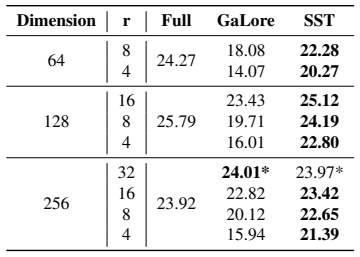
Table 12 : The BLEU score on IWSLT’14 for Euclidean Transformer, compared with GaLore.Values highlighted in bold represent the highest performance among the low rank methods, while those marked with an “*” denote performance that exceeds that of the full-rank variants.
원문 · CC BY 4.0 · Jialin Zhao, Yingtao Zhang, Xinghang Li, Huaping Liu, Carlo Vittorio Cannistraci · Sparse Spectral Training and Inference on Euclidean and Hyperbolic Neural Networks · 원문 그림 인용 · 원본 PDF 19쪽에서 그림 영역을 추출했습니다.한계와 적용 범위
원문은 SST가 낮은 rank에서 수렴에 더 많은 학습 step이 필요할 수 있다고 보고합니다. 학습 step을 20,000에서 640,000까지 늘린 BLEU 실험에서 r=4 조건의 SST는 full-rank와의 격차가 줄었지만 같은 길이에서 따라잡는 것은 확인되지 않았습니다. 또한 구현 비교에서 SST는 파라미터 수가 LoRA보다 약간 많고 frozen 파라미터는 더 많으며, 학습 시간은 LoRA와 비슷하거나 linear 함수 계산 때문에 더 걸립니다. 따라서 이 결과는 실험한 모델 계열과 설정에서 얻은 것이며, 다른 데이터셋이나 큰 규모에서의 일반적 우위를 보장하지 않습니다.

Table 19 : BLEU scores under different training steps. The default training step in Table 1 is 40,000.
원문 · CC BY 4.0 · Jialin Zhao, Yingtao Zhang, Xinghang Li, Huaping Liu, Carlo Vittorio Cannistraci · Sparse Spectral Training and Inference on Euclidean and Hyperbolic Neural Networks · 원문 그림 인용 · 원본 PDF 22쪽에서 그림 영역을 추출했습니다.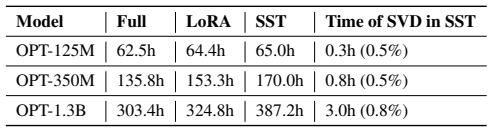
Table 22 : Overall training time on different sizes of OPT models with 19.7 billion training tokens, using 4 A100 GPU. “Time of SVD in SST” is the overall time of singular value decomposition within SST.
원문 · CC BY 4.0 · Jialin Zhao, Yingtao Zhang, Xinghang Li, Huaping Liu, Carlo Vittorio Cannistraci · Sparse Spectral Training and Inference on Euclidean and Hyperbolic Neural Networks · 원문 그림 인용 · 원본 PDF 24쪽에서 그림 영역을 추출했습니다.논문 정보
- 저자
- Jialin Zhao, Yingtao Zhang, Xinghang Li, Huaping Liu, Carlo Vittorio Cannistraci
- 학회·저널
- arXiv · 프리프린트
- 최초 공개일
- 2024년 5월 24일
- 등록일
- 2026년 10월 30일
- 수정일
- 2025년 8월 13일
- 버전
- v3
- arXiv
- 2405.15481
- 분류
- cs.LG
- 원문 이용 조건
- CC BY 4.0
- 제공 범위
- 논문 정보, 해설, 허용된 원문 그림
AI 해설은 논문 원문과 별개의 설명이며 오류가 있을 수 있습니다. 원문과 그림은 각 출처의 이용 조건과 따로 표시된 권리를 따릅니다.
초록
The growing demands on GPU memory posed by the increasing number of neural network parameters call for training approaches that are more memory-efficient. Previous memory reduction training techniques, such as Low-Rank Adaptation (LoRA) and ReLoRA, face challenges, with LoRA being constrained by its low-rank structure, particularly during intensive tasks like pre-training, and ReLoRA suffering from saddle point issues. In this paper, we propose Sparse Spectral Training (SST) to optimize memory usage for pre-training. SST updates all singular values and selectively updates singular vectors through a multinomial sampling method weighted by the magnitude of the singular values. Furthermore, SST employs singular value decomposition to initialize and periodically reinitialize low-rank parameters, reducing distortion relative to full-rank training compared to other low-rank methods. Through comprehensive testing on both Euclidean and hyperbolic neural networks across various tasks, SST demonstrates its ability to outperform existing memory reduction training methods and is comparable to full-rank training in various cases. On LLaMA-1.3B, with only 18.7\% of the parameters trainable compared to full-rank training (using a rank equivalent to 6\% of the embedding dimension), SST reduces the perplexity gap between other low-rank methods and full-rank training by 97.4\%. This result highlights SST as an effective parameter-efficient technique for model pre-training.
원문 인용
Jialin Zhao, Yingtao Zhang, Xinghang Li, Huaping Liu, Carlo Vittorio Cannistraci (2024). Sparse Spectral Training and Inference on Euclidean and Hyperbolic Neural Networks. arXiv:2405.15481v3. https://arxiv.org/abs/2405.15481v3
BibTeX
@misc{zhao2024sparse,
  title = {{Sparse Spectral Training and Inference on Euclidean and Hyperbolic Neural Networks}},
  author = {Jialin Zhao and Yingtao Zhang and Xinghang Li and Huaping Liu and Carlo Vittorio Cannistraci},
  year = {2024},
  eprint = {2405.15481},
  archivePrefix = {arXiv},
  url = {https://arxiv.org/abs/2405.15481v3}
}