논문 해설
Does Your Trial Simulator Know What the Drug Does? An Intervention-Blind Test of Interventional Validity on 7,207 Registered Trials
임상시험 시뮬레이터는 약물이 무엇을 하는지 알고 있는가? 등록된 7,207건의 임상시험을 대상으로 한 중재 블라인드 검증 기반 중재적 타당성 테스트
- 연구 문제 임상시험 시뮬레이터의 정확도는 치료 효과를 입증하지 못하므로, 개입을 가린 기준과 비교하여 개입 정보의 기여를 측정합니다.
- 연구 방법 치료군과 대조군 대비를 구성하고, 개입 식별 필드를 제외한 블라인드 기준 모델과 전체 모델의 오차를 비교하는 개입 기술 지표를 사용합니다.
- 주요 결과 등록 기반 그래디언트 부스팅 모델은 개입 기술 지표가 음수였고, 프로토콜만 읽는 대형 언어 모델은 0.20으로 나타났습니다.
시뮬레이터가 치료 효과를 실제로 예측하는지 묻기
임상시험 시뮬레이터는 보통 보이지 않는 팔의 결과를 맞히는 정확도로 평가됩니다. 그러나 한 팔의 결과는 질환의 자연 경과, 집단 특성, 위약 반응만으로도 상당 부분 예측될 수 있습니다. 따라서 높은 예측 정확도가 치료 효과를 이해했다는 증거가 되지는 않습니다. 이 논문은 치료군 결과에서 대조군 결과를 뺀 시험 내 대비, 즉 위험차 또는 표준화 평균차를 대상으로 삼아 이 차이를 측정 가능한 양으로 만듭니다.
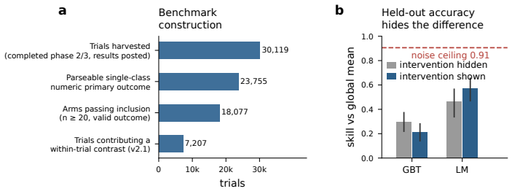
Figure 1 :Held-out accuracy does not separate the systems; the blind control does.(a) Benchmark construction. (b) Skill against the global training mean on the 878 binary test contrasts with the intervention shown or withheld; GBT = registry-trained gradient boosting (five-seed mean), LM = large language model (protocol-only prompt, single run); whiskers 95% trial-bootstrap intervals; dashed line noise ceiling.
원문 · CC BY 4.0 · Alicem Koyun · Does Your Trial Simulator Know What the Drug Does? An Intervention-Blind Test of Interventional Validity on 7,207 Registered Trials · 원문 그림 인용 · 원본 PDF 5쪽에서 그림 영역을 추출했습니다.개입 블라인드 기준과 개입 기술 지표
연구는 ClinicalTrials.gov에서 결과가 게재된 완료 2/3상 시험을 모아 치료군과 대조군의 쌍을 만들고 9,996개 대비를 구성합니다. 평가 지표인 개입 기술(interventional skill)은 전체 모델의 평균제곱오차를 개입 정보를 제외한 블라인드 기준 모델의 평균제곱오차와 비교하여 IS = 1 − MSE(FULL)/MSE(BLIND)로 정의됩니다. 블라인드 기준은 개입 이름, 유형, 설명, 프로토콜 팔 설명, 결과 집단 제목 등 개입을 식별하는 모든 필드를 제외하고 같은 시험과 같은 절차로 학습됩니다. 따라서 IS가 0보다 크면 개입 필드가 블라인드 기준에 없는 정보를 더한 것이고, 0 이하이면 개입 필드가 예측에 도움이 되지 않은 것입니다.
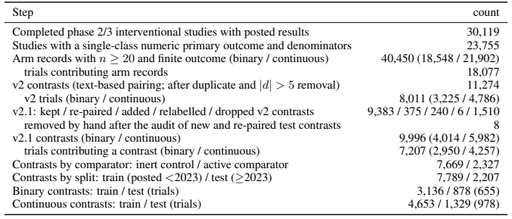
Table 2 : Cohort counts at each construction step (harvest of 9 September 2026; v2.1 pairing of 4 October 2026).
원문 · CC BY 4.0 · Alicem Koyun · Does Your Trial Simulator Know What the Drug Does? An Intervention-Blind Test of Interventional Validity on 7,207 Registered Trials · 원문 그림 인용 · 원본 PDF 17쪽에서 그림 영역을 추출했습니다.등록 기반 시뮬레이터와 언어 모델의 결과
시간 분할에서 등록 자료로 학습한 그래디언트 부스팅 모델은 개입 기술 지표가 −0.12 [−0.21, −0.05]였습니다. 다섯 개 시드의 평균을 쓴 이 결과는 개입 필드를 추가하면 테스트 오차가 오히려 커진다는 뜻입니다. 반면 프로토콜만 읽는 대형 언어 모델은 0.20 [0.08, 0.31]을 보였습니다. 소형 모델과 Llama 3.1 70B는 각각 0.08 [−0.01, 0.17], 0.08 [0.00, 0.15]로 탐지 한계 근처에 있습니다. 이 수치들은 모두 같은 878개 이진 테스트 대비와 시험 단위 부트스트랩 구간을 사용한 결과입니다.
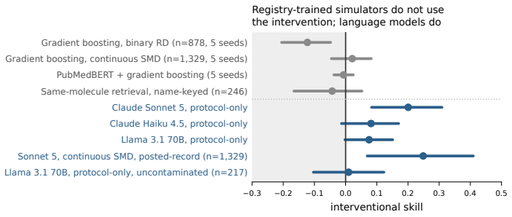
Figure 2 :Interventional skill by system and stratum (v2.1).Whiskers are 95% trial-bootstrap intervals; n = test contrasts. Grey labels: registry-trained models; blue labels: language models with protocol-only prompts (continuous row posted-record), and Llama 3.1 70B on the uncontaminated stratum (trials completed, posted and published after its training cutoff).
원문 · CC BY 4.0 · Alicem Koyun · Does Your Trial Simulator Know What the Drug Does? An Intervention-Blind Test of Interventional Validity on 7,207 Registered Trials · 원문 그림 인용 · 원본 PDF 7쪽에서 그림 영역을 추출했습니다.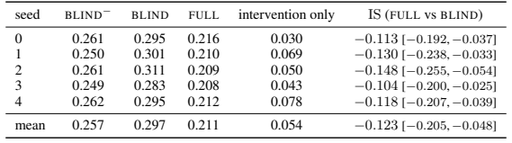
Table 7 : Gradient boosting, binary risk difference, v2.1 temporal test split (878 contrasts / 655 trials), by seed. Columns 2–5: skill against the global training mean.BLIND − omits comparator type;BLIND includes it and is the reference for IS. The mean-row interval applies one shared set of 1,000 trial resamples to all seeds. v2 values in the released CSV .
원문 · CC BY 4.0 · Alicem Koyun · Does Your Trial Simulator Know What the Drug Does? An Intervention-Blind Test of Interventional Validity on 7,207 Registered Trials · 원문 그림 인용 · 원본 PDF 23쪽에서 그림 영역을 추출했습니다.개입을 실제로 사용하는지 확인하는 섭동 실험
대형 언어 모델이 개입 정보를 실제 개입으로 사용하는지 확인하려고 두 가지 섭동을 적용했습니다. 팔 교체 실험에서는 치료군과 대조군 블록을 맞바꾼 프롬프트를 사용했고, 원래 예측이 0이 아닌 742개 대비에서 예측의 부호가 86% 반전되었습니다. 무관한 약물을 치료로 대체한 사전 등록 대조에서는 예측된 효과가 줄어들었고, 능동 비교군 시험에서는 이익 예측이 해악 방향으로 바뀌었습니다. 이 결과는 해당 모델과 프롬프트 조건에서 얻은 관찰이며, 모든 언어 모델에 대한 일반 증명이 아닙니다.
지표의 하한성과 노출 검정의 한계
블라인드 기준은 조건, 평가변수, 적격 기준 문장만으로도 약물 계열을 어느 정도 복원할 수 있습니다. 실제 분석에서 블라인드 프롬프트로 약물 계열을 맞힌 비율은 45%였고, 무작위 대조의 2%보다 훨씬 높았습니다. 따라서 개입 기술 지표는 개입이 기여하는 몫의 보수적 하한으로 읽어야 합니다. 또한 학습 시점 이후 시험만 쓴 미오염 집합은 152개 시험으로 검정력이 낮아 학습 데이터 노출에 따른 기억 효과를 확정하거나 배제하지 못합니다. 개입 기술 지표는 개입 기술의 필요조건이지만 충분조건은 아닙니다.
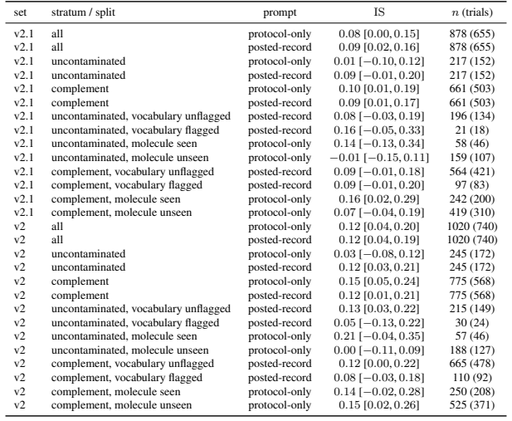
Table 6 : Exposure test with Llama 3.1 70B (knowledge cutoff December 2023). Interventional skill with 95% trial-level bootstrap intervals (2,000 resamples). Uncontaminated: primary completion and first results posting on or after 2024-01-01 and no earlier linked results publication. “Molecule seen”: a normalised treatment name occurs among treatment arms in the registry training split (a proxy for prior knowledge, not a measure of pretraining exposure). “Flagged”: results-group descriptions match an outcome-vocabulary pattern.
원문 · CC BY 4.0 · Alicem Koyun · Does Your Trial Simulator Know What the Drug Does? An Intervention-Blind Test of Interventional Validity on 7,207 Registered Trials · 원문 그림 인용 · 원본 PDF 22쪽에서 그림 영역을 추출했습니다.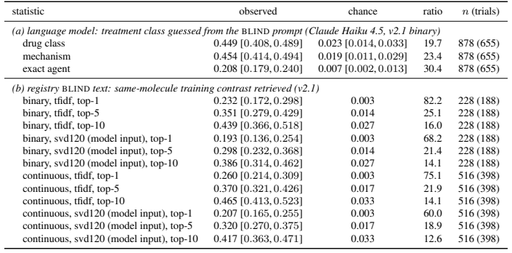
Table 18 : How blind isBLIND? (a) Claude Haiku 4.5 reads the original condition-B prompt and guesses the withheld treatment’s drug class, mechanism and an example agent; a Haiku 4.5 judge scores the guess against the true treatment and, as a chance reference, against the treatment of a randomly permuted contrast (judge calls that failed to parse are excluded). On the 878 v2.1 binary test contrasts (v2 values in results/cr/blindness.csv); 95% trial-level bootstrap intervals (2,000 resamples). (b) For v2.1 test contrasts whose normalised treatment name occurs in the training split, the share for which a training contrast with the same molecule is among the k nearest byBLINDtext (endpoint and condition fields), as TF-IDF and as the 120-dimensional SVD the registry model uses; chance is the hypergeometric rate forkrandom training contrasts; 1,000 trial resamples.
원문 · CC BY 4.0 · Alicem Koyun · Does Your Trial Simulator Know What the Drug Does? An Intervention-Blind Test of Interventional Validity on 7,207 Registered Trials · 원문 그림 인용 · 원본 PDF 28쪽에서 그림 영역을 추출했습니다.논문 정보
- 저자
- Alicem Koyun
- 학회·저널
- arXiv · 프리프린트
- 최초 공개일
- 2026년 11월 4일
- 등록일
- 2026년 11월 6일
- 수정일
- 2026년 11월 4일
- 버전
- v1
- arXiv
- 2611.05907
- 분류
- stat.AP · cs.AI · cs.LG
- 원문 이용 조건
- CC BY 4.0
- 제공 범위
- 논문 정보, 해설, 허용된 원문 그림
AI 해설은 논문 원문과 별개의 설명이며 오류가 있을 수 있습니다. 원문과 그림은 각 출처의 이용 조건과 따로 표시된 권리를 따릅니다.
초록
Patient world models are increasingly proposed as simulators of clinical trials, and recent surveys rank their capabilities on a ladder from temporal prediction to counterfactual rollouts. Position on that ladder is currently assigned by reading papers rather than by measurement. We turn the counterfactual rung into a measured quantity. From 30,119 completed phase 2/3 trials with results posted to ClinicalTrials.gov we construct 9,996 audited within-trial contrasts from 7,207 trials, and we score a simulator on how much of its accuracy depends on knowing which intervention was tested. The instrument is an intervention-blind reference: the same model, trained on the same trials, with every intervention-identifying field withheld. Interventional skill is the error the full model removes relative to that reference. On a temporal split (878 test contrasts from 655 trials) a registry-trained gradient-boosting simulator removes a fifth of the error of a trivial baseline, but its interventional skill is -0.12 (95% CI -0.21 to -0.05): withholding the intervention makes it better, and no alternative featurisation, stratum, temporal cut or same-molecule retrieval yields an interval above zero. A frontier language model reading only the registered protocol has interventional skill 0.20 [0.08, 0.31]; smaller and open-weight models sit at the limit of detection. Perturbation tests show the large model uses the intervention as such: swapping the arms reverses the sign of its prediction in 86% of contrasts. The blind reference is itself not drug-blind (a language model recovers the withheld drug class 45% of the time from the blind prompt), so interventional skill is a conservative lower bound. A reliability layer shows that ranking by predicted error lowers it but that calibrated error control does not transfer under temporal shift. Benchmark, code, prompts and per-call model outputs are released.
원문 인용
Alicem Koyun (2026). Does Your Trial Simulator Know What the Drug Does? An Intervention-Blind Test of Interventional Validity on 7,207 Registered Trials. arXiv:2611.05907v1. https://arxiv.org/abs/2611.05907v1
BibTeX
@misc{koyun2026does,
  title = {{Does Your Trial Simulator Know What the Drug Does? An Intervention-Blind Test of Interventional Validity on 7,207 Registered Trials}},
  author = {Alicem Koyun},
  year = {2026},
  eprint = {2611.05907},
  archivePrefix = {arXiv},
  url = {https://arxiv.org/abs/2611.05907v1}
}