논문 해설
Generalizable AI-Generated Image Detection with Embedding-Space Explanations
임베딩 공간 설명을 활용한 일반화 가능한 AI 생성 이미지 탐지
- 연구 문제 AI 생성 이미지 탐지기는 판정 이유를 설명하기 어렵고, 설명 기능을 탐지와 같은 모델에 묶으면 일반화가 떨어질 수 있습니다.
- 연구 방법 DINOv3 기반 탐지기를 먼저 학습해 잠근 뒤, 잠긴 시각 특징을 고정된 텍스트 임베딩 공간으로 예측하고 VLM이 이를 설명으로 바꾸도록 분리합니다.
- 주요 결과 14개 미관측 생성기에서 평균 AUC 97.4를 보이며, 설명 품질은 XPlainVerse에서 BERTScore F1 69.8, LOKI에서 56.1로 보고됩니다.
검출기와 설명을 한 모델에 묶을 때의 문제
AI 생성 이미지 탐지는 진짜와 가짜를 가르는 점수만으로는 사용자가 판정의 이유를 확인하기 어렵습니다. 기존 설명 가능 탐지기는 대부분 다중모달 모델 하나가 진위 판정과 설명 생성을 함께 학습하므로, 두 목적이 같은 가중치와 표현을 공유합니다. 이 구조에서는 설명 목적의 손실이 시각 표현을 바꾸어 교차 생성기 일반화를 떨어뜨릴 수 있습니다. 한편 순수 시각 자기지도 인코더인 DINOv3는 여러 생성기에 걸쳐 잘 일반화된다는 근거가 제시됩니다. FOX는 이 두 문제를 함께 다루기 위해 판정을 먼저 완성하고 잠근 뒤 설명을 별도로 학습하는 구조를 택합니다.
잠근 탐지기와 임베딩 예측으로 설명을 연결하는 구조
FOX는 다섯 구성요소로 이루어집니다. X-Encoder는 DINOv3 ViT-L/16을 기반으로 하며 Stage 1에서 LoRA만 적응한 뒤 잠깁니다. Classifier는 X-Encoder 특징에서 진위 로짓을 읽어 판정을 내리며, Stage 1 종료 시점에 함께 잠깁니다. Predictor는 같은 잠긴 시각 특징을 고정된 의미 임베딩 공간으로 보내 설명의 전역 표현을 예측합니다. Y-Encoder는 E5-large-v2로 구성되며 학습 목표를 미리 계산하는 데만 쓰이고 추론에서는 로드되지 않습니다. Y-Decoder는 Qwen2.5-VL-3B-Instruct로, 판정을 프롬프트에 단어로 넣고 설명을 생성합니다.
Stage 2에서는 Predictor를 InfoNCE로 학습합니다. Y-Encoder가 고정되어 목표 점들이 학습 중 움직이지 않으므로, 두 측이 상수로 수렴하는 해법은 구조적으로 막혀 있다고 설명됩니다. 추론 시 판정은 Classifier의 로짓에서 바로 읽히므로 언어 모델 디코딩이 필요하지 않습니다.
세 단계 학습과 질의 모듈
Stage 3는 세 단계로 나뉩니다. Stage 3a에서는 Y-Decoder의 언어 측 LoRA만 학습하며, 판정은 프롬프트에 주어지고 Predictor의 조건은 주어지지 않습니다. 이 디코더를 질의 조건이 없는 디코더라고 부릅니다. Stage 3b에서는 Predictor에 네 개의 학습 가능한 질의 슬롯을 가진 교차 어텐션 모듈을 붙여 Predictor FT를 얻습니다. 이때 문장 수준 대조 손실의 가중치는 질의 없는 디코더가 문장을 설명하지 못하는 정도, 즉 교사 강제 음의 로그우도에서 계산됩니다. 설명을 잘 설명하지 못하는 문장일수록 큰 가중치를 받습니다. 순열 불변 목표가 동일 슬롯 고정점을 낳을 수 있으므로, 원문은 어닐링된 라우팅, 소유 및 부하 균형 손실, 쌍별 코사인 페널티, 슬롯별 출력 투영을 함께 둡니다.
Stage 3c에서는 Predictor FT, 질의 모듈, Y-Decoder를 모두 잠그고 출력 투영을 0으로 초기화한 잔차 교차 어텐션 어댑터만 학습합니다. 따라서 어댑터가 학습되기 전에는 디코더 출력이 바뀌지 않습니다.
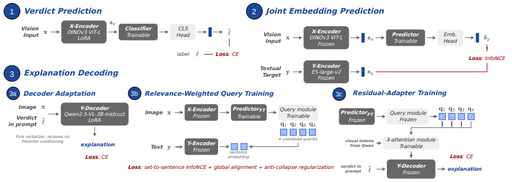
Figure 2 .Training of FOX.Detection and explanation are optimized separately. Stage 1 adapts theX-Encoderthrough LoRA jointly with theClassifierunder cross-entropy; Stage 2 trains thePredictorwith InfoNCE against the frozenY-Encoder. Stage 3 trains a LoRA on the decoder (3a), the query module together with thePredictor(3b), and the residual adapter (3c).
원문 · CC BY 4.0 · Nikos Giakoumoglou, Paschalis Giakoumoglou, Tania Stathaki, Symeon Papadopoulos · Generalizable AI-Generated Image Detection with Embedding-Space Explanations · 원문 그림 인용 · 원본 PDF 4쪽에서 그림 영역을 추출했습니다.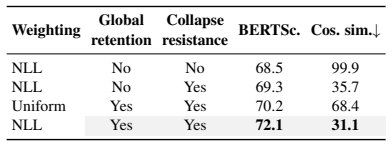
Table 6 .Ablation on query training.. Cosine similarity is the mean pairwise similarity between query vectors (×100); lower values indicate less query collapse.
원문 · CC BY 4.0 · Nikos Giakoumoglou, Paschalis Giakoumoglou, Tania Stathaki, Symeon Papadopoulos · Generalizable AI-Generated Image Detection with Embedding-Space Explanations · 원문 그림 인용 · 원본 PDF 8쪽에서 그림 영역을 추출했습니다.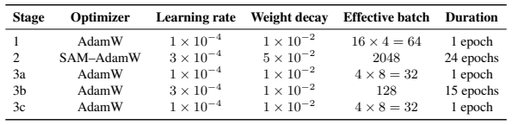
Table C.1 . Optimization settings for the five sequential training steps. Products in the effective-batch column denote physical batch size times gradient accumulation.
원문 · CC BY 4.0 · Nikos Giakoumoglou, Paschalis Giakoumoglou, Tania Stathaki, Symeon Papadopoulos · Generalizable AI-Generated Image Detection with Embedding-Space Explanations · 원문 그림 인용 · 원본 PDF 20쪽에서 그림 영역을 추출했습니다.탐지 성능과 설명 품질의 검증
FOX는 14개의 미관측 생성기에서 평균 AUC 97.4를 기록합니다. 설명 품질은 XPlainVerse에서 BERTScore F1 69.8, LOKI에서 56.1로 보고됩니다. LOKI는 XPlainVerse 학습 분포 밖의 외부 평가이며, 이 자리에서 나온 점수는 저자들이 재계산한 값입니다. 설명 경로의 기여를 분리하기 위한 비교에서는 Stage 3a만 쓴 변형이 LOKI에서 FakeVLM보다 낮게 나타났습니다. 구조 비교에서는 판정과 설명을 분리한 구조가 AUC 97.4와 BERTScore 72.1을 보였고, 단일 end-to-end 파이프라인은 AUC 93.4와 BERTScore 68.9를 보였습니다.
질의 수는 네 개일 때 BERTScore 72.1이었고 한 개일 때는 69.3이었습니다. 이 결과들은 XPlainVerse에서 학습하고 Chameleon으로 체크포인트를 고른 설정에서 얻은 것이며, 다른 학습 데이터나 과제로 넓혀 해석하지 않아야 합니다.
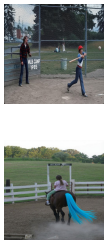
Figure 3 .Qualitative explanations produced by FOX.For each detected fake: input image (left), the explanation produced by the guided Y-Decoder(center), and the ground-truth forensic annotation (right).
원문 · CC BY 4.0 · Nikos Giakoumoglou, Paschalis Giakoumoglou, Tania Stathaki, Symeon Papadopoulos · Generalizable AI-Generated Image Detection with Embedding-Space Explanations · 원문 그림 인용 · 원본 PDF 6쪽에서 그림 영역을 추출했습니다.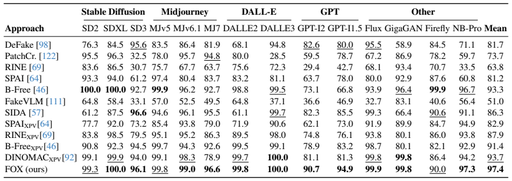
Table 1 .Detection performance on unseen generators.AUC (×100) on 14 unseen generators. Best per column inbold, second best underlined, with ties bolded jointly. The XPV ows indicate retraining on XPlainVerse.
원문 · CC BY 4.0 · Nikos Giakoumoglou, Paschalis Giakoumoglou, Tania Stathaki, Symeon Papadopoulos · Generalizable AI-Generated Image Detection with Embedding-Space Explanations · 원문 그림 인용 · 원본 PDF 6쪽에서 그림 영역을 추출했습니다.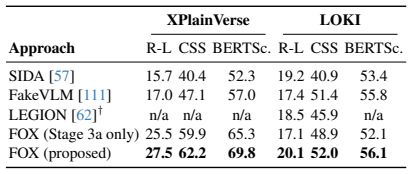
Table 2 .Explanation performance comparison.ROUGE-L (R- L), CSS [62], and BERTScore F1 [119] (×100). †No public LE- GION detection checkpoint is available, entries are from [62].
원문 · CC BY 4.0 · Nikos Giakoumoglou, Paschalis Giakoumoglou, Tania Stathaki, Symeon Papadopoulos · Generalizable AI-Generated Image Detection with Embedding-Space Explanations · 원문 그림 인용 · 원본 PDF 6쪽에서 그림 영역을 추출했습니다.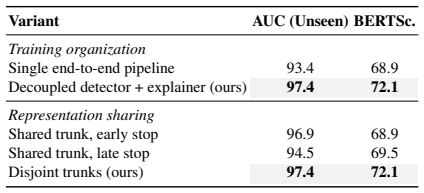
Table 5 .Ablation on training design.Joint versus separate opti- mization and shared versus disjoint trunks.
원문 · CC BY 4.0 · Nikos Giakoumoglou, Paschalis Giakoumoglou, Tania Stathaki, Symeon Papadopoulos · Generalizable AI-Generated Image Detection with Embedding-Space Explanations · 원문 그림 인용 · 원본 PDF 8쪽에서 그림 영역을 추출했습니다.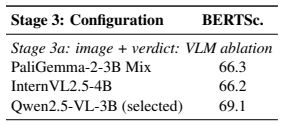
Table 7 .Ablation on the explanation. Top:VLM backbone. Bottom:progressive conditioning with Qwen2.5-VL-3B fixed.
원문 · CC BY 4.0 · Nikos Giakoumoglou, Paschalis Giakoumoglou, Tania Stathaki, Symeon Papadopoulos · Generalizable AI-Generated Image Detection with Embedding-Space Explanations · 원문 그림 인용 · 원본 PDF 8쪽에서 그림 영역을 추출했습니다.적용 범위와 한계
저자들이 밝힌 한계는 몇 가지로 정리됩니다. 예측된 임베딩은 설명 자체가 아니라 디코더를 위한 포렌식 안내이므로, 설명이 탐지기의 실제 계산 과정을 충실히 재현한다고 볼 수 없습니다. 설명 품질은 자동으로 만든 참조 설명과의 유사도 지표로 측정되며, 이는 사실성이나 인과적 충실도를 보장하지 않습니다. FOX는 이미지 전체에 대한 판정을 내리며 조작된 영역을 위치 지정하지 않습니다. 학습은 국부적으로 편집된 이미지에서 이루어졌지만 평가는 대부분 완전 합성 생성기에서 이루어졌습니다. 또한 네 개의 비정렬 질의는 미리 정의된 의미 역할이 없어 개별 질의의 해석은 직접 할 수 없습니다.
논문 정보
- 저자
- Nikos Giakoumoglou, Paschalis Giakoumoglou, Tania Stathaki, Symeon Papadopoulos
- 학회·저널
- arXiv · 프리프린트
- 최초 공개일
- 2026년 11월 3일
- 등록일
- 2026년 11월 5일
- 수정일
- 2026년 11월 3일
- 버전
- v1
- arXiv
- 2611.04111
- 분류
- cs.CV · cs.AI · cs.MM
- 원문 이용 조건
- CC BY 4.0
- 제공 범위
- 논문 정보, 해설, 허용된 원문 그림
AI 해설은 논문 원문과 별개의 설명이며 오류가 있을 수 있습니다. 원문과 그림은 각 출처의 이용 조건과 따로 표시된 권리를 따릅니다.
초록
AI-generated images have reached unprecedented realism, while instruction-driven AI editors re-synthesize images for local changes, leaving no splice boundary to localize. Most detectors are black boxes with unverifiable verdicts and generalize poorly because adapting a backbone on the detection distribution memorizes generator-specific fingerprints that quickly become obsolete. Specialist detectors built on pure-vision representations, particularly DINOv3, generalize well across generators, but explainable methods forgo this advantage: jointly training one multimodal model for classification and language generation subjects its visual representation to the language objective. We therefore require that explanation training cannot alter the verdict. We introduce FOX, which first builds and locks a specialist DINOv3 detector, then uses its representation to guide a lightweight VLM toward forensic explanation. A joint-embedding predictor maps locked visual evidence into a frozen text encoder's semantic space, producing guidance that the VLM verbalizes on demand. FOX achieves 97.4 mean AUC across 14 unseen generators, 69.8 BERTScore on XPlainVerse, and 56.1 on LOKI.
원문 인용
Nikos Giakoumoglou, Paschalis Giakoumoglou, Tania Stathaki, Symeon Papadopoulos (2026). Generalizable AI-Generated Image Detection with Embedding-Space Explanations. arXiv:2611.04111v1. https://arxiv.org/abs/2611.04111v1
BibTeX
@misc{giakoumoglou2026generalizable,
  title = {{Generalizable AI-Generated Image Detection with Embedding-Space Explanations}},
  author = {Nikos Giakoumoglou and Paschalis Giakoumoglou and Tania Stathaki and Symeon Papadopoulos},
  year = {2026},
  eprint = {2611.04111},
  archivePrefix = {arXiv},
  url = {https://arxiv.org/abs/2611.04111v1}
}