논문 해설
Evaluating generative samplers for lattice field theory by scale
격자장 이론을 위한 생성형 샘플러를 스케일별로 평가하기
- 연구 문제 생성 샘플러의 전역 ESS가 작아도 장거리 관측량은 정확할 수 있으며, 이 논문은 스케일별 중첩으로 이 차이를 설명합니다.
- 연구 방법 격자 절단별 Rényi 발산 흐름으로 짧은 거리 불일치를 분리하고, 집합 변수의 주변 Metropolis 검정을 정확한 국소 업데이트와 결합합니다.
- 주요 결과 자유장에서 비슷한 ESS의 두 샘플러가 자화율에서 다른 편향을 보이며, 2차원 ϕ4 OSQ 샘플러에서는 전역 ESS가 떨어져도 주변 검정 수용률이 높게 유지됩니다.
전역 ESS만으로는 부족한 이유
생성 샘플러는 보통 유효 표본 크기(ESS)로 평가되지만, 이 논문은 작은 전역 ESS가 장거리 관측량의 부정확함을 뜻하지 않는다고 지적합니다. 따라서 질문은 어떤 스케일의 불일치가 ESS를 결정하고 어떤 불일치가 물리 관측량에 영향을 주는지입니다. 점근적 ESS 분율은 e^{-D2(p∥q)}로 주어지며, 여기서 D2는 차수 2의 Rényi 발산입니다.
스케일별 중첩 흐름
논문은 격자 운동량 k̂ ≤ Λ인 모드만 남기는 거친 투영 R_Λ를 정의하고, D2(Λ) = D2(R_Λ p ∥ R_Λ q)를 중첩 흐름으로 사용합니다. Λ를 낮추면 짧은 거리 모드가 제거되며, Jensen 부등식으로 이 값이 단조 감소함이 증명됩니다. 따라서 격자 절단에서의 값은 전역 ESS를 결정하고, 더 작은 절단은 긴 파장의 오차를 분리합니다. 이 분석은 Gaussian 가정이나 병진 불변성을 요구하지 않습니다.
주변 Metropolis 검정과 복합 체인
주변 검정은 몇 개의 집합 변수 Φ(예: 자화 M)의 주변 밀도비만으로 제안을 수용합니다. 수용률은 α_Φ = 1 − TV(p_Φ⊗q_Φ, q_Φ⊗p_Φ)로 주어지며 전변동 거리 TV에 의존하고, 전체 구성의 독립 Metropolis 수용률 α보다 작지 않습니다. 정확한 밀도비가 있을 때 검정 단독의 정상 분포는 p_Φ(Φ) q(U|Φ)입니다. 복합 체인은 검정 뒤에 정확한 HMC 국소 업데이트를 n_ref번 적용하며, 이 체인은 유한 이완 길이에서 일반적으로 정확하지 않습니다. 이때 목표 주변 분포 p_Φ는 입력으로 공급되어야 합니다.
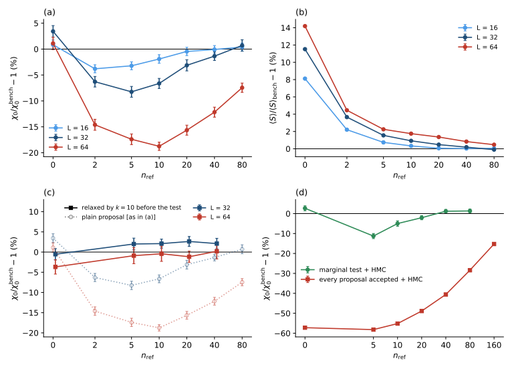
FIG. 5 . Composite chain atκ = 0.2705with the reference process (21) as proposal, marginal test onM with pM from long Monte Carlo ensembles. (a) Relative deviation ofχ0 from its benchmark value against the numbernref of plain HMC trajectories per cycle, reference of Table II. (b) The same for⟨S⟩/V , same runs. (c)χ0 for proposals relaxed byk = 10HMC trajectories before the test, Eq.(23) (filled squares), compared with (a) (open circles). (d)χ0 at L = 32for the reference of sampler A (Table V): marginal test followed by HMC, and every proposal accepted followed by HMC.
원문 · CC BY 4.0 · Satoshi Iso, Lingxiao Wang · Evaluating generative samplers for lattice field theory by scale · 원문 그림 인용 · 원본 PDF 14쪽에서 그림 영역을 추출했습니다.자유장에서의 검증
자유장 이론에서는 가우스 목표와 제안을 모드별로 정확히 계산할 수 있습니다. 질량 오차는 장거리 모드에 집중되어 자화율을 바꾸고, 격자 인공물은 짧은 거리에서 커지지만 영 모드에서는 사라져 자화율을 유지합니다. 그림 1과 Proposition 3은 이 차이를 보여 줍니다. 복합 체인에서는 영 모드가 목표 분포를 따르며, 나머지 모드의 편향은 이완 시간 τ_m으로 제한됩니다. 이 상한은 모드 분산의 상대 오차가 부피에 대해 균일하게 제한될 때 부피에 의존하지 않습니다. 이 결과는 가우스 자유장이라는 정확히 풀 수 있는 조건에서 얻은 것입니다.

원문 그림 TABLE I. Free field, L = 64, ξ = 4, both mismatches tuned to D2 ≃ 7 (7.05 and 6.77), N = 2 × 10⁴ samples per run, 40 runs. Entries: mean over the runs and, in parentheses, the standard deviation of a single run. True value χ = 16.
원문 · CC BY 4.0 · Satoshi Iso, Lingxiao Wang · Evaluating generative samplers for lattice field theory by scale · 원문 그림 인용 · 원본 PDF 7쪽에서 그림 영역을 추출했습니다.2차원 ϕ4 이론에서의 OSQ 샘플러 평가
κ = 0.2705의 2차원 ϕ4 이론에서 L = 16, 32, 64 격자의 학습된 OSQ 샘플러를 벤치마크 앙상블과 비교합니다. 이는 전역 중첩이 부피와 함께 무너져도 주변 검정은 작동할 수 있음을 보여 줍니다. 다만 이 결과는 이 샘플러와 격자 크기 범위에서 얻은 것입니다.
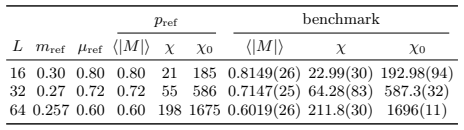
원문 그림 TABLE II. OSQ samplers with fixed reference atκ = 0.2705. All have the same network with6.7 × 104 parameters and use T = 10, g = √ 2, 250 Euler–Maruyama steps, batches of 16 paths, 1000 training steps with a cosine learning-rate schedule and an exponential moving average of the parameters. The reference parametersmref and µref are fixed from the benchmark values, rounded; the training objective(19) uses no benchmark configurations. The columnspref give ⟨|M|⟩, χ and χ0 in the reference distribution, the columns benchmark those of the benchmark ensembles.
원문 · CC BY 4.0 · Satoshi Iso, Lingxiao Wang · Evaluating generative samplers for lattice field theory by scale · 원문 그림 인용 · 원본 PDF 9쪽에서 그림 영역을 추출했습니다.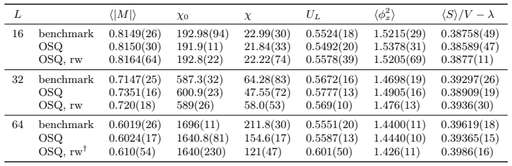
원문 그림 TABLE III. Observables atκ = 0.2705from the benchmark ensembles and from the OSQ samplers of Table II, without weights and reweighted with the path weights(20) (rw). χ0 = V⟨M 2⟩, χ = V (⟨M 2⟩ − ⟨|M|⟩2). Errors from a jackknife analysis with 64 blocks. †The effective sample size is about 6 and the largest weight carries a third of the total weight, so these errors are not reliable. AtL= 32the weights are also too heavy-tailed for reliable rw errors (Appendix C).
원문 · CC BY 4.0 · Satoshi Iso, Lingxiao Wang · Evaluating generative samplers for lattice field theory by scale · 원문 그림 인용 · 원본 PDF 10쪽에서 그림 영역을 추출했습니다.
원문 그림 TABLE V. Samplers at L = 32 with the reference held fixed at the initial values mref = 0.264, µref = 0.403 (A) and with trainable reference (B, C), after the given number of training steps; for B and C, mref and µref are the learned values. Observables without weights; the other quantities are defined as in Table IV.
원문 · CC BY 4.0 · Satoshi Iso, Lingxiao Wang · Evaluating generative samplers for lattice field theory by scale · 원문 그림 인용 · 원본 PDF 12쪽에서 그림 영역을 추출했습니다.남은 한계와 적용 범위
복합 체인은 유한 이완 길이에서 편향이 남으며, 자외선 오차를 제거하는 동안 상호작용을 통해 영 모드가 잠시 밀릴 수 있습니다. 목표 주변 분포 p_Φ의 추정 오차와 저차 미결정 모드의 느린 이완도 남은 한계입니다. 상호작용이 있을 때 Proposition 3(i)은 보장되지 않는다고 원문에서 보고되며, 제안을 먼저 이완하는 방식으로 이 효과가 줄어듭니다. 결과는 주로 2차원 ϕ4 이론의 제한된 격자 범위와 특정 샘플러에 대한 것이며, 더 큰 부피에서의 비용과 정확한 주변 분포의 확보는 아직 확인되지 않았습니다.
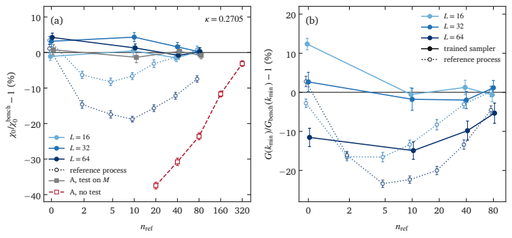
FIG. 6 . Composite chain atκ = 0.2705with the trained samplers as proposals, marginal test onM with pM from long Monte Carlo ensembles, followed bynref plain HMC trajectories. (a) Relative deviation ofχ0 from its benchmark value againstnref for the samplers of Table II (filled circles), for their reference processes atL = 32and64[open circles, dotted; the runs of Fig. 5(a)], and for sampler A of Table V with the marginal test (filled squares) and with every proposal accepted (open squares, dashed). (b) Relative deviation of the lowest nonzero mode,G(kmin), for the samplers of Table II and their reference processes, same runs as in (a). Points at the samenref are drawn slightly displaced.
원문 · CC BY 4.0 · Satoshi Iso, Lingxiao Wang · Evaluating generative samplers for lattice field theory by scale · 원문 그림 인용 · 원본 PDF 15쪽에서 그림 영역을 추출했습니다.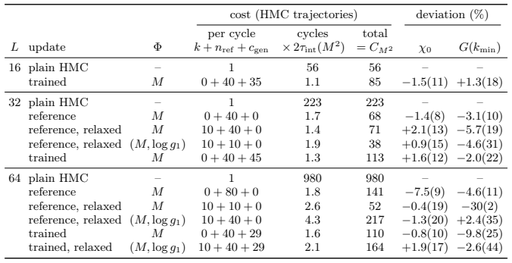
원문 그림 TABLE VII. Cost of an effective independent sample of M2 and remaining infrared deviations at κ = 0.2705. The cost per cycle, in HMC trajectories, is k + nref + cgen: k = 10 trajectories applied to relaxed proposals before the test, nref trajectories after it, and the generator time cgen converted into trajectories. For plain HMC a cycle is one trajectory. Multiplied by the number of cycles per independent sample, 2τint(M2 ), it gives CM2 . Reference proposals come from the reference process, Eq. (21), whose generation cost is omitted; trained proposals come from the OSQ samplers of Table II. Deviations are relative to the benchmark; plain-HMC autocorrelation times are from Fig. 7(c). Costs exclude training and the determination of pΦ. On RIKYU, generation takes 0.70, 3.2 and 8.3 ms per sample at L = 16, 32 and 64 on an NVIDIA GB200 GPU (batches of 2048, 250 Euler–Maruyama steps), and one HMC trajectory takes 0.020, 0.072 and 0.29 ms on one Arm Neoverse-V2 core (compiled Numba implementation); this conversion compares batched GPU generation with single-core CPU HMC and favors the generator.
원문 · CC BY 4.0 · Satoshi Iso, Lingxiao Wang · Evaluating generative samplers for lattice field theory by scale · 원문 그림 인용 · 원본 PDF 16쪽에서 그림 영역을 추출했습니다.논문 정보
- 저자
- Satoshi Iso, Lingxiao Wang
- 학회·저널
- arXiv · 프리프린트
- 최초 공개일
- 2026년 11월 8일
- 등록일
- 2026년 11월 10일
- 수정일
- 2026년 11월 8일
- 버전
- v1
- arXiv
- 2611.11108
- 분류
- hep-lat · cs.LG
- 원문 이용 조건
- CC BY 4.0
- 제공 범위
- 논문 정보, 해설, 허용된 원문 그림
AI 해설은 논문 원문과 별개의 설명이며 오류가 있을 수 있습니다. 원문과 그림은 각 출처의 이용 조건과 따로 표시된 권리를 따릅니다.
초록
Generative samplers for lattice field theory are commonly evaluated by their effective sample size (ESS). We show that a small global ESS need not imply inaccurate long-distance observables: errors spread over many short-distance modes can dominate this diagnostic. We introduce a scale-resolved diagnostic based on the overlap between coarse-grained model and target distributions. At the lattice cutoff, this overlap determines the asymptotic ESS fraction; lower cutoffs isolate long-wavelength errors. In the exactly solvable free theory, two samplers with comparable ESS yield a $32\%$ bias and no bias in the susceptibility, respectively. In two-dimensional $φ^4$ theory near criticality, trained diffusion samplers show the same separation of scales: their path-weight ESS fraction falls rapidly over the volumes studied, while low moments of the magnetization remain close to their target values. Varying the reference parameters substantially changes infrared observables, with little effect on the log-weight variance. Given the target magnetization distribution, a marginal Metropolis test maintains an acceptance rate of order one in our tests. Combined with exact local updates, it reduces the remaining mismatch, although residual bias remains at finite relaxation length. In the free field, uniformly bounded relative errors in the proposal mode variances give a volume-independent bound on the number of updates needed for a prescribed accuracy of the chain's stationary mode variances at fixed correlation length. The target marginal must be supplied or computed separately; estimating it from the samplers' own weights can inherit the poor global overlap.
원문 인용
Satoshi Iso, Lingxiao Wang (2026). Evaluating generative samplers for lattice field theory by scale. arXiv:2611.11108v1. https://arxiv.org/abs/2611.11108v1
BibTeX
@misc{iso2026evaluating,
  title = {{Evaluating generative samplers for lattice field theory by scale}},
  author = {Satoshi Iso and Lingxiao Wang},
  year = {2026},
  eprint = {2611.11108},
  archivePrefix = {arXiv},
  url = {https://arxiv.org/abs/2611.11108v1}
}