Paper commentary
NeRF-SLAM: Real-Time Dense Monocular SLAM with Neural Radiance Fields
- Problem Building a radiance field from a monocular video while the camera moves is slow and needs poses, and without depth supervision it tends to produce floaters.
- Method Feeds poses, depths and marginal covariances from a dense monocular SLAM tracker into a hash-based hierarchical volumetric radiance field, and weights the depth loss by the tracker's covariance.
- Results Reached 41.40 dB average PSNR and 4.49 cm average Depth L1 over eight Replica scenes, against 17.76 dB and 14.18 cm for Nice-SLAM without ground-truth depth.
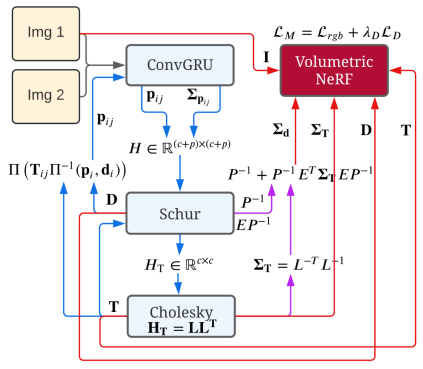
Figure 2 . The input to our pipeline consists of sequential monoc- ular images (here represented as Img 1 & Img 2). Starting from the top-right, our architecture fits a NeRF using Instant-NGP [17], which we supervise using RGB images I, depths D, where the depths are weighted by their marginal covariance, ΣD. Inspired by Rosinol et al. [23], we compute these covariances from dense monocular SLAM. In our case, we use Droid-SLAM [31]. We provide more details about the flow of information in Sec. 3.1. In blue, we show Droid-SLAM’s [31] contributions and flow of in- formation, similarly, in pink are Rosinol’s contribution [23], and in red, our contribution.
Original paper · CC BY 4.0 · Antoni Rosinol, John J. Leonard, Luca Carlone · NeRF-SLAM: Real-Time Dense Monocular SLAM with Neural Radiance Fields · Original paper figure · Extracted the figure area from page 4 of the original PDF.Why monocular radiance fields are hard to build live
Monocular images give no direct depth measurement, so geometry has to be inferred, and learned flow and depth models have improved that inference.
Neural radiance fields give photometrically accurate scene representations, but fitting one requires costly volumetric rendering, which makes reconstruction slow. Early versions also needed ground-truth poses to converge.
Pose-free fitting has become more practical: a radiance field can be fitted in real time given posed images, and ground-truth poses are not strictly needed when the initial estimate is reasonably good. Without depth supervision, density-based fields tend to produce floaters, ghost geometry that comes from poor initialization or bad local minima.
Depth supervision reduces floaters and speeds convergence, which is why the depth source matters when the only input is a stream of RGB images.
Using SLAM outputs as the supervision
The core insight is that a dense monocular SLAM system which estimates accurate poses and dense depth maps, together with their uncertainty, supplies what a radiance field needs to be fitted while the camera moves. The pipeline takes a stream of RGB images as its only input, with no poses or depths supplied.
The pipeline replaces the TSDF volume of prior probabilistic fusion with a hash-based hierarchical volumetric radiance field, which gives photometric detail and lets poses be optimized together with the map. The authors present this as the first scene reconstruction pipeline to combine dense monocular SLAM with hierarchical volumetric neural radiance fields.
Tracking and mapping run as two threads, and the mapping thread fits the field on the keyframes that the tracker supplies.
Dense tracking with Droid-SLAM
The tracking module is Droid-SLAM, which supplies dense depth maps and poses for each keyframe. It first computes dense optical flow between frame pairs with an architecture similar to Raft, where a Convolutional GRU takes the correlation between two frames and a current flow guess and returns an updated flow together with a weight for that measurement.
The flows and weights act as measurements in a dense bundle adjustment whose geometry is a set of inverse depth maps, one per keyframe. The Schur complement gives a reduced camera matrix \(H_T\) of size \(c\times c\) that does not depend on the depths, so the camera poses are solved from its Cholesky factor, and the depths follow from those poses.
Covariances from the Hessian
The Hessian is split into the camera block \(C\), the off-diagonal camera-depth coupling \(E\) and the diagonal depth block \(P\), so the pose update and the inverse-depth update can be read separately. \[ \begin{bmatrix} C & E \\ E^{T} & P \end{bmatrix} \begin{bmatrix} \Delta\xi \\ \Delta d \end{bmatrix} = \begin{bmatrix} v \\ w \end{bmatrix} \] Here \(\Delta\xi\) is the update on the Lie algebra of the poses in SE(3), \(\Delta d\) is the update to the per-pixel inverse depths, and \(v\) and \(w\) are the pose and depth residuals.
This block structure yields the marginal covariances of the dense depths and of the poses in closed form, following Rosinol et al. \[ \Sigma_d = P^{-1} + P^{-T} E^{T} \Sigma_T E P^{-1}, \qquad \Sigma_T = (L L^{T})^{-1} \] The depth covariance is the inverse of the per-pixel diagonal term plus a correction that couples the depths to the pose covariance through \(E\), while the pose covariance is built from the Cholesky factor \(L\) of the reduced system.
The authors refer to Rosinol et al. for the real-time computation.
Depth-weighted mapping loss
The mapping loss adds a color term and a depth term, with the depth term scaled by \(\lambda_D\), which is set to 1.0. \[ L_M(T,\Theta) = L_{rgb}(T,\Theta) + \lambda_D L_D(T,\Theta) \] Both terms are minimized over the camera poses \(T\) and the neural parameters \(\Theta\), so the poses are refined during mapping.
The depth residual compares the tracker depth \(D\) with the rendered depth \(D^\star\) and is measured in the norm weighted by \(\Sigma_D\), the tracker's depth uncertainty. \[ L_D(T,\Theta) = \lVert D - D^{\star}(T,\Theta) \rVert^{2}_{\Sigma_D} \] The color term compares the input image \(I\) with the rendered image \(I^\star\) in the plain squared norm.
\[ L_{rgb}(T,\Theta) = \lVert I - I^{\star}(T,\Theta) \rVert^{2} \]
The rendered depth is the expected ray termination distance, in which samples along each pixel ray contribute through their density and transmittance. \[ d^{\star} = \sum_i T_i \left(1 - \exp(-\sigma_i \delta_i)\right) d_i \] Here \(\sigma_i\) is the volume density at sample \(i\) produced by an MLP, \(\delta_i\) is the distance between consecutive samples, and \(d_i\) is the depth of sample \(i\).
The transmittance \(T_i\) accumulates the densities of the samples before \(i\) along the ray. \[ T_i = \exp\left(-\sum_{j<i} \sigma_j \delta_j\right) \] Colors are rendered in the same way, using the color \(c_i\) that the MLP estimates at each sample. The paper reuses the symbol \(T\) for both the poses and the transmittance.
Depth maps from dense SLAM are noisy, because textureless regions still receive depth values, and the resulting point clouds contain large outliers. Uncertainty was already a useful weight for TSDF fusion, and the authors use the depth uncertainty to weight the depth loss in the same way. Figure 1 shows the RGB input, the depth uncertainty, a point cloud thresholded at a depth uncertainty of 1.0 for visualization, and the rendered radiance field from the input viewpoint.
Keyframe handoff and implementation
The tracking thread continuously minimizes the bundle adjustment reprojection error over an active window of keyframes. The mapping thread optimizes all keyframes it has received and does not keep a sliding window of active frames.
The two threads communicate only when tracking creates a keyframe, and then tracking sends the poses, images, depth maps and marginal covariances of the keyframes in its window, which holds at most 8 keyframes. A new keyframe is created when the mean optical flow from the previous keyframe exceeds 2.5 pixels. The mapping thread also renders the reconstruction for interactive visualization.
The implementation uses PyTorch and CUDA on an RTX 2080 Ti with 11Gb of memory. Instant-NGP is the radiance field, modified to add the mapping loss, and the tracker reuses the pre-trained weights of Droid-SLAM. Depth and pose uncertainties are computed with Rosinol's real-time approach. A single GPU serves both threads, although the approach allows two separate GPUs.
Datasets and baselines
Cube-Diorama is a synthetic dataset generated with Blender, providing ground-truth poses, depths and images, and it is used for the ablation experiments. Replica covers 5 offices and 3 apartments, modeled in high detail.
The baselines are TSDF-Fusion, σ-Fusion, iMAP and Nice-SLAM. TSDF-Fusion gives every depth map a uniform weight, while σ-Fusion weights depths by their uncertainties; both fuse the posed depth maps from the tracker in a hash-based volumetric representation. iMAP represents the scene with one large MLP, and Nice-SLAM uses hierarchical dense volumetric grids.
iMAP and Nice-SLAM are run with depth rendered from the ground-truth meshes, which the authors say gives better results than a casually moving RGB-D camera would reasonably achieve, so Nice-SLAM is also run without ground-truth depth. Geometry is measured by Depth L1 in cm, where lower is better, and photometry by PSNR between input RGB images and rendered images, where higher is better.
Replica geometry and photometry
Table 1 lists each method per scene and as an average over eight scenes, with the iMAP and Nice-SLAM rows at the top using ground-truth depth. The remaining rows use the poses and depths of the tracker, except the Nice-SLAM row without depth.
The pipeline averages 41.40 dB PSNR and 4.49 cm Depth L1, against 24.61 dB and 4.08 cm for Nice-SLAM with ground-truth depth, and 17.76 dB and 14.18 cm for Nice-SLAM without it. Its PSNR is the highest of the rows in every scene, including against Nice-SLAM with ground-truth depth. Its Depth L1 is lower than Nice-SLAM without depth in every scene, but its average Depth L1 is not lower than Nice-SLAM with ground-truth depth, which gives 4.08 cm against 4.49 cm.
The headline gains are stated relative to Nice-SLAM: up to 179% PSNR improvement in office-1 and up to 86% better L1 in room-2. The text does not name the Nice-SLAM row for these figures, but the printed values that match them are the no-depth row: 53.44 dB against 19.14 dB on office-1, and 2.58 cm against 19.03 cm on room-2. Against the ground-truth-depth row the pipeline is not better on every scene, for example 2.97 cm against 2.53 cm on room-0 Depth L1.
TSDF-Fusion and σ-Fusion average 7.07 dB and 7.08 dB PSNR, and 21.88 cm and 20.10 cm Depth L1, so σ-Fusion gives the better geometry while both are poor photometrically. The authors render marching-cubes meshes for these two methods, which is the reason given for their photometric results. Nice-SLAM without ground-truth depth keeps much higher PSNR than the two TSDF baselines, at 17.76 dB on average.
The authors compare the raw point cloud from the tracker, a σ-Fusion mesh, Nice-SLAM and the pipeline on Replica office-0. The authors note that a TSDF map built from the same poses, depths and uncertainties renders clearly worse than the pipeline.
Nice-SLAM with ground-truth depth is better than iMAP on both measures, at 24.61 dB against 6.95 dB PSNR and 4.08 cm against 7.64 cm Depth L1.
Depth and uncertainty weighting on Cube-Diorama
The ablation uses the room scene of Cube-Diorama and compares no depth, raw depths without weighting, and covariance-weighted depths over time.
The authors attribute the bias to the geometry, since the raw tracker depths are noisy, and Figure 5 shows the tracker point cloud, its thresholded version, and reconstructions after 120s with and without depth weighting.
In the convergence plot, the no-depth variant already converges photometrically, but its Depth L1 is 7.8cm after 500s. Raw dense depths lower the Depth L1 to 4.1cm after 500s, while unweighted depth leaves PSNR about 3dB below the no-depth variant. Weighted depth reaches PSNR similar to the no-depth variant and Depth L1 similar to the raw-depth variant, which the paper presents as the best PSNR and L1 among the tested variants.
Figure 6 plots PSNR and Depth L1 over time for the three variants in the room scene.
Convergence from noisy poses
With ground-truth poses and ground-truth depth the field converges fast and accurately, while ground-truth poses without depth still converge, but more slowly. With noisy poses and no depth, the field does not converge within 60s.
Using ground-truth depth with noisy poses still gives good results, and this is the target the pipeline aims for. With noisy depths weighted by their marginal covariances, the pipeline still reaches good results despite noisy poses and depths.
Frame rates of the two threads
On 640×480 images the pipeline runs at 12 frames per second. A keyframe is added whenever the mean optical flow exceeds 2.5 pixels.
The mapping thread averages 10 frames per second. The same section also gives the overall rate as 10 frames per second, reached by running tracking and radiance field reconstruction in parallel with custom CUDA kernels.
Memory use and tested scope
The approach needs about 11Gb of GPU memory, because it uses dense correlation volumes between image pairs for tracking and hierarchical volumetric grids for mapping. The authors say this may be prohibitive for robotics with low compute power, such as drones.
The authors name two ways to reduce this memory: computing correlation volumes on the fly, as noted for RAFT, and streaming inactive volumetric regions to the CPU while a sliding window stays on the GPU. No experiment with either change is reported.
The evaluation uses Replica scenes with 2000 frames each and one Cube-Diorama room scene for the ablations. The depth-weighting ablation therefore rests on a single scene. The iMAP and Nice-SLAM rows use ground-truth-mesh depth, which the authors note may give better results than a casually moving RGB-D camera would achieve.
Paper info
- Authors
- Antoni Rosinol, John J. Leonard, Luca Carlone
- Venue
- arXiv · Preprint
- First published
- 2022-10-24
- Added
- 2026-11-5
- Updated
- 2022-10-24
- Version
- v1
- arXiv
- 2210.13641
- Category
- cs.CV
- Original paper terms
- CC BY 4.0
- What we show
- Paper info, commentary and permitted figures from the original paper
AI commentary is a separate explanation from the original paper and may contain errors. The original paper and figures follow each source's terms of use and any rights noted separately.
Abstract
We propose a novel geometric and photometric 3D mapping pipeline for accurate and real-time scene reconstruction from monocular images. To achieve this, we leverage recent advances in dense monocular SLAM and real-time hierarchical volumetric neural radiance fields. Our insight is that dense monocular SLAM provides the right information to fit a neural radiance field of the scene in real-time, by providing accurate pose estimates and depth-maps with associated uncertainty. With our proposed uncertainty-based depth loss, we achieve not only good photometric accuracy, but also great geometric accuracy. In fact, our proposed pipeline achieves better geometric and photometric accuracy than competing approaches (up to 179% better PSNR and 86% better L1 depth), while working in real-time and using only monocular images.
Quote from the paper
Antoni Rosinol, John J. Leonard, Luca Carlone (2022). NeRF-SLAM: Real-Time Dense Monocular SLAM with Neural Radiance Fields. arXiv:2210.13641v1. https://arxiv.org/abs/2210.13641v1
BibTeX
@misc{rosinol2022nerf,
  title = {{NeRF-SLAM: Real-Time Dense Monocular SLAM with Neural Radiance Fields}},
  author = {Antoni Rosinol and John J. Leonard and Luca Carlone},
  year = {2022},
  eprint = {2210.13641},
  archivePrefix = {arXiv},
  url = {https://arxiv.org/abs/2210.13641v1}
}