論文解説
NeRF-SLAM: Real-Time Dense Monocular SLAM with Neural Radiance Fields
NeRF-SLAM:神経放射場を用いたリアルタイム高密度単眼SLAM
- 課題 単眼RGB映像だけから、幾何と測光の両方が正確な神経放射場をリアルタイムで得る問題を扱います。
- 手法 Droid-SLAMの姿勢、高密度深度、周辺共分散を使い、Instant-NGPベースの放射場を不確実性重み付きの深度損失で学習します。
- 結果 Replicaでは、NeRF-SLAMは平均PSNR 41.40 dBと平均Depth L1 4.49 cmを報告しています。深度の重み付けがない深度の利用は、PSNRを約3dB下げます。
単眼映像でリアルタイム3D再構成が難しい理由
単眼カメラの映像だけからシーンを幾何的にも測光的にも正確に再構成するのは、深度を直接測定できないため、今も難しい課題です。RGB-Dセンサーは直射日光のような条件で失敗することがあり、ライダーは重くて高価です。ステレオは較正誤差に敏感です。一方で単眼カメラは安価で軽量ですが、深度を直接得られません。神経放射場(NeRF)は写真の測光に忠実な3D表現を提供しますが、ボリュームレンダリングのコストが高いため学習が遅く、本来は正確な姿勢を必要としていました。この論文は、この二つの流れの限界を同時に解決することを目指しており、単眼RGBストリームだけを入力として、リアルタイムで神経放射場を学習する問題を扱います。
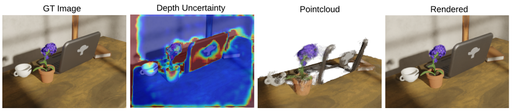
Figure 1 . From left to right, input RGB image, estimated depth uncertainty, back-projected depth-maps into a pointcloud, after thresholding the depth by its uncertainty (σd≤ 1.0) for visualization, and our resulting neural radiance field, rendered from the same viewpoint as the input image. Our pipeline is capable of reconstructing neural radiance fields in real-time given only a stream of RGB images.
出典 · CC BY 4.0 · Antoni Rosinol, John J. Leonard, Luca Carlone · NeRF-SLAM: Real-Time Dense Monocular SLAM with Neural Radiance Fields · 論文の図を引用 · 元のPDFの2ページ目から図の部分を抽出しています。高密度SLAMの出力を放射場の監督信号として使う構成
NeRF-SLAMは、追跡モジュールとしてDroid-SLAMを使い、キーフレームごとに高密度の深度マップと姿勢を得ます。Droid-SLAMは、高密度オプティカルフローを計算したあと、高密度バンドル調整で逆深度マップとカメラポーズを同時に解きます。このとき、ヘッセ行列をカメラブロックと深度ブロックに分け、深度変数をSchur complementで消去すると、深度に依存しない縮小カメラ行列HTが得られます。これをCholesky分解で解いて姿勢を求め、その姿勢を使って深度を計算します。著者らはRosinolらの方法に従い、このヘッセ行列のブロック構造から深度と姿勢の周辺共分散を計算します。マッピング側ではInstant-NGPベースのハッシュボリューム放射場を使い、深度損失LDは深度の差を周辺共分散ΣDで重み付けします。
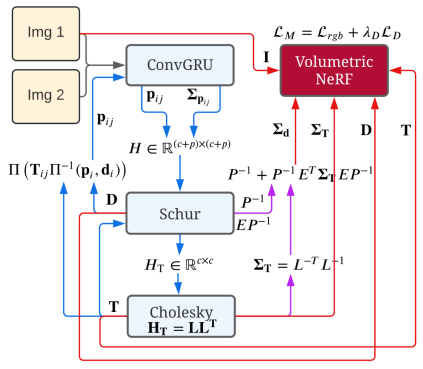
Figure 2 . The input to our pipeline consists of sequential monoc- ular images (here represented as Img 1 & Img 2). Starting from the top-right, our architecture fits a NeRF using Instant-NGP [17], which we supervise using RGB images I, depths D, where the depths are weighted by their marginal covariance, ΣD. Inspired by Rosinol et al. [23], we compute these covariances from dense monocular SLAM. In our case, we use Droid-SLAM [31]. We provide more details about the flow of information in Sec. 3.1. In blue, we show Droid-SLAM’s [31] contributions and flow of in- formation, similarly, in pink are Rosinol’s contribution [23], and in red, our contribution.
出典 · CC BY 4.0 · Antoni Rosinol, John J. Leonard, Luca Carlone · NeRF-SLAM: Real-Time Dense Monocular SLAM with Neural Radiance Fields · 論文の図を引用 · 元のPDFの4ページ目から図の部分を抽出しています。不確実性重み付き深度損失と色損失の結合
マッピングの損失は、色損失Lrgbと深度損失LDをλDで結合したLM(T, Θ)として定義されます。論文ではλDは1.0に設定されています。深度損失は、レンダリングされた深度D⋆と追跡モジュールの深度Dとの差を、共分散ΣDに対するマハラノビス型ノルムで測ります。レンダリング深度は、光線に沿ったサンプルの密度σiと透過率Tiで重み付けした期待終了距離として計算されます。ここで透過率Tiは、サンプルiより前までの密度積分の指数関数です。この構成は、ノイズの大きい深度マップの影響を不確実性に応じて抑えることを狙ったものです。深度を重み付けせずに使う場合と区別して検証されています。
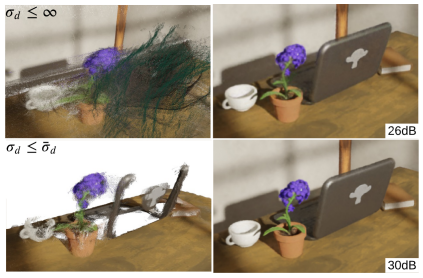
Figure 5 . (Top-Left) Raw pointcloud estimated by the tracking module, (Bottom-Left) Pointcloud after thresholding the depth un- certainty (σd≤ 1.0) for visualization. (Right Column) Radiance field reconstructions after 120s of optimization, with and without depth weighting (top-right and bottom-right respectively). Room scene in Cube-Diorama dataset [1].
出典 · CC BY 4.0 · Antoni Rosinol, John J. Leonard, Luca Carlone · NeRF-SLAM: Real-Time Dense Monocular SLAM with Neural Radiance Fields · 論文の図を引用 · 元のPDFの8ページ目から図の部分を抽出しています。追跡とマッピングの並列構成
システムでは追跡スレッドとマッピングスレッドが並列に動作し、両スレッド間の通信は、追跡パイプラインが新しいキーフレームを作るときにだけ行われます。追跡スレッドは、アクティブなスライディングウィンドウの再投影誤差を継続的に最小化します。アクティブウィンドウは最大8個のキーフレームで保たれます。新しいキーフレームは、前のキーフレームと現在のフレームの間の平均オプティカルフローが2.5ピクセルを超えたときに生成されます。マッピングスレッドは受け取ったすべてのキーフレームを使い、スライディングウィンドウは設けていません。
Replicaデータセットにおける幾何・測光の比較
Replicaデータセットでは、NeRF-SLAMをiMAP、Nice-SLAM、TSDF-Fusion、σ-Fusionと比較しています。iMAPとNice-SLAMは、標準設定ではGT深度を教師信号として使います。Nice-SLAMについては、GT深度なしで実行した結果も併せて報告されています。TSDF-Fusion、σ-Fusion、そしてNeRF-SLAMは、高密度単眼SLAMの姿勢と深度を使います。表1では、NeRF-SLAMの平均Depth L1は4.49 cm、平均PSNRは41.40 dBと報告されています。著者らは、Nice-SLAMと比べてoffice-1では最大179%のPSNR向上、room-2では最大86%低いL1誤差を報告しています。
この比較のNice-SLAMの結果には、GT深度を使った設定と使わない設定の両方が含まれるため、条件を分けて読む必要があります。
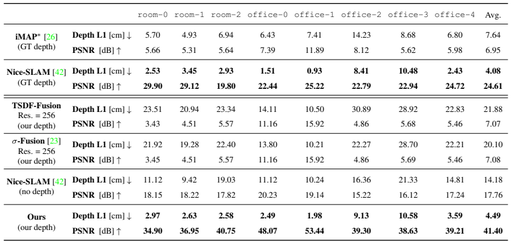
Table 1 . Geometric (L1) and Photometric (PSNR) results for the Replica dataset. iMAP and Nice-SLAM are first evaluated using the ground-truth depth from Replica as supervision (top two rows). We also evaluate Nice-SLAM when not using ground-truth depth as supervision for comparison. TSDF-Fusion, σ-Fusion, and our approach are evaluated using the poses and depths from dense monocular SLAM, as explained in Sec. 3.1. Best results in bold.
出典 · CC BY 4.0 · Antoni Rosinol, John J. Leonard, Luca Carlone · NeRF-SLAM: Real-Time Dense Monocular SLAM with Neural Radiance Fields · 論文の図を引用 · 元のPDFの6ページ目から図の部分を抽出しています。深度損失の重み付けの有無によるアブレーション実験
Cube-DioramaのRoomシーンで、著者らは深度を使わない場合、生の深度を重み付けせずに使った場合、不確実性で重み付けした深度を使った場合を比較しています。論文では、深度を重み付けしないとPSNRが深度を使わない場合より約3dB下がると報告されています。また、生の深度はL1深度誤差を減らす一方で、幾何を偏らせる可能性があると説明されています。重み付けした深度は、深度を使わない場合と同程度のPSNRを保ちながら、生の深度と同程度のL1深度誤差を得ると報告されています。この結果は、Cube-DioramaデータセットのRoomシーンと、120秒の最適化で測定したことに基づいています。
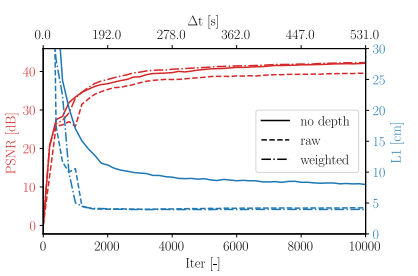
Figure 6 . Convergence plot comparing the PSNR and L1 depth metrics over time ( ∆t[s]) and iteration (Iter[-]) when not using depths (‘no depth’), when using the raw depths without weighting (‘raw’), and using our approach with weighted depth (‘weighted’). Room scene in Cube-Diorama dataset [1].
出典 · CC BY 4.0 · Antoni Rosinol, John J. Leonard, Luca Carlone · NeRF-SLAM: Real-Time Dense Monocular SLAM with Neural Radiance Fields · 論文の図を引用 · 元のPDFの8ページ目から図の部分を抽出しています。メモリ要件と適用範囲
著者らは、この手法が追跡の高密度相関ボリュームとマッピングの階層的なボリュームグリッドのため、約11GBのGPUメモリを必要とすると述べています。この要件は、計算資源の少ないロボット、例えばドローンには大きすぎる可能性があります。著者らは、相関ボリュームを必要なときに計算する方法と、アクティブな領域だけをGPUにストリーミングする方法を緩和策として示しています。ただし、これは今後の方向性として示されたもので、本論文では実装も検証もされていません。リアルタイムの結果は、RTX 2080 Ti GPUと640×480の解像度の条件で報告されています。
論文情報
- 著者
- Antoni Rosinol, John J. Leonard, Luca Carlone
- 学会・ジャーナル
- arXiv · プレプリント
- 公開日
- 2022年10月24日
- 登録日
- 2026年11月5日
- 更新日
- 2022年10月24日
- バージョン
- v1
- arXiv
- 2210.13641
- カテゴリ
- cs.CV
- ライセンス
- CC BY 4.0
- 掲載内容
- 論文情報・解説・論文の図
この解説は、Refivuの韓国語解説をAIで翻訳したものです。不正確な翻訳や誤りが含まれる可能性があります。論文と図の利用条件は各出典に従います。
アブストラクト
We propose a novel geometric and photometric 3D mapping pipeline for accurate and real-time scene reconstruction from monocular images. To achieve this, we leverage recent advances in dense monocular SLAM and real-time hierarchical volumetric neural radiance fields. Our insight is that dense monocular SLAM provides the right information to fit a neural radiance field of the scene in real-time, by providing accurate pose estimates and depth-maps with associated uncertainty. With our proposed uncertainty-based depth loss, we achieve not only good photometric accuracy, but also great geometric accuracy. In fact, our proposed pipeline achieves better geometric and photometric accuracy than competing approaches (up to 179% better PSNR and 86% better L1 depth), while working in real-time and using only monocular images.
この論文を引用
Antoni Rosinol, John J. Leonard, Luca Carlone (2022). NeRF-SLAM: Real-Time Dense Monocular SLAM with Neural Radiance Fields. arXiv:2210.13641v1. https://arxiv.org/abs/2210.13641v1
BibTeX
@misc{rosinol2022nerf,
  title = {{NeRF-SLAM: Real-Time Dense Monocular SLAM with Neural Radiance Fields}},
  author = {Antoni Rosinol and John J. Leonard and Luca Carlone},
  year = {2022},
  eprint = {2210.13641},
  archivePrefix = {arXiv},
  url = {https://arxiv.org/abs/2210.13641v1}
}