Paper commentary
Where Is Uncertainty Observed? A Mechanistic Understanding of Uncertainty Quantification in LLMs
Four observation lenses sort UQ estimators by where they read uncertainty
- Problem Existing surveys sort uncertainty methods by source or estimation mechanism, but none say where inside the model computation the signal should be read. Without that, it is unclear whether an estimator has enough information to recover a given target.
- Method The authors define four lenses on the residual stream: structural, representational, distributional, and semantical. They order the lenses from inner to outer by the information each one carries, which guides which lens to pick for each target.
- Results Of 159 surveyed papers, 146 target correctness, and 81 of those report only ranking metrics. Grounding and faithfulness are targeted by only 11 and 6 papers.
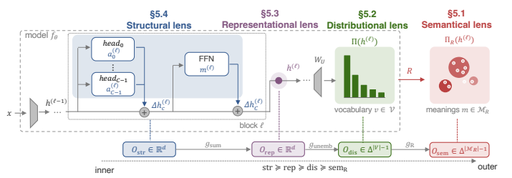
Figure 3 : Four mechanistic observation lenses in the residual stream.
Original paper · CC BY 4.0 · Xiaoyu Liang, Virginia Ceccatelli, Aliai Eusebi, Tobias Braun, Nils Loose, Carlo Malagnino, Lorenzo Cavallaro · Where Is Uncertainty Observed? A Mechanistic Understanding of Uncertainty Quantification in LLMs · Original paper figure · Extracted the figure area from page 9 of the original PDF.Why the read point matters
Existing surveys of UQ for LLMs sort methods by the source of uncertainty, by how it arises during development, or by the estimation mechanism. None of these say where inside the model computation the signal is read, and that gap is the subject of this section. The authors ask where uncertainty should be observed, and what information each observation point reveals.
Take a bat-and-ball math query whose correct answer is 5 ¢. The next-digit distribution puts 0.9996 on the wrong answer 10¢, so a token-level view looks confident. The sampled answers agree on that same wrong answer, so a meaning-level view sees low uncertainty too. The hidden state, however, lies near the uncertain direction, which is why observing only the meaning misses it.
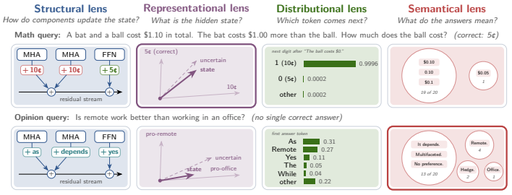
Figure 2 : Four lenses applied to two queries. For the math query, the sampled answers agree on a wrong answer, so semantic uncertainty is low, but the hidden state lies near the uncertain direction. For the opinion query, the token distribution spreads over many phrasings, but the answers share one stance. A colored frame marks the suited lens. Illustrative values from an experiment on Qwen2.5-0.5B-Instruct (Qwen et al., 2025).
Original paper · CC BY 4.0For the opinion query, the picture flips: the token distribution spreads over many phrasings. The sampled answers share one stance, so the semantic view captures what the token view misses. The authors read these two cases as showing that the suited observation point depends on the query. Illustrative values come from an experiment on Qwen2.5-0.5B-Instruct, so the numbers are examples rather than a benchmark result.
No single lens fits every target, so the paper frames a choice of lens for each case. The lens determines sufficiency, while the sampling and auxiliary structure determine efficiency. That framing sets up the four lenses the paper defines next, ordered by the information they carry.
Four lenses on one residual stream
The core idea is to read uncertainty at four fixed points along the residual stream, the channel every transformer component uses. Each point exposes one canonical kind of object, so each lens has its own observation space. Residual naturality means each lens reads the model alone, so the structural, representational and distributional lenses need no extra specification.
Only the semantical lens needs an external semantic relation R, which is the one structure outside the model used to define a lens.
The structural lens reads each component's write to the residual stream, covering attention heads and the FFN. Each write is indexed by its component (ℓ,c), and the attention weights and FFN activation count as parts of the write. The representational lens reads the summed hidden state h(ℓ) at each layer, obtained by the sum map g_sum from the structural lens.
The distributional lens unembeds that state into a next-token distribution Π(h(ℓ)), a softmax over the vocabulary. The semantical lens groups sampled outputs by a semantic relation R and reads the resulting distribution over meanings.
The lenses run from inner to outer, and each inner observation determines every outer one. Moving to token probabilities drops the norm of the state and the mean of its coordinates in LayerNorm. Moving to meanings then discards the lexical form of the outputs, keeping only what R reads as meaning. So the structural lens is the finest view of the computation, while the semantical lens is closest to human interpretation.
A readout map changes how a lens is read without changing which lens it is. The Logit Lens uses the identity map, while the J-Lens uses a Jacobian-based map and the tuned lens learns an affine map. The sparse autoencoder rewrites h(ℓ) in a learned feature basis yet still reads the representational lens.
What the survey finds about evaluation
The survey covers 159 papers, and the authors tag each method with one evaluation target. Of these, 146 papers target correctness, and 81 of those report ranking metrics only. Correctness is the default target, while grounding is targeted by 11 papers and faithfulness by 6. Those two targets beyond correctness are therefore thinly covered in the surveyed literature.
Most representational and structural methods fit an external model against output-level labels. Few inner-lens estimators are native, and most of them are still scored against the output. Grounding methods mostly assess causal reliance, which needs attribution to individual component writes. Yet these grounding methods are evaluated against contextual support labels instead.
McCabe et al. (2026) show that the cluster-count and frequency-weighted approximations underestimate semantic entropy. Their alphabet-size estimator, they argue, corrects this bias. The SE Blackbox variant weights clusters by empirical frequency, while NumSets counts the clusters.
Limits of the lens view
The lens framework stops at the information in each observation, and the paper says every lens map is lossy. Architectures with cross-layer connections, such as cross-layer key-value sharing, are left open for future work. Lens maps discard the component split, the lexical form, or the norm, so the lost information depends on which lens map is applied.
The authors separate what an observation holds from what an estimator can exploit, and the second question stays open.
The lens hierarchy is validated empirically through decodability, but the authors don't yet exploit it directly. Readout maps such as the J-lens, R-lens, U-space and SAE offer another route, and they don't change the lens itself.
For causal reliance in grounding, the authors argue that native inner-lens estimators are necessary, because component attribution depends on O_str. Supervised probes need reference labels and generalize poorly, so the authors favour estimators that read the model computation directly. Such label-free estimators can be checked with causal mechanistic validation, and intervening on a causally relevant signal should change behavior.
Uncertainty can guide decisions about answering, relying on context, or extended reasoning. Retrieval routing needs structural attribution, reasoning decisions need hidden-state analysis, and selective answering needs distributional or semantic signals.
Paper info
- Authors
- Xiaoyu Liang, Virginia Ceccatelli, Aliai Eusebi, Tobias Braun, Nils Loose, Carlo Malagnino, Lorenzo Cavallaro
- Venue
- arXiv · Preprint
- First published
- 2026-11-11
- Added
- 2026-11-13
- Updated
- 2026-11-11
- Version
- v1
- arXiv
- 2611.15735
- Category
- cs.CL · cs.AI · cs.LG
- Original paper terms
- CC BY 4.0
- What we show
- Paper info, commentary and permitted figures from the original paper
AI commentary is a separate explanation from the original paper and may contain errors. The original paper and figures follow each source's terms of use and any rights noted separately.
Abstract
Knowing when a large language model's (LLM's) response can be trusted is critical for its safe use. Uncertainty quantification (UQ) can help LLMs recognize if their responses may be unreliable. Existing taxonomies organize UQ methods by uncertainty source or estimation mechanism. They leave unresolved the question of where uncertainty is observed in the model's computation. The answer matters because the observation point determines whether an estimator has access to enough information to recover a given target, and how well it can recover it. Drawing on mechanistic interpretability, we define four mechanistic observation lenses: the structural lens observes component updates, the representational lens observes hidden states, the distributional lens observes token probabilities, and the semantical lens observes distributions over meanings. We relate these lenses through the residual stream and order them by the information they carry, which gives a principle for selecting UQ methods for different targets. We survey existing methods through the four lenses. Furthermore, we distinguish evaluation targets, criteria, and metrics to clarify different UQ evaluation protocols. Finally, we identify open problems and research directions to connect uncertainty estimation to the internal computation and downstream use of LLMs.
Quote from the paper
Xiaoyu Liang, Virginia Ceccatelli, Aliai Eusebi, Tobias Braun, Nils Loose, Carlo Malagnino, Lorenzo Cavallaro (2026). Where Is Uncertainty Observed? A Mechanistic Understanding of Uncertainty Quantification in LLMs. arXiv:2611.15735v1. https://arxiv.org/abs/2611.15735v1
BibTeX
@misc{liang2026where,
  title = {{Where Is Uncertainty Observed? A Mechanistic Understanding of Uncertainty Quantification in LLMs}},
  author = {Xiaoyu Liang and Virginia Ceccatelli and Aliai Eusebi and Tobias Braun and Nils Loose and Carlo Malagnino and Lorenzo Cavallaro},
  year = {2026},
  eprint = {2611.15735},
  archivePrefix = {arXiv},
  url = {https://arxiv.org/abs/2611.15735v1}
}