Paper commentary
Differential Backpack Language Models: Sense Inhibition via Signed Contextualization Weights
Signed sense weights let Backpack models suppress wrong word senses
- Problem Backpack language models weight each word sense with non-negative scores, so context can only ignore a wrong sense, not push against it. A financial sentence still leaks the river sense of bank into the prediction.
- Method Differential Backpack computes sense weights as a difference of two softmax maps, with a learned gain per sense. Context can then actively inhibit a sense while the readout stays linear, so each sense's contribution remains inspectable.
- Results On WikiText-103 at equal parameters, perplexity falls from 24.60 to 23.52, against 21.09 for a plain Transformer.
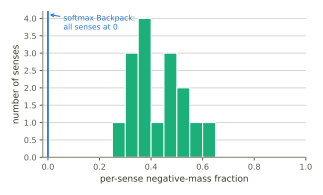
Figure 4 : Per-sense negative-mass fraction of the differ- ential Backpack in the main configuration (k=16); 0 is purely excitatory,1purely inhibitory.
Original paper · CC BY 4.0 · Konstantinos Skianis, Giannis Nikolentzos, Polykarpos Meladianos, Michalis Vazirgiannis · Differential Backpack Language Models: Sense Inhibition via Signed Contextualization Weights · Original paper figure · Extracted the figure area from page 12 of the original PDF.Why non-negative sense weights can't drop a wrong sense
A Backpack predicts each next token from a weighted sum of sense vectors taken from the preceding tokens. Each vocabulary item owns k non-contextual sense vectors, and the hidden states of an underlying Transformer set how much weight each sense receives. In the original model every contextualization weight is a softmax output, so it is never negative.
Context can therefore select a sense or ignore it, but it can't make a sense push the prediction the other way. When bank appears in a financial sentence, its river sense leaks into the prediction. The sum has no term that cancels this wrong-sense contribution.
This matters because the linear readout is what makes each sense's contribution exactly inspectable. Because the readout is linear in the senses, any sense of any word has an exact, inspectable contribution to any prediction. The authors separate the linear readout, which carries the interpretability, from the non-negative combination, which merely restricts it.
They keep the first and relax the second.
The cost of this constraint shows up in perplexity on WikiText-103 at matched parameters. The softmax Backpack scored 24.60 perplexity, compared to 21.09 for a plain Transformer. Its tax over the Transformer is 3.51 perplexity points. The DIFF Transformer scored 21.00 on the same setup, so the authors test whether differential attention helps inside the trunk instead.
Signed sense weights from two softmax maps
The key idea is to keep the linear readout and relax only the non-negativity of the sense weights. The authors compute each sense's weight as a first softmax map minus a second softmax map scaled by a learned per-sense gain. They call the result a differential Backpack and set it against the original softmax Backpack.
Concretely, the sense weights for sense \(\ell\) are \(A^{\ell}=\mathrm{softmax}(Q_1K_1^\top/\sqrt{d_h})-\lambda^{\ell}\,\mathrm{softmax}(Q_2K_2^\top/\sqrt{d_h})\), with both maps causal. The first map excites a sense, and the second, scaled by \(\lambda^{\ell}\), inhibits it. Each entry lies in \([-\lambda^{\ell},1]\) and each row's total mass is \(1-\lambda^{\ell}\).
The gain is reparameterized as a difference of two exponentials plus an initial value, following the DIFF Transformer, and it starts at 0.5 at the sense layer.
The readout is still a sum of sense vectors weighted by \(A^{\ell}\), so the logits remain an exact linear function of the sense vectors. Each sense's contribution to each position is therefore its signed weight times its vector times the tied embedding. The authors apply no normalization after the combination, because normalizing the output would make the readout nonlinear in the senses.
Sense vectors are layer-normalized when they are created instead.
The authors expect the change to matter most in a Backpack, not in a standard Transformer. A Backpack has no such downstream route, because its sense vectors are frozen and can't be reshaped, so non-negative weights block any "not this sense" signal.
The second map costs one extra query/key projection at the sense layer, about 0.5M parameters or 0.8% of the 70M model. The authors report about 6% of forward FLOPs and a 12–16% cost in training throughput.
What signed weights can reach
A softmax Backpack's output is a convex mix of the senses present in context, so it can't leave the region those senses span. Proposition 1 covers a differential Backpack whose gain lies in (0,1) and i≥2. A row is realizable when its entries sum to 1−λ and their negative part totals at most λ. Normalized by 1−λ, these coefficients range over an ℓ1 ball section that properly contains the simplex.
The paper calls this the geometry of signed sparse coding, which lets signed weights extrapolate past the senses in context.
Proposition 2 turns this into a concrete gap at k=1 with orthonormal u and v. A target of (1+s)u−sv lies outside the segment a softmax Backpack can reach. Every softmax Backpack has squared error at least 2s², while a differential Backpack reaches zero exactly when λ ≥ s/(1+s). The separation depends on λ, which the model grows during training.
The authors checked this floor on a synthetic task with six orthonormal targets, trained by regression on the combined sense output. With more heads the softmax error falls to 0.092 at k=4, 0.028 at k=8 and 0.002 at k=16, as heads cancel.
Trained models sometimes push the gain above 1, with individual senses reaching 2.15 at k=4. Those senses are net inhibitory, so the separation argument of Proposition 2 no longer applies to them. Forcing the gain into (0,1) with a sigmoid costs 0.32 perplexity at k=4, from 33.30 to 33.62. At k=16 the same constraint changes perplexity from 28.84 to 28.79, so it costs nothing measurable there.
The authors didn't test whether this regime matters beyond these two sense counts.
Perplexity gap at matched parameters
At matched parameters, the differential Backpack lowers exact validation perplexity on WikiText-103 from 24.60 to 23.52. That cuts the gap to the plain Transformer from 3.51 to 2.43, a 31% reduction at equal parameters and budget. The gap narrows but doesn't close, so the authors frame the change as a cheaper interpretable architecture, not a state-of-the-art gain.
Three-seed reruns of the two arms gave 24.60 with standard deviation 0.12 and 23.52 with standard deviation 0.04. The 1.08 ppl gap between these arms is 14 standard errors apart, with Welch's t=14.4.
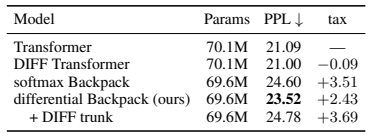
Table 1 : WikiText-103 exact validation perplexity at matched parameters and identical training budget (20k steps, single seed); tax is the gap to the plain Trans- former.
Original paper · CC BY 4.0A DIFF Transformer reaches 21.00, compared to 21.09 for the plain Transformer, so differential attention alone doesn't move the baseline. Adding differential attention to the differential Backpack's underlying Transformer raises perplexity to 24.78, which is worse than the softmax Backpack. The authors read this as evidence that the gain comes from signing the sense weights, not from differential attention in general.
The same comparison holds at 170M, where the differential Backpack reaches 23.15 against 23.84 for the softmax Backpack over three seeds. The sense-count sweep on WikiText-103 with 8k steps shows the differential Backpack ahead at every inventory size. It scores 33.3 compared to 34.6 at k=4, 28.8 compared to 30.4 at k=16, and 27.0 compared to 28.0 at k=64.
The authors note that the idealized separation in §3.3 shrinks with k, so it doesn't fully explain this profile.
Ladder of rules and controls
The ladder separates the linear interface from the signed form, and the first step is a nonlinear readout. That gain costs the attribution residual, which jumps from 6×10 −7 to 0.66, so linearity is cheap in perplexity but valuable for attribution.
The differential Backpack carries 19M more parameters in its non-contextual dictionary, so the tax reflects depth the dictionary displaces. Removing the constraints entirely gives 26.67, worse than softmax at 24.60, and hard selection gives 31.58.
To test whether signing causes the gain, the authors built three controls that each remove one ingredient of the differential form. The sum control adds the two maps with softplus of the gain, keeping the two-map structure but leaving weights non-negative. The λ=0 control freezes the gain at zero, which switches inhibition off and doubles as a noise check.
Signedness alone doesn't explain the gain, because Cog Attention reaches 24.72, close to softmax, despite 0.39 negative weight mass. The authors credit the difference-of-softmax structure with its positive row sum, which matches the geometry of Proposition 1.
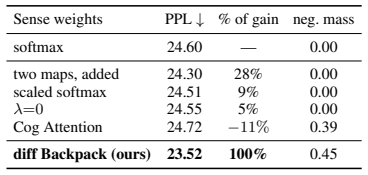
Table 3 : Controls for the causal claim (WikiText-103, main configuration). “% of gain” is the share of diff’s 1.08 ppl improvement over softmax each rule recovers.
Original paper · CC BY 4.0How the learned inhibition shows up
The trained model places 45% of its weight mass on negative weights, which the softmax map never produces. The subtraction also engages more of the sense-by-position grid, which argues against the idea that subtraction simply sharpens selection.
Removing the subtraction at inference from a trained 70M differential Backpack raised validation perplexity from 23.5 to 350. The loss increase was largest after non-lexical tokens and fell mildly with polysemy, so inhibition looks like a general part of the combination.
For bank, the river sense's signed self-weight moves from −0.10 to −0.50 in a financial context, while its finance sense rises from +0.33 to +0.46. The softmax Backpack can only move one way, so its river sense goes from +0.07 to +0.06. This is the mechanism the authors point to: a wrong sense gets cancelled instead of merely left unused.
On every linear rung, the attributed change in the logit agrees with the actual change when the top pairs are removed, to numerical precision. With the MLP the rank correlation drops to 0.77–0.82, and the median contribution is off by 43–48%. Removing the ten top pairs cost 3.7 nats of target log-probability, compared to 0.01 for ten random pairs.
Frozen sentence representations and the WiC probe
The sense outputs of the differential Backpack are tested as frozen sentence representations with zero-shot STS-B similarity. STS-B scores mean-pooled representations by cosine similarity, with no trained parameters. At 70M the differential Backpack's sense outputs reach 0.495 Spearman on STS-B, compared to 0.372 for the softmax Backpack, a 33% relative gain.
At 170M the scores are 0.554 against 0.466, a 19% relative gain. At 350M the scores are 0.539 against 0.476, a 13% relative gain.
The Transformers' hidden states carry no attribution interface, so they are a different kind of baseline. The Transformer's hidden state scores 0.488 on STS-B at 70M, and the differential sense output scores 0.495. The DIFF Transformer's hidden state scores 0.499, so the differential sense output sits within noise of both. Cog Attention recovers part of the STS-B gain, at 0.422, but stays well short of diff.
The trade-off is syntactic: the differential Backpack's senses are slightly worse for POS tagging. Sense clustering ARI rises from 0.151 for the softmax Backpack to 0.174 for the differential one at 70M. SST-2 probes favour the differential senses at every scale, but each gap stays within one standard error.
The WiC probe is the negative result of the paper, and the authors use it to test whether signed weights help word-sense disambiguation. Each sentence pair gets a cosine similarity between the target word's occurrences under four representations, with a threshold fit on train. All features reach only 53–58% accuracy, against a majority class of 50%.
Every differential-minus-softmax difference lies within 1.7 standard errors, so the authors find no advantage for signed sense weights. The contextual hidden-state baseline reaches only 56–58%, so the probe can't diagnose these models at this scale. The inhibitory half of the signed self-weights reaches 55.3% at 170M and 54.2% at 70M, which the authors call small but measurable.
Debiasing by suppressing a gendered sense
The authors follow the sense-intervention protocol of Hewitt et al. (2023) and pick 20 profession nouns for the test. For each noun they find the most gendered sense exactly through the linear readout, comparing the he and she logits of that sense's vector. They then edit that sense's contextualization weights at inference in three ways: down-weighting them by 0.5, removing them, or suppressing them with the negated absolute value.
Suppression is the signed operation that only a differential Backpack performs natively, so the softmax Backpack can only be down-weighted or removed.
Bias is the mean absolute gap between the log-probabilities of he and she over six templates. Because an intervention can always cut bias by damaging the model, the authors also measure collateral damage as a KL divergence over the non-gendered vocabulary. Validation perplexity moves by less than 0.004 ppl, so the edits touch only the targeted senses.
At 170M suppression cuts bias by 39.7% (0.763 in absolute terms) at a collateral KL of 0.056. At matched damage, softmax removal achieves a 0.535 reduction while differential suppression achieves 0.763, 43% more.
Suppression adds substantially over removal for the differential Backpack, from 27.9% to 39.7%. For softmax it adds almost nothing, from 30.8% to 31.4%, which fits the view that only signed weights can exploit this pathway. At 350M the pattern repeats: 32.5% bias reduction at KL 0.042, against 27.7% at KL 0.233 for softmax. Differential Backpacks start from a higher baseline bias, so their advantage is controllability rather than lower bias to begin with.
Limitations: where the claims stop
The scale claims stop at 350M parameters, and the paper says whether the advantage survives at billion-parameter scale is open. The advantage persists across 70M to 350M but shrinks, from 4.4% relative at 70M to 2.9% at 170M and 2.5% at 350M. The tax reduction falls from 31% to 21% over the same range. Only the WikiText-103 and 170M OpenWebText comparisons use three seeds per arm.
The perplexity gains are consistent but modest in absolute terms. Differential contextualization narrows the Backpack's gap to a Transformer without closing it.
The interpretability evidence is qualitative, and the bank analysis shows one clear case rather than every sense. The inhibition ablation shows that inhibition is not polysemy-specific, so the disambiguation reading describes instances rather than the dataset-level role.
All experiments are on English, so the results aren't established for other languages. Signed weights also give up the conic selection reading of the original Backpack, though exact per-sense attribution is kept. The gender measure is binary, English and pronoun-based, so it omits non-binary identities and other forms of bias. A lower bias score doesn't make a model unbiased, and the same suppression edit could insert an association as well as remove one.
All models train on public corpora that carry their sources' biases, and the authors release no new data.
Paper info
- Authors
- Konstantinos Skianis, Giannis Nikolentzos, Polykarpos Meladianos, Michalis Vazirgiannis
- Venue
- arXiv · Preprint
- First published
- 2026-11-11
- Added
- 2026-11-13
- Updated
- 2026-11-11
- Version
- v1
- arXiv
- 2611.15642
- Category
- cs.CL
- Original paper terms
- CC BY 4.0
- What we show
- Paper info, commentary and permitted figures from the original paper
AI commentary is a separate explanation from the original paper and may contain errors. The original paper and figures follow each source's terms of use and any rights noted separately.
Abstract
Backpack language models predict with a strictly linear combination of non-contextual per-word sense vectors, weighted by non-negative contextualization scores. We show that non-negativity conflates two properties: the linear readout, which carries the interpretability, and the conic combination, which merely restricts it. We relax the latter by computing the sense weights with differential attention, a difference of two softmax maps with a learned per-sense gain, so context can actively inhibit a sense; we call the result a differential Backpack. At equal parameters on WikiText-103 this cuts the Backpack's perplexity gap to a Transformer by 31%, improves over the softmax Backpack at every sense count, persists with a shrinking margin up to 350M parameters on OpenWebText, and is localized at the sense layer by ablations and controls. The learned inhibition is directly interpretable (a financial context drives the river sense of bank to -0.50), and the preserved per-sense attribution predicts counterfactual removals exactly. We tested a number of combination rules, showing the linear interface is nearly free. Making the readout nonlinear gains only 0.43 perplexity points while invalidating two thirds of the decomposition. The differential Backpack's senses are also better representations, improving zero-shot sentence similarity by up to 33%.
Quote from the paper
Konstantinos Skianis, Giannis Nikolentzos, Polykarpos Meladianos, Michalis Vazirgiannis (2026). Differential Backpack Language Models: Sense Inhibition via Signed Contextualization Weights. arXiv:2611.15642v1. https://arxiv.org/abs/2611.15642v1
BibTeX
@misc{skianis2026differential,
  title = {{Differential Backpack Language Models: Sense Inhibition via Signed Contextualization Weights}},
  author = {Konstantinos Skianis and Giannis Nikolentzos and Polykarpos Meladianos and Michalis Vazirgiannis},
  year = {2026},
  eprint = {2611.15642},
  archivePrefix = {arXiv},
  url = {https://arxiv.org/abs/2611.15642v1}
}