Paper commentary
LLMs and the Homogenization of Teaching
Directly prompted LLMs produce less diverse math problems and essay feedback
- Problem LLMs often lack diversity in open-ended text, which can narrow the thinking students are invited to do. It was unclear whether this holds for math items and essay feedback.
- Method The authors compare frontier and open-weight models with human-written references, scoring lexical, semantic and instructional-form diversity. They also test diversity prompting and post-training.
- Results Directly prompted outputs were 78% higher on Self-BLEU and 51% higher on embedding similarity than human-authored content.
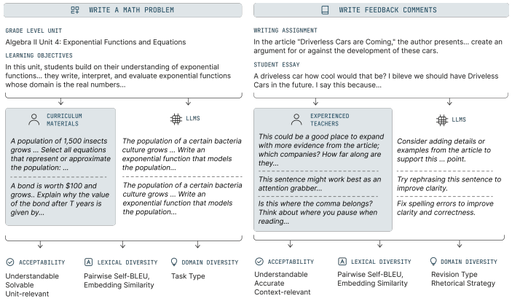
Figure 1 : We study diversity in two educational generation tasks: math item generation and essay feedback.
Original paper · CC BY 4.0 · Mei Tan, Hyunji Nam, Hari Subramonyam, Dorottya Demszky · LLMs and the Homogenization of Teaching · Original paper figure · Extracted the figure area from page 2 of the original PDF.Why homogeneity matters in teaching
Materials decide whether students compute, interpret, evaluate or connect ideas. LLMs are now used to produce tutoring responses, lesson plans, assessments and feedback, and studies have flagged errors in these outputs. Correct output can still be narrow, though, because a system that keeps offering the same few moves looks competent while limiting what students practise.
The authors connect this to a wider literature showing that LLM outputs cover only a slice of the human response distribution. Post-training may add to this through a typicality bias, and human demonstrations are themselves modal. So the paper asks whether directly prompted models generate more homogeneous content than human-authored content in math items and essay feedback.
Human references and model settings
The math references come from a filtered subset of the public MathFish dataset, with 1,477 unique problems from Illustrative Mathematics. The authors removed duplicate items and excluded problems that depended on images or tables. The essay feedback references are 3,021 inline excerpt-comment pairs written by 61 experienced U.S. middle and high school ELA teachers.
Those teachers averaged 8.25 years of teaching experience, and the comments address 448 student essays across 18 writing assignments.
Six models are evaluated: GPT-5.2, Gemini-3.5-Flash, Llama-3.3-70B Versatile, Qwen-3.6-27B, Llama-3.1-8B-Instruct and Qwen-2.5-7B-Instruct. Direct prompting gives the model the unit's learning objective summary for math, or the essay and its assignment for feedback. Verbalized sampling asks the model for N possible responses, each with an estimated probability, while negatively correlated sampling asks for N responses that differ from one another.
Figures 2 and 3 show the prompts for each condition.
Post-training uses supervised fine-tuning (SFT) and direct preference optimization (DPO) on the two open-weight models, Qwen-2.5-7B-Instruct and Llama-3.1-8B-Instruct. SFT trains each example on the task context paired with a human-authored response. The authors train with OpenRLHF, and their training details and hyperparameters sit in Appendix D.
Masking and acceptability filtering
Masking targets surface variation, so renamed variables and copied student wording don't inflate the diversity scores. Each output gets a second copy with spans swapped for placeholders, and both copies are scored. GPT-5-nano proposes the maskable spans, and programmatic checks plus targeted human review catch its likely errors. In math, names and labels become [text variable], equation letters become [equation variable], and numbers take a type tag such as [fraction].
In feedback, quotes from the essay become [quote], rewrites become [rewrite], and suggested new text becomes [insertion]. Masking can't strip all essay-specific language, since feedback reacts to what the student wrote.
Low-quality outputs can look diverse, so the authors score only outputs that pass an acceptability check. Three LLM judges, GPT-5-nano, Claude-Haiku-4.5, and Gemini-2.5-Flash-Lite, evaluate every output, and the team adjudicates any case without unanimous agreement. Outputs must be understandable first, and the same criteria apply to human-authored and model-generated responses.
For math, a problem must be solvable and unit-relevant, so it has enough information for a valid solution and addresses the unit's content. The team reviewed all 1,616 math disagreement cases and overturned the majority judgment in 26.2% of them. Disagreements often came from multiple-choice problems with no correct answer or from references to missing diagrams.
For feedback, a comment must be accurate and context-relevant, so it can't invent or misdiagnose an issue. Claude-Sonnet-5 adjudicated 37,056 feedback disagreement cases, informed by a manual audit of 200 sampled cases. The team manually reviewed 5,000 overturned cases and agreed with the adjudicator in 96% of them.
How diversity is measured
Self-BLEU averages pairwise BLEU-3 among the outputs for each instructional unit, so lower values mean more varied outputs. They average Self-BLEU across those samples, then across units or assignments, and report both original and masked text.
Embedding similarity is the mean pairwise cosine similarity among output embeddings, computed with text-embedding-3-small. Like Self-BLEU, they report embedding similarity on both unmasked and masked text.
For instructional form, Claude-Sonnet-5 acts as an LLM judge that labels each generated output with codebooks adapted from educational research. In math, Task Type records the mathematical activity a problem asks students to perform, such as compute, construct, interpret, analyze, connect or evaluate. For essay feedback, Revision Type records the revision work a comment makes available, and Rhetorical Strategy records how the comment is delivered.
Each comment receives all applicable revision types and rhetorical strategies, and the judge's labels agreed with manual annotations in 88% of Math Task Types.
Direct prompting narrows the outputs
Directly prompted models fall well short of human references on lexical and semantic diversity in both tasks. For math items, Self-BLEU runs 73–136% higher and embedding similarity 41–112% higher than for human references. For essay feedback, Self-BLEU runs 45–98% higher and embedding similarity 27–50% higher. Self-BLEU averages pairwise BLEU-3 across outputs for each instructional unit, so lower values mean more varied text.
Embedding similarity uses text-embedding-3-small vectors, and the authors compare pairwise cosine similarity within each unit.
The gap survives masking, which strips quotes, names, and numbers that could inflate variety. In essay feedback, masking widens the embedding similarity gap from 27–50% to 48–59%. The authors read this as models getting more of their apparent variety from surface features than human authors do. In the unmasked math table, the human Self-BLEU is 0.394, compared to 0.852 for GPT-5.2.
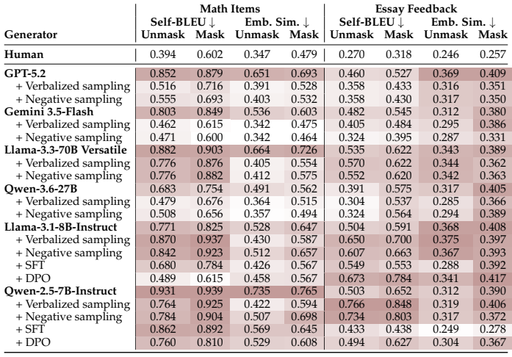
Table 3 :Lexical and semantic diversity across math items and essay feedback.We report average pairwise Self-BLEU and embedding similarity (Emb. Sim.) within topic; lower values indicate greater diversity. Masked variants are computed after pre-processing to remove superficial variation.
Original paper · CC BY 4.0The gap also shows up in instructional form, not only in wording. Compute tasks make up about 49% of human-authored math problems but 81% of problems from direct prompting. Compute and construct together account for about 96% of model-generated problems. Analyze and connect each account for less than 1% of generated problems, so models rarely ask students to analyze worked reasoning or connect representations.
In feedback, operate comments make up 48% of human comments but 73% of model comments under direct prompting. Correction strategies cover 25% of human comments but 56% of model comments. Because the models amplify the forms already most common in human content, the narrowing is a concentration rather than a new habit.
Diversity prompts and post-training add variety without new forms
Verbalized sampling and negatively correlated sampling each ask the model for 20 responses in a single call. For frontier models, diversity prompting cuts average Self-BLEU by 33.6% and embedding similarity by 28.0%. Even so, frontier outputs stay 66.2% more homogeneous on Self-BLEU than human content, and 27.3% more on embedding similarity.
Masking removes 25–51% of the Self-BLEU gain for frontier models, so part of that improvement is surface wording.
For open-weight models, prompting shows no significant effect on Self-BLEU and lowers embedding similarity by 11.7%. Under diversity prompting, compute tasks fall from 81% to 64% of math problems, still above the 49% human share. Vocabulary grows 91% for interpret items and 74% for evaluate items, yet those two types cover under 5% of generated problems.
SFT cuts average Self-BLEU by 12.6% and embedding similarity by 20.6%, while DPO cuts them by 10.9% and 16.0%. On these conventional metrics, smaller open-weight models gain more from post-training than from diversity prompting. Even so, SFT outputs remain 78.3% more homogeneous on Self-BLEU than human-authored content, and DPO outputs remain 81.9% more homogeneous.
These gains cost acceptability, since only 76% of Llama-3.1-8B-Instruct DPO math problems are solvable. For SFT, only 75% of comments meet the accuracy or relevance criteria for both models. Among acceptable outputs, compute and construct still make up 96% of post-training math problems, leaving 4% for the other seven types. SFT also overproduces questions, with 41.5% of its comments containing one against 27% in the human training data.
What bounds these results
Masking can't fully remove essay-specific language, because feedback is inherently reactive to student writing. So some feedback variation stays tied to the student text, even after the masked metrics are computed. The authors call their human reference distributions constrained, so they don't set a ceiling on diversity. Claude-Sonnet-5 labels the domain measures, and its labels were checked against manual annotations.
On a stratified random sample of 100 outputs per task, agreement was 88% for Math Task Types, 96% for Feedback Revision Types and 92% for Feedback Rhetorical Strategies.
The post-training experiments cover only Qwen-2.5-7B-Instruct and Llama-3.1-8B-Instruct. They didn't apply SFT or DPO to frontier models such as GPT-5.2. Training used 10 of the 20 math units and 9 of the 18 writing assignments, with the rest held out for evaluation. The study covers two educational generation tasks, math items and essay feedback, and no others.
DPO training loss collapsed almost immediately, which the authors attribute to stylistic differences that make the preference signal easy to exploit.
Neither Self-BLEU nor embedding similarity shows whether diversity is consequential in practice. Acceptability judgments rest on LLM judges, and the authors manually reviewed 1,616 math disagreement cases. They overturned the majority judgment in 26.2% of those math cases. For essay feedback, Claude-Sonnet-5 adjudicated 37,056 disagreement cases, informed by a manual audit of 200 sampled cases.
A manual review of 5,000 overturned cases agreed with the adjudicator in 96% of them.
Essay feedback comes from 3,021 comments written by 61 teachers, covering 448 essays and 18 writing assignments. Models ran at temperature 1 with model-default top-p, and the authors didn't test other sampling settings.
Paper info
- Authors
- Mei Tan, Hyunji Nam, Hari Subramonyam, Dorottya Demszky
- Venue
- arXiv · Preprint
- First published
- 2026-11-10
- Added
- 2026-11-13
- Updated
- 2026-11-10
- Version
- v1
- arXiv
- 2611.14828
- Category
- cs.CL
- Original paper terms
- CC BY 4.0
- What we show
- Paper info, commentary and permitted figures from the original paper
AI commentary is a separate explanation from the original paper and may contain errors. The original paper and figures follow each source's terms of use and any rights noted separately.
Abstract
Large language models (LLMs) are known to lack diversity in open-ended text generation, a limitation that is especially consequential in education, where homogeneity can narrow the kinds of thinking and disciplinary work students are invited to do. We study diversity in two educational generation tasks: math items and essay feedback. We compare frontier and open-weight models with human-authored reference distributions using lexical, semantic, and domain-grounded measures. For math, we examine the mathematical activities students are asked to perform; for feedback, we examine the revision work requested and the rhetorical strategies used to communicate it. We evaluate direct prompting, two diversity prompting methods, and post-training. Across both tasks, directly prompted model outputs are markedly less diverse than human-authored content--78% higher on lexical (Self-BLEU) and 51% higher on semantic (embedding) similarity--and represent a narrower range of instructional forms. Diversity prompting and post-training increase variation largely through surface features without broadening the instructional repertoire. Models inherit and amplify the most normative routines of human instruction. Overcoming mode collapse in education will require richer instructional data and investment in teachers' creative capacity and professional judgment.
Quote from the paper
Mei Tan, Hyunji Nam, Hari Subramonyam, Dorottya Demszky (2026). LLMs and the Homogenization of Teaching. arXiv:2611.14828v1. https://arxiv.org/abs/2611.14828v1
BibTeX
@misc{tan2026llms,
  title = {{LLMs and the Homogenization of Teaching}},
  author = {Mei Tan and Hyunji Nam and Hari Subramonyam and Dorottya Demszky},
  year = {2026},
  eprint = {2611.14828},
  archivePrefix = {arXiv},
  url = {https://arxiv.org/abs/2611.14828v1}
}