論文解説
LLMs and the Homogenization of Teaching
LLMと教育の画一化
- 課題 LLMが作る数学の問題とフィードバックは、人が書いた教育資料より狭い課題タイプに集中するのかが問題です。
- 手法 Self-BLEUと埋め込み類似度に、マスキングと受容性チェックを加えます。さらに教育用コードブックで、課題タイプの分布を比較します。
教育コンテンツの同質化問題
LLMが数学の問題やエッセイのフィードバックを作るとき、出力が狭い範囲に集中する現象を扱います。この論文は、正確で理解しやすい出力であっても、同じ種類の課題とフィードバックを繰り返すだけでは、学生が考えたり探究したりする機会が減ると見ています。そのため、語彙や意味の多様性に加えて、教育課題のタイプの幅も合わせて測定します。教育資料が学生にどのような思考や学術的な作業を求めているのかが、中心となる問いです。
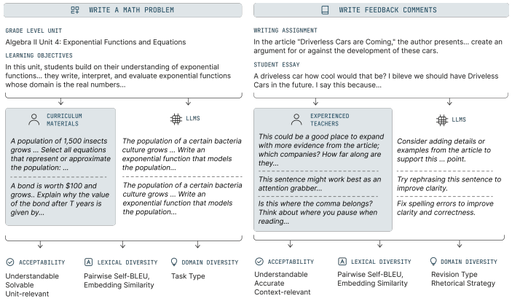
Figure 1 : We study diversity in two educational generation tasks: math item generation and essay feedback.
出典 · CC BY 4.0 · Mei Tan, Hyunji Nam, Hari Subramonyam, Dorottya Demszky · LLMs and the Homogenization of Teaching · 論文の図を引用 · 元のPDFの2ページ目から図の部分を抽出しています。人間のデータとモデル生成の設定
人間の基準データとして、Illustrative Mathematicsを基にしたMathFishのサブセットの数学の問題1,477件と、61人の教師が書いた3,021件のインラインフィードバックのコメントを使いました。モデルはGPT-5.2、Gemini-3.5-Flash、Llama-3.3-70B Versatile、Qwen-3.6-27B、Llama-3.1-8B-Instruct、Qwen-2.5-7B-Instructを含みました。生成条件は、直接プロンプト、Verbalized samplingやnegatively correlated samplingのような多様性プロンプト、SFTとDPOによる事後学習に分けられます。
マスキングと受容性チェック
表面的な語彙の違いで多様性の指標が膨らまないように、各出力についてマスクされたバージョンを作り、元の出力とマスク版の両方で多様性を計算しました。数学の問題では変数名と数値を、フィードバックでは学生の文章の引用と提案文をタグに置き換えました。さらに分析の前に、理解しやすさ、解答可能性、正確さ、文脈との関連性を判定し、基準を満たした出力だけを残しました。判定が食い違った事例は、人が確認しました。
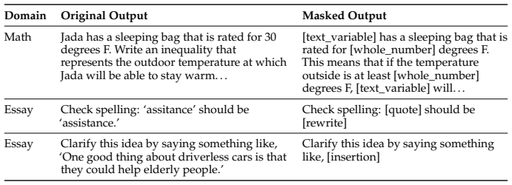
Table 1 : Examples of unmasked and masked outputs for math items and essay feedback.
出典 · CC BY 4.0 · Mei Tan, Hyunji Nam, Hari Subramonyam, Dorottya Demszky · LLMs and the Homogenization of Teaching · 論文の図を引用 · 元のPDFの5ページ目から図の部分を抽出しています。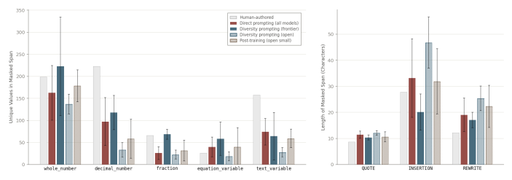
Figure 6 :Diversity of masked text in math items and essay feedback.Left: number of unique values for each masked variable type in math problems. Right: average length of masked text spans in essay feedback. Error bars show 95% confidence intervals across models.
出典 · CC BY 4.0 · Mei Tan, Hyunji Nam, Hari Subramonyam, Dorottya Demszky · LLMs and the Homogenization of Teaching · 論文の図を引用 · 元のPDFの10ページ目から図の部分を抽出しています。語彙・意味・ドメインの指標
語彙の多様性は、BLEU-3を基にしたSelf-BLEUで測定しました。意味の多様性は、text-embedding-3-smallの埋め込み間の平均ペアワイズコサイン類似度で測定しました。どちらも値が低いほど多様性が大きくなります。ドメインの測定では、数学の課題タイプ、フィードバックの修正タイプ、修辞戦略を、教育研究に基づくコードブックで分類し、分布の幅を見ます。
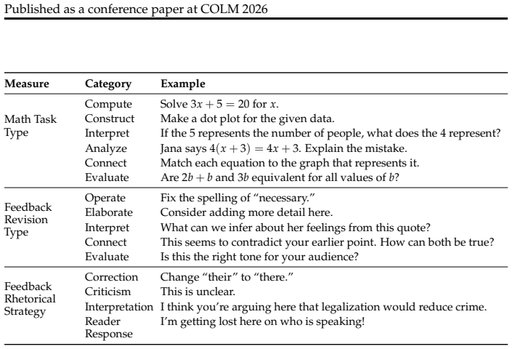
Table 2 : Selected examples of domain-grounded measures that illustrate the breadth of learning opportunities and disciplinary work that educational materials make available. Additional categories and all definitions and examples are provided in Appendix E.
出典 · CC BY 4.0 · Mei Tan, Hyunji Nam, Hari Subramonyam, Dorottya Demszky · LLMs and the Homogenization of Teaching · 論文の図を引用 · 元のPDFの7ページ目から図の部分を抽出しています。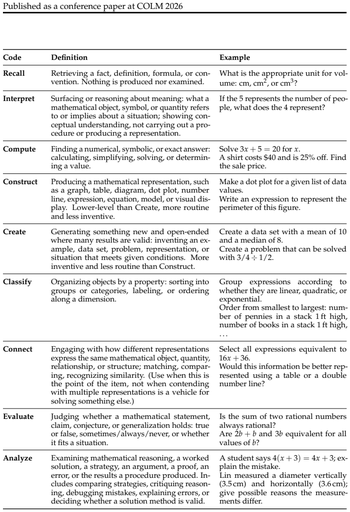
Table 7 : Codebook for classifying the mathematicalTask Type
出典 · CC BY 4.0 · Mei Tan, Hyunji Nam, Hari Subramonyam, Dorottya Demszky · LLMs and the Homogenization of Teaching · 論文の図を引用 · 元のPDFの23ページ目から図の部分を抽出しています。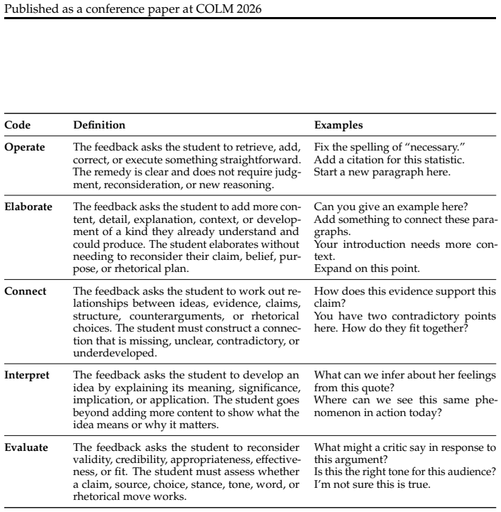
Table 8 : Codebook for classifying the feedbackRevision Type.
出典 · CC BY 4.0 · Mei Tan, Hyunji Nam, Hari Subramonyam, Dorottya Demszky · LLMs and the Homogenization of Teaching · 論文の図を引用 · 元のPDFの24ページ目から図の部分を抽出しています。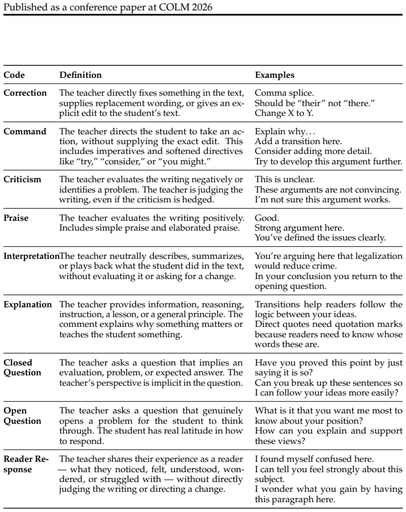
Table 9 : Codebook for classifying theRhetorical Strategyused to deliver feedback.
出典 · CC BY 4.0 · Mei Tan, Hyunji Nam, Hari Subramonyam, Dorottya Demszky · LLMs and the Homogenization of Teaching · 論文の図を引用 · 元のPDFの25ページ目から図の部分を抽出しています。直接プロンプト出力の同質性
直接プロンプトを使った6つのモデルはすべて、人間の参照データより Self-BLEUが高くなりました。数学の問題では、Self-BLEUが人間の参照より73–136%高く、埋め込み類似度は41–112%高くなりました。フィードバックでは、Self-BLEUが45–98%、埋め込み類似度が27–50%高くなりました。マスキング後、フィードバックの埋め込み類似度の差は48–59%に広がりました。
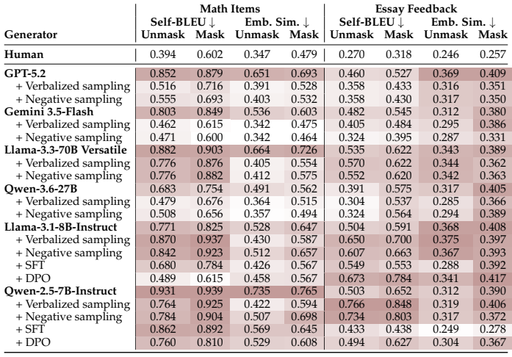
Table 3 :Lexical and semantic diversity across math items and essay feedback.We report average pairwise Self-BLEU and embedding similarity (Emb. Sim.) within topic; lower values indicate greater diversity. Masked variants are computed after pre-processing to remove superficial variation.
出典 · CC BY 4.0 · Mei Tan, Hyunji Nam, Hari Subramonyam, Dorottya Demszky · LLMs and the Homogenization of Teaching · 論文の図を引用 · 元のPDFの8ページ目から図の部分を抽出しています。支配的な課題タイプへの集中
詳細化の要求は18%から28%に増えました。数学の問題では、computeの課題が人間のデータの約49%から直接プロンプトの出力では81%に増え、analyzeとconnectはそれぞれ1%未満でした。
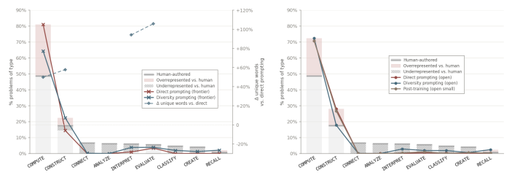
Figure 5 :Distribution of math task types.Human-authored and model-generated problems under direct prompting, diversity prompting, and post-training. Left: frontier models; right: open-weight models. Dashed lines show the percentage change in unique words relative to direct prompting (right axis).
出典 · CC BY 4.0 · Mei Tan, Hyunji Nam, Hari Subramonyam, Dorottya Demszky · LLMs and the Homogenization of Teaching · 論文の図を引用 · 元のPDFの9ページ目から図の部分を抽出しています。多様性への介入と事後学習の効果
SFTではSelf-BLEUが12.6%、DPOでは10.9%下がりました。事後学習のあとも、数学の課題の分布はcomputeとconstructを中心に残りました。
SFTフィードバックにおける質問の過剰
SFTのフィードバックでは、質問を含むコメントが41.5%で、人間の学習データの27%より多くなりました。同じSFTの出力は語彙がより反復的で、3語のフレーズを3–4倍多く繰り返しました。この結果はSFTのフィードバックに限った観察で、DPOのフィードバック全体の結論には広げていません。
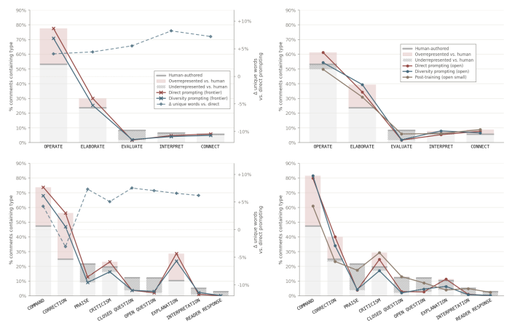
Figure 4 :Distribution of essay feedback types.Revision types (top) and rhetorical strate- gies (bottom) for human-authored and model-generated feedback under direct prompting, diversity prompting, and post-training. Left: frontier models; right: open-weight models. Categories are not mutually exclusive. Dashed lines show the percentage change in unique words relative to direct prompting (right axis).
出典 · CC BY 4.0 · Mei Tan, Hyunji Nam, Hari Subramonyam, Dorottya Demszky · LLMs and the Homogenization of Teaching · 論文の図を引用 · 元のPDFの9ページ目から図の部分を抽出しています。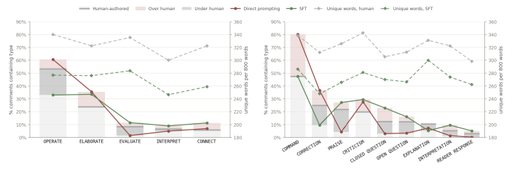
Figure 11 :Effects of SFT on essay feedback.Distribution of feedback revision types (left) and rhetorical strategies (right) for human-authored feedback, direct prompting, and SFT. Dashed lines show lexical diversity (unique words in equal-length samples, right axis).
出典 · CC BY 4.0 · Mei Tan, Hyunji Nam, Hari Subramonyam, Dorottya Demszky · LLMs and the Homogenization of Teaching · 論文の図を引用 · 元のPDFの22ページ目から図の部分を抽出しています。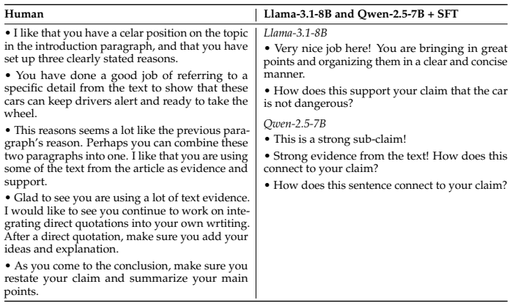
Table 13 : Human vs. SFT feedback on the same driverless cars essay.
出典 · CC BY 4.0 · Mei Tan, Hyunji Nam, Hari Subramonyam, Dorottya Demszky · LLMs and the Homogenization of Teaching · 論文の図を引用 · 元のPDFの29ページ目から図の部分を抽出しています。受容性と自動分類の限界
DPOを適用したLlama-3.1-8B-Instructの数学の問題は、76%しか解けず、理解できたのは82%だけでした。ドメイン測定の数学の課題タイプのラベルは、人のアノテーションと88%一致しました。そのため、自動分類の結果には誤差が残ります。
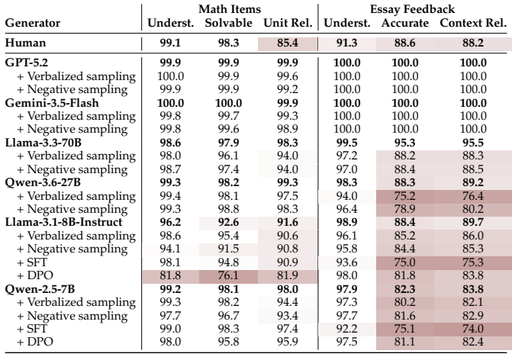
Table 6 :Validity of generated items across math problems and essay feedback.Percentage of generated items satisfying each quality criterion. Higher values indicate greater validity; cell shading marks values below 95%, with darker shading denoting lower validity.
出典 · CC BY 4.0 · Mei Tan, Hyunji Nam, Hari Subramonyam, Dorottya Demszky · LLMs and the Homogenization of Teaching · 論文の図を引用 · 元のPDFの20ページ目から図の部分を抽出しています。論文情報
- 著者
- Mei Tan, Hyunji Nam, Hari Subramonyam, Dorottya Demszky
- 学会・ジャーナル
- arXiv · プレプリント
- 公開日
- 2026年11月10日
- 登録日
- 2026年11月13日
- 更新日
- 2026年11月10日
- バージョン
- v1
- arXiv
- 2611.14828
- カテゴリ
- cs.CL
- ライセンス
- CC BY 4.0
- 掲載内容
- 論文情報・解説・論文の図
この解説は、Refivuの韓国語解説をAIで翻訳したものです。不正確な翻訳や誤りが含まれる可能性があります。論文と図の利用条件は各出典に従います。
アブストラクト
Large language models (LLMs) are known to lack diversity in open-ended text generation, a limitation that is especially consequential in education, where homogeneity can narrow the kinds of thinking and disciplinary work students are invited to do. We study diversity in two educational generation tasks: math items and essay feedback. We compare frontier and open-weight models with human-authored reference distributions using lexical, semantic, and domain-grounded measures. For math, we examine the mathematical activities students are asked to perform; for feedback, we examine the revision work requested and the rhetorical strategies used to communicate it. We evaluate direct prompting, two diversity prompting methods, and post-training. Across both tasks, directly prompted model outputs are markedly less diverse than human-authored content--78% higher on lexical (Self-BLEU) and 51% higher on semantic (embedding) similarity--and represent a narrower range of instructional forms. Diversity prompting and post-training increase variation largely through surface features without broadening the instructional repertoire. Models inherit and amplify the most normative routines of human instruction. Overcoming mode collapse in education will require richer instructional data and investment in teachers' creative capacity and professional judgment.
この論文を引用
Mei Tan, Hyunji Nam, Hari Subramonyam, Dorottya Demszky (2026). LLMs and the Homogenization of Teaching. arXiv:2611.14828v1. https://arxiv.org/abs/2611.14828v1
BibTeX
@misc{tan2026llms,
  title = {{LLMs and the Homogenization of Teaching}},
  author = {Mei Tan and Hyunji Nam and Hari Subramonyam and Dorottya Demszky},
  year = {2026},
  eprint = {2611.14828},
  archivePrefix = {arXiv},
  url = {https://arxiv.org/abs/2611.14828v1}
}