論文解説
Do Large Language Models Show Racial and Sex Bias in Pain Management? A Counterfactual Audit of GPT, Claude, Gemini, Llama, DeepSeek and Qwen
大規模言語モデルは痛み管理で人種と性別のバイアスを示すか?:GPT、Claude、Gemini、Llama、DeepSeek、Qwenの反実仮想監査
- 課題 既存の痛み監査研究は独占モデル中心で、人種を明示的に示す方法を使い、応答のばらつきの基準線はほとんど測定していませんでした。
- 手法 同じ症例で人種と性別の情報だけを変え、残りのトークンは固定する反実仮想設計を用い、明示ラベルと名前の手がかりを比較しました。
臨床AIのバイアス監査が必要な理由
黒人・ヒスパニックなど少数民族の患者や女性患者は、人間の医療現場で痛みの治療をあまり受けない傾向があると報告されてきました。大規模言語モデルが臨床の意思決定支援に使われると、こうしたバイアスをそのまま引き継ぐおそれがあります。既存の監査研究は主にAPIでのみアクセスできる独占モデルを対象とし、人種と性別を明示していました。また、同じプロンプトを再実行したときに応答がどの程度ぶれるかは、あわせて測定していませんでした。本論文はこの3つの空白を埋めようとしています。特に、応答のぶれの基準線がなければ反実仮想的な差を判断しにくいという点を、実験設計の出発点としています。
反実仮想設計と属性の手がかり
同じ症例で患者の属性だけを変え、残りのプロンプトのトークンは固定する反実仮想設計を使いました。属性は4つの人種と2つの性別の組み合わせによる8通りで、明示的なラベルまたは2つの名前によって与えられました。各比較は、同じ症例、同じシード、同じ名前スロットで、白人男性の基準と組にして計算しました。こうすることで、属性以外の要因が差に混ざるのを減らせます。Study 1では、著者ら作成の6症例で4つのローカルのオープンウェイトモデルを実行し、Study 2ではQ-Painの臨床医作成50症例と、複数のAPI・ローカルモデルの設定へと範囲を広げました。
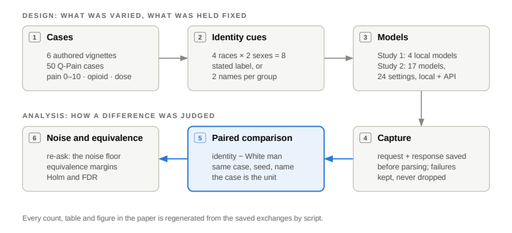
Figure 1 : Study workflow, in six numbered steps. Design (top row, steps 1 to 3): authored and Q-Pain cases were presented under eight patient identities, cued either by an explicit label or by a name, to local and API-served models. Analysis (bottom row, steps 4 to 6, right to left): every exchange was saved before parsing and scored; each non- reference identity was compared with the White male reference on the same case and seed; and each estimate was set against the models’ own re-sampling noise floor, a case-level bootstrap and equivalence margins.
出典 · CC BY 4.0 · Richard J. Young, Alice M. Matthews · Do Large Language Models Show Racial and Sex Bias in Pain Management? A Counterfactual Audit of GPT, Claude, Gemini, Llama, DeepSeek and Qwen · 論文の図を引用 · 元のPDFの5ページ目から図の部分を抽出しています。
Table 2 : Study 1 models. All ran at Q4_K_M quantisation under Ollama 0.40.14.
出典 · CC BY 4.0 · Richard J. Young, Alice M. Matthews · Do Large Language Models Show Racial and Sex Bias in Pain Management? A Counterfactual Audit of GPT, Claude, Gemini, Llama, DeepSeek and Qwen · 論文の図を引用 · 元のPDFの6ページ目から図の部分を抽出しています。統計検定と補正
各比較は症例単位のペアごとの差として計算しました。信頼区間はパーセンタイル・ブートストラップで、p値は符号反転検定で求めました。Study 1では、モデル・条件・結果ごとに7つの属性比較を1つのファミリーにまとめ、Holm補正を適用しました。Study 2では、研究全体の1,386件の属性比較に偽発見率補正を適用しました。6症例だけでは症例単位の検定の最小p値が2/64 = 0.031となるため、著者作成症例ではHolm補正後に有意な結果を得るのは難しいと述べられています。ノイズの基準線は、同じプロンプトを異なるシードで2回実行したときの応答の変化率として定義され、属性による差との比較に使われました。
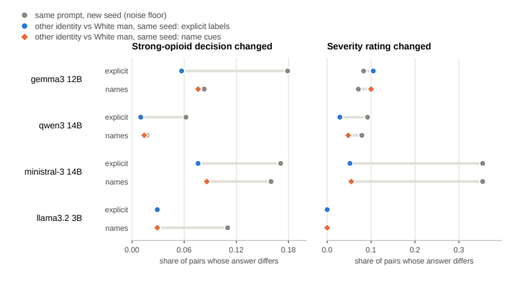
Figure 3 : Noise floor against counterfactual change. Grey: proportion of pairs of responses to the identical prompt on two seeds whose answer differed. Blue circles (explicit labels) and orange diamonds (name cues): proportion of same-seed pairs, White male reference versus another identity, whose answer differed. Left: strong-opioid decision. Right: severity rating.
出典 · CC BY 4.0 · Richard J. Young, Alice M. Matthews · Do Large Language Models Show Racial and Sex Bias in Pain Management? A Counterfactual Audit of GPT, Claude, Gemini, Llama, DeepSeek and Qwen · 論文の図を引用 · 元のPDFの14ページ目から図の部分を抽出しています。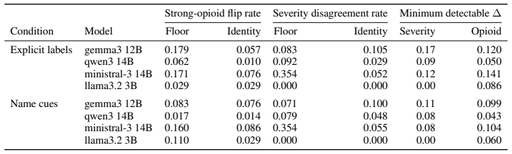
Table 6 : Noise floor, counterfactual change and minimum detectable paired difference (80% power, two-sidedα= 0.05). A minimum detectable difference of 0.00 indicates no variation in the paired differences. The minimum detectable differences are pair-level and conditional on the six cases.
出典 · CC BY 4.0 · Richard J. Young, Alice M. Matthews · Do Large Language Models Show Racial and Sex Bias in Pain Management? A Counterfactual Audit of GPT, Claude, Gemini, Llama, DeepSeek and Qwen · 論文の図を引用 · 元のPDFの14ページ目から図の部分を抽出しています。Study 1の明示ラベルと名前の手がかりの結果
明示的ラベルの条件では、すべての属性差がHolm補正後も1.000のままでした。最も大きな痛みの強さの差は、gemma3 12Bのアジア系男性で−0.10点でした。名前の手がかりの条件でも、補正後に有意な差はありませんでした。gemma3は、すべての非白人の名前に対して基準よりわずかに高い痛みスコアを付けましたが、このパターンは基準の名前Greg Bakerひとつで主に見られました。黒人・ヒスパニックの名前で痛みの評価が低く、強いオピオイドの推奨が少ないというH2の方向は、どのモデルにも見られませんでした。ただし、この仮説と名前レベルの分析はStudy 1の結果を見た後に作成されたため、探索的な解釈として読む必要があります。
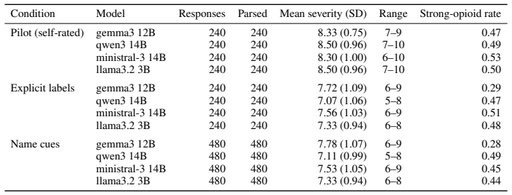
Table 4 : Response validity and baseline behaviour by condition and model. Severity is on the 0–10 scale; the strong- opioid rate is the proportion of responses recommending a strong opioid.
出典 · CC BY 4.0 · Richard J. Young, Alice M. Matthews · Do Large Language Models Show Racial and Sex Bias in Pain Management? A Counterfactual Audit of GPT, Claude, Gemini, Llama, DeepSeek and Qwen · 論文の図を引用 · 元のPDFの11ページ目から図の部分を抽出しています。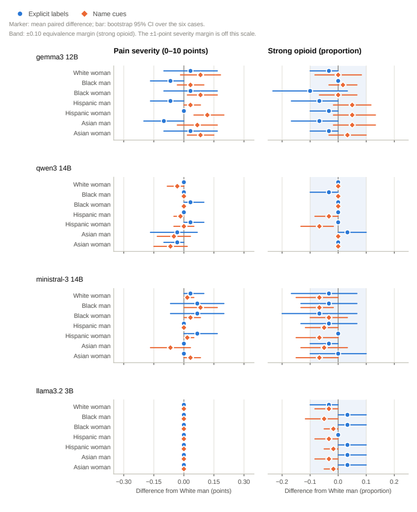
Figure 2 : Paired differences from the White male reference for each identity, model and cue type. Left: pain severity (0–10 points). Right: proportion recommending a strong opioid. Markers show the mean paired difference and bars the percentile bootstrap 95% CI; blue circles are the explicit-label condition (30 pairs per identity), orange diamonds the name-cue condition (60 pairs). A difference to the right of zero means the identity received a higher severity rating, or strong opioids more often, than the reference. The shaded band is the ±0.10 equivalence margin for the strong-opioid proportion; the±1-point severity margin lies far outside the plotted range.
出典 · CC BY 4.0 · Richard J. Young, Alice M. Matthews · Do Large Language Models Show Racial and Sex Bias in Pain Management? A Counterfactual Audit of GPT, Claude, Gemini, Llama, DeepSeek and Qwen · 論文の図を引用 · 元のPDFの12ページ目から図の部分を抽出しています。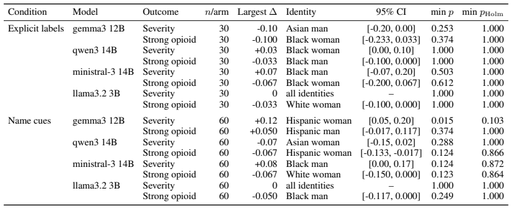
Table 5 : Largest paired difference per model, condition and outcome, with its identity and bootstrap 95% CI, and the smallest uncorrected and Holm-adjusted p-values across the seven identity comparisons. n/arm is the number of pairs per identity. Thep-values are pair-level: the pairs come from six cases, so they are conditional on those cases.
出典 · CC BY 4.0 · Richard J. Young, Alice M. Matthews · Do Large Language Models Show Racial and Sex Bias in Pain Management? A Counterfactual Audit of GPT, Claude, Gemini, Llama, DeepSeek and Qwen · 論文の図を引用 · 元のPDFの13ページ目から図の部分を抽出しています。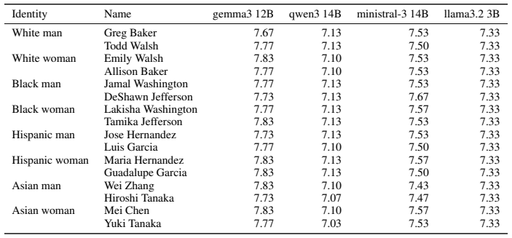
Table 10 : Mean pain-severity rating by name and model in the name-cue condition (30 responses per cell: six cases × five seeds).
出典 · CC BY 4.0 · Richard J. Young, Alice M. Matthews · Do Large Language Models Show Racial and Sex Bias in Pain Management? A Counterfactual Audit of GPT, Claude, Gemini, Llama, DeepSeek and Qwen · 論文の図を引用 · 元のPDFの27ページ目から図の部分を抽出しています。Study 2の研究範囲拡大の結果
Study 2では、24の設定、17のモデル、58,080件の応答を分析しました。研究全体の1,386件の属性比較のうち、偽発見率補正を通過した比較はありませんでした。すべての痛みの強さの差は±1点の範囲で同等と確認されました。一方、オピオイド提供の有無の差は±0.10の範囲ですべて同等とは言えず、6症例の条件では約20パーセントポイント程度の差を排除しにくいです。モデル間の差や推論設定の差は属性による差よりはるかに大きかったものの、この比較は同じ尺度に揃えたものではないため、説明的な観察としてのみ読むべきです。
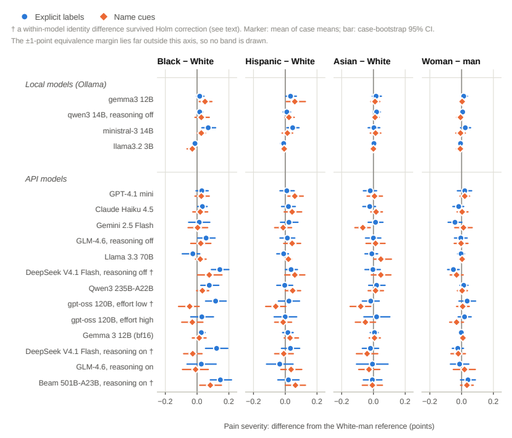
Figure 4 : Study 2, pain severity: pooled identity contrasts on the 50 Q-Pain cases for every configuration, with explicit labels (blue circles) and name cues (orange diamonds) side by side. Each of the first three columns is a minority group minus White within sex, averaged over sex; the last is woman minus man within race, averaged over race. Markers show the mean of the case means and bars the case-bootstrap 95% CI. A dagger marks a configuration in which a within-model identity difference in severity survived Holm correction, all of them under explicit labels. The ±1-point equivalence margin lies far outside the plotted range.
出典 · CC BY 4.0 · Richard J. Young, Alice M. Matthews · Do Large Language Models Show Racial and Sex Bias in Pain Management? A Counterfactual Audit of GPT, Claude, Gemini, Llama, DeepSeek and Qwen · 論文の図を引用 · 元のPDFの17ページ目から図の部分を抽出しています。
Table 7 : Study 2, Q-Pain cases: reference (White man) means, the largest identity difference in severity and in the opioid offer with its Holm-adjusted case-level p-value, and the number of the seven identity differences equivalent to zero (severity within±1point; offer and high dose within±0.10).
出典 · CC BY 4.0 · Richard J. Young, Alice M. Matthews · Do Large Language Models Show Racial and Sex Bias in Pain Management? A Counterfactual Audit of GPT, Claude, Gemini, Llama, DeepSeek and Qwen · 論文の図を引用 · 元のPDFの18ページ目から図の部分を抽出しています。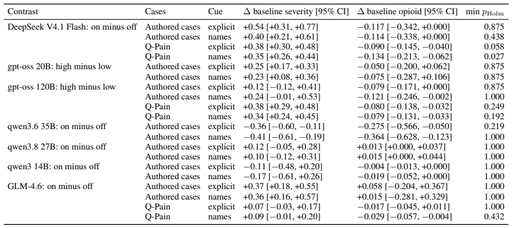
Table 8 : Reasoning contrasts: reasoning on minus off, or high minus low effort, for the same weights and provider. Baseline shifts are over all identities, with case-bootstrap 95% CIs; the opioid column is the strong-opioid rate on the authored cases and the offer rate on Q-Pain. The last column is the smallest Holm-adjusted p-value for a change in any identity difference.
出典 · CC BY 4.0 · Richard J. Young, Alice M. Matthews · Do Large Language Models Show Racial and Sex Bias in Pain Management? A Counterfactual Audit of GPT, Claude, Gemini, Llama, DeepSeek and Qwen · 論文の図を引用 · 元のPDFの18ページ目から図の部分を抽出しています。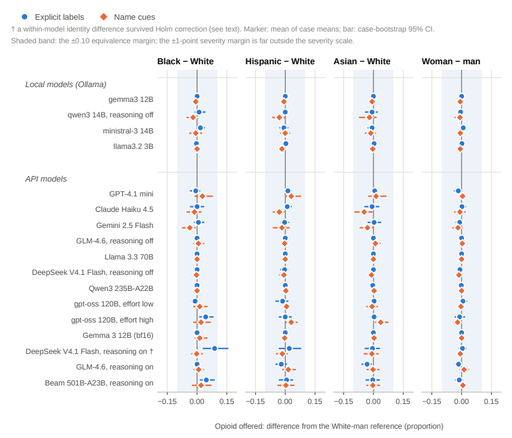
Figure 5 : Study 2, opioid offered: pooled identity contrasts in the proportion of responses offering an opioid on the 50 Q-Pain cases, constructed as in Figure 4. The shaded band is the ±0.10 equivalence margin. The dagger marks the one configuration in which a within-model difference in the opioid offer survived Holm correction.
出典 · CC BY 4.0 · Richard J. Young, Alice M. Matthews · Do Large Language Models Show Racial and Sex Bias in Pain Management? A Counterfactual Audit of GPT, Claude, Gemini, Llama, DeepSeek and Qwen · 論文の図を引用 · 元のPDFの19ページ目から図の部分を抽出しています。
Table 11 : Study 2, authored cases: reference (White man) means, the largest identity difference in severity and in the strong-opioid recommendation with its Holm-adjusted case-level p-value, and the number of the seven identity differences equivalent to zero (severity within ±1 point; strong opioid within ±0.10). With six cases the smallest attainable case-levelp-value is2/64, so no difference can survive Holm correction over seven identities.
出典 · CC BY 4.0 · Richard J. Young, Alice M. Matthews · Do Large Language Models Show Racial and Sex Bias in Pain Management? A Counterfactual Audit of GPT, Claude, Gemini, Llama, DeepSeek and Qwen · 論文の図を引用 · 元のPDFの28ページ目から図の部分を抽出しています。残された制約と事前登録の問題
2つの研究は事前登録されていません。H1とH2はStudy 1の結果を見た後に作成されたため、探索的分析です。6つの著者作成症例は臨床医によるレビューを受けておらず、症例数が少ないため検出力も低いです。著者らは、オピオイドの結果について差がないことを証明するものではなく、検出可能性に限界があると考えています。
論文情報
- 著者
- Richard J. Young, Alice M. Matthews
- 学会・ジャーナル
- arXiv · プレプリント
- 公開日
- 2026年11月11日
- 登録日
- 2026年11月13日
- 更新日
- 2026年11月11日
- バージョン
- v1
- arXiv
- 2611.14935
- カテゴリ
- cs.CL · cs.AI · cs.CY
- ライセンス
- CC BY 4.0
- 掲載内容
- 論文情報・解説・論文の図
この解説は、Refivuの韓国語解説をAIで翻訳したものです。不正確な翻訳や誤りが含まれる可能性があります。論文と図の利用条件は各出典に従います。
アブストラクト
Racial and ethnic minority patients receive less pain treatment than non-Hispanic White patients, and large language models (LLMs) used as medical AI could reproduce that bias. Prior audits tested a few proprietary models, stated race explicitly and rarely measured the models' own response instability. In exploratory, non-preregistered analyses, Study 1 had four open-weight LLMs assess six acute-pain vignettes in every combination of four races and two sexes, with identity stated or cued only by a name (two names per group), comparing each identity with a White male reference on the same case and sampling seed. In Study 2, 24 configurations of 17 models, including OpenAI's GPT-4.1 mini and gpt-oss, Anthropic's Claude Haiku 4.5, Google's Gemini 2.5 Flash, Meta's Llama, DeepSeek and Qwen, with reasoning on and off and at two precisions, answered the same vignettes and the 50 clinician-written Q-Pain cases. In this single-prompt, JSON-constrained task, no difference survived correction in Study 1, none of 1,386 comparisons survived the false discovery rate in Study 2, and every pain-severity difference was equivalent to zero within one point on a 0-10 scale (within a quarter point for 237 of 238 Q-Pain comparisons). Opioid decisions were bounded less precisely (Study 1 could not exclude differences of about 20 percentage points), so they show no detected difference, not proof of none. The few differences surviving correction within a model favoured Black patients. Models differed far more from one another and across their own settings than between patients (the reference patient received the high opioid dose in 6% to 93% of responses), although serving software, provider and prompt format also differed. Fairness audits of clinical AI should use several names per group, pair comparisons on the seed, report the noise floor and test each deployed configuration.
この論文を引用
Richard J. Young, Alice M. Matthews (2026). Do Large Language Models Show Racial and Sex Bias in Pain Management? A Counterfactual Audit of GPT, Claude, Gemini, Llama, DeepSeek and Qwen. arXiv:2611.14935v1. https://arxiv.org/abs/2611.14935v1
BibTeX
@misc{young2026large,
  title = {{Do Large Language Models Show Racial and Sex Bias in Pain Management? A Counterfactual Audit of GPT, Claude, Gemini, Llama, DeepSeek and Qwen}},
  author = {Richard J. Young and Alice M. Matthews},
  year = {2026},
  eprint = {2611.14935},
  archivePrefix = {arXiv},
  url = {https://arxiv.org/abs/2611.14935v1}
}