Paper commentary
DETER: Suppression During Pretraining for Tamper Resistance
DETER suppresses medical knowledge during pretraining to resist later fine-tuning
- Problem Unlearning applied after pretraining gets undone quickly once anyone with the open weights fine-tunes the model.
- Method DETER keeps filtering the pretraining corpus and, at fixed intervals, takes gradient ascent steps on removed medical documents. Unlike post-hoc unlearning, it runs during pretraining itself.
- Results At 1030M, DETER needed 20.36 times the PubMed fine-tuning tokens of filtering alone to reach the unfiltered model's PubMed loss.
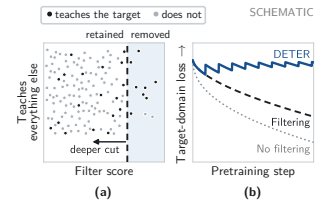
Figure 1 :Conceptual overview.(a) Filtering de- cides before pretraining: its selection still contains data that teach thetarget domainalong withre- tain capabilities, and a deeper cut removes more of both. (b) Adding periodic suppression provides a second layer of defense against target-domain learning.
Original paper · CC BY 4.0 · Maria Ios Glarou, Martin Jaggi · DETER: Suppression During Pretraining for Tamper Resistance · Original paper figure · Extracted the figure area from page 2 of the original PDF.Why post-training unlearning falls short
Open-weight models make unlearning hard, because anyone holding the weights can fine-tune them on the suppressed domain. Tamper resistance measures how well unlearning survives that fine-tuning, which amounts to how hard it is to recover the suppressed capability. Post-training unlearning methods tend to break under this threat model, since target performance returns after little extra fine-tuning.
Pretraining data filtering holds up better, so the authors build on it as their starting point.
Filtering has to trade off removing target-domain learning against keeping the retain distribution intact. Token-level removal and influence-based scoring improve this trade-off, but they still estimate which data will teach the target domain. The final model's knowledge remains a proxy drawn from those estimates, so target learning can persist even under careful selection.
Filtering gives the model no explicit signal about target-domain behavior, because that behavior emerges from the retained corpus. The highest-scoring removed documents could supply an explicit negative training signal, a second layer of defense. The question is whether suppressing target learning during pretraining resists fine-tuning better than filtering or post-hoc unlearning.
The authors test this by pretraining models of up to 1B parameters, using medical knowledge as the proxy target domain. Measured by PubMed fine-tuning tokens needed to reach the unfiltered PubMed loss, suppression more than doubles the count at every model size.
Suppression steps inside pretraining
The idea is to keep ordinary next-token pretraining on the filtered corpus and, at fixed intervals, take a suppression step on removed medical documents. The default suppression objective is gradient ascent on the negative next-token loss, which lowers the likelihood of the target tokens it sees. The authors expect this simple objective to work because ordinary pretraining keeps supplying a positive signal on retained data, without a replacement distribution being named.
Each suppression step starts from the current parameters and applies one optimizer update with the learning rate scaled by c. \[ \theta^{(s+1)} = \mathrm{Update}\left(\theta^{(s)}, \nabla_\theta \mathcal{L}_F(\theta^{(s)}); c\,\eta_t\right), \qquad \theta^{(0)} = \theta_t, \quad s = 0, \ldots, S-1 \] Here \(\theta_t\) holds the parameters after \(t\) pretraining steps, \(S\) is the number of suppression steps, and pretraining resumes from \(\theta^{(S)}\).
The schedule is set by the start step, the interval \(P\), the step count \(S\), the multiplier \(c\) and the objective \(\mathcal{L}_F\).
Pretraining and suppression update the same parameters but keep separate optimizer states. Under Muon, each keeps its own momentum buffer for the attention and MLP matrices, and the AdamW-optimized parameters get separate moment estimates for each. The two objectives therefore interact only through the shared weights.
The experiments use decoder-only transformers at 113M, 224M, 521M and 1030M parameters, trained with approximately 20 pretraining tokens per parameter. The main configuration removes 20% of corpus tokens by filtering, defines the suppression set from the top 5% of corpus tokens, and takes one suppression step every 50 pretraining steps at c=5.
The baselines are FILTERING, RMU applied after pretraining with the same target-token budget, and TOKEN FILTERING.
How much fine-tuning the suppressed models need
The adversary's yardstick is the count of PubMed fine-tuning tokens that brings a model down to the NO FILTERING PubMed loss. Dividing that count by the FILTERING count at the same size gives a normalized value, where 1.00× means no extra cost beyond filtering. Each figure is averaged over three fine-tuning seeds, and the learning rate is the one that reaches the threshold with the fewest tokens.
The gap widens with size, as DETER reaches 4.07× at 224M and 13.53× at 521M. At 1030M, RMU reaches 1.47× and TOKEN FILTERING reaches 2.16×, so both stay well below DETER.
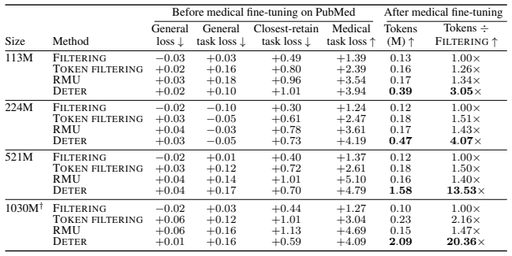
Table 1 :Suppression during pretraining requires substantially more target-domain fine-tuning than fil- tering, token filtering or post-hoc RMU, with little change in general loss.General loss is measured on held-out retained FineWeb-Edu; medical task loss is averaged over MedQuAD, MedMCQA, MedQA-USMLE, and MMLU medicine; general task loss is measured on MMLU STEM and non-STEM; and closest-retain task loss on MMLU biology. All are reported relative to NO FILTERING. The last two columns give the number of PubMed fine-tuning tokens needed to reach the PubMed loss of NO FILTERING, and this number normalized by the corresponding value for FILTERINGat the same model size. Results are averaged over three fine-tuning seeds. DETERdenotes suppression during pretraining. †1030M settings:c= 3; 20% token filtering.
Original paper · CC BY 4.0Figure 3 plots the attack curves, and the horizontal line marks the loss of NO FILTERING. For RMU, medical loss drops steeply early in fine-tuning and approaches the filtering curve. With suppression throughout pretraining, medical loss declines more gradually and stays above filtering across the attacks the authors ran. For the two largest models the attack extends to 0.08% of pretraining, and on medical tasks DETER converges with token filtering by the end at both sizes.
The authors read this as suppression changing the shape of the attack, though the normalized counts alone don't show that shape. The fine-tuning compute needed to undo suppression rises more than fivefold from the smallest model to the largest.
Does the damage stay on medicine
Suppression touches only a subset of the medical documents, yet the model gets worse at medicine more broadly before any fine-tuning. Held-out PubMed loss and the loss on correct medical benchmark answers both rise, as Figure 2 shows. The authors treat biology as the closest retained domain, because its text overlaps with medical text. Biology is affected less than medicine, and general-domain evaluations are affected far less still.
Over the same size, DETER's closest-retain task loss is +0.59, against +0.44 for FILTERING.
At 521M, DETER's closest-retain task loss is +0.70, below RMU's +1.01 and close to TOKEN FILTERING's +0.72. At the two largest scales, suppression separates medicine from retained loss more than the other interventions do.
At 224M with AdamW, shared statistics give a closest-retain loss of +54.10, against +2.02 for separate statistics. Sharing statistics makes suppression look stronger at the end of pretraining. Most of that extra medical loss disappears within the first few adversarial fine-tuning steps.
Restricting suppression to medical tokens reduces spillover to biology, but it lowers resistance relative to document-level suppression.
Starting suppression at 0%, 20% or 60%
The authors vary the onset of suppression over 0%, 20% and 60% of pretraining, following Sam et al. (2026). Later starts get a shorter interval P, and c is chosen to roughly match general loss, so the number of suppression steps stays fixed. Across start times, later starts yield higher target-domain fine-tuning difficulty in Table 2. The shorter interval alone doesn't explain this gap, since using it from the beginning of pretraining doesn't reproduce a late start's resistance.
At 521M, a 0% start gives lower general and biology task loss than a 60% start. The authors read this as a sign that larger models can use suppression earlier in their pretraining trajectory.
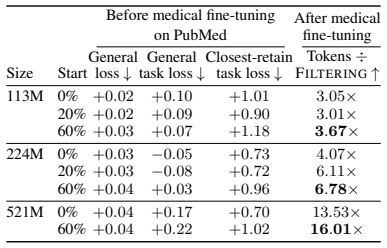
Table 2 :Starting suppression earlier becomes more effective as model size increases.We compare suppression onsets while keeping the number of suppression updates fixed and approx- imately matching general loss. General loss is measured on held-out retained FineWeb-Edu; general task loss on MMLU STEM and non-STEM; and closest-retain task loss on MMLU biology. All are reported relative to NO FILTERINGand values near zero suggest better preserved general performance. The final column gives the number of PubMed fine-tuning tokens needed to reach the PubMed loss of NO FILTERING, normalized by the corresponding value for FILTERINGat the same model size. Results are averaged over three fine-tuning seeds.
Original paper · CC BY 4.0The authors offer one explanation: early in pretraining, the representations behind medical predictions aren't yet separated from those behind retained capabilities. Gradient ascent on medical data may then disrupt features shared across tasks instead of selectively impairing medical capability. They expect that smaller models need more of their pretraining trajectory before they can develop representations that permit selective suppression.
Larger models, by contrast, may reach that regime earlier.
Which suppression objective works
The authors ask whether gradient ascent is the right suppression objective, or whether the alternatives do better. At 113M with AdamW, they compare gradient ascent with six other choices of the suppression loss L_F. Two of these alternatives carry no target distribution at all. Maximum entropy maximises the entropy of the model's next-token distribution.
Uniform-target self-distillation is the forget term of Unilogit.
The last two alternatives use a weaker predictor of the target domain as their target distribution. Past-self distillation pulls the model's next-token distribution toward that of an early checkpoint, θ_t⋆, with t⋆ ≤ t_start. Small-model distillation pulls toward a 61M model that is pretrained on D_ρ and held fixed throughout pretraining.
Gradient ascent gives the strongest resistance versus general-loss trade-off among these objectives, as Figure 6 shows. Each point for an objective varies the suppression strength c, and the results come from one fine-tuning seed. The authors extended the best-performing objectives to 224M, where the advantage of gradient ascent appears to persist.
Ordinary pretraining, meanwhile, keeps providing a positive learning signal on retained data. Those assumptions don't appear to translate into a better trade-off in these runs.
Separate or shared optimizer statistics during suppression
Sharing optimizer statistics between pretraining and suppression changes how the two objectives interact, even though both update the same parameters. All main experiments keep separate optimizer statistics for pretraining and suppression, so the comparison tests the alternative. Sharing statistics makes suppression look stronger at the end of pretraining.
But nearly all of the added medical loss disappears within the first few adversarial fine-tuning steps.
With Muon at 113M, separate states add +0.57 closest-retain loss, while shared states add +25.60, both relative to NO FILTERING. Pretraining gradients shape the optimizer history used for suppression, and suppression gradients shape the history used for pretraining, when statistics are shared. Separate statistics keep those histories distinct while still letting both objectives shape the same model.
For AdamW at 113M, the distinction goes beyond momentum. So separate momentum histories alone don't reproduce the benefit of fully separate optimizer states.
Whether suppression needs filtering, and token versus document granularity
At 113M, suppression still raises fine-tuning difficulty when the corpus is not filtered. Combining suppression with document filtering gives a substantially better trade-off with general loss. The authors read this gain as filtering reducing the conflict, since it removes medical content that standard pretraining would otherwise learn. Without filtering, standard pretraining pushes toward medical knowledge while suppression applies an opposing gradient signal.
Token filtering goes further by removing medical spans from documents that document filtering keeps.
Restricting suppression to medical tokens, chosen by a token-level mask, lowers spillover into biology at matched general loss. It also lowers resistance compared with suppressing whole target-domain documents. The authors suggest that noise in the token-level mask may partly explain the weaker resistance, rather than finer granularity itself.
The token-level comparison is made at a scale where suppression steps can draw entirely from the most medical filtered-out data. At larger pretraining scales, token-level selection could draw on more of the filtered-out corpus, which holds a greater mix of medical and retain content. The suppression set is built from the top 5% of corpus tokens, within the 20% removed by filtering.
The paper doesn't test suppression combined with token-filtered pretraining, leaving that combination to future work.
Limitations: what these experiments don't show
The proxy target domain here is medical knowledge, and the largest model in the study has 1030M parameters. So the observed scaling trends don't establish anything for genuinely hazardous capabilities or for other domains. Bigger models are also untested, so the scaling claim stops at the sizes the authors trained.
The authors didn't vary classifier quality or the way the suppression set is built. False positives, missed subdomains, and the source and diversity of suppression data therefore remain unresolved. The same classifier also defines the FineWeb-Edu evaluation splits, so shared blind spots could go unnoticed. External corpora and benchmarks give complementary coverage, but they aren't exhaustive.
Recovery was measured on models pretrained with a single seed. The authors didn't exhaustively evaluate adversarial modifications beyond the fine-tuning attacks they ran. Every method reached the NO FILTERING PubMed loss within the evaluated attack budget. Suppression needed 2.09M PubMed tokens, which is 0.010% of its pretraining tokens. The authors read these small budgets as evidence that more fine-tuning is needed under the tested attacks and sizes.
They don't claim the result extends past those attacks and model sizes. Future work could compare SGTM and TAR, and test different optimizers for pretraining and suppression.
Paper info
- Authors
- Maria Ios Glarou, Martin Jaggi
- Venue
- arXiv · Preprint
- First published
- 2026-11-11
- Added
- 2026-11-13
- Updated
- 2026-11-11
- Version
- v1
- arXiv
- 2611.15479
- Category
- cs.LG
- Original paper terms
- CC BY 4.0
- What we show
- Paper info, commentary and permitted figures from the original paper
AI commentary is a separate explanation from the original paper and may contain errors. The original paper and figures follow each source's terms of use and any rights noted separately.
Abstract
Open-weight language models can acquire knowledge that could enable biological, chemical, or cyber misuse. Any attempt to limit such knowledge must remain effective after the model weights are released and can be fine-tuned. Unlearning applied after pretraining can be rapidly undone, whereas filtering the pretraining corpus offers greater resistance. We ask whether actively suppressing knowledge during pretraining can further increase the fine-tuning required to acquire it. Even simple gradient ascent interleaved with standard pretraining on the filtered corpus makes medical knowledge harder to acquire through adversarial fine-tuning than filtering alone or post-hoc unlearning. At 1B parameters, reaching the held-out PubMed loss of an unfiltered model requires over 20$\times$ as many PubMed fine-tuning tokens as after filtering alone. Retained knowledge is evaluated using both held-out data and downstream tasks. Across model sizes, varying suppression strength reveals an increasingly favorable trade-off between fine-tuning difficulty and held-out loss on retained pretraining data. These results point to pretraining as an effective stage for making unwanted capabilities harder to acquire through subsequent fine-tuning. Code is available at \href{https://github.com/MEGlr/DETER}{\texttt{github.com/MEGlr/DETER}}.
Quote from the paper
Maria Ios Glarou, Martin Jaggi (2026). DETER: Suppression During Pretraining for Tamper Resistance. arXiv:2611.15479v1. https://arxiv.org/abs/2611.15479v1
BibTeX
@misc{glarou2026deter,
  title = {{DETER: Suppression During Pretraining for Tamper Resistance}},
  author = {Maria Ios Glarou and Martin Jaggi},
  year = {2026},
  eprint = {2611.15479},
  archivePrefix = {arXiv},
  url = {https://arxiv.org/abs/2611.15479v1}
}