Paper commentary
Testing Conversation Preservation Across LLM APIs: A Rule-Based Oracle for Detecting Silent Information Loss
isloss checks whether translated LLM requests keep conversation information
- Problem Translated LLM requests can pass schema checks yet silently drop information the model needs, such as tool error flags. Existing tests miss this because they treat many lossy outputs as expected.
- Method isloss maps source and translated payloads into a shared form called ConvIR, which keeps only conversation facts. It then applies 27 preservation rules, without needing a reference translation or model calls.
- Results isloss detected 76.0% of activated planted faults, with 2.0% false alarms on allowed changes. Across a synthetic suite, 18.5% of completed translations silently changed prompt, role, or tool information.
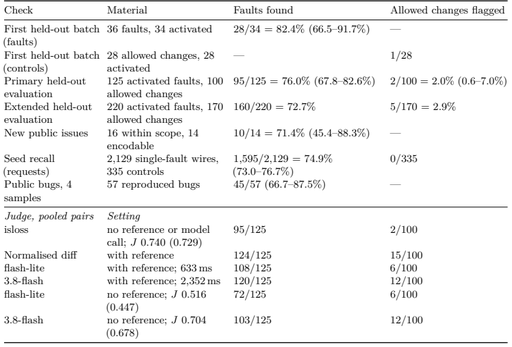
Table 3 :Detection accuracy of isloss and comparison with alternative judges.The primary held-out evaluation pools six specification-based blind batches authored after the checking rules were fixed; the extended evaluation adds four later blind batches (batch map: Appendix A.3). Intervals are Wilson 95% CIs; J is recall minus false-alarm rate, with the strictly cross-dialect value in parentheses. Without a reference translation, isloss has the highest observedJ among the tested judges. With a target-dialect reference, normalised diff and two Gemini judges score higher. Full results: Table 12 and Table 13.
Original paper · CC BY 4.0 · Xin Liu, Xu Han, Yuxin Wang, Haoran Song, Mingjian Zhao, Lei Wang · Testing Conversation Preservation Across LLM APIs: A Rule-Based Oracle for Detecting Silent Information Loss · Original paper figure · Extracted the figure area from page 10 of the original PDF.Why a valid translation isn't enough
LLM applications, particularly agents, increasingly reach models from several providers through translators that convert request and reply formats. A silent error in one of those layers can therefore reach the model without anyone noticing. A translated payload can pass the target schema and still change what the caller communicated.
Anthropic marks a failed tool result with is_error set to true. Gemini carries the same failure signal inside functionResponse.response instead. Some translators drop that signal and send an ordinary tool response, yet the payload stays well formed. The model then reasons from a conversation the caller never intended. The change matters for action as well as format, because the model's next decision depends on it.
Figure 3 shows how the checker identifies this loss.
Comparing JSON directly is too strict, since roles and field names differ by design. A direct comparison would report harmless representation changes as if they were losses. The harder case is information the target API has no native field for, such as Anthropic's tool-error flag in OpenAI Chat. A useful check must therefore separate a loss the target can't avoid from one the translator could have avoided.
Existing tests don't catch this well either. In an audit of the four best-tested projects, unit tests treated 26 of 41 request-side changes (63.4%) as expected output. The authors therefore ask which properties of the original conversation survive when a payload is valid for its target. isloss answers this by mapping both payloads into ConvIR and checking them against 27 preservation rules.
Comparing meaning instead of JSON
isloss reduces each payload to ConvIR, a neutral form that keeps only conversation facts and drops API syntax. ConvIR stores an ordered list of events, each with a speaker, content type, payload and flags such as is_error. Because both sides become events rather than raw JSON, a renamed tool-result container no longer looks like a missing one.
Anthropic's top-level system field and an OpenAI leading system message map to the same instruction event. Likewise, an assistant message and a Gemini model message map to the same assistant speaker. Dropping is_error, by contrast, removes the indication that the tool failed, so the comparison flags it as loss. The checker compares IR(S) and IR(T) only after applying the permitted representation changes.
They also include merging adjacent messages from the same author and accounting for OpenAI Chat's separate text and tool-call fields. isloss asks three questions about each detected difference: what changed, whether the target can represent it, and whether the translator disclosed it. A documented degradation still counts as loss, since disclosure doesn't make the translated conversation equivalent to the source.
Each of the 27 preservation rules is linked to its supporting vendor specification, so a finding traces back to its rule. isloss reaches 0.740 on the same pairs, but it doesn't need a trusted translation to compare against. The checker also covers only the properties in ConvIR, so passing shows preservation of those properties, not full equivalence.
How one check runs
The checker maps the source and translated payloads into ConvIR, which strips away the API-specific syntax. ConvIR holds an ordered sequence of conversation events plus the generation controls the caller explicitly set. Each event records its speaker, content type, payload, and flags such as is_error, so renamed containers no longer look missing.
Only after this mapping does the checker apply the 27 preservation rules to what remains. Before comparing, isloss applies permitted representation changes such as consistent role-name and tool-call-identifier mappings.
For each difference, the checker asks three questions: what changed, whether the target can represent it, and whether the translator disclosed it. Those answers sort each difference into T1, an undisclosed change to protected information. T2 holds separately reported degradations and informational notes, which are excluded from the primary finding count.
T3 holds permitted changes of representation, which are not counted as information-loss findings. A documented degradation still counts as a loss, so T2 makes it visible without making the translation equivalent to the source.
The Gemini example shows the sorting in practice, with Anthropic and Gemini payloads using different role and field names. Only the dropped tool-result error flag is counted as a finding, because the renaming is a representation change. The authors classify that dropped flag as T1, because Gemini can carry the error and this translation didn't preserve it.
The system-instruction experiment adds a second kind of loss, where a mid-conversation system message keeps its text but loses authority. The authors score deletion as T1, since the instruction is removed from the request entirely. LiteLLM's demotion to a user message is recorded as T2, as a conservative exclusion from the primary count. The check therefore separates a deleted instruction from a demoted one, instead of treating both as the same text loss.
Does the checker catch planted faults?
isloss detects 95 of 125 activated faults, a recall of 76.0% on the primary held-out evaluation. The Wilson 95% interval for that recall runs from 67.8–82.6%. It flags 2 of 100 allowed changes, a false-alarm rate of 2.0%. The authors count a planted fault toward recall only when its edit changes the translated payload, which they call activation.
The authors then added four later blind batches to the evaluation. Across this extended set, isloss catches 160 of 220 activated faults, or 72.7%. On the larger set, it flags 5 of 170 allowed changes, a false-alarm rate of 2.9%. A separate human-designed test kit found 37 of 40 faults and no false alarms among 10 allowed changes. Three program-mutant suites detected 81.6–84.3% of activated mutants.
On the same held-out pairs, a normalised diff with a reference translation reached J = 0.842. isloss reached J = 0.740 without a reference translation or any model call. The authors note that a trusted reference is hard to obtain for unseen inputs or new translators.
On four public-bug samples, isloss detected 45 of 57 reproduced bugs, or 78.9%. Human reviewers confirmed 31 of 54 request-side candidates as defects. Among agreed cases, 23 of 24 avoidable candidates were confirmed, or 95.8%. Only 6 of 16 agreed unavoidable-loss cases were confirmed, at 37.5%.
How often translations lose information
The census covers 685 completed translations from six configurations of five codebases, built from 51 statically valid shapes. The authors stress that this rate covers their synthetic suite and says nothing about how often real traffic loses information. The full-suite rate of 18.5% doesn't depend on live source acceptance, so it stands apart from the narrower subsets.
Static validity doesn't mean a live endpoint accepts the request. claude-sonnet-4-6 accepted only 13 of the 51 shapes (25.5%), and 38 shapes were rejected. Stratum 2a covers 13 shapes and 182 translation cells, while Stratum 2b uses the eight shapes accepted by claude-opus-4-8, giving 112 cells.
The most frequent primary mechanism is a dropped tool-result error flag, which affects 154 requests. Text placed after a tool call moved before it in 54 requests. Dropped sampling and token limits sit outside the primary rate because they aren't prompt, role or tool fields.
At gateways, Bifrost and new-api changed meaning in 187 of 204 judged cells (91.7%) on the 51-shape suite. Among 198 judged reply streams, 57 (28.79%) carried avoidable meaning changes. Replays of recorded coding-agent requests show the same classes of silent change, with a lower primary rate. Seven recorded shapes pass static checks, and across 14 paths they yield four primary findings in 98 cells (4.1%).
The agent corpus contains 14 distinct shapes, so these rates describe the replayed requests only.
Do the changes alter model behaviour?
The failure is a loss of information the model needs for its next step. Once the failure indication is gone, the model's next decision can rest on a different conversation.
The mid-conversation system instruction study tests a harness instruction that disables the shell tool. Deleting that instruction reduced refusals on gemini-3.5-flash-lite from 11/11 to 0/11 at both insertion positions. Demotion to a user message behaved differently. Refusals remained in five of the six tested model and placement pairs, so the effect depended on both the model and the position.
The same deletion removed refusals on gemini-3.8-flash and Qwen2.5-7B-Instruct as well.
A separate Anthropic-target probe removed a notice embedded in the final user turn instead of a mid-conversation system message. Refusals fell from 30/30 to 0/30 on claude-haiku-5-5, and from 10/30 to 0/30 on claude-sonnet-4-6. The Sonnet result did not meet the pre-specified prediction, and Appendix A.1 gives the details.
Google's OpenAI-compatible Gemini endpoint was checked against native-API controls with two Gemini models and ten repetitions per arm. The endpoint passed 10 of 11 behavioural probes. Its failed probe retains only the last of two top-level system messages, so the first instruction is lost. Effects aren't uniform across tasks, since a GSM8K control showed no statistically detectable accuracy drop.
Still, nine of the ten tested mechanisms changed at least one measured behavioural outcome. They didn't test the 277/685 OpenAI-bound cells against live OpenAI endpoints, or include GPT models in the live-model experiments.
Where the evidence stops
The 18.5% rate comes from a synthetic request suite, so it isn't an estimate of information loss in real-world traffic. The 36.4% reply-stream rate comes from a separate experiment on tested official OpenAI SDK streams, not from deployed traffic. The recorded agent corpus is small, with seven of 14 shapes passing the static source checks.
Its lower primary rate reflects a limited set of observed traffic, so it doesn't calibrate production-wide prevalence. Synthetic rates measure deliberately constructed feature combinations, rather than their incidence in production traffic.
The live-model work covers six models: two Gemini models, two Claude models, and two open-weight models. No GPT model appears in those live experiments, and the 277 OpenAI-bound cells never reached a live OpenAI endpoint. The live experiments cover selected mechanisms, so the authors don't claim that every detected loss changes model behaviour.
The authors haven't measured effects on published benchmark scores or leaderboard rankings. The GSM8K control shows that these behavioural effects depend on the task.
Human judgement shapes the findings, because reviewers disagreed on 12 of 54 candidates. The checker sees only payloads at its capture points, so provider-side rewriting after the last instrumented boundary stays hidden. The authors make avoidability decisions auditable by linking each rule to its specification and including negative controls.
isloss remains an offline research checker, and its use in continuous-integration workflows is future work.
Paper info
- Authors
- Xin Liu, Xu Han, Yuxin Wang, Haoran Song, Mingjian Zhao, Lei Wang
- Venue
- arXiv · Preprint
- First published
- 2026-11-11
- Added
- 2026-11-13
- Updated
- 2026-11-11
- Version
- v1
- arXiv
- 2611.15543
- Category
- cs.SE · cs.AI
- Original paper terms
- CC BY 4.0
- What we show
- Paper info, commentary and permitted figures from the original paper
AI commentary is a separate explanation from the original paper and may contain errors. The original paper and figures follow each source's terms of use and any rights noted separately.
Abstract
LLM applications increasingly rely on translators and compatibility layers to move conversations across APIs. Yet a translated request can be accepted by the target API while silently losing information about instruction roles, tool interactions, error states, or generation controls. We introduce isloss, a deterministic oracle for testing conversation-information preservation across LLM API translations. It maps source and translated requests and replies to a shared intermediate representation, ConvIR, and applies explicit rules to distinguish legitimate representation changes from information loss. Unlike schema validation or reference-based differential testing, isloss requires neither a reference translation nor additional model calls. It also distinguishes avoidable loss from degradation caused by target API limitations. We evaluate isloss using specification-based fault injection, human review, and experiments on translators, gateways, and client libraries. On held-out tests, it detects 95/125 planted faults (76.0%) with 2/100 false alarms (2.0%). Across a synthetic request suite spanning six configurations of five translator codebases, 127/685 completed translations (18.5%) pass static target checks while silently changing prompt, role, or tool information in ways the target API could have preserved. In translated replies, 203/558 streams (36.4%) cause exceptions or silent corruption in at least one tested official OpenAI SDK. Targeted experiments across six models show that translation-induced changes can alter model behaviour when tasks depend on the affected information. These results establish conversation preservation as a distinct correctness requirement for reliable LLM interoperability, agent execution, and model evaluation.
Figures from the paper
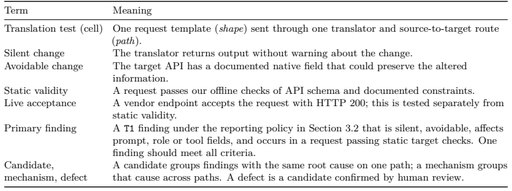
Table 1 :Terms used to interpret the results.Rule definitions and detailed counting conventions appear in Secs. 3–5 and Appendix A.1.
Original paper · CC BY 4.0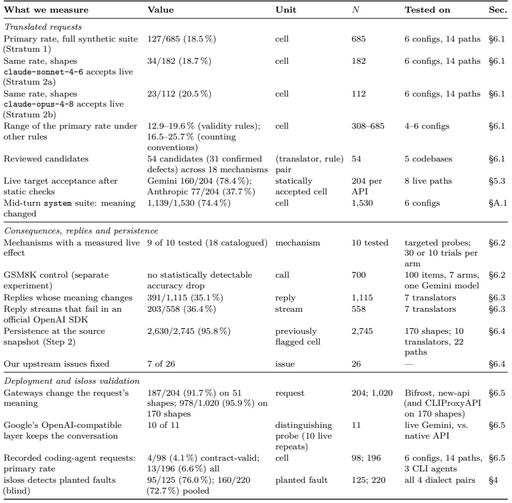
Table 4 :Units and denominators for the main results.Acellis one request or reply tested on one translation path. Each row identifies the unit, denominator, subjects, and location of a result. The full map, including the corpus and supporting live or human evidence, is Table 15 (Appendix B.1).
Original paper · CC BY 4.0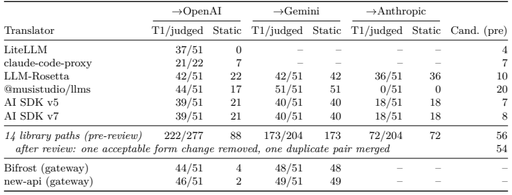
Table 5 :Meaning changes in the main request census.All 51 source shapes pass static checks; 13 are accepted live byclaude-sonnet-4-6. T1/judged counts cells with undeclared changes before target-validity filtering; Static counts those passing offline target checks.Cand. gives pre-review candidate counts; the reviewed catalogue is reported in Section 6.1. ForLiteLLM->OpenAI, the pre-serialisation dictionary has 37 T1 cells that fail the target checks: all 37 retainthinking_blocks, and 12 also retaintop_k. At the serialisedhosted_vllmbody, which stripsthinking_blocks, 25/37 pass.
Original paper · CC BY 4.0
Table 6 :Four translation outcomes for the same mid-conversation instruction.Six translators preserve the instruction, delete it, demote it to user text, or explicitly refuse the input; each translator gives the same outcome on all 11 paraphrases in both placements. Panel (a) gives the source and intact target requests; panel (b) gives the emitted request and isloss rule; panel (c) reports the live trials in which the model obeys the prohibition (k/11, temperature zero). These live counts concern the target models, not live validation of the Anthropic source. Across the 112 trials in which the model obeys the prohibition, the API returns HTTP 200, norun_cmd call is made, and the reply ends withfinish_reason: stop rather than a token-limit termination. AI SDK v5 and LLM-Rosetta produce the same normalised intact request (R). Claude results appear in Table 19.
Original paper · CC BY 4.0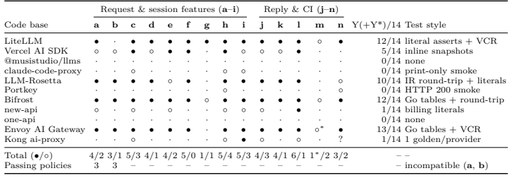
Table 7 :Existing test coverage across 11 translator codebases.Columns cover 14 request, session and reply features. The audit groups them under authority (P1,a–b), call–result links (P2,c–h), reasoning integrity (P3,i–k) and controls (P4,l–n). Symbols:• = asserted (Y);◦∗ = a narrow helper assertion (Y*);◦ = partial coverage (P);· = absent (N); ? = not inspectable. Partial coverage may be fixture-only, restricted to one direction, or limited to a sub-case. Bottom rows summarise coverage and incompatible behaviours encoded as passing assertions in the audit. Gemini’s first-party compatibility endpoint has no public repository.
Original paper · CC BY 4.0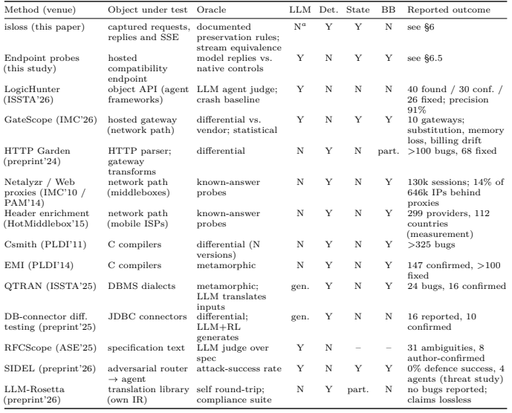
Table 8 :Comparison with related testing and measurement methods.LLM = a model is needed at test time; Det. = deterministic verdicts; State = multi-turn state is considered; BB = black-box use is possible. “gen.” means that an LLM generates inputs but the verdict is deterministic. “preprint” means that no peer-reviewed venue was found at the time of writing.a For our approach, captured-payload checking needs no model call; the separate behavioural probes do (Section A.3). Outcomes for other methods are as reported in their papers.
Original paper · CC BY 4.0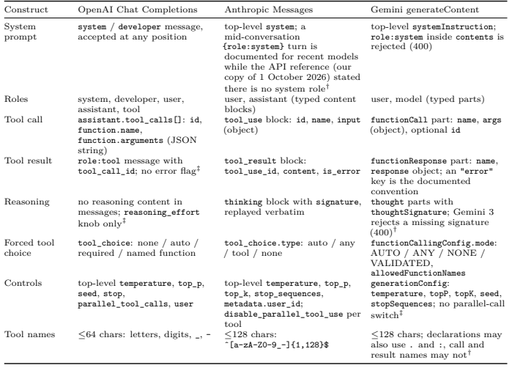
Table 9 :How the three APIs encode the tested constructs.† marks vendor documentation that is silent or self-contradictory.‡ marks a construct without a native representation in that format; carrying it requires another encoding, declaring a loss, or refusing the input.
Original paper · CC BY 4.0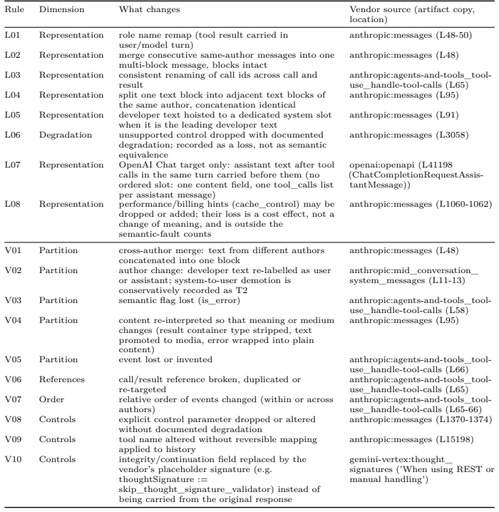
Table 10 :Documented mapping conventions and request-side violation dimensions. L01–L08 describe permitted mappings or explicit degradation allowances;V01–V10 identify protected dimensions. A documented degradation is not equivalent to preservation. Each row identifies its vendor source, with the quoted text retained in the replication archive. This reference table supports, rather than exhausts, the executable isloss catalogue.
Original paper · CC BY 4.0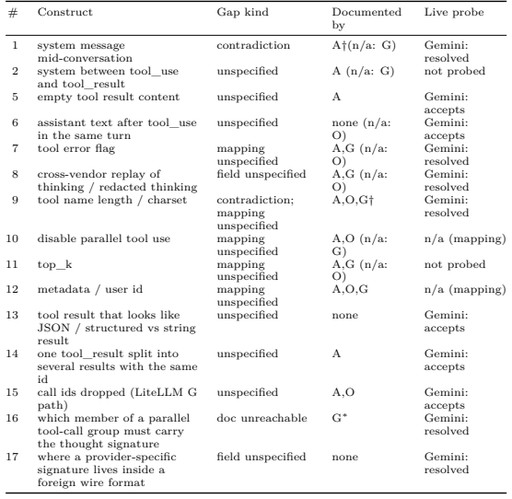
Table 11 :Specification gaps found while grounding the rules.The table lists 15 of 17 recorded interactions; original audit numbering is retained and entries 3 and 4 are the two benign interactions omitted from this table. “Documented by” identifies the vendor (A/O/G);† marks contradictory vendor text, and G∗ marks a Vertex mirror. “n/a” indicates that the API cannot express the construct. “not probed” means that the indicated live probe was not run; it does not imply acceptance or rejection.
Original paper · CC BY 4.0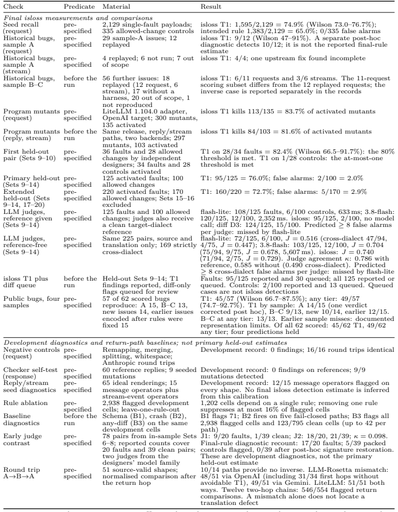
Table 12 :Detailed assessment of checker accuracy.The main-text summary appears in Table 3; additional judge comparisons appear in Table 13. “Before the run” means that the protocol was written before execution and committed with the results. “Killed” means that a mutant produces a finding absent from the unmodified translator. Final isloss detection counts useT1 findings; exploratory results with other scoring criteria are identified separately. For allowed-change controls, “packed” denotes pairs as constructed, five of which carry a packing-script placeholder signature; “filled” denotes the post-hoc restoration of those signatures. These controls should not be conflated with the untouched primary held-out set.
Original paper · CC BY 4.0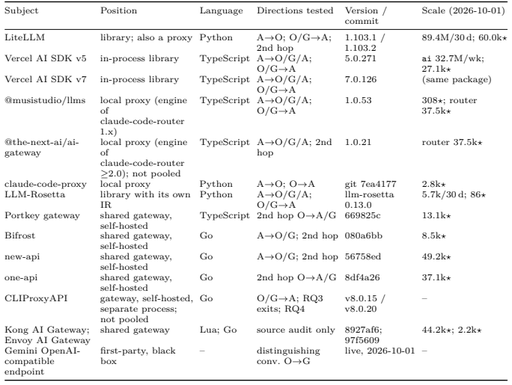
Table 14 :Subjects and software provenance.A = Anthropic Messages, O = OpenAI Chat Completions, G = Gemini generateContent. “2nd hop” means that the subject receives another translator’s OpenAI-format request. Download and star counts are recorded at capture time.
Original paper · CC BY 4.0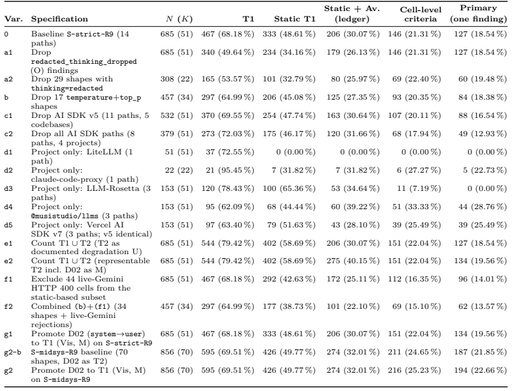
Table 17 :Sensitivity of the main census to validity and counting choices.N is the number of judged cells andK the number of request-shape clusters; variants(a)–(g) change the assumptions specified in each row.
Original paper · CC BY 4.0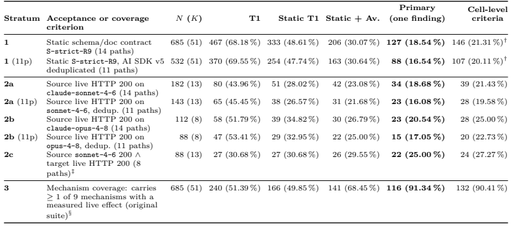
Table 18 :Request counts under static checks, endpoint acceptance, and mechanism coverage. Stratum 1 is the main suite; Strata 2a–2c are acceptance subsets rather than a nested sequence. Static T1 counts meaning changes whose translated bodies pass static target checks; it does not establish live acceptance or the absence of a warning. The primary column requires one finding to satisfy all criteria.†Removing the LLM-Rosetta-to Gemini list-valued tool-result re-encoding candidate changes the cell-level conjunction to 140/685 (101/532 after deduplication) but leaves the primary counts 127/685 and 88/532 unchanged. ‡Both-end acceptance covers eight target paths, four Anthropic and four Gemini; OpenAI targets are checked offline only.§The mechanism-coverage row uses the original 685-cell suite: 240/685 cells carry at least one of nine mechanisms with a live-probe effect, not 240 individually live-tested translations. Its percentages use the corresponding Stratum 1 column totals. Finding-aligned coverage of the primary findings is 116/127 (91.34%); counting a mechanism merely present elsewhere in the same cell would instead give 120/127 and is not the reported primary-coverage definition.
Original paper · CC BY 4.0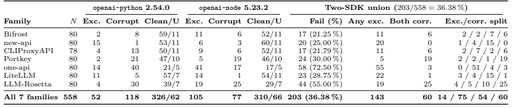
Table 22 :Official SDK outcomes for 558 translated HTTP 200 streams.Results are grouped by translator family foropenai-python 2.54.0 and openai-node 5.23.2; CLIProxyAPI additionally refuses two streams with HTTP 500. Each Clean/U entry gives two counts: preserved replies / unavoidable losses; the slash does not denote a ratio. The exception/corruption split partitions affected streams into: both SDKs raise; one raises and the other silently corrupts; one raises and the other has neither failure; or both silently corrupt.
Original paper · CC BY 4.0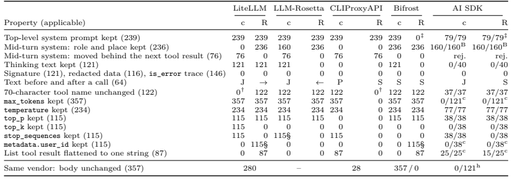
Table 23 :The same translator through Chat Completions (c) and Responses (R).Counts describe outgoing properties, not isloss verdicts. The first column gives applicable shapes, or blocks foris_error; AI SDK usesk/n where its core rejects inputs before either endpoint runs. B permitsallowSystemInMessages; c marks properties affected by the original capture driver.† denotes renamed or truncated tool names restored on return;‡ denotes role:system items without type, counted as retained only where the track supplies that key; § denotes another representation (stop or top-level user). For text surrounding a call: J joins it into one string, P retains separate parts, S retains separate messages/items, and arrows indicate movement across the call. The bottom row is a same-vendor control: unchanged bodies after removingmodel/stream and sorting keys; h marks post-hoc AI SDK normalisation.
Original paper · CC BY 4.0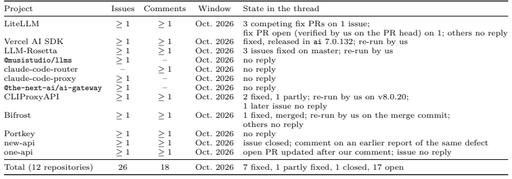
Table 24 :Upstream reports and verification status in October 2026.Fixed means that our rerun verifies a merged commit or release. No reply means no response to our post. Queued drafts are excluded. The anonymous build coarsens issue numbers, per-project counts, and filing-date ranges.
Original paper · CC BY 4.0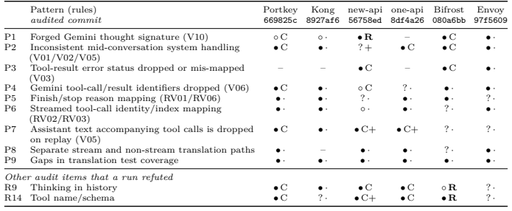
Table 25 :Source audit and captured gateway behaviour.Nine patterns recur in at least three independent codebases (P1–P9); runtime tests refute two further audit items (R9, R14). Each cell gives the audit mark followed by the run mark. Audit:• present,◦ absent, – no applicable path/field, ? unresolved or another change. Run: C confirmed,Rrefuted, + additional behaviour (noted below),· not exercised or not triggered.
Original paper · CC BY 4.0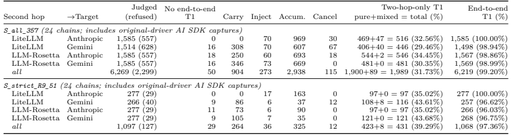
Table 26 :Two-hop translation judged with isloss.Rows aggregate 24 library chains by second hop and final target. Eight AI SDK v5/v7 first-hop chains use original-driver captures. The 16-chain subset without AI SDK has 4,357 judged and 1,355 refused cells on all 357 shapes, with 1,609/4,357 two-hop-only T1 (36.93%) and 4,307/4,357 end-to-end T1 (98.85%); on the 51 statically valid source shapes, it has 689 judged and 127 refused cells, with 287/689 two-hop-only T1 (41.65%) and 660/689 end-to-end T1 (95.79%). The full table includes all 24 chains: 6,269 judged/2,299 refused cells in the upper panel and 1,097/127 in the lower panel. Two-hop-only includes pure two-hop findings and mixed-with-cancellation cases; end-to-end counts cells with at least one end-to-end T1 finding. Gateway second hops are recorded separately in the replication archive.
Original paper · CC BY 4.0Quote from the paper
Xin Liu, Xu Han, Yuxin Wang, Haoran Song, Mingjian Zhao, Lei Wang (2026). Testing Conversation Preservation Across LLM APIs: A Rule-Based Oracle for Detecting Silent Information Loss. arXiv:2611.15543v1. https://arxiv.org/abs/2611.15543v1
BibTeX
@misc{liu2026testing,
  title = {{Testing Conversation Preservation Across LLM APIs: A Rule-Based Oracle for Detecting Silent Information Loss}},
  author = {Xin Liu and Xu Han and Yuxin Wang and Haoran Song and Mingjian Zhao and Lei Wang},
  year = {2026},
  eprint = {2611.15543},
  archivePrefix = {arXiv},
  url = {https://arxiv.org/abs/2611.15543v1}
}