Paper commentary
Reinforcement Learning via Self-Distillation
- Problem Outcome-only rewards in verifiable RL give each attempt one scalar, which leaves credit assignment weak and makes GRPO advantages vanish when every rollout in a group earns the same reward.
- Method SDPO re-scores each sampled attempt with the same policy conditioned on environment feedback, then distills that feedback-informed next-token distribution back into the student through a logit-level KL loss.
- Results Reached 48.8% final accuracy on LiveCodeBench v6 with Qwen3-8B, against 41.2% for GRPO. On very hard test-time questions, SDPO reached 53.2% discovery at 2750 attempts, against 41.5% for best-of-k sampling.
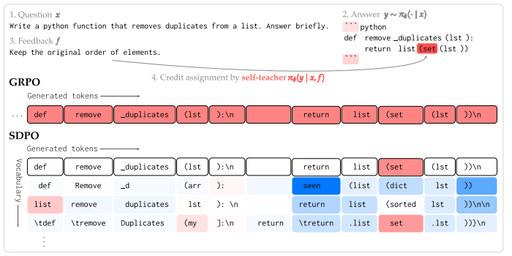
Figure 22 :Dense credit assignment through self-teaching in SDPO.The answer is gen- erated by then model (Qwen3-8B) before seeing the feedback. Then, we re-evaluate the log-probs of the original attempt with the self-teacher after seeing the feedback. We show the per-token log(P(self-teacher)/P(student)), with red indicating negative values (self-teacher disagrees), blue indicating positive values (teacher reinforces), and white indicating values around zero. Using binary rewards, GRPO would assign the same, negative advantage to all tokens in the sequence. In contrast, SDPO turns the feedback into dense credit assignment across the sequence. The first row shows the tokens of the generated response. The 3 other rows show the top-k logits of the self-teacher that are used during self-distillation, suggest- ing alternative tokens. Notably, in this example, the self-teacher identifies the error through retrospection without an explicit solution. The credit assignment on the generated sequence, and the alternative top-k logits correctly show that replacing set with dict maintains the order of elements. Further, in the seventh shown position, the model also identifies an alternative solution path which starts with the seen token, instead of directly returning the output. The activation is sparse, identifying where mistakes happen and adjusting to the students’ response distribution for specifically these few tokens.
Original paper · CC BY 4.0 · Jonas Hübotter, Frederike Lübeck, Lejs Behric, Anton Baumann, Marco Bagatella, Daniel Marta, Ido Hakimi, Idan Shenfeld, Thomas Kleine Buening, Carlos Guestrin, Andreas Krause · Reinforcement Learning via Self-Distillation · Original paper figure · Extracted the figure area from page 50 of the original PDF.Why scalar rewards limit credit assignment
Most reinforcement learning for LLMs in verifiable domains runs under RLVR, where each sampled answer receives one scalar reward, often binary, such as whether its unit tests pass. GRPO turns these sparse outcomes into advantages within a rollout group, so a group in which every rollout earns the same reward yields zero advantages and no learning signal.
The authors place the bottleneck in the reward channel rather than in RL as such: a scalar reward says that an attempt failed but not what went wrong. Figure 2 sets the two settings side by side: in RLVR the agent sees only the scalar reward, while in RLRF the feedback can carry the reward together with observations of the environment state.
Re-scoring an attempt with its own feedback
SDPO follows the usual on-policy loop: the current policy samples several responses to a question x, and the environment evaluates each of them. Each evaluation yields feedback f, which can contain environment output such as runtime errors and, when another rollout in the group solved the question, a sample solution produced by the student itself.
The self-teacher is the same network evaluated with f added to the prompt, so no separate teacher model is trained or loaded.
The loss is \( \mathcal{L}_{\text{SDPO}}(\theta) = \sum_t \mathrm{KL}\big(\pi_\theta(\cdot \mid x, y_{<t}) \,\|\, \mathrm{stopgrad}(\pi_\theta(\cdot \mid x, f, y_{<t}))\big) \), so for each position t of the original attempt the student's next-token distribution is pulled toward the self-teacher's. The stop-gradient on the teacher branch means that gradients move only the student; without it, the teacher could drift toward the student and stop using the feedback.
Differentiating the loss gives a logit-level policy gradient in which each candidate next token \( \hat y_t \) receives the advantage \( \log \frac{\pi_\theta(\hat y_t \mid x, f, y_{<t})}{\pi_\theta(\hat y_t \mid x, y_{<t})} \). A candidate that the feedback-informed teacher finds more likely than the student does receives a positive advantage, and a less likely candidate receives a negative one.
The advantage is zero only where student and teacher agree, whereas GRPO gives the sampled token one advantage that is constant within the rollout. Figure 4 shows this on a code example: the per-token log ratio is negative, in red, where the self-teacher disagrees with the student's attempt.
In an RLVR pipeline the change is small, because the advantage term is the only part that is swapped. The extra cost is one log-probability pass under the self-teacher, and the full-vocabulary KL is approximated by the top K logits of the student plus a term for the tail probability, with K=100 described as a reasonable choice. Off-policy data can be used by extending the SDPO gradient with PPO-style clipped importance sampling.
Standard RLVR environments with scalar rewards
The tasks are Science Q&A in chemistry, physics, biology and materials science, built from the L3 reasoning subsets of SciKnowEval, and tool use built on ToolAlpaca, each with a train-test split. Qwen3-8B and Olmo3-7B-Instruct serve as starting checkpoints, and accuracy is avg@16 plotted against wall-clock training time, excluding initialization and validation.
The baseline is an improved GRPO that adds asymmetric clipping, unbiased normalization and off-policy correction, tuned with a hyperparameter sweep. An on-policy GRPO variant uses the hyperparameters of vanilla SDPO, so it sits next to SDPO in the comparison. SDPO runs are strictly on-policy, with one gradient step per generation batch, while the GRPO runs in the table take four off-policy mini-batch steps.
Aggregated over the tasks, SDPO reached 70.2% final accuracy against 66.6% for the GRPO baseline. In Table 3, the Qwen3-8B Chemistry runs reach 80.9 for SDPO and 74.5 for GRPO after five hours of training. The authors report that SDPO outperforms GRPO in almost all runs.
SDPO responses were more than 3× shorter on average across tasks than GRPO responses. On Chemistry with Olmo3-7B-Instruct, the response length fell by 11× relative to GRPO while accuracy stayed higher. Figure 7 gives one Qwen3-8B example after 50 training steps: the GRPO response runs to 5,549 tokens with repeated filler such as Wait and Hmm, while the SDPO response is 764 tokens and selects the correct option C.
The authors read this as SDPO improving how the model reasons rather than only shortening it, but that argument rests on a representative example rather than on a broad analysis.
LiveCodeBench v6 with rich feedback
The evaluation uses LiveCodeBench v6, a set of 131 contest-style questions released between February and May 2025.
SDPO reached 48.8% final accuracy against 41.2% for GRPO, and it reached GRPO's final accuracy in 4× fewer generations. The same SDPO accuracy is above the 40.5% reported for Claude Sonnet 4 and the 39.7% reported for Claude Opus 4 on the public leaderboard, which are external figures rather than runs from this study. The authors also report that the gains are largest on medium and hard questions, with the breakdown given in an appendix figure.
The authors vary the Qwen3 model size, from 0.6B up to 8B, and compare the final LCBv6 validation accuracy at train step 80. SDPO's gain over GRPO is larger on the bigger models and small on the smallest ones. The authors tie this to the teacher's accuracy in retrospection, which they describe as appearing with scale rather than being established for smaller models.
A Qwen2.5-Instruct scaling study points the same way, with SDPO underperforming GRPO on Qwen2.5-1.5B.
Where the gain comes from
To separate rich feedback from denser credit assignment, the authors compare logit-level, token-level and sequence-level SDPO. Logit-level SDPO credits the 100 most likely tokens at each position, token-level SDPO credits only the most likely token, and sequence-level SDPO averages the SDPO advantages into one scalar per sequence, as GRPO does.
The ordering is logit-level above token-level above sequence-level, and even sequence-level SDPO outperforms GRPO, which the authors read as evidence that rich feedback helps even without dense credit.
The self-teacher is not frozen; it is updated during training, so in principle the student can learn from a target that improves over time. In the later stages of training the student's accuracy surpasses the initial teacher's accuracy, which the authors take as bootstrapping. Non-regularized teachers underperform the regularized ones, and SDPO still performs well with a frozen teacher.
The three kinds of feedback in the teacher prompt are the environment output, a sample solution from the group and the student's original attempt. The authors note that using only solutions or only initial attempts reduces diversity in both teacher and student.
The hybrid advantage mixes reward-based GRPO advantages with SDPO advantages through a weight \( \lambda \in [0,1] \), as \( A^{\text{SDPO+GRPO}}_{i,t} = \lambda A^{\text{GRPO}}_{i,t} + (1-\lambda) A^{\text{SDPO}}_{i,t} \). The motivation is that GRPO advantages are unbiased for the expected reward, while SDPO advantages are biased because they come from rich feedback and the self-teacher.
With \( \lambda = 0.9 \), SDPO+GRPO is more robust than SDPO on Qwen3-0.6B, but it slightly underperforms SDPO on Qwen3-8B.
Forgetting on holdout tasks
Because on-policy training is associated with less forgetting, the authors test final checkpoints on IFEval, ArenaHard-v2 and MMLU-Pro as holdout tasks, alongside LCBv6. The off-policy comparison is SFT on successful generations of the self-teacher, which needs twice as many generations as SDPO for the same number of steps.
Averaged over the holdout tasks, SDPO scores 42.4, GRPO 41.8, SFT 41.4 and the base model 43.5, so SDPO keeps more holdout performance than GRPO and SFT but not as much as the base model. The authors conclude that SDPO gives the best performance-forgetting tradeoff among the methods compared.
Test-time discovery on hard questions
Here the model receives a single hard binary-reward question, and discovery@k is the probability that a solution appears within k attempts. Best-of-k sampling from the base model coincides with pass@k, while multi-turn sampling reprompts the same model with earlier attempts and feedback without changing its weights. Under a binary reward, RLVR receives no signal until the first success, whereas SDPO can correct itself after every failed attempt that comes with feedback.
The test-time variant repeatedly distills \( \pi_\theta(\cdot \mid x, c) \), where c is the history of attempts and feedback, into the weights that answer the bare question x, so the history is stored in the parameters rather than the context. Because the history is no longer in the prompt, this avoids the context-length limit that bounds multi-turn sampling.
Each update uses a batch size of 16.
Only questions that at least one method solved within 512 steps across 5 seeds were kept, which leaves 19 hard and 9 very hard questions. Best-of-k uses the standard pass@k estimate from 2944 independent rollouts, and multi-turn sampling drops the earliest feedback once the 32k prompt limit is reached within the 40k context.
On very hard questions SDPO discovers a solution in 53.2% of cases at 2750 attempts, against 41.5% for best-of-k sampling and 35.6% for multi-turn sampling. To reach a 22% discovery probability on these questions, SDPO needs about 3× fewer generations than the two baselines. On hard questions SDPO reaches 78% discovery at 2750 attempts and 67% with roughly 2.4× fewer generations, while multi-turn and best-of-k solve 68.4% and 72.3% of the questions overall.
Figure 13 plots these curves with bootstrapped 90% confidence intervals across 5 random seeds per question.
SDPO alone solves question Q3, first after 321 attempts, which corresponds to 20 iteration steps at batch size 16. The initial self-teacher is below 1% accurate on almost all questions and exactly 0% on 78% of them, and the authors read this as one turn of in-context feedback being insufficient, with the iterated updates doing the work.
Limitations
The gains depend on the base model's in-context learning; the authors suggest SDPO is primarily suited to stronger base models, since it underperforms GRPO on weaker ones. Performance also depends on feedback quality, and uninformative or misleading environment feedback may not be learnable through SDPO. SDPO advantages are biased with respect to the expected reward, and the RLVR experiments use strictly on-policy updates.
SDPO adds log-probability computation under the self-teacher, and the authors note this may matter more for smaller models with shorter generations. Agentic environments, large multi-task runs and open-ended text tasks are left as future work. The test-time comparison covers 19 hard and 9 very hard questions, and SDPO's holdout average of 42.4 stays below the base model's 43.5.
Paper info
- Authors
- Jonas Hübotter, Frederike Lübeck, Lejs Behric, Anton Baumann, Marco Bagatella, Daniel Marta, Ido Hakimi, Idan Shenfeld, Thomas Kleine Buening, Carlos Guestrin, Andreas Krause
- Venue
- arXiv · Preprint
- First published
- 2026-1-28
- Added
- 2026-10-29
- Updated
- 2026-2-16
- Version
- v2
- arXiv
- 2601.20802
- Category
- cs.LG · cs.AI
- Original paper terms
- CC BY 4.0
- What we show
- Paper info, commentary and permitted figures from the original paper
AI commentary is a separate explanation from the original paper and may contain errors. The original paper and figures follow each source's terms of use and any rights noted separately.
Abstract
Large language models are increasingly post-trained with reinforcement learning in verifiable domains such as code and math. Yet, current methods for reinforcement learning with verifiable rewards (RLVR) learn only from a scalar outcome reward per attempt, creating a severe credit-assignment bottleneck. Many verifiable environments actually provide rich textual feedback, such as runtime errors or judge evaluations, that explain why an attempt failed. We formalize this setting as reinforcement learning with rich feedback and introduce Self-Distillation Policy Optimization (SDPO), which converts tokenized feedback into a dense learning signal without any external teacher or explicit reward model. SDPO treats the current model conditioned on feedback as a self-teacher and distills its feedback-informed next-token predictions back into the policy. In this way, SDPO leverages the model's ability to retrospectively identify its own mistakes in-context. Across scientific reasoning, tool use, and competitive programming on LiveCodeBench v6, SDPO improves sample efficiency and final accuracy over strong RLVR baselines. Notably, SDPO also outperforms baselines in standard RLVR environments that only return scalar feedback by using successful rollouts as implicit feedback for failed attempts. Finally, applying SDPO to individual questions at test time accelerates discovery on difficult binary-reward tasks, achieving the same discovery probability as best-of-k sampling or multi-turn conversations with 3x fewer attempts.
Quote from the paper
Jonas Hübotter, Frederike Lübeck, Lejs Behric, Anton Baumann, Marco Bagatella, Daniel Marta, Ido Hakimi, Idan Shenfeld, Thomas Kleine Buening, Carlos Guestrin, Andreas Krause (2026). Reinforcement Learning via Self-Distillation. arXiv:2601.20802v2. https://arxiv.org/abs/2601.20802v2
BibTeX
@misc{hbotter2026reinforcement,
  title = {{Reinforcement Learning via Self-Distillation}},
  author = {Jonas Hübotter and Frederike Lübeck and Lejs Behric and Anton Baumann and Marco Bagatella and Daniel Marta and Ido Hakimi and Idan Shenfeld and Thomas Kleine Buening and Carlos Guestrin and Andreas Krause},
  year = {2026},
  eprint = {2601.20802},
  archivePrefix = {arXiv},
  url = {https://arxiv.org/abs/2601.20802v2}
}