Paper commentary
CogACT: A Foundational Vision-Language-Action Model for Synergizing Cognition and Action in Robotic Manipulation
- Problem Repurposing a VLM for robot control by discretizing actions into tokens or by attaching simple regression heads limits action precision and ignores the multimodal nature of actions.
- Method Keeps the VLM as a cognition module and adds a diffusion-transformer action module that denoises several future actions, plus a similarity-weighted action ensemble at inference.
- Results Reached 74.8% average success in SIMPLER Visual Matching on the Google robot and a task-averaged success rate of 71.2 on the Realman robot after fine-tuning.
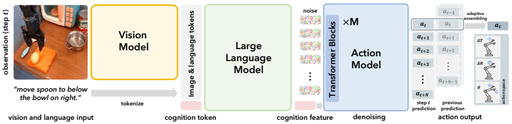
Figure 2 . Overview of our architecture. Our model is componentized into three parts: 1) a vision module encoding information from the current image observation into visual tokens; 2) a language module that integrates the visual tokens with the language instructions, and produces a cognition feature determining the desired action to be executed; 3) a diffusion action module, which predicts a sequence of multi-step actions conditioned on the cognition feature. An adaptive ensemble strategy is applied for trajectory ensemble at inference.
Original paper · CC BY 4.0 · Qixiu Li, Yaobo Liang, Zeyu Wang, Lin Luo, Xi Chen, Mozheng Liao, Fangyun Wei, Yu Deng, Sicheng Xu, Yizhong Zhang, Xiaofan Wang, Bei Liu, Jianlong Fu, Jianmin Bao, Dong Chen, Yuanchun Shi, Jiaolong Yang, Baining Guo · CogACT: A Foundational Vision-Language-Action Model for Synergizing Cognition and Action in Robotic Manipulation · Original paper figure · Extracted the figure area from page 4 of the original PDF.Why repurposing a VLM for actions is limiting
Many large VLAs keep the next-token interface of the VLM and turn each robot action dimension into discrete bins, as RT-2 and OpenVLA do. A fixed grid of bins is a weak fit for continuous control, so the discretization limits how precisely the robot can be commanded. Regression heads avoid tokenization, as the LSTM-style heads of RoboFlamingo do, but a regression output gives one point per observation and misses that several trajectories can succeed at the same task.
Robot actions are continuous, multimodal, temporally correlated and need high precision, so the design treats them as a different kind of signal from language. The VLM supplies broad visual and semantic knowledge, while the motion decoding needs a module built for action signals. The authors therefore keep the VLM as a source of conditioning and attach a separate action module that reads the VLM output through attention.
How the three modules pass information
The policy is split into a vision module, a language module and an action module, and the cognition feature passed from the language module is the only signal the action module receives from the VLM side.
Each observation goes through DINOv2 and SigLIP, and the two downsampled feature maps are concatenated along channels, projected linearly and serialized into visual tokens, with 256 tokens by default. The instruction is tokenized with the LLaMA-2 tokenizer and joined with the visual tokens and one learnable cognition token, and the whole sequence runs through LLaMA-2 with causal attention.
The output at the cognition token is the cognition feature, written as \(f^{c}_{t}\), and it serves as the condition for the action module rather than as a language answer.
The vision and language modules come from a Prismatic VLM with about 7B parameters in total, which is close in size to OpenVLA.
Diffusion action module and training objective
The action module starts from a noisy action sequence covering the current step and future steps, and it denoises that sequence over several steps while the cognition feature conditions every step. The cognition feature and the noisy actions enter the transformer blocks as input tokens, and the denoising step index is added to the cognition feature through a sinusoidal positional encoding.
The default horizon predicts 15 future actions, so the action module works on a context of 17 tokens, which is N + 2 with N = 15. The authors attribute smoother predicted trajectories and higher task success to predicting these future steps, following the same idea in earlier diffusion-policy and action-chunking work.
Training minimizes the mean-squared error between the predicted noise and the ground-truth noise, and the vision, language and action modules are updated end to end. The objective is \[ \mathcal{L}_{MSE} = \mathbb{E}_{\epsilon \sim \mathcal{N}(0,1), i} \left\| \hat{\epsilon}_i - \epsilon \right\|^2 \] Because the vision and language modules are included in this update, the perception and cognition parts are trained together with the action decoder rather than kept fixed.
Adaptive weighting of past action predictions
Executing a whole predicted chunk without re-planning uses the observation only once and can produce jerky motion, while executing only the current step gives a less smooth trajectory. The temporal ensemble of ACT blends predictions for the same time step from earlier chunks, using preset weights.
Preset weights average predictions that may come from different feasible modes, and the average can land on an action that matches none of those modes. The adaptive version instead weights each earlier prediction by how similar it is to the current prediction, so that predictions from a different mode count for less.
For time step t, the executed action is \[ \hat{a}_t = \sum_{k=0}^{K} w^{ada}_k \, a_{t|o_{t-k}} \] Each weight is \[ w^{ada}_k = \exp\left(\alpha \cdot \langle a_{t|o_t}, a_{t|o_{t-k}} \rangle\right) \], where the angle brackets denote cosine similarity and \(\alpha\) is set to 0.1 in practice. As written, the formula has no division by the sum of the weights, so the weights are not normalized in the equation itself.
The window K is chosen so that K multiplied by the average standard deviation of the 6D action per timestep stays at a constant C, which the authors set to 0.2 for all experiments. The resulting window is 2 for the RT-1 dataset with the Google robot and 7 for BridgeDataV2 with the WidowX robot.
Cached past predictions can be reused, so the authors report that the ensemble adds little cost at inference.
Training data and implementation settings
Pretraining uses 25 VLA datasets from the Open X-Embodiment collection, and the data mixture excludes the Language Table and Droid datasets. The resulting training set contains 0.4 million robot trajectories and 22.5 million frames.
DiT-Base is the default action model in these runs.
Simulated evaluation samples actions with DDIM using 10 sampling steps and classifier-free guidance at scale 1.5, with the ensemble weight \(\alpha\) set to 0.1. The guidance scale is applied at its default of 1.5 for all reported runs.
Simulated results on Google and WidowX robots
SIMPLER gives the Google robot two settings with the same four tasks: Visual Matching, which minimizes the gap between simulated and real visuals, and Variant Aggregations, which adds changes to background, lighting, distractors and table texture. Success rate is the metric throughout.
In Visual Matching, the model reaches 74.8% average success, against 52.4 for RT-1 and 46.3 for RT-2-X in the same table. Under Variant Aggregations it reaches 61.3%, above RT-2-X at 54.4. The authors report margins of 22.4 points over RT-1 in Visual Matching and 17.6 points in Variant Aggregations, and RT-1 was trained only on the Google robot subset.
The model has 7.6B parameters, while RT-2-X has 55B, and its average on the Google robot is still higher.
On WidowX in Visual Matching, each of the four tasks was repeated five times, and the average is 51.3, above Octo-Small at 26.7 and Octo-Base at 17.5. RT-1-X scores 1.1 and OpenVLA 4.2 on the same average.
The authors summarize the simulated gap as more than 35% over OpenVLA, a model of similar size, and 18 absolute points over RT-2-X. Some baseline scores are taken from the SIMPLER paper, while OpenVLA was evaluated by the authors from its released weights, and RT-2-X has no reported WidowX score.
Real-robot results on Realman and Franka arms
On the Realman arm, three tasks named Pick, Stack and Place were fine-tuned on 391 demonstrations, which include demonstrations of other tasks as well. The evaluation runs 24 trials for Pick, 48 for Stack and 24 for Place.
CogACT reaches a task-averaged success rate of 71.2, against 12.1 for OpenVLA and 4.9 for Octo-Base, all pre-trained on OXE and fine-tuned on the same collected data. The authors put the margin over OpenVLA at 59.1% in success rate.
With unseen tables and extra unseen distractors, CogACT averages 58.4, against 9.7 for OpenVLA. On unseen colors, shapes and categories, it scores 87.5, 81.3 and 25.0, averaging 64.6, while OpenVLA scores 0.0, 6.3 and 12.5, averaging 6.3.
The Franka arm has 7 DoFs and a 1-DoF gripper, and it is used for four tasks, with 100 demonstrations per task and 400 in total. CogACT averages 61.4 against 6.8 for OpenVLA and 5.8 for Octo-Base, and each task is tested over 11 trials.
Action module size and architecture
The ablation compares MLP heads with 3 and 7 layers against DiT-Small, DiT-Base and DiT-Large on the Google robot and WidowX robot in SIMPLER. The parameter counts are 3M, 89M, 13M, 89M and 308M for the five models, in the same order.
The authors attribute the advantage of the transformer to the attention mechanism's sequence modeling, which is a hypothesis they did not test in isolation.
DiT-Large reaches the highest average in this ablation, 64.8.
Adaptive ensemble against fixed-weight strategies
Under the same ensemble window, Adaptive Ensemble averages 62.5, Temporal Ensemble averages 58.9 and Action Chunking averages 50.7. Action Chunking executes the first two predicted actions directly, and the Temporal Ensemble and Adaptive Ensemble use the same window. The authors attribute the gain to the similarity weighting between the current and historical predictions.
Sensitivity to the guidance scale
The average is 55.7 at scale 1.0, 62.5 at scale 1.5 and 62.7 at scale 3.0. At scale 3.0 the WidowX column is 48.3, lower than 51.3 at scale 1.5. The authors report that applying the guidance improves success rates, which is why 1.5 is the default.
Limitations
The real-robot results rest on 24, 48 and 24 trials for Pick, Stack and Place, and the Franka tasks use 11 trials each. The unseen-category settings use 8 trials for the category task and 16 trials for the unseen-shape tasks.
Unseen categories were the weakest Realman generalization setting, at 25.0 against 87.5 for unseen colors and 81.3 for unseen shapes.
Octo-Base and OpenVLA were tested at several fine-tuned checkpoints and the best-performing ones were chosen, while the model was tested at one checkpoint at 10K steps. Octo-Base and Octo-Small were re-run with more random seeds to reduce sampling variance.
The simulated evaluation covers only the SIMPLER environments for the Google robot and WidowX robot, and the action space is a 7-DoF gripper with an open or close state. The largest action module has 300M parameters. The scaling trend is drawn from three diffusion transformer sizes, so it rests on few points.
Paper info
- Authors
- Qixiu Li, Yaobo Liang, Zeyu Wang, Lin Luo, Xi Chen, Mozheng Liao, Fangyun Wei, Yu Deng, Sicheng Xu, Yizhong Zhang, Xiaofan Wang, Bei Liu, Jianlong Fu, Jianmin Bao, Dong Chen, Yuanchun Shi, Jiaolong Yang, Baining Guo
- Venue
- arXiv · Preprint
- First published
- 2024-11-29
- Added
- 2026-10-21
- Updated
- 2024-11-29
- Version
- v1
- arXiv
- 2411.19650
- Category
- cs.RO · cs.AI · cs.CL · cs.CV · cs.LG
- Original paper terms
- CC BY 4.0
- What we show
- Paper info, commentary and permitted figures from the original paper
AI commentary is a separate explanation from the original paper and may contain errors. The original paper and figures follow each source's terms of use and any rights noted separately.
Abstract
The advancement of large Vision-Language-Action (VLA) models has significantly improved robotic manipulation in terms of language-guided task execution and generalization to unseen scenarios. While existing VLAs adapted from pretrained large Vision-Language-Models (VLM) have demonstrated promising generalizability, their task performance is still unsatisfactory as indicated by the low tasks success rates in different environments. In this paper, we present a new advanced VLA architecture derived from VLM. Unlike previous works that directly repurpose VLM for action prediction by simple action quantization, we propose a omponentized VLA architecture that has a specialized action module conditioned on VLM output. We systematically study the design of the action module and demonstrates the strong performance enhancement with diffusion action transformers for action sequence modeling, as well as their favorable scaling behaviors. We also conduct comprehensive experiments and ablation studies to evaluate the efficacy of our models with varied designs. The evaluation on 5 robot embodiments in simulation and real work shows that our model not only significantly surpasses existing VLAs in task performance and but also exhibits remarkable adaptation to new robots and generalization to unseen objects and backgrounds. It exceeds the average success rates of OpenVLA which has similar model size (7B) with ours by over 35% in simulated evaluation and 55% in real robot experiments. It also outperforms the large RT-2-X model (55B) by 18% absolute success rates in simulation. Code and models can be found on our project page (https://cogact.github.io/).
Quote from the paper
Qixiu Li, Yaobo Liang, Zeyu Wang, Lin Luo, Xi Chen, Mozheng Liao, Fangyun Wei, Yu Deng, Sicheng Xu, Yizhong Zhang, Xiaofan Wang, Bei Liu, Jianlong Fu, Jianmin Bao, Dong Chen, Yuanchun Shi, Jiaolong Yang, Baining Guo (2024). CogACT: A Foundational Vision-Language-Action Model for Synergizing Cognition and Action in Robotic Manipulation. arXiv:2411.19650v1. https://arxiv.org/abs/2411.19650v1
BibTeX
@misc{li2024cogact,
  title = {{CogACT: A Foundational Vision-Language-Action Model for Synergizing Cognition and Action in Robotic Manipulation}},
  author = {Qixiu Li and Yaobo Liang and Zeyu Wang and Lin Luo and Xi Chen and Mozheng Liao and Fangyun Wei and Yu Deng and Sicheng Xu and Yizhong Zhang and Xiaofan Wang and Bei Liu and Jianlong Fu and Jianmin Bao and Dong Chen and Yuanchun Shi and Jiaolong Yang and Baining Guo},
  year = {2024},
  eprint = {2411.19650},
  archivePrefix = {arXiv},
  url = {https://arxiv.org/abs/2411.19650v1}
}