Paper commentary
What Does a Skill Vocabulary Cost? A Closed-Loop Decomposition over Demonstrated Motions
MPQ separates a skill vocabulary's cost from its selector's in closed loop
- Problem Codebook-based skill policies learn their motion vocabulary jointly with the selector and decoder. When they fail in closed loop, the cause cannot be traced to the vocabulary, the choice of skill, or its execution.
- Method MPQ places a library of demonstrated motions after a trained policy. It swaps each predicted action chunk for its nearest library element and corrects that element toward the prediction within a bound.
- Results Across six architectures, the wrapped policy is statistically equivalent to the original. On LIBERO-90, execution costs the ACT selector 12.1 points, while the choice of skill costs at most 0.9 points.
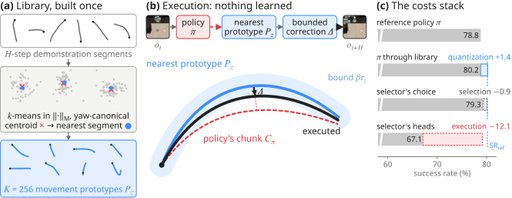
Figure 1 : Movement Prototype Quantization.(a)Library construction. Demonstration segments are fit to B-spline control points, yaw-canonicalized, clustered under the Gram metric and projected onto real segments (LIBERO-90).(b)Execution. The chunkC π of a frozen policy is matched to its nearest movement prototypeP z, placed in the chunk’s frame and corrected towardC π within the deviation bound (Eq. 5). Blue: demonstrated. Red: predicted. Black: executed.(c)Decomposition. A reference policy executed through the library (SR ref, dashed) sets the baseline. Substituting a selector’s choice, then its placement and correction, splits the selector’s shortfall into selection and execution (LIBERO-90, Table 3).
Original paper · CC BY 4.0 · Maximilian Xiling Li, Nils Blank, Paul Mattes, Pankhuri Vanjani, Rudolf Lioutikov · What Does a Skill Vocabulary Cost? A Closed-Loop Decomposition over Demonstrated Motions · Original paper figure · Converted the paper's own image file from its arXiv HTML version to PNG.Why the vocabulary's cost stays hidden
Discrete skill policies pick their motions from a finite set, and most current methods learn that set as a latent codebook. The codebook is trained jointly with its selector and decoder, so the three costs are entangled. When such a policy fails in closed loop, success reports only the sum of the vocabulary, selection and execution costs.
Offline reconstruction of demonstration actions then stands in for closed-loop quality.
Moving the vocabulary behind the policy
The authors keep a continuous policy and apply a finite library to the chunks it predicts. The library is then judged by closed-loop success instead of by reconstruction.
Running the reference policy through the library gives a baseline, called the library reference. Any selector over the same library can be compared against that baseline. The shortfall of a selector then splits into three terms, as the next equation shows.
\[ SR(\pi) - SR(L) = \bigl[SR(\pi) - SR_{\mathrm{ref}}\bigr] + \bigl[SR_{\mathrm{ref}} - SR(L_{idx})\bigr] + \bigl[SR(L_{idx}) - SR(L)\bigr] \] The quantization term measures what the library cannot represent, and the selection term measures the choice under the reference's placement and correction. The execution term measures the learned placement and correction against the reference's own.
The split holds only if library elements run without a learned decoder and the wrapper costs the reference nothing. The first condition rules out codebooks, because a decoder could hide part of any drop.
How each predicted chunk is executed
Figure 1 shows the three stages: library construction, execution and the decomposition baseline. Each library element is a set of B-spline control points, and a fixed linear map turns it into an executable trajectory. Because that map is not learned, every point in the control-point space decodes to a valid trajectory.
Distances are computed on the control points with the Gram metric, so no trajectory has to be decoded to compare two elements. Before matching, the chunk is rotated by a yaw rotation so that its net horizontal displacement points along the x axis. The authors remove only yaw because gravity separates vertical from horizontal motion.
The library is built by clustering overlapping segments of the demonstrations with k-means, after whitening by the Cholesky factor of the Gram matrix. Each prototype also gets a tolerance, the 0.75 quantile of the Gram distances from its cluster members.
At run time the layer matches each predicted chunk to its nearest prototype, places that prototype in the prediction's frame, and computes the gap between them. It then moves the placed prototype toward the prediction by a correction clipped to the bound, as the following equations give. \[ \Delta = e \cdot \min\!\left(1, \frac{\beta\,\tau_z}{\lVert e \rVert_M}\right), \qquad C_{\mathrm{exec}} = R^{-1}P_z + \Delta \] Setting β to 0 leaves only the choice of element, while larger β lets the correction grow toward the spline fit of the prediction.
The gripper channel passes through unchanged, so the policy still decides when the gripper closes.
Why the bound scales with tolerance
An amplitude bound would scale the correction with each prototype's norm. An amplitude bound would therefore leave small motions the least room to correct.
Success rises from 58.8 at β=0 to 79.4 at β=0.5 for wrapped ACT, and then stays flat for larger budgets. At β=0.5 the bound still clips 88% of chunks, so the correction is active on most steps.
Does the wrapper cost the policy anything?
Table 1 wraps six architectures, including the 7B OpenVLA-OFT, with an in-suite library of K=256 and β=0.5. The largest losses are between 1 and 2 points for QueST and VQ-BeT on LIBERO-90.
Pooled over 13 policy and benchmark cells, including RoboCasa, success changes by +0.6 points. The 95% interval runs from −0.8 to +1.9, and two one-sided tests show equivalence within ±3 points.
Observation shift and a real robot
LIBERO-Plus perturbs the LIBERO-10 tasks along six axes, with 100 paired variants per axis. The layer keeps each executed chunk within the bound of a demonstrated one even where the bare policy moves farther from the demonstrations.
The difference is not significant (Fisher exact test, p=0.48), and with fifteen attempts per arm only large differences could show.
Where a selector's gap sits
In the choice-first order, the selection term changes success by at most 0.9 points. Execution costs the ACT selector 12.1 points and the Diffusion Policy selector 10.3 points, while the flow DiT selector reaches its reference (83.0 against 83.4).
A small selection term could mean that the correction hides a poor choice, so the authors forced the layer to run the r-th nearest prototype. So the selectors choose well, and the selection term is small for that reason rather than because the correction hides their choices.
The staged selector loses 14.6 points in execution, and conditioning its heads on the chosen prototype raises success from 65.6 to about 70. The selector still falls about 10 points short, so the element-independent heads explain only a small part of the loss.
Removing the bound does not help, because the staged selector then plateaus at 61 to 63 while MPQ reaches 79. A correction network of Diffusion Policy's width raises its selector from 82.0 to 85.8, but execution still costs 6.3 points.
Offline reconstruction against closed loop
Wrapped ACT matches bare ACT from K=128 onward, while reconstruction keeps improving by 1.7 points over two further doublings. Choosing K by reconstruction would therefore pick a library several times larger than the task needs.
Adding amplitude to the yaw canonicalization costs 5 points in closed loop, yet it ranks highest offline with 95.9. Across the library ablations, reconstruction varies by 3.1 points while closed-loop success varies by 5.5.
The RoboCasa demonstrations occupy only 100 of the 256 prototypes in the LIBERO-90 library, against 167 of their own. Re-clustering both corpora together brings RoboCasa within 1.2 points of its own library.
Limits of the claim
The decomposition was tested only on selectors built on a reference's network or features.
Paper info
- Authors
- Maximilian Xiling Li, Nils Blank, Paul Mattes, Pankhuri Vanjani, Rudolf Lioutikov
- Venue
- arXiv · Preprint
- First published
- 2026-11-24
- Added
- 2026-11-26
- Updated
- 2026-11-24
- Version
- v1
- arXiv
- 2611.32858
- Category
- cs.RO · cs.LG
- Original paper terms
- CC BY 4.0
- What we show
- Paper info, commentary and permitted figures from the original paper
AI commentary is a separate explanation from the original paper and may contain errors. The original paper and figures follow each source's terms of use and any rights noted separately.
Abstract
Discrete skill policies execute motions drawn from a finite vocabulary. In most current methods, this vocabulary is a latent codebook learned jointly with a selector and a decoder. When such a policy fails in closed loop, the failure cannot be traced to the vocabulary, to the choice of skill or to its execution. We present Movement Prototype Quantization (MPQ), which places a library of demonstrated motions after a trained policy instead of inside it. MPQ replaces each predicted action chunk with its nearest library element, corrects that element toward the prediction within a bound, and trains no parameters. Across six architectures, including a 7B vision-language-action model, the wrapped policy is statistically equivalent to the original. A reference policy executed through the library is therefore a baseline for any selector over the same library. Substituting a selector's components one at a time attributes its shortfall to them. On LIBERO-90, with selectors on three backbones, quantization costs nothing and the choice of skill costs at most 2 points under the reference's placement and correction. The selectors' own placement and correction account for nearly all of the remaining gap, up to 12 points. Offline reconstruction predicts none of these differences and misjudges library size, design and transfer across benchmark suites. Project page: https://intuitive-robots.github.io/mpq.
Quote from the paper
Maximilian Xiling Li, Nils Blank, Paul Mattes, Pankhuri Vanjani, Rudolf Lioutikov (2026). What Does a Skill Vocabulary Cost? A Closed-Loop Decomposition over Demonstrated Motions. arXiv:2611.32858v1. https://arxiv.org/abs/2611.32858v1
BibTeX
@misc{li2026what,
  title = {{What Does a Skill Vocabulary Cost? A Closed-Loop Decomposition over Demonstrated Motions}},
  author = {Maximilian Xiling Li and Nils Blank and Paul Mattes and Pankhuri Vanjani and Rudolf Lioutikov},
  year = {2026},
  eprint = {2611.32858},
  archivePrefix = {arXiv},
  url = {https://arxiv.org/abs/2611.32858v1}
}