Paper commentary
When Repair Accuracy Misleads: Training a VLM on Its Own Failures
Verified failure-driven repair fixes a vision-language model's mistakes but can break negation
- Problem Held-out failure accuracy misleads, since many mined failures are label errors.
- Method VFR, verified failure-driven repair, keeps a mined failure only if three LLM judges answer correctly from the image alone. It then trains with LoRA, using answer-first targets and replay data.
- Results VFR raises accuracy on independently labeled pairs from 87.4% to 92.4%, and spatial relation accuracy rises from 66.7% to 96.8%. Negation accuracy falls from 88.7% to 79.7%.
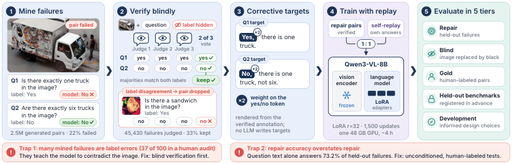
Figure 1 . Verified failure-driven repair. (1) We mine typed minimal pairs that the target VLM answers wrongly against the stored annotation; on this counting pair from the training split, it answers No to Q1. (2) Three LLM judges answer each question from the image without seeing its stored label; a pair is kept only if both two-of-three majorities agree with the stored labels. Inset: a rejected pair; its stored label puts a sandwich on this plate of chicken, and all three judges answer No. (3) Each kept question gets an answer-first, fact-grounded target rendered from the annotation, with extra weight on the yes/no token. (4) We fine-tune with LoRA on repair pairs mixed 1:1 with self-replay, whose open-ended targets are the base model’s own answers. (5) We evaluate on five tiers. Orange boxes: the two traps and our response to each. Photos: COCO [30] train2017 images 326700 and 402717 (Flickr photos 7574779034 and 8098728576; CC BY 2.0), cropped.
Original paper · CC BY 4.0 · Ang Qi, Yue Wang · When Repair Accuracy Misleads: Training a VLM on Its Own Failures · Original paper figure · Converted the paper's own image file from its arXiv HTML version to PNG.Why mined failures make a weak repair signal
The obvious way to repair a vision-language model is to collect the typed questions it gets wrong and train on them directly. Qwen3-VL-8B-Instruct failed at least one question in 22.2% of 2.5 million generated minimal pairs, and in 53.7% of the spatial-relation pairs. Because the failures recur for a given model, they can be mined at scale.
The first trap is that many mined failures are not model errors at all. Training on those pairs teaches the model to contradict the image it sees.
Mined failures repeat wording patterns, so a classifier that sees only the question text gets both answers right on 73.2% of held-out failure pairs. A score like that can rise without the image playing any real role.
With the image replaced by a black one, the trained model still answers 47.5% of VAL pairs correctly, compared to 1.9% for the base model. So the trained model has also learned regularities of the question templates, not only the image content.
The key idea: verify failures before training
The authors keep the simple recipe of mining failures and training on them, and add one check in between. Three LLM judges answer each question from the image alone, without seeing the stored label, so a label that the image contradicts can be caught before training. The reasoning is that dropping such pairs stops the model from learning to contradict what it sees.
The second change is the training target: instead of a bare Yes or No, each answer states the answer first and then the verified fact. The fact comes from the stored annotation, so no language model writes the target text. Every target begins with the same first token as the bare answer, so first-token scoring stays unchanged.
Because repair accuracy can mislead, the authors also judge the model on unconditioned pairs that a human labels blind. They add a black-image diagnostic and held-out benchmarks registered in advance, so no single number decides the result.
How VFR runs, stage by stage
The pipeline has five stages, and the first two decide which pairs reach training. The pairs come from COCO train2017 instances and captions and from GQA scene graphs, across five types: object existence, attribute swap, spatial relation, counting, and negation.
The verification committee has three judges, Claude Sonnet 5, Seed2.1 Pro, and Gemini 3.6 Flash, each answering yes, no, or uncertain. A pair survives only when both majorities match the stored labels, which kept 33.1% of 45,430 judged failures.
Each kept question gets a corrective target rendered from the stored factor, using eight templates per type and 19 for negation. For a target of length \(L\) whose first token is the Yes/No decision, \(\ell_t\) is the cross-entropy of token \(t\), and the decision token gets weight \(w\). \[\mathcal{L}_{\mathrm{cell}}=\frac{w\,\ell_1+\sum_{t=2}^{L}\ell_t}{w+L-1}\] A pair's loss averages its two cells, and at the mean target length of 10.87 tokens the decision token carries 9.2% of the cell loss at \(w=1\) and 16.9% at \(w=2\), the value the authors use.
Training mixes repair pairs with replay rows in equal shares, and the replay rows use the frozen base model's own greedy responses as targets for descriptions, open-ended VQA, and text-only instructions. Training runs one epoch of 1,500 updates, each with 8 repair pairs and 8 replay rows, and takes 4.1 hours on one 48 GB GPU.
Repair and gold accuracy
VFR repairs 82.8% of held-out failures across five seeds, up from 10.0% for the base model. Every failure type improves, with spatial relations at 93.0% and attributes at 66.1%. Table 1 places these repair numbers beside the gold and held-out columns.
The gold test is the more demanding check, because its pairs are sampled regardless of failure and labeled blind by one author. On it VFR raises pair accuracy from 87.4% to 92.4%, with the five seeds ranging from 91.8% to 92.8%.
Selecting failures adds 8.5 points of TEST repair but only 0.8 on gold, so failure selection moves the repair number far more than the gold number.
What verification changes
The unverified arm applies the same recipe to mined failures drawn without the committee, and it repairs 76.0% across three seeds. That is 6.8 points below VFR on repair, but the repair gap understates the problem. VAL contains only committee-approved failures, so that comparison favors the distribution VFR was trained on.
On the gold test the unverified arm falls to 80.8%, below the base model's 87.4%, and 11.6 points below VFR. It breaks 17.6% of the pairs the base model gets right.
Negations about absent objects show the mechanism: accuracy there drops to 4.0%, from 88.0% for the base model. The sighted-blind gap on negated questions averages −6.0 points for the unverified arm, while VFR's is +25.2 points. The authors read this as the model learning to answer negated templates from their wording rather than from the image.
None of the development benchmarks sees this, since the unverified arm stays within 0.7 points of VFR on each.
Negation: repair that hides a gold loss
VFR repairs 88.9% of held-out negation failures, yet its accuracy on negated gold pairs falls from 88.7% to 79.7%. The held-out number can't show this loss, which is why the gold test is needed.
Absent-object negations make up 6.1% of VFR's training negations, so the model saw few of them.
The authors split the labeled answer's log-odds into a blind part and the image's contribution.
Two-image questions and the partial fix
On VisMin's relation subset, paired accuracy falls from 74.3% for the base model to 49.6% for VFR, averaged over five seeds.
The same prompt slightly lowers the base model's paired accuracy, from 74.3% to 72.5%, so the prompt alone is not the fix.
Multi-image replay swaps 1,500 single-image description rows for 750 two-image caption-selection groups built from unedited COCO photos. Over five matched seeds it gains 12.4 points over VFR on average, with a 95% t-interval of 0.1 to 24.7. Only seeds 42 and 45 cleared the registered 10-point criterion, so the authors call the fix partial and uneven.
Held-out benchmarks and What'sUp
It loses 3.3 points on BLINK, with a 95% interval of 1.4 to 5.1, mostly on its two-image tasks. CV-Bench 3D, MME, and MMVP show no clear change.
The spatial gain partly survives paraphrase: on gold, VFR scores 87.3% on reworded spatial questions, compared to 96.8% on the original wording and 62.0% for the base model.
On What'sUp caption choice stays level, at 97.7% for VFR and 97.6% for the base model. Yes/no accuracy on objects under others falls from 84.5% to 26.4% of photos. The authors conclude that training broke how the model answers yes/no questions, not how it chooses a caption.
Limitations
The study repairs one model, and mining is specific to that model, so a second backbone remains future work. The questions come from templates, and the gold test shares the generator.
All human labels come from one author with no second annotator or adjudication, and 194 of 200 repeated questions agreed. The committee is a filter rather than ground truth, and 5.0% of verified target cells were factually wrong.
Most ablations use one seed, and the multi-image fix varies across seeds. The blind diagnostic uses a black image, which is an unusual input, so neither the blind score nor the sighted-blind gap directly measures grounding.
Paper info
- Authors
- Ang Qi, Yue Wang
- Venue
- arXiv · Preprint
- First published
- 2026-11-24
- Added
- 2026-11-26
- Updated
- 2026-11-24
- Version
- v1
- arXiv
- 2611.32982
- Category
- cs.CV · cs.CL
- Original paper terms
- CC BY 4.0
- What we show
- Paper info, commentary and permitted figures from the original paper
AI commentary is a separate explanation from the original paper and may contain errors. The original paper and figures follow each source's terms of use and any rights noted separately.
Abstract
Fine-tuning a vision-language model on its own failures is a direct way to repair it, but accuracy on held-out failures, the obvious measure of success, misleads. Many mined failures are not model errors: a human audit of 100 failures of Qwen3-VL-8B-Instruct on questions generated from COCO and GQA found label errors in 37. And mined failures share wording regularities: question-only classifiers get both answers right on 73.2% of held-out failure pairs. We study both traps with verified failure-driven repair (VFR): typed minimal-pair failure mining, verification by three LLM judges that answer without seeing the stored labels, answer-first corrective targets, and LoRA fine-tuning with replay. VFR repairs 82.8% of held-out failures (base model: 10.0%), and on independently labeled, unconditioned pairs it raises overall accuracy from 87.4% to 92.4% through spatial relations, whose accuracy rises from 66.7% to 96.8% even where the wording points to the wrong answer. Yet on negation, of which it repairs 88.9% of held-out failures, its accuracy on unconditioned pairs falls from 88.7% to 79.7%: it breaks negations about absent objects, rare in its training set. Without verification, accuracy on unconditioned pairs falls to 80.8%, below the base model's 87.4%, through a negation shortcut our development benchmarks miss; without failure selection, it stays at 92.0% (one seed) while repair falls to 73.4%. Training also lowers two-image relation accuracy (74.3% to 49.6%; replay data alone: 48.4%); multi-image replay partly and unevenly reverses this. Paraphrasing the spatial questions keeps most of the gain (87.3% vs. the base model's 62.0%), though rewording lowers spatial repair on held-out failures from 92.9% to 76.8%. On What'sUp's independent photos of objects under others, caption choice stays perfect while accuracy on our yes/no pairs falls from 84.5% to 26.4%.
Quote from the paper
Ang Qi, Yue Wang (2026). When Repair Accuracy Misleads: Training a VLM on Its Own Failures. arXiv:2611.32982v1. https://arxiv.org/abs/2611.32982v1
BibTeX
@misc{qi2026when,
  title = {{When Repair Accuracy Misleads: Training a VLM on Its Own Failures}},
  author = {Ang Qi and Yue Wang},
  year = {2026},
  eprint = {2611.32982},
  archivePrefix = {arXiv},
  url = {https://arxiv.org/abs/2611.32982v1}
}