Paper commentary
RVLM: Fewer Tokens, Better Resolution Scaling, Fine-Grained Spatial Grounding
RVLM groups image patches into regions, using fewer visual tokens than patch grids
- Problem Patch-based vision-language models split images into a fixed grid, so token count follows pixel area rather than scene content. Blank margins can cost more tokens than text, and existing token pruning or merging can remove coverage or blur locations.
- Method RVLM uses Felzenszwalb-Huttenlocher segmentation, which needs no training, to group neighboring patches of similar appearance into regions. It pools each region's patches into one visual token and keeps the patch-to-region map for precise pointing.
- Results Across tasks including VQA, pointing, counting, segmentation and depth, RVLM matches or improves performance while using 21.5% fewer visual tokens than the patch baseline. At the highest resolution it gains 5.3 points with 51.8% fewer tokens.
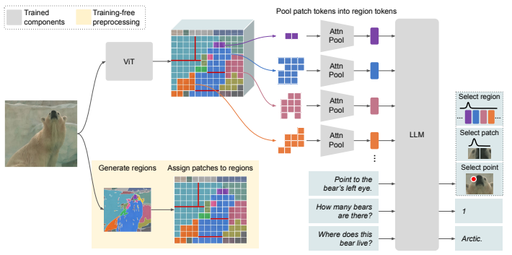
Figure 2 :Overview of RVLM.We generate content-adaptive regions using Felzenszwalb- Huttenlocher segmentation and assign each ViT patch to a region. This is a CPU-side preprocessing that runs in parallel to the model execution. Patch features within each region are aggregated through attention pooling to produce a sequence of region tokens for the LLM. The retained patch-to-region correspondence enables coarse-to-fine spatial grounding, where the LLM selects a region, then a patch within it, and finally a precise point within the patch.
Original paper · CC BY 4.0 · Savya Khosla, Chris Dongjoo Kim, Alex Schwing, Derek Hoiem, Christopher Clark, Sangho Lee · RVLM: Fewer Tokens, Better Resolution Scaling, Fine-Grained Spatial Grounding · Original paper figure · Extracted the figure area from page 4 of the original PDF.Why patch grids waste visual tokens
A patch-based VLM splits each image into a uniform grid, so each cell becomes a token and the total follows the pixel count. A sharp photo of one object can therefore cost more tokens than a cluttered scene at lower resolution. Blank margins on a document can take up more tokens than the text, purely because they cover more area. Existing fixes shrink the grid by fixed spatial pooling, or prune and merge tokens after the fact.
Fixed pooling ignores content, and pruning or merging can remove coverage or blur which token maps to which location.
Content-adaptive tokenization lets visual units follow the image instead of the grid. Existing versions, however, rely on learned features or segmentation models, which adds compute or makes regions unstable during VLM training.
Grouping patches by appearance
The core idea is to let each visual token stand for a region of similar pixels rather than a fixed spatial window. RVLM builds these regions with training-free Felzenszwalb-Huttenlocher segmentation, so no extra model runs before the forward pass. Each ViT patch is then assigned to exactly one region, and the patch features inside a region are pooled into one token.
Because the patch-to-region map is kept, a prediction can be traced back to image locations.
A region may cover a whole object or only part of one. The LLM can combine several tokens for one object, just as it combines patch or subword tokens.
Which region strategies hold up
The authors compared several ways to build regions and found three properties that separate the working ones. Regions must cover the whole image, and SAM leaves some patches without any region assignment. With C-RADIOv4-H as the T-REN encoder, about 37% of region tokens became spatially disconnected after 1,000 steps on text-heavy PixMo-Cap images.
The third property is that regions must keep fine structure such as small text, which SLIC often fails to isolate. FH reached 159 images per second with eight dataloader workers, compared to 23 for EPOC. The authors conclude that FH meets all three properties without added parameters or forward passes, so RVLM uses it.
How one image becomes region tokens
FH runs with a scale parameter k=100, Gaussian smoothing at sigma=0.8, and a minimum component size of 32 pixels. Each patch goes to the smallest region that covers at least 25% of its pixels, with the largest overlap as the fallback. Groups are capped at 16 patches, so larger regions are split into spatially contiguous groups.
The vision encoder, SigLIP2-So400m/14, reads a low-resolution overview plus up to K overlapping high-resolution crops, with K=14 in training and K=32 at inference. Each region token gets a three-dimensional position from the patch nearest the region's center, encoded with interleaved M-RoPE.
For pointing, the LLM emits a token whose hidden state scores all region tokens, then picks a patch in that region, then a point on a 4×4 grid. For segmentation, the model reuses the first stage to pick an anchor region and scores masks at region, patch and cell levels. Training runs 31,971 steps in stage 1 and 24,000 steps in stage 2, with focal and Dice losses for segmentation.
Accuracy against the patch baseline
PVLM and RVLM share architecture, data and recipe, so the comparison changes only the tokenization. On PixMo-Point, RVLM-4B scored 86.4, close to PVLM-4B at 85.2. Token count fell from 985 to 773, a 21.5% reduction.
The gains concentrate on spatial tasks: counting rose 0.9 points, segmentation 1.3 points and depth 1.9 points. The largest drop is on InfoVQA, where RVLM scored 74.3, compared to 79.2 for PVLM. The authors attribute this to very small details being absorbed into larger surrounding regions.
Scaling with image resolution
Examples were grouped into five resolution buckets, and the gain grows with image size. Across the buckets the gain rises from +0.0 to +5.3 points while the token reduction rises from 4.5% to 51.8%. At the highest test-time setting, RVLM gained 5.3 points with 51.8% fewer visual tokens.
For a fixed budget, the authors took 21,273 examples from 2.08 to 2.63 MP and capped them at seven maximum resolutions. The authors say region tokenization gains from extra detail without the rapid sequence growth of patches.
Throughput and memory
Throughput was measured on a single H100 over 512 PixMo-Cap examples, with one output token and five runs.
FH adds roughly 49 ms of CPU time per image, and eight dataloader workers keep it hidden behind GPU work. The authors expect larger LLMs to gain more from shorter visual sequences.
Pointing and post-hoc token compression
FastV, ToMe and VisionZip were applied to PVLM, with each image's budget set to the number of RVLM region tokens. On pointing, RVLM scored 67.1, compared to 63.3 to 64.2 for the three compression baselines. On segmentation, RVLM scored 71.2, compared to 42.6 to 51.6 for the baselines. Image QA stayed close across all methods, with scores of 84.2 to 84.4.
The authors argue that pruning removes individual spatial representations, and merging mixes locations into shared tokens. RVLM keeps an explicit map from every patch to a region token, which lets its coarse-to-fine decoder recover precise positions. Swapping patch tokens naively for region tokens dropped PixMo-Point pointing to 10.0, compared to 84.4 for patch tokens and 86.6 with the proposed design.
Limitations
The efficiency measurements use a 4B-parameter model, and the authors expect larger LLMs might gain more. On ScreenSpot Pro, RVLM scored 26.0, compared to 29.3 for PVLM. The authors attribute the drops on fine-detail tasks to small details being absorbed into larger regions.
Pathology, satellite and video were tested without training on them, and RVLM stays within 0.5 points of PVLM on video. Long video and sparse mixture-of-experts backbones are left as future work.
Paper info
- Authors
- Savya Khosla, Chris Dongjoo Kim, Alex Schwing, Derek Hoiem, Christopher Clark, Sangho Lee
- Venue
- arXiv · Preprint
- First published
- 2026-11-22
- Added
- 2026-11-24
- Updated
- 2026-11-22
- Version
- v1
- arXiv
- 2611.29146
- Category
- cs.CV
- Original paper terms
- CC BY 4.0
- What we show
- Paper info, commentary and permitted figures from the original paper
AI commentary is a separate explanation from the original paper and may contain errors. The original paper and figures follow each source's terms of use and any rights noted separately.
Abstract
Vision-Language Models (VLMs) tokenize images using fixed spatial grids, so visual token count grows with pixel area rather than scene content. We propose to group neighboring patches based on their visual appearance, allowing tokens to represent coherent image regions rather than fixed spatial windows. We introduce RVLM, a VLM trained to use regions rather than patches as its visual units. Analyzing region construction for general-purpose VLMs, we find that regions must cover the full image, stay spatially connected during end-to-end training, and preserve fine structure such as small text, while semantic grouping adds little. RVLM therefore partitions images using training-free Felzenszwalb-Huttenlocher segmentation, assigns each ViT patch to a region, and pools patches within each region into a variable-length sequence of visual tokens. The patch-to-region assignment is retained to support spatially precise prediction through coarse-to-fine decoding. Across tasks spanning VQA, pointing, counting, segmentation, and depth estimation, RVLM matches or improves example-weighted task performance while using 21.5% fewer visual tokens than an identically trained patch baseline. The advantage grows with image resolution, reaching a 5.3-point gain while using 51.8% fewer visual tokens at the highest-resolution setting. The gains are largest on spatially demanding tasks, where prior token-reduction methods degrade most sharply. RVLM adds no model parameters and improves inference throughput by up to 35.9%. On unseen pathology and satellite images and on video benchmarks without any video training, RVLM performs on par with the patch baseline while using 2-3$\times$ fewer visual tokens. These results establish regions as a scalable alternative to patch-based visual representations while preserving the spatial precision required for grounded prediction.
Quote from the paper
Savya Khosla, Chris Dongjoo Kim, Alex Schwing, Derek Hoiem, Christopher Clark, Sangho Lee (2026). RVLM: Fewer Tokens, Better Resolution Scaling, Fine-Grained Spatial Grounding. arXiv:2611.29146v1. https://arxiv.org/abs/2611.29146v1
BibTeX
@misc{khosla2026rvlm,
  title = {{RVLM: Fewer Tokens, Better Resolution Scaling, Fine-Grained Spatial Grounding}},
  author = {Savya Khosla and Chris Dongjoo Kim and Alex Schwing and Derek Hoiem and Christopher Clark and Sangho Lee},
  year = {2026},
  eprint = {2611.29146},
  archivePrefix = {arXiv},
  url = {https://arxiv.org/abs/2611.29146v1}
}