Paper commentary
ClothCast: Generative Cloth World Modeling under Partial Observability
ClothCast predicts garment motion from one view by moving points with gripper priors
- Problem Single RGB-D views hide parts of the cloth, and earlier geometry-capable world models do not tie the action to cloth points. Forecasting a garment is hard because its folds and layered self-contact change in many ways.
- Method ClothCast carries cloth points with a blended rigid prior built from the gripper poses. A video-diffusion model then predicts only the residual motion, so the learned part covers just what the grippers do not explain.
- Results On 492 held-out episodes, ClothCast reaches 14.0 mm sequence-averaged Chamfer distance, against 35.6 mm for Flex-π, the strongest geometry baseline.
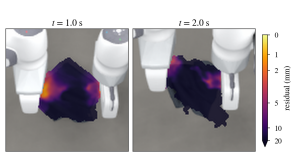
Figure 2 .Stage-2 residual over the rigid prior.Distance between each pixel’s front-most predicted point and its rigid-prior position (Eq. (1)) on the episode of Fig. 1, at two frames of the first window; a departure from the prior, not an error (bright: small; nonlinear scale saturating at 20 mm; robot pixels uncolored). The median is about 5 mm within 3 cm of a holding gripper, and 18 mm at 1 s and 73 mm at 2 s for points 10 to 15 cm away, where the hanging cloth departs from the grippers’ rigid motion; the pull toward the prior (Sec. 3.3) affects under 3% of the colored pixels.
Original paper · CC BY 4.0 · Yushen Hu, Yilong Song, Zhen Zhou, Apurv Kushwaha, Harshvardhan Chandirasekar, Zhu-Tian Chen · ClothCast: Generative Cloth World Modeling under Partial Observability · Original paper figure · Extracted the figure area from page 4 of the original PDF.Why one view isn't enough for cloth forecasting
Forecasting a garment is hard because it has no single pose, only a range of folds, wrinkles and layered self-contact. A single RGB-D image also shows only part of the cloth, so the forecast has to say what happens to the hidden layers too. Geometry-capable world models such as Flex-π and DepthWorld take the action as a plain vector that is not tied to image pixels or cloth points.
Other models place the action in the camera view or as 3D robot point flows, yet they still have to learn how the scene moves.
Cloth dynamics models can apply the grasp motion directly to the cloth state, but they need a category-specific reconstruction or explicit material parameters. The question is whether a motion prior taken from the grippers can carry most of the cloth, so that the learned part only has to cover the rest. On the 50-episode ablation subset, the prior alone already beats both geometry-capable world models, which is the evidence that motivates the design.
A rigid prior plus a learned residual
The central idea is that a grasped cloth moves with its gripper, so the planned trajectory already predicts much of the motion. ClothCast therefore stores the cloth as a set of 3D points and moves them with a blended rigid prior built from the gripper poses. A video-diffusion backbone, built on the Ctrl-World architecture, predicts only the residual, meaning the departure of the cloth from that prior.
The prior weights each arm's rigid motion by how close the point is to that arm's grasp point and whether the arm holds the cloth. It writes the blended position as a weighted sum over the two arms, \( \bar p_{i,t}=\sum_a w^a_{i,t}\Phi^a_t(p_i) \), where \( \Phi^a_t \) carries the point rigidly with arm a's gripper displacement since the window start.
The weight is a holding indicator times a distance kernel with λ = 0.05 m, normalized over both arms, and λ matters only while both arms hold. With one arm holding, the whole point set follows that gripper as a rigid body, while with neither holding the two rigid motions are averaged.
The residual is supervised as flow tiles, one per layer and frame, equal to the ground-truth displacement minus the prior, divided by 3σt and clipped. σt is the larger of 0.2 m and the largest displacement of a holding gripper from its start, so small and large manipulations share one signal range.
From one view to RGB-D frames
Only the three diffusion models are learned; the prior, the settling and the depth rendering are fixed by hand. Figure 1 shows ClothCast on one test episode, with points colored by the material coordinates of their nearest ground-truth point at t0, for visualization only.
Stage 1 predicts a layered depth image from the single RGB-D observation, storing up to four cloth surfaces that each camera ray crosses. It generates three tiles: the surface depth, the gap offsets of up to three hidden layers beneath it, and a visible-cloth mask. Where the mask marks visible cloth with valid sensor depth, the observed depth is kept, and a scalar k fitted by least squares rescales the rest of the predicted surface.
Those four layers can represent 87% of the labeled cloth-layer pixels at t0.
Stage 2 moves the layered points in windows of 21 frames, which is 2 s; the first frame is history and the model predicts the next 20. At decode time the predicted residual is added to the prior, and near a holding gripper the surface flow is pulled toward the prior with a Gaussian weight. The latent diffusion loss weights all pixels equally, so the few pixels near a gripper contribute little, and the authors add a loss on decoded tiles to correct this.
Stage 3 renders the moved points into a depth image, filling gaps along stretched links and repairing the main cloth region and depth spikes. A completion network then synthesizes RGB from a single predicted depth canvas, with the robot mask painted in a fixed color. After the last frame in which an arm holds the cloth, the learned motion is replaced by settling, which relaxes each point toward its target height with a time constant of 0.15 s.
ClothCastBench and the evaluation protocol
ClothCastBench has 10,000 simulated dual-arm episodes, with 2,500 for each of four garment classes. A fixed split holds out 516 episodes for testing and keeps 9,484 for training. Each episode gives 256×256 RGB-D frames at 10 Hz, with the ground-truth cloth mesh and layered depth labels at every frame. Cosmos-Predict2.5 produced no output for 24 test episodes, so all comparisons use the remaining 492 episodes.
Geometry is scored as a Chamfer distance on visible cloth pixels, excluding the robot, with no subsampling or alignment.
Comparison with Flex-π, DepthWorld and Cosmos
On the 492 test episodes, ClothCast averaged 14.0 mm over all predicted frames, compared to 35.6 mm for Flex-π and 61.1 mm for DepthWorld. That is 2.5 times lower than Flex-π, the strongest geometry baseline, and 4.4 times lower than DepthWorld. ClothCast's coverage over all frames is 0.89, while the baselines predict every pixel.
On RGB, ClothCast scored 20.93 dB cloth PSNR, 3.7 dB above Cosmos-Predict2.5 at 17.21 dB. Its cloth SSIM is the highest and its cloth LPIPS the lowest in the same table. At the first predicted frame, Flex-π, Cosmos and DepthWorld were higher, with 31.1, 31.0 and 29.1 dB, compared to 28.2 dB for ClothCast; from 1 s on, ClothCast leads.
Does the learned residual earn its place?
The ablation runs on 50 randomly sampled, class-balanced test episodes, with rollouts on different hardware and seeds than the main run. On these episodes the rigid prior alone reached 21.2 mm, below Flex-π's 34.2 mm and DepthWorld's 67.2 mm.
Without post-processing, moving the Stage-1 points with the prior gives 24.8 mm, and adding the residual gives 15.8 mm, each covering about half of the drop from Flex-π's 34.2 mm. Removing settling leaves the error unchanged up to 3 s but lifts the last-frame error from 15.8 to 20.8 mm. The rigid prior depends more on post-processing, since its released cloth stays in the air, and its raw points end at 36.5 mm.
Recovering the camera pose from the t0 frame gave 14.34 mm, compared to 14.47 mm with the calibrated pose. The recovery needs the robot model, which the baselines don't receive, and it is untested on real data.
What the hidden layers add
Because the benchmark labels every layer, the authors can score occluded geometry directly on the same rollouts. With the hidden-layer points, the full-geometry Chamfer distance fell from 16.4 mm to 13.4 mm, a paired difference of 3.0 mm with a 95% interval of 2.9 to 3.1 mm. Occluded cloth also lay 9.4 mm from the nearest predicted point, instead of 14.2 mm when only the surface layer was used.
The authors did not train a model without the hidden layers, so this compares two readouts of the same rollouts, not two trained models.
So the layers appear in roughly the right amount, though not reliably in the places where hidden cloth is revealed.
Real-robot test with WidowX arms
The real data has 418 episodes of two WidowX AI arms manipulating seven items, and 84 episodes were held out for testing. The geometry stages were trained only in simulation, with Stage 1 fine-tuned on re-rendered WidowX episodes, and Stage 3 was fine-tuned for three epochs on real episodes. Measured against the sensor depth, the predicted visible surface scored 35.3 mm over all frames, at a coverage of 0.66.
No baseline was run on the real recordings, so the real comparison is only against the prior.
The authors tie the gap to the pillow covers being sewn two-layer sleeves, with test episodes that are mostly carries.
Limitations
The benchmark is preliminary: it covers three scripted dual-arm programs, and the robot touches the cloth only through grasp springs. The authors say it needs more cloth types, motions, fabrics and real data. Each forecast is a single sample taking minutes per episode, so planning with several samples per candidate action is left to future work.
Paper info
- Authors
- Yushen Hu, Yilong Song, Zhen Zhou, Apurv Kushwaha, Harshvardhan Chandirasekar, Zhu-Tian Chen
- Venue
- arXiv · Preprint
- First published
- 2026-11-22
- Added
- 2026-11-24
- Updated
- 2026-11-22
- Version
- v1
- arXiv
- 2611.29369
- Category
- cs.CV
- Original paper terms
- CC BY 4.0
- What we show
- Paper info, commentary and permitted figures from the original paper
AI commentary is a separate explanation from the original paper and may contain errors. The original paper and figures follow each source's terms of use and any rights noted separately.
Abstract
World models support robotic manipulation by predicting how the scene evolves under a planned action. For garments this prediction is notoriously difficult: deformations are complex, and self-occlusion leaves much of the cloth unobserved. Planned gripper trajectories provide a useful motion prior because cloth held by a gripper moves with it, while the remaining deformation must be predicted. We introduce ClothCast, a world model that applies this prior to the cloth's points and learns the residual motion. ClothCast takes one RGB-D observation, the camera pose, the robot's own model and the planned gripper trajectories, with no cloth mesh or material parameters. It lifts the observation to a layered point set that includes hypothesized occluded layers, carries the points with a blended rigid prior derived from the gripper poses, and predicts the residual motion with a video-diffusion point-flow model. Over entire 4- to 11-second episodes at 10 Hz, the moved points are rendered into depth, from which a geometry-conditioned completion model synthesizes RGB; after release, a hand-designed settling step replaces the learned motion. We further release ClothCastBench, 10,000 simulated dual-arm cloth-manipulation episodes with the ground-truth cloth mesh, including occluded layers, at every frame. On 492 held-out episodes, ClothCast achieves 2.5x lower sequence-averaged visible-surface Chamfer distance than Flex-π, the strongest baseline in geometry (14.0 mm vs. 35.6 mm), and 3.7 dB higher cloth-region PSNR than Cosmos-Predict2.5, the strongest baseline in cloth PSNR. On a 50-episode ablation subset, the rigid prior alone, applied to ClothCast's learned initial geometry with the same post-processing, already outperforms both geometry-capable baselines, and the learned residual lowers its error by about a third.
Quote from the paper
Yushen Hu, Yilong Song, Zhen Zhou, Apurv Kushwaha, Harshvardhan Chandirasekar, Zhu-Tian Chen (2026). ClothCast: Generative Cloth World Modeling under Partial Observability. arXiv:2611.29369v1. https://arxiv.org/abs/2611.29369v1
BibTeX
@misc{hu2026clothcast,
  title = {{ClothCast: Generative Cloth World Modeling under Partial Observability}},
  author = {Yushen Hu and Yilong Song and Zhen Zhou and Apurv Kushwaha and Harshvardhan Chandirasekar and Zhu-Tian Chen},
  year = {2026},
  eprint = {2611.29369},
  archivePrefix = {arXiv},
  url = {https://arxiv.org/abs/2611.29369v1}
}