Paper commentary
On Adaptive Step Sizes for Eligibility Traces in Deep Reinforcement Learning
Adaptive step sizes must sit inside eligibility traces to keep deep RL updates equivalent
- Problem Adaptive vector step sizes placed outside an eligibility trace break its equivalence between forward and backward views. Adam's step sizes also have no online backward view, because they depend on future TD errors.
- Method FSD is a new optimizer that preconditions updates in function space instead of parameter space. It places its step size inside the trace, so the forward and backward views stay equal.
- Results AC(λ) with FSD had the highest return in every MuJoCo environment except Hopper, compared with SGD and naive Adam.
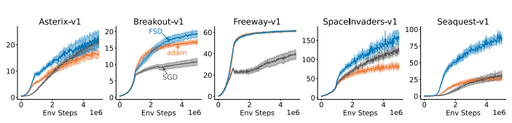
Figure 4 : Optimizer comparisons for Q(λ). Each learning curve is averaged over 30 seeds and the shaded region is the95%bootstrap confidence interval.
Original paper · CC BY 4.0 · Esraa Elelimy, Martha White · On Adaptive Step Sizes for Eligibility Traces in Deep Reinforcement Learning · Original paper figure · Extracted the figure area from page 10 of the original PDF.Why buffer-based learning and short returns fall short
Many deep RL agents store transitions in a replay buffer and learn by sampling from it. That delays learning, because a transition can only be learned from when the buffer happens to sample it, and it costs memory. Random sampling also breaks the long-range temporal order, so credit beyond one step becomes hard to assign.
Eligibility traces offer a streaming alternative, because an exponentially decaying sum of past gradients lets an agent update at every step. Their backward view is meant to reproduce the forward λ-return that PPO computes, and that forward view needs future transitions before any update. Traces were long thought unworkable with neural networks, but recent work has used them in deep RL.
The gap is that Stream-X methods rely on an adaptive scalar step size and have not used vector step sizes such as Adam.
Placing the step size inside the trace
The core idea is to move the adaptive step size from the weight update into the eligibility trace. Placed in the weight update, as the naive approach does, the step size produces an update that departs from the forward view whenever it changes over time. Placed inside the trace, the same step size keeps the two views equal, provided the weights stay fixed during an episode.
With a time-dependent vector step size \\(\\alpha_t\\), the traced update builds \\( z_t = \\gamma\\lambda z_{t-1} + \\alpha_t \\odot \\nabla_w \\hat v(S_t, w_t) \\) and moves the weights by \\( w_{t+1} = w_t + \\delta_t z_t \\). The naive version keeps the trace without the step size and multiplies the TD-weighted trace by \\(\\alpha_t\\) at update time.
Theorem 3.1 shows that summing the forward updates over an episode gives the same total as summing the traced backward updates. The theorem is stated for semi-gradient TD, and the authors say the same argument carries over to gradient TD updates, with details in the appendix.
How the naive placement changes the fixed point
The authors answer this in the simplest case, linear TD(λ) with on-policy samples and a state-dependent step size. There the traced update converges to the TD(λ) fixed point with \\(D_\\mu\\) replaced by \\(\\tilde D = D_\\alpha D_\\mu\\). The naive update instead places \\(D_\\alpha\\) between \\((I-\\gamma\\lambda P)^{-1}\\) and \\((I-\\gamma P)\\), so its fixed point differs.
The two fixed points coincide when the step size is constant or when λ is zero. Proposition 3.3 measures the gap between the naive and traced totals as \\(\\gamma\\lambda\\) times a sum of \\(\\delta^\\lambda_t \\psi_t\\), where \\(\\psi_t = (\\alpha_t - \\alpha_{t-1}) \\odot \\bar z_{t-1}\\). So the error grows with how much the step size changes between steps and with the size of the trace.
Adaptive optimizers change the step size at every step, so this error is nonzero in general.
Why Adam-style step sizes don't fit traces
Adam, RMSProp and RL-specific optimizers such as TIDBD compute step sizes from gradient statistics. In the forward view those gradients contain the λ-return TD error, which depends on future transitions. A step size that depends on future TD errors can't be formed by a trace that only sees the past, which is what an online trace requires.
Proposition 4.1 says an online trace exists only if each product of the step matrix and the value gradient doesn't depend on later TD errors. Applying these step sizes outside the trace is still possible, but then the update no longer matches the forward view.
Function-Space Distance as a preconditioner
FSD replaces the Euclidean distance on parameters in the proximal update with a distance measured on the learned value function. Linearizing the value function around the current weights turns that distance into a quadratic form with matrix \\(G_t = \\mathbb{E}_s[\\nabla_w \\hat v \\nabla_w \\hat v^\\top]\\). Because \\(G_t\\) contains no TD error, the traced update built from it is an exact backward view.
Inverting the full \\(G_t\\) is too costly, so FSD keeps only its diagonal, estimated with an exponential average of squared gradients and bias correction. Taking the square root gives the vector step size \\(\\alpha_t = \\alpha / \\sqrt{m_t + \\epsilon}\\), where a small \\(\\epsilon\\) guards against division by zero.
The value update becomes \\( z_t \\leftarrow \\gamma\\lambda z_{t-1} + \\alpha_t \\odot \\nabla_w \\hat v(S_t, w_t) \\) followed by \\( w_{t+1} \\leftarrow w_t + \\delta_t z_t \\). For action values the same preconditioner is used, with the gradient of \\(\\hat q\\) in place of the gradient of \\(\\hat v\\). For the policy, a KL-based distance gives a diagonal preconditioner built from squared score-function gradients, and an entropy term is added to the update.
Semi-gradient and gradient TD critics
AC(λ) pairs FSD with a semi-gradient TD(λ) critic. ARC(λ) pairs FSD with a critic that uses a TDRC(λ) variant, a gradient TD method with regularized corrections. TDRC was chosen because earlier work found it more consistent than GTD2 and TDC.
For semi-gradient value estimation, the FSD preconditioner equals the Gauss-Newton matrix. For the policy, the Gauss-Newton form would depend on the λ-return TD error, so it would carry future information and differ from FSD.
MuJoCo results against streaming and buffer baselines
Both actor and critic used a learning rate of 10−4, with β = 0.999 and λ = 0.8 for the eligibility-trace methods. The baselines are PPO, Gradient PPO and StreamAC, and PPO used default MuJoCo hyperparameters. StreamAC is the closest baseline, because like ARC(λ) and AC(λ) it uses no replay buffer and updates every step.
AC(λ) had the highest return in HalfCheetah and Humanoid-Standup. In Walker2d, PPO and Gradient PPO scored higher than the FSD methods, and in Reacher only StreamAC had some failed seeds. Across environments AC(λ) was as good as or better than ARC(λ), which the authors read as FSD narrowing the gap between semi-gradient and gradient methods.
FSD against SGD and naive Adam on MuJoCo
The authors held AC(λ) fixed and swapped in SGD or naive Adam, the placement given in Eq. 8, as the optimizer. AC(λ) with FSD had the highest return in every MuJoCo environment except Hopper, where it matched SGD. In Humanoid SGD and naive Adam did not learn, and in Reacher they were unstable.
Only the optimizer changes between these rows, so the gap reflects the optimizer choice in this setup.
Discrete-action results on MinAtar
The discrete-action study uses five MinAtar games and compares QRC(λ) and Q(λ) with FSD against StreamQ and DQN. Both use Watkins' trace, which is cut whenever a non-greedy action is selected. For QRC(λ) the authors regularized the auxiliary network's output rather than the network weights, because they found that more stable. Both QRC(λ) and Q(λ) with FSD outperformed StreamQ in all five games.
Against DQN, which uses a replay buffer, they scored higher in Seaquest, similar in Freeway and SpaceInvaders, and lower in Asterix and Breakout. Overall the two FSD methods performed similarly, and the curves average over 30 seeds with 95% bootstrap intervals.
Optimizer comparison for Q(λ) on MinAtar
For Q(λ) the authors compared FSD with SGD and naive Adam on the MinAtar games. FSD had the highest return in three games and matched naive Adam in Freeway. In Asterix FSD learned faster, but SGD caught up to its return by the end.
FSD was the top or tied-top optimizer in most games across both benchmarks, though SGD matched it in Hopper and Asterix.
Limitations
The diagonal preconditioner drops off-diagonal curvature, which may limit it when gradients are highly correlated. The authors describe the empirical study as narrowly scoped and aimed at initial insights. The next steps they list are more complex environments, larger networks, architectural choices, other initializations and normalization, and hyperparameter sensitivity.
The fixed-point analysis covers only linear TD(λ) with on-policy samples. The equivalence holds only while the weights stay fixed within an episode. For the MuJoCo methods the authors did not run a systematic hyperparameter sweep, and they used one learning rate of 10−4.
Paper info
- Authors
- Esraa Elelimy, Martha White
- Venue
- arXiv · Preprint
- First published
- 2026-11-22
- Added
- 2026-11-24
- Updated
- 2026-11-22
- Version
- v1
- arXiv
- 2611.29178
- Category
- cs.LG · cs.AI
- Original paper terms
- CC BY 4.0
- What we show
- Paper info, commentary and permitted figures from the original paper
AI commentary is a separate explanation from the original paper and may contain errors. The original paper and figures follow each source's terms of use and any rights noted separately.
Abstract
Many deep reinforcement learning (RL) algorithms store agent-environment interactions in a replay buffer and later learn by sampling transitions from it. However, this approach can be memory-inefficient and can delay learning because the agent can learn from a transition only when the buffer samples it. Additionally, most of these methods use one-step or short multi-step temporal-difference (TD) updates, which are slow at credit assignment. An alternative approach is to learn from the stream of observations as they arrive without relying on a buffer. Eligibility-trace algorithms allow these incremental updates and can also assign credit over many steps. These algorithms were common with linear function approximation but have only recently been used in deep RL. Basic questions, such as how to use vector step sizes with eligibility traces in the deep RL setting, remain open. In this work, we first show that adaptive vector step sizes must be part of the eligibility trace to keep the equivalence between the forward and backward views. We then show that the step sizes of common optimizers, such as Adam, do not have an online backward view. We introduce a new optimizer, Function-Space Distance (FSD), that maintains the forward-backward equivalence. We test four eligibility-trace algorithms covering semi-gradient and gradient TD updates, as well as value-based and actor-critic methods. We show that FSD performs better than SGD or naively applied Adam. The resulting algorithms outperform or match other streaming methods and are comparable to or better than PPO, which uses a buffer, in most environments. Code available at https://github.com/esraaelelimy/ada_traces
Quote from the paper
Esraa Elelimy, Martha White (2026). On Adaptive Step Sizes for Eligibility Traces in Deep Reinforcement Learning. arXiv:2611.29178v1. https://arxiv.org/abs/2611.29178v1
BibTeX
@misc{elelimy2026adaptive,
  title = {{On Adaptive Step Sizes for Eligibility Traces in Deep Reinforcement Learning}},
  author = {Esraa Elelimy and Martha White},
  year = {2026},
  eprint = {2611.29178},
  archivePrefix = {arXiv},
  url = {https://arxiv.org/abs/2611.29178v1}
}