Paper commentary
ViRA: Toward Ultra-High-Resolution Visual Agents via Cross-Input Relative Policy Optimization
- Problem Zoom agents trained on the final answer can reach a correct answer without reading the evidence, and rewarding the zoom call does not fully close that gap.
- Method CrossRPO trains on contrast sets, comparing each rollout only with rollouts of its own version and adding a joint term weighted by how often the other versions are answered correctly.
- Results ViRA-9B trained with CrossRPO reached 63.3% set accuracy on ViRA-Bench at the maximum resolution, against 59.3% for GRPO trained on each version separately.
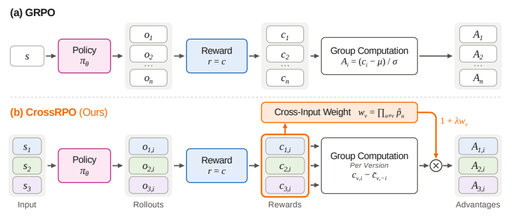
Figure 3 . GRPO and CrossRPO. The policy 𝜋𝜃 samples the rollouts, and the reward 𝑟 is the correctness 𝑐 of the answer. (a) GRPO compares the rollouts of one input 𝑠. (b) CrossRPO compares rollouts within each version 𝑠𝑣 of a set and multiplies the result by 1 + 𝜆𝑤𝑣, where 𝑤𝑣 comes from the rewards of the other versions.
Original paper · CC BY 4.0 · Huawei Lin, Jinting Liu, Tongyan Wang, Xuyang Chen, Ruihua Shi, Zhichao Xu, Jiaxin Qin, Guoshenghui Zhao, Baijian Yang, Yingjie Victor Chen, Tan Yu, Weijie Zhao · ViRA: Toward Ultra-High-Resolution Visual Agents via Cross-Input Relative Policy Optimization · Original paper figure · Extracted the figure area from page 6 of the original PDF.Why a correct answer can come from common sense
Zoom agents crop a high-resolution photo to the regions they need, but a correct final answer alone does not show that the agent looked at the evidence.
Rewards that credit the zoom call, or a crop that covers annotated evidence, change the signal but can still be met without using what the zoom shows. The paper gives a DeepEyes example in which the agent zooms onto the right object, writes a conclusion the zoom does not support, and then answers differently when the zoom is given alone.
How the CrossRPO advantage is computed
GRPO draws several rollouts for one input and scores each against the others. Applied to each version of a set separately, no reward depends on the other versions. Pooled across versions, a guess that is right on one version can score above the wrong answers on the others, so the pooled signal rewards guessing. CrossRPO keeps the comparison inside each version and adds a term that depends on the other versions.
For rollout \(i\) of version \(v\), the advantage is \( A_{v,i} = (r_{v,i} - \bar r_{v,-i}) + \lambda\, w_v\,(c_{v,i} - \bar c_{v,-i}) \), where \(r\) is the rollout reward, \(c\) its correctness, and \(\bar r_{v,-i}\) and \(\bar c_{v,-i}\) the means over the other rollouts of the same version. The first bracket is a leave-one-out baseline within the version, so it is the RLOO term.
The second bracket is the joint term. It is scaled by \(\lambda\), which is set to 0.5 for ViRA-9B and ViRA-27B.
The cross-input weight \(w_v\) is what makes a correct answer on version \(v\) worth more when the other versions are answered correctly. For \(K \le 3\), it is the product of the empirical accuracies \(\hat p_u\) of the other versions. For \(K > 3\), it is the mean of the products over pairs of other versions. Because each \(\hat p_u\) is the share of correct rollouts on version \(u\), a version that is never answered correctly removes the joint credit for \(K \le 3\), while for \(K > 3\) only the pairs that contain it are removed.
CrossRPO applies to sets of any size, whereas methods designed for two inputs handle only pairs.
With \(K\) versions, each set receives \(n = 12/K\) rollouts per version, so every set has 12 rollouts in total, the same as one GRPO input.
What the unbiasedness result establishes
The gradient of the set-level objective then equals the sum over versions of the expected value of each version's score function times this projection. CrossRPO estimates the projection by averaging the set reward over all combinations of one rollout per other version. Conditioned on a rollout of version \(v\), this average has the projection as its expectation.
Under the paper's Assumption A.4, the expectation of the estimate equals \(n\) times the gradient of the objective for every set-level reward, which is Theorem A.19. If versions have unequal numbers of rollouts, weighting each version's terms by one over its rollout count restores the gradient exactly. The batch scale is consistent, though not exactly unbiased, for a finite batch, and it changes only the length of the step.
How ViRA-Bench is built
Several models propose objects and write questions, and vision-language models and human reviewers check each set, with humans accepting, correcting or rewriting each question.
CrossRPO against separate and pooled training
With the same data and reward, ViRA-9B trained with CrossRPO reached 63.3% set accuracy on ViRA-Bench at the maximum resolution. GRPO trained on each version separately reached 59.3% under the same conditions. The maximum resolution here is the largest input the model accepts, which is 16.8MP for Qwen3.5-9B. The comparison is therefore at the model's own maximum budget, not at a fixed budget.
Pooled GRPO, which compares rollouts across all versions, reached 52.6% in the same comparison. Separate per-version training that keeps the cross-input weight out of the update reached 58.7%. The gap from 58.7% to 63.3% is therefore the part attributed to the cross-input weight, under the same data and reward.
The gain depends on the contrast sets. When the cross-input weight is computed from photos of other questions, CrossRPO loses its gain over separate training. Table 3 lists the ablations on the same data, reward and tool, so each row isolates the effect of its advantage on set accuracy at each budget. The table reports means over three runs for the ViRA-Bench results.
Set accuracy across pixel budgets
Table 1 reports set accuracy on ViRA-Bench and ViRA-Bench-Real at 0.5, 1, 2 and 4MP and at each model's maximum resolution, with tokens per set in parentheses. At the maximum, ViRA-9B reaches 63.3 on ViRA-Bench and 77.4 on ViRA-Bench-Real, against 34.6 for Qwen3.5-9B with the zoom tool.
ViRA-27B reaches 71.5 on ViRA-Bench and 76.5 on ViRA-Bench-Real at its maximum of 16.8MP. The paper states that ViRA-27B exceeds every proprietary model it tests on ViRA-Bench at every resolution, with the proprietary models run through the same zoom tool via their APIs.
Joint term beyond three versions
Each method was trained three times, and each run was evaluated three times. The text experiments use one base model and one pass over fewer than 3,000 questions, so the paper presents them as a check that the joint term transfers to text rather than as a measure of the accuracy it can reach there.
Limitations
ViRA-Bench-Real has only 78 sets, all shot indoors with one camera, and it shows mostly posters, signs, stickers and labels.
Only the Qwen3.5-9B and Qwen3.8-27B families are trained, and the paper has not tested CrossRPO on other architectures.
Paper info
- Authors
- Huawei Lin, Jinting Liu, Tongyan Wang, Xuyang Chen, Ruihua Shi, Zhichao Xu, Jiaxin Qin, Guoshenghui Zhao, Baijian Yang, Yingjie Victor Chen, Tan Yu, Weijie Zhao
- Venue
- arXiv · Preprint
- First published
- 2026-11-16
- Added
- 2026-11-18
- Updated
- 2026-11-16
- Version
- v1
- arXiv
- 2611.21605
- Category
- cs.CV · cs.AI
- Original paper terms
- CC BY 4.0
- What we show
- Paper info, commentary and permitted figures from the original paper
AI commentary is a separate explanation from the original paper and may contain errors. The original paper and figures follow each source's terms of use and any rights noted separately.
Abstract
Visual agents answer questions about ultra-high-resolution photos by zooming into the relevant regions. However, existing agents often answer from common sense instead of reading the evidence. Reinforcement learning (RL) on the final answer cannot correct this, because a guess earns the same reward as reading. We propose Cross-Input Relative Policy Optimization (CrossRPO), which trains agents on contrast sets. A contrast set asks one question about several versions of an image that differ only in a small region with the evidence and have different answers, so only reading the evidence solves the whole set. CrossRPO rewards solving the whole set, and we prove that it does not reinforce a set answered from common sense. We build contrast sets for training (ViRA-Train) and evaluation (ViRA-Bench) by editing one small object in images of 21 to 120 megapixels, and we photograph further sets with real changes (ViRA-Bench-Real) to exclude editing traces. We train two Visual Reasoning Agents, ViRA-9B and ViRA-27B, with CrossRPO on only about 3,500 items of ViRA-Train each. CrossRPO achieves 63.3% set accuracy on ViRA-Bench at the maximum resolution, against 59.3% for GRPO. ViRA-9B is the most accurate open model of its size on all benchmarks, and ViRA-27B outperforms Claude Haiku 5.5 and GPT-6-Luna, both at their highest thinking level, on most benchmarks.
Quote from the paper
Huawei Lin, Jinting Liu, Tongyan Wang, Xuyang Chen, Ruihua Shi, Zhichao Xu, Jiaxin Qin, Guoshenghui Zhao, Baijian Yang, Yingjie Victor Chen, Tan Yu, Weijie Zhao (2026). ViRA: Toward Ultra-High-Resolution Visual Agents via Cross-Input Relative Policy Optimization. arXiv:2611.21605v1. https://arxiv.org/abs/2611.21605v1
BibTeX
@misc{lin2026vira,
  title = {{ViRA: Toward Ultra-High-Resolution Visual Agents via Cross-Input Relative Policy Optimization}},
  author = {Huawei Lin and Jinting Liu and Tongyan Wang and Xuyang Chen and Ruihua Shi and Zhichao Xu and Jiaxin Qin and Guoshenghui Zhao and Baijian Yang and Yingjie Victor Chen and Tan Yu and Weijie Zhao},
  year = {2026},
  eprint = {2611.21605},
  archivePrefix = {arXiv},
  url = {https://arxiv.org/abs/2611.21605v1}
}