Paper commentary
BLIP-Live: Balancing Timeliness & Firing Precision in Proactive Streaming Video Agents
- Problem Proactive streaming agents must answer at the right moment and stay silent otherwise, but existing metrics each leave one side of that trade-off unmeasured.
- Method BLIP-Live pairs a human-verified dataset with silence labels, the PAUC-F metric, a training-free harness tuned by automated search, and teacher-forced finetuning with masked loss.
- Results BLIP-Live-Qwen reached a mean PAUC-F of 49.08 at ω = 0.5 on ProactiveVideoQA, against 34.01 for MMDuet2.
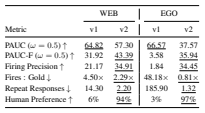
Table 4 :PAUC-F vs PAUC for model selection.We build two harness variants optimiz- ing PAUC (v1) vs PAUC-F (v2). PAUC-F optimized v2 shows better firing precision, closer firing counts as ground- truth (Fires:Gold), less consec- utive repeated responses, and higher human preference.
Original paper · CC BY 4.0 · Kanchana Ranasinghe, Honglu Zhou, Dominick Reilly, Le Xue, Shusheng Yang, Juan Carlos Niebles, Silvio Savarese, Ran Xu · BLIP-Live: Balancing Timeliness & Firing Precision in Proactive Streaming Video Agents · Original paper figure · Extracted the figure area from page 5 of the original PDF.Why timing alone is not enough
A streaming agent sees the video one frame at a time, and for a query raised earlier it must decide at every timestep whether to answer or stay quiet. An answer loses value when it arrives late, and repeated answers make even a correct one unhelpful, so the agent has to balance when it speaks against how often it speaks.
PAUC measures quality-weighted timeliness, but only recall inside the gold window counts, so responses fired outside that window are discarded instead of penalized. Duplicate replies inside the gold window also leave the PAUC score unchanged. ESTP-F1 adds a precision term for out-of-window firing, but it ignores redundant firing inside the window and needs a task-dependent timing term for recall.
Each metric covers only part of the trade-off, which motivates a score that keeps timeliness and adds firing precision.
How the BLIP-Live-780K labels are made
The dataset holds 784,944 proactive responses over 177,789 videos, and it uses the same source videos as LLaVA-Video-178K. Unlike the earlier proactive datasets compared in Table 1, both response content and response intervals were checked by humans, which gives explicit supervision for when to stay silent. A query may need one response or several, and each response covers a single frame or a frame interval.
Labels come from a three-stage pipeline that starts with automated generation and ends with expert review. The generator sees the whole clip but has to restrict itself to evidence visible before each timestamp. Human annotators drop queries that are not valid, then check every response or silent state and fix its timing and, where needed, its wording.
Expert reviewers judge the corrected annotations batch by batch, and a batch below the acceptance threshold returns for another revision.
Queries fell from 186,751 to 177,789 after filtering and deduplication.
PAUC-F: recall plus firing precision
PAUC-F keeps PAUC as its recall term and adds a precision term, combined in a harmonic form. The definitions are \(R=\mathrm{PAUC}\), \(P=N_{\text{value}}/N_{\text{fires}}\), and \(\mathrm{PAUC\text{-}F}=2PR/(P+R)\).
\(N_{\text{fires}}\) counts every emitted response, including those outside the gold window. \(N_{\text{value}}\) takes at most one response per gold turn, namely the earliest in-window fire whose judge score is 1 or 2, with a maximum score of \(S=2\). Extra fires therefore enlarge only the denominator of \(P\), which lowers precision, while PAUC itself, and so \(R\), does not change.
PAUC-F inherits the quality-timeliness weight \(\omega\) of PAUC, and the paper reports it at \(\omega = 0.0\), \(0.5\) and \(1.0\).
Testing the metric against excess firing
The authors build a toy test from ground-truth responses: Oracle + 5x repeats them five extra times inside the gold window, and Spam 0.5 fires every 0.5 s across the video. The test covers the WEB and EGO splits of ProactiveVideoQA and the Explicit Proactive subset of ESTP-Bench. PAUC and ESTP-F1 each reward at least some of these undesired patterns, while PAUC-F penalizes both.
In the sparse example over 100 gold turns, one perfect response at the start of a window gives a PAUC of 0.2575. Adding out-of-window fires leaves PAUC at 0.2575 but moves PAUC-F from 0.4095, at precision 1.0000, down to 0.0191 at 100 extra fires, where precision is 0.0099.
Two harness variants were tuned on a held-out validation split, one maximizing PAUC (v1) and one maximizing PAUC-F (v2). On WEB, PAUC-F rises from 31.92 for v1 to 43.39 for v2, while PAUC is lower for v2 (57.30 against 64.82). On EGO, PAUC-F rises from 3.58 to 35.94 and firing precision from 1.84 to 34.45. Repeated responses fall from 14.30 to 2.20 on WEB and from 185.90 to 1.32 on EGO.
Human preference favours v2 at 94% on WEB and 97% on EGO, against 6% and 3% for v1.
The preference judgement came from 10 participants who rated 20 samples drawn from the WEB and EGO splits.
A training-free harness for frozen VLMs
At each timestep \(t\), the model receives a window of past frames and a textual state of earlier queries and responses, and it must output silence or a response for the current timestamp.
The harness has four components: a system prompt that fixes the task and output schema, a past-frame window, a memory of earlier interactions, and a parser for structured output. The frozen VLM is queried at the target frame rate, the parser decides between silence and a response, and accepted responses are written back to memory.
The authors note that some offline evaluations use 5 s chunks and condition a response at frame \(t\) on frames up to \(t+5\), which departs from the streaming setting. The harness is therefore built to follow the streaming protocol rather than to reuse an offline evaluation.
The four components are tuned by agent-assisted search, and the VLM weights stay frozen. Each round proposes hypotheses about one component, implements the change and scores it with PAUC-F on the validation split; a round holds ten candidate variants, and the variants that improve the score are promoted and combined into the next round. Gemma4-26B-A4B and Qwen3.5-35B-A3B each went through 10 rounds with 100 candidate evaluations, and both converged on a common design that differs only slightly in system prompt and output schema.
Model-specific calibration changes only the system prompt and output schema, on a fixed 20-sample subset of the validation set. Five candidates were tried over five rounds, a total budget of 100 video samples, and this calibration is applied to every other offline model before evaluation. The user query stays in memory and can be updated midway through a video, so a new query can arrive while the same stream is still being processed.
Teacher-forced finetuning with masked loss
Finetuning keeps the same streaming interface and trains with teacher-forced SFT, which keeps the cost of standard teacher-forced training. Each video timeline is a sequence of frame inputs and model turns, and every turn is Silence, Response or Hold, with a Response turn followed by its annotated text. The timelines are cut into chunks that carry the memory, absolute timestamps and the matching source-frame range.
Each chunk spans \(L = 32\) frames, and every response turn in it is fully supervised. Long runs of non-response turns are subsampled so that silence does not take over the token budget. Silence marks irrelevant frames, Response marks the first frame with enough evidence, and Hold marks later frames of the same event, which suppresses repeated answers.
Finetuned models predict all three states, and Hold and Silence emit no response and leave memory unchanged.
During training the memory keeps the user query and the last annotated response, while inference uses the model's last generated response. Memory keeps responses that have left the visual window, which discourages repetition. Both finetuned models use \(L = 32\) frames and \(m = 1\) at 1 Hz, while the frozen-model harness uses three frames.
Loss masking acts at token level: every Response target keeps its loss, repeated Silence and Hold continuations are subsampled, and the response text after each Response token is not masked. The authors motivate this by the large share of silence timestamps in the task and cite similar practice in Li et al. (2026).
ProactiveVideoQA results
ProactiveVideoQA is scored on WEB, EGO, TV and VAD with PAUC-F at three values of \(\omega\) under a GPT-4.1 judge. Offline models run under the authors' harness with per-model calibration, Gemini-Live runs both with its default harness and with the authors' harness (ours-v), and streaming native models use their default inference setting.
The authors report a 44% gain over MMDuet2 on this mean. Among the proprietary rows, the highest mean at \(\omega = 0.5\) is GPT-5.6-Sol at 42.03.
BLIP-Live-Gemma reaches 41.38 at \(\omega = 0.5\), compared with 33.61 for the offline Gemma4-A4B under the authors' harness.
On the split scores, BLIP-Live-Qwen reaches 57.48 on WEB, 46.05 on EGO, 43.11 on TV and 49.67 on VAD at \(\omega = 0.5\).
ESTP-Bench, StreamingBench and OVO-Bench
The offline Qwen3.5-A3B under the authors' harness reaches 26.20, and BLIP-Live-Gemma reaches 23.80.
On the standard ESTP-F1 over the full benchmark, BLIP-Live-Qwen scores 35.1 overall and 35.2 on the Explicit split. The authors attribute this to ESTP-F1 overlooking in-window repetition on splits with longer gold intervals, so repetitive models can score higher there.
On the Proactive Output split of StreamingBench, BLIP-Live-Qwen reaches a time accuracy of 47.60, above Gemma4-A4B at 36.80 and MMDuet2 at 34.69. On the authors' interactive PO-I split, where queries arrive mid-video, BLIP-Live-Qwen scores 54.6 and BLIP-Live-Gemma scores 48.6. The PO baselines come from the official leaderboard, whereas PO-I is introduced in this paper.
On the CRR task of OVO-Bench, BLIP-Live-Qwen scores 62.50, above Gemini 1.5 Pro at 61.67 and BLIP-Live-Gemma at 60.83. In CRR the query comes before enough evidence exists, so the model has to wait until the evidence appears before it responds. The OVO-Bench baseline numbers follow Li et al. (2025).
What each training and harness part contributes
With the Qwen3.5-A3B backbone, recipe and harness fixed, training on BLIP-Live-780K reaches a mean of 49.08, against 45.28 with VideoChat3 data and 18.92 with MMDuet2 data. The unfinetuned base model with the same harness reaches 42.94 on that mean.
For BLIP-Live-Gemma on WEB and EGO, raw generated data gives 54.8 and 42.4, intermediate pre-cleaning data gives 55.4 and 42.9, and the final human-verified data gives 56.5 and 43.8. At 10% of the data the scores are 53.8 on WEB and 42.3 on EGO.
On Gemma4-A4B, removing the sliding window drops WEB from 43.4 to 33.6 and EGO from 36.0 to 7.0. Removing online memory gives 36.8 on WEB and 14.1 on EGO, while removing structured output gives 42.2 and 34.6. The VideoChat3 harness reaches 26.3 on WEB and 2.4 on EGO.
For BLIP-Live-Gemma, removing Loss Masking drives PAUC-F to 0.0 on both WEB and EGO, which the authors read as collapse to silence. Removing Hold gives 32.9 on WEB and 24.4 on EGO, and removing memory gives 54.8 and 40.5.
Without Hold, WEB fires rise from 978 to 2,840 and firing precision falls from 75.1% to 25.8%, while PAUC stays at 45.26% with Hold and 45.39% without it. The authors read this as Hold improving firing selectivity, since PAUC does not move.
Limits of the evidence
The human preference study uses 10 participants and 20 samples from the WEB and EGO splits. Harness calibration for the offline models uses a fixed 20-sample subset and a budget of 100 video samples. Model selection uses the BLIP-Live-780K validation split, and the four test benchmarks are held out.
Streaming native models run with their default inference settings, while offline models run under the authors' harness, so the two groups are not one controlled comparison. Gemini-Live appears with its default harness and with ours-v, and ours-v is an adapted integration because the model is accessed through a closed API.
On the Implicit and Contextual splits of ESTP-F1, the ranking can reflect repeated firing rather than timing. The training-data ablation uses one backbone, Qwen3.5-A3B, so its effect is shown on that backbone only. The annotation ablation reports only the WEB and EGO splits at \(\omega = 0.5\).
Paper info
- Authors
- Kanchana Ranasinghe, Honglu Zhou, Dominick Reilly, Le Xue, Shusheng Yang, Juan Carlos Niebles, Silvio Savarese, Ran Xu
- Venue
- arXiv · Preprint
- First published
- 2026-11-16
- Added
- 2026-11-18
- Updated
- 2026-11-16
- Version
- v1
- arXiv
- 2611.21553
- Category
- cs.CV
- Original paper terms
- CC BY 4.0
- What we show
- Paper info, commentary and permitted figures from the original paper
AI commentary is a separate explanation from the original paper and may contain errors. The original paper and figures follow each source's terms of use and any rights noted separately.
Abstract
Streaming video understanding is becoming increasingly important for real-world interactive systems. Such systems must be proactive for natural and useful human interaction: they should respond as soon as sufficient evidence becomes available while avoiding premature, redundant, or incorrect responses. We present BLIP-Live, a framework unifying data, metrics, harness, and training around a shared formulation of proactivity as effective causal response decisions balancing the two competing objectives of responding vs silence. First, we construct BLIP-Live-780K dataset containing human annotations of proactive response content and timing, which defines this desired behavior. We then propose PAUC-F, a metric to effectively measure our desired proactive behavior. PAUC-F combines existing response timeliness metrics with firing precision to reward early useful responses without rewarding excessive firing. With our desired behavior defined and measurable, we finally investigate model-agnostic inference harnesses that draw out proactive streaming capabilities of offline vision language models (VLMs), together with training pipelines that learn to further improve their proactive responsiveness. Across both settings, we find that combinations of sliding visual windows, online interaction memory, and structured response outputs consistently yield strongest proactive performance. Our experiments result in two models, with our BLIP-Live-Qwen model achieving state-of-the-art performance across four proactive streaming benchmarks, with gains up to 44% over baselines and outperforming multiple closed API models. Our code and data will be released publicly.
Quote from the paper
Kanchana Ranasinghe, Honglu Zhou, Dominick Reilly, Le Xue, Shusheng Yang, Juan Carlos Niebles, Silvio Savarese, Ran Xu (2026). BLIP-Live: Balancing Timeliness & Firing Precision in Proactive Streaming Video Agents. arXiv:2611.21553v1. https://arxiv.org/abs/2611.21553v1
BibTeX
@misc{ranasinghe2026blip,
  title = {{BLIP-Live: Balancing Timeliness & Firing Precision in Proactive Streaming Video Agents}},
  author = {Kanchana Ranasinghe and Honglu Zhou and Dominick Reilly and Le Xue and Shusheng Yang and Juan Carlos Niebles and Silvio Savarese and Ran Xu},
  year = {2026},
  eprint = {2611.21553},
  archivePrefix = {arXiv},
  url = {https://arxiv.org/abs/2611.21553v1}
}