Paper commentary
ScenarioForge: Resource-Grounded Generation and Execution Validation of Cyber Exercises
- Problem LLM-written cyber exercises can read well yet fail to instantiate, because they may name unavailable implementations, incompatible configurations or objectives the range cannot support.
- Method The framework treats model output as a proposal, binds it to catalog assets and CORE, then checks deployment, runtime state and challenge objectives in sequence.
- Results Both framework conditions reached 50/50 (100%) builds and 160/160 intent fields, against 41/50 builds and 147/160 fields for direct R5 generation.
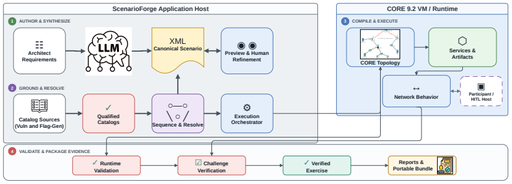
Fig. 1 . ScenarioForge workflow and trust boundaries. The canonical XML is refined and grounded against qualified catalogs before orchestration through CORE gRPC and SSH/SFTP paths. ScenarioForge then validates observed runtime state and challenge outcomes, producing a verified exercise and portable evidence bundle; participant or test hosts attach through HITL when configured.
Original paper · CC BY 4.0 · Jaime C. Acosta, Anantaa Kotal, Aritran Piplai · ScenarioForge: Resource-Grounded Generation and Execution Validation of Cyber Exercises · Original paper figure · Extracted the figure area from page 2 of the original PDF.Why a plausible description is not yet an exercise
Authoring a cyber exercise means setting up infrastructure, vulnerable components, network dependencies, participant actions and success conditions together. That combination is what makes manual construction costly, and automation mainly helps with diversity and adaptability.
A draft can still name implementations that do not exist, versions that conflict, configurations that fail, or objectives the range cannot support. Judging a draft for soundness, realism, creativity or usability says nothing about whether it can be instantiated and operated.
The study therefore targets the gap between a described exercise and one the range can actually run.
From model proposal to grounded specification
Figure 1 lays out four stages, running from authoring and synthesis through grounding and resolution, compilation and execution, to validation and packaged evidence. The canonical scenario XML is the object that travels through all four stages, so every stage reads and writes the same record.
In the first stage the model extracts constraints, splits the request into infrastructure and exercise components, fills in roles and relationships the user did not give, and writes the result as constrained XML. Explicit constraints stay authoritative: a named vulnerability, a node count or a challenge order survives, while the surrounding topology and services can still be generated.
The model never calls CORE, Docker or a remote shell; it only refines the XML.
An element survives grounding only if it can be matched to a runnable asset or to a deterministic configuration the backend supports. A vulnerable service must resolve to a catalog entry that carries a compatible version and runtime definition, because a service name by itself is not enough. A challenge objective qualifies only when the generator behind it yields an artifact and also a way to verify that artifact.
Algorithm 1 handles components one at a time: it lists the compatible assets, selects one, and writes the binding back into the XML. Only after every component is bound does it build the dependency graph, reject cycles or unresolved prerequisites, compile the topology and run preflight. Deployment, runtime validation and objective verification follow, and the algorithm returns an evidence record only when they all pass; otherwise it returns a typed failure.
The stated worst-case cost is \(O(|X| + nc + e + t + p)\) time and \(O(n + e + t)\) space, where n counts components, c catalog entries, e dependency edges, t compiled records and p probes. This bound excludes LLM inference and counts each backend request as one unit, and indexing can reduce the time toward \(O(|X| + n + e + t + p)\).
Three invariants tie the algorithm to the implementation: each selected resource is recorded by a catalog key in the resolved specification, every dependency endpoint must name a persisted step or typed artifact before ordering, and deployment and validation read the same resolved XML and node identifiers as the preview. Because of these invariants, a failure has a typed location (grounding, dependency analysis, preflight, deployment, runtime validation or objective verification), and a preview-only repair cannot slip into execution unnoticed.
Challenge chains and pivots
Each exercise is a dependency graph whose steps are individually verifiable challenge objectives, each tied to a grounded service, file, credential or challenge node and to an expected result. Sequence fixes a valid order and Resolve selects resources and parameters, and both write to the same XML. Topological ordering then turns the graph into a Flow whose edges carry generated files, credentials, endpoints and access capabilities.
After deployment, the Solutions Script walks the graph and records each step as pass, fail, inconclusive or skip. HTTP, SSH and TCP challenge-node strategies run automatically, while vulnerability-host and artifact-only steps keep their flags, hints, solutions and interfaces for a participant or an exploit harness. Intermediate outputs reach only the steps that depend on them.
A pivot is modelled as a dependency edge from a provider host to a target host: a predecessor gives access to the provider, and the dependent step needs that access before it can reach the target. Providers can be vulnerable hosts, generated challenge nodes or supported SSH fallbacks. Policy must permit the service from the provider and deny unauthorized sources, and probes from the provider must succeed while probes from representative prohibited sources must fail.
The authors pair positive and negative probes so that an allow list alone is not taken as proof of isolation. Each dependent step carries its own provider-target pair, so several pivots do not overwrite one another's context.
Checking each layer of a run
Validation is split into three failure classes: catalog preflight over deployment metadata, services and inject wiring; runtime validation of the active CORE session; and challenge verification along the resolved sequence. A pass at one stage carries no guarantee for the next.
For the web and check-artifacts paths, strict success requires the validation_summary ok field to be true and every relevant issue counter to be clear. Strict validation demands zero missing nodes, no stopped Docker services, no missing injects, and no missing generator outputs or generator injects. Positive and negative reachability probes check segmentation, and artifact checks look at the deployed environment rather than at the generated plan.
Once topology, resources and dependencies are fixed, the range is instantiated: gRPC manages session topology and lifecycle, while SSH handles placement, Docker, services, injects and inspection. The scenarioforge-eval harness parses YAML, persists seed and XML, runs preview, sequencing, execution and artifact checks, and keeps phases that share a CORE VM in series.
Strict success there also requires a clean process exit and observed expected containers, ports and injects, along with the policy, traffic and access paths.
For the 194 runs whose images were already cached, total reproduction time ranged from 73.7 to 727.0 seconds; for the 32 runs that needed image pulls, it ranged from 87.7 to 550.0 seconds. These times include composition, image builds, service startup, network convergence and validation.
What the 226-scenario dataset covers
The Execution Dataset holds 226 fixed, materialized scenarios built from one validated catalog snapshot. That snapshot covers 294 enabled, self-contained Vulhub images and the full set of 85 custom-built challenge-resource generators; ten imported entries that need external online services were left out. Thirty source specifications expand into the 226 resolved cases, which freeze topology, resource, policy, traffic and validation choices before execution.
The 867 challenge steps split into 457 vulnerability-backed steps (52.7%) and 410 generated-resource-backed steps (47.3%). Chain lengths run from one to ten objectives, and the four-objective case is the most common, with 113 scenarios.
Every one of the 226 runs went through the whole chain of phases, from XML build to live artifact checks, without a single phase failure. The specifications fix intended membership, while the retained batch records are what establish outcomes and localize any failure by phase.
Traffic labels are reproducible synthetic byte profiles with recognizable seeded framing, so replay does not depend on external media. This dataset is distinct from the 50-prompt matched benchmark.
How the 50-prompt benchmark is set up
The 50 requests were written by gpt-5.6-sol across five tiers of 12, 12, 10, 10 and 6 cases, moving from routed networks to services, firewall and NAT segmentation, vulnerable containers and combined stress cases. Requests and expected fields were fixed before any evaluated condition started running.
Seven conditions run over the 50 prompts, yielding 350 retained native authoring artifacts and 1,120 intent-field decisions, which is 160 per condition. Each condition receives requests totalling 462 topology-node instances: 128 routers and 334 hosts. Six field types make up the 160 intent decisions per condition.
The framework arm sends only the description through the AI Generator, and both framework conditions share the schema, compiler, catalogs, validation and repair path. The two framework conditions differ only in the model: Qwen3.8-27B-NVFP4 (called Qwen3.8) in one and gpt-5.6-sol in the other, which lets the effect of a model change be read without a framework change.
The direct arm sends the same description to gpt-5.6-sol without ScenarioForge, through five cumulative scaffold levels.
The five rungs are R1, a CORE XML request; R2, a structural example; R3, node and service vocabulary; R4, segmentation vocabulary; and R5, container-image guidance, with each rung keeping every earlier instruction. Because the request stays the same across rungs, differences between R1 and R5 reflect added representation guidance rather than a changed task.
The framework conditions receive no rung-specific scaffold and use the ordinary AI Generator path under test.
Buildability is successful CORE 9.2 construction of a nonempty session; the scorer calls open_xml(start=False), so nodes, containers and physical interfaces stay inactive. Intent accuracy is scored field by field: the scorer parses each native output and checks whether each requested field is matched. Missing or unreadable outputs stay in the denominator.
Flow and challenge-chain outcomes fall outside this comparison, since downstream sequencing determines order and flag sequence rather than the generator.
Benchmark results and their cost
Both framework conditions reached 50/50 (100%) builds and 160/160 intent fields. Direct frontier generation climbed across the rungs but stayed short: R5 reached 41/50 (82%) builds and 147/160 intent fields (91.9%). R5 remained nine builds short, and it satisfied every intent field in 38 of 50 requests.
Qwen3.8 and GPT5.6 tied inside the framework. The authors take the tie to mean that model scale mattered less than the shared framework path, which covers the schema, catalogs, compiler, validation and repair.
Build success rose from 4/49 (8.2%) at R1 to 28/50 (56%) at R2, and intent accuracy went from 55.0% (88/160) to 85.0% (136/160). The structural example at R2 gave the largest gain; node and service vocabulary mainly improved buildability, segmentation vocabulary raised intent without changing buildability, and image guidance added a smaller final gain.
The authors conclude that more explicit syntax and vocabulary narrowed the gap without closing it.
The Qwen3.8 framework condition used a mean of 89,680 total tokens and a median of 94.4 s of AI time, while GPT5.6 in the same framework used 41,437 tokens and 37.4 s. Direct R5 used 3,225 tokens and 27.1 s, and the token and time values include every retained attempt's model calls. The table places these costs beside the tied outcomes, which the authors use to separate authoring quality from provider effort.
Runtime checks with Flow disabled
Checks ran on the ARM CORE VM for 100 framework scenarios, half from each model, with Flow sequencing turned off. Each scenario received its runtime and live-artifact checks after a 60-second wait. On the first pass, ScenarioForge+Qwen3.8 passed 46/50 and ScenarioForge+GPT5.6 passed 47/50.
The substitutions relied on earlier successful executions on the same ARM endpoint, and the authors report first-pass and remediation outcomes separately.
Construction reached 100% while first-pass runtime and artifact success stayed lower, which points to a failure layer after construction: a topology can build while an architecture-incompatible container or a transient daemon event stops startup. Keeping original and remediated results apart is what allows topology quality and endpoint or transient-infrastructure effects to be told apart.
One case: access and pivots in a segmented range
The case dataset-segmented-enterprise-pivots run01 has six objectives: two vulnerability-backed and four generated, with two access requirements that gate later work. Its representative artifacts include a ChatOps transcript, a wallet note, a parser endpoint, an SSH key and an HTTP credential page. The other cases in Table IV vary the structure: a three-objective CI supply-chain chain, a ten-objective segmented-scale case, a five-generated-objective multi-artifact case and a four-objective messaging chain.
Figure 2 shows the routed and segmented placement for this case, including the HITL attachment, NAT and firewall enforcement, and the distributed challenge containers. Consolidated counts separate ordinary hosts from challenge nodes.
Figure 3 shows the resolved dependencies: access acquired on docker-17 gates the wallet service on docker-15, which is a second access prerequisite. Typed artifact edges carry the wallet file to the parser on docker-16 and its returned endpoint to docker-20.
Releasing the records
The comparison data sits in its own collection with the 50 requests, the outputs of seven conditions, scoring records and analysis scripts.
Replay can start from a specification and seed, or from an authoritative XML, which bypasses model variation. The reproduction archive may hold credentials, flags and generated secrets, so it needs protection.
Limitations
The matched benchmark uses one open-weight model, Qwen3.8-27B-NVFP4, and one frontier model, gpt-5.6-sol. The request suite was generated by gpt-5.6-sol, which is also the direct baseline model. The benchmark does not score Flow or challenge-chain outcomes.
Two GPT cases and four Qwen cases passed only after documented substitutions, so the qualified 50/50 outcomes are not first-pass results. First-pass runtime and artifact success was 46/50 for Qwen3.8 and 47/50 for GPT5.6.
The Execution Dataset ran on a customized CORE 9.2 fork in a local 8 GB VMware VM on an Apple M4 Max host, and the fork's fixes are presented as infrastructure contributions rather than AI Generator outputs. Ten imported entries that need external online services were excluded from the catalog snapshot.
Traffic uses synthetic byte profiles rather than real media, and real streams were not part of the evaluation. Provider calls allow one retry, and only after a provider timeout.
Paper info
- Authors
- Jaime C. Acosta, Anantaa Kotal, Aritran Piplai
- Venue
- arXiv · Preprint
- First published
- 2026-11-16
- Added
- 2026-11-18
- Updated
- 2026-11-16
- Version
- v1
- arXiv
- 2611.21579
- Category
- cs.CR · cs.AI
- Original paper terms
- CC BY 4.0
- What we show
- Paper info, commentary and permitted figures from the original paper
AI commentary is a separate explanation from the original paper and may contain errors. The original paper and figures follow each source's terms of use and any rights noted separately.
Abstract
Cyber-range and capture-the-flag scenario construction remains labor-intensive because authors must coordinate infrastructure, vulnerable services, attack paths, artifacts, and success conditions. LLMs can propose detailed exercises, but plausible descriptions do not guarantee deployable software or verifiable objectives. We present ScenarioForge, which turns high-level requirements into resource-grounded topologies, services, traffic, segmentation, and challenge chains, then instantiates and validates them in the Common Open Research Emulator (CORE). The ScenarioForge Execution Dataset contains 226 materialized scenarios covering 294 Vulhub images and all 85 custom-built challenge-resource generators developed with our AI-assisted scaffolding. All 226 passed construction, preview, sequencing, deployment, strict runtime validation, and live artifact checks; their 867 steps, each an individually verifiable challenge objective, comprise 457 vulnerability-backed and 410 generated-resource-backed instances. In a separate 50-prompt matched benchmark, ScenarioForge+Qwen3.8 and ScenarioForge+GPT5.6 each achieved 50/50 (100%) topology/build success and 160/160 intent fields; direct frontier generation reached 41/50 builds and 147/160 fields only with the full cumulative scaffold: structure, vocabulary, policy, and container-image guidance. The test still omitted ScenarioForge's downstream challenge-resource generation, dependency/flag sequencing, deployment, and live validation. The artifacts support operationally rich, reproducible exercises for training and evaluation.
Quote from the paper
Jaime C. Acosta, Anantaa Kotal, Aritran Piplai (2026). ScenarioForge: Resource-Grounded Generation and Execution Validation of Cyber Exercises. arXiv:2611.21579v1. https://arxiv.org/abs/2611.21579v1
BibTeX
@misc{acosta2026scenarioforge,
  title = {{ScenarioForge: Resource-Grounded Generation and Execution Validation of Cyber Exercises}},
  author = {Jaime C. Acosta and Anantaa Kotal and Aritran Piplai},
  year = {2026},
  eprint = {2611.21579},
  archivePrefix = {arXiv},
  url = {https://arxiv.org/abs/2611.21579v1}
}