Paper commentary
Detection-Efficient Watermarking for Vision--Language Agents via Risk-Constrained Strength Allocation
- Problem Uniform watermark strength treats a token that carries a visual fact the same as a stylistic one, which fits vision-language agent outputs poorly.
- Method Scales per-step watermark strength by normalized predictive entropy and a zero-shot relevance-risk proxy, with one risk penalty λ setting how far strength is pulled down.
- Results At mean strength 0.812, the risk-constrained setting reached clean ROC-AUC 0.9552, against 0.8553 for fixed watermarking at mean strength 0.800 in the matched comparison.
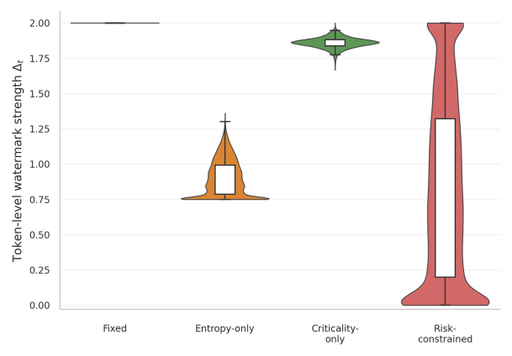
Fig. 2 . Token-level watermark-strength distributions across the full evaluation set. Adaptive methods redistribute watermark strength across decoding steps rather than applying a uniform intervention.
Original paper · CC BY 4.0 · Dumindu Samaraweera, Prashant Shekhar · Detection-Efficient Watermarking for Vision--Language Agents via Risk-Constrained Strength Allocation · Original paper figure · Extracted the figure area from page 11 of the original PDF.Why one watermark strength fits vision-language outputs poorly
Statistical watermarking biases decoding with a secret, key-dependent rule, and a detector later checks a response for that bias. The bias has a price: a stronger intervention can change word choice, likelihood and fluency, and in a vision-language agent the changed word may name an object, an attribute or a spatial relation.
Existing schemes apply one strength to every token decision. For open-ended text that is defensible, because a substituted token is often one plausible continuation among many. For visually grounded responses the same uniform intervention also reaches decisions where a change would matter, so a policy that treats all decisions alike has no way to spare the important ones.
Recent adaptive methods raise watermark pressure when the next-token distribution is dispersed and lower it when the distribution is concentrated. The authors point out two gaps: these methods use generation uncertainty alone, with no signal about whether a decision is semantically important or grounded in the image, and they are usually evaluated at one default setting, so a gain may simply reflect lower average intervention.
The study therefore asks whether risk-aware allocation exposes a controllable detection-quality frontier, and whether that frontier can be reached by simpler policies at equal watermark budget.
How the per-step strength is computed
At each decoding step the unwatermarked distribution is a softmax over the logits, \(p_t(v)=\mathrm{softmax}(z_t(v))\), where \(z_t(v)\) is the logit of candidate token \(v\). The predictive entropy \(H_t=-\sum_{v\in V}p_t(v)\log p_t(v)\) is normalized to \(g_t\in[0,1]\). A large \(g_t\) means the probability mass is spread over several plausible tokens, which leaves room to bias generation toward the green list.
A small \(g_t\) means the mass is concentrated, so changing the preferred token would matter more.
The strength is the solution of a bounded per-step objective: maximize \(g_t\Delta_t-\lambda(c_t+\epsilon)\Delta_t^2\) over \(0\le\Delta_t\le\Delta_{\max}\). The first term rewards strength where detection opportunity is high, and the second penalizes intervention in proportion to the decision-level risk \(c_t\), with \(\epsilon\) a small constant.
The unconstrained stationary point is \(g_t/(2\lambda(c_t+\epsilon))\), and clipping it to the feasible range gives \(\Delta_t=\min\left(\Delta_{\max},\,g_t/(2\lambda(c_t+\epsilon))\right)\).
The four strategies compared differ only in how \(\Delta_t\) is set. The fixed baseline uses a constant \(\Delta\). The entropy-only variant uses \(\Delta_{\min}+(\Delta_{\max}-\Delta_{\min})g_t\), and the criticality-only variant uses a function \(f(c_t)\) of the risk alone. The joint risk-constrained variant uses the clipped rule above.
The penalty \(\lambda\) is a policy setting that moves the operating point. It is not learned from semantic annotations, so it should not be read as a calibrated risk coefficient.
Building the relevance-risk proxy
Each vocabulary token \(v\) has an embedding \(e_v\), taken from the same embedding matrix as the language model. Three scores compare these embeddings with representations of the input, using cosine similarity. The context score \(s_{\mathrm{ctx}}(v)\) is a softmax over the maximum similarity of \(e_v\) to the language-context states \(h^L_i\).
The local-variation score \(s_{\mathrm{local}}(v)\) is a softmax over the spread between that maximum and the minimum similarity. The image score \(s_{\mathrm{img}}(v)\) is a softmax over the similarity of \(e_v\) to the image representation \(h_{\mathrm{img}}\).
The three scores are summed and min-max normalized over the vocabulary to give \(r(v)\in[0,1]\). The decision-level risk is the probability-weighted average \(c_t=\sum_{v\in V}p_t(v)r(v)\), which also lies in \(0\) to \(1\). A high \(c_t\) means the probability mass sits on tokens the proxy considers relevant. It does not show that such a token is necessary or that changing it would cause semantic harm.
Applying the strength through logit bias and detection
At each step a key-dependent green/red partition is built. The partition index comes from a pseudo-random permutation seeded with a fixed key and the most recent token, so the effective prefix length is one token. The green list is filled first with semantically ranked tokens, a number that depends on the normalized entropy \(g_t\), and then with pseudo-randomly chosen vocabulary until it holds about half the vocabulary.
The remaining candidates form the red list.
The adaptive strength \(\Delta_t\) is subtracted from the red-list logits. Since adding a constant to every logit leaves the softmax unchanged, this equals adding \(\Delta_t\) to the green-list logits. The result goes to a greedy decoder. The fixed baseline uses the same partition and logit-bias mechanism with a constant \(\Delta_t=\Delta\), so the allocation policy is the only difference between the fixed and adaptive runs.
The detector computes the green-list z-score \((G-\gamma T)/\sqrt{T\gamma(1-\gamma)}\), where \(G\) is the number of green-list tokens, \(T\) the response length and \(\gamma\) the green-list fraction. A response is labeled watermarked when the score exceeds a threshold \(\tau\). ROC-AUC integrates over all thresholds, while accuracy, precision, recall and F1 are read at selected thresholds.
The evaluation covers 1,000 image-query instances from AMBER, taken as the first records in JSON order. Each instance has an unwatermarked response and a response under each watermark setting, so comparisons are paired. Decoding is greedy with at most 128 new tokens. The primary risk-constrained setting uses Δmax 2.0 and λ 0.20, chosen on a separate calibration sweep rather than on the final evaluation results.
Default settings across the detection and intervention range
At their default settings, fixed watermarking reached ROC-AUC 0.9921 at mean strength 2.000, and criticality-only reached 0.9879 at mean strength 1.860. Figure 1 plots response similarity against clean-output ROC-AUC for these default configurations, with bubble size showing perplexity change.
The joint setting's F1 was 0.8929 and its recall 0.9050, while fixed watermarking's F1 was 0.9370 and its recall 0.9890.
Figure 2 shows token-level strength distributions over the full evaluation set. Fixed watermarking is a single point at 2.0, while the adaptive policies move their mass toward lower strengths, and the joint distribution moves furthest.
Matched strength separates policy from intervention
Fixed, entropy-only and criticality-only watermarking were swept over nominal strengths 0.5, 0.8, 1.2, 1.6 and 2.0, and the joint setting was swept over λ from 0.05 to 0.40 with Δmax 2.0.
At that point the joint setting reached ROC-AUC 0.9552 at mean strength 0.812, against 0.8553 for fixed watermarking at 0.800, 0.8442 for entropy-only at 0.756, and 0.8405 for criticality-only at 0.744.
The same comparison shows a larger perplexity change for the joint setting, 0.1689, compared with 0.0600 to 0.0682 for the other three. The authors read this as the expected cost of moving intervention to different positions rather than reducing it.
Figure 3 shows clean-output ROC-AUC on the left and perplexity change on the right, both against observed mean watermark strength.
Moving along the frontier with λ
Between these ends, λ 0.10 gives mean strength 1.221 with ROC-AUC 0.9845, λ 0.15 gives 1.003 with 0.9782, λ 0.30 gives 0.558 with 0.8994, and λ 0.20 gives 0.812 with 0.9552. Perplexity change falls as λ rises, from 0.3524 at λ 0.05 to 0.0605 at λ 0.40, and response similarity rises from 0.1177 to 0.3195 over the same range.
The authors treat λ 0.20 as an intermediate point, not an optimum for every metric. A deployment that values quality over detection could choose a larger λ and accept lower detection. Figure 4 marks λ 0.20 as the selected value, and Figure 5 shows the calibration trade-off across risk penalties with that value as the intermediate operating point.
Detection after paraphrase and synonym substitution
Paraphrases come from the T5 paraphraser checkpoint in deterministic mode, and synonym substitution replaces up to five alphabetic words per response with WordNet synonyms, seeded per instance by image index.
After paraphrasing, the joint setting's ROC-AUC fell from 0.9552 to 0.9459 and its F1 from 0.8929 to 0.8769.
These results cover only the two procedures tested. Deletion, truncation, repeated rewriting and detector-aware attacks were not evaluated.
Limitations
The study uses one VLA configuration, LLaVA-1.5-7B, one 1,000-instance subset of AMBER, and one prompt template.
The relevance-risk proxy has not been validated as a semantic-importance estimator. Whether the specific relevance construction adds anything beyond a strength-matched randomized control was not tested.
Robustness covers two transformation procedures. Adaptive, detector-aware attacks were not evaluated, and calibration rests on finite samples of 200 and 800 instances. The VLA-Mark comparison was not run in a common environment, so no same-environment numerical comparison is reported.
Paper info
- Authors
- Dumindu Samaraweera, Prashant Shekhar
- Venue
- arXiv · Preprint
- First published
- 2026-11-16
- Added
- 2026-11-18
- Updated
- 2026-11-16
- Version
- v1
- arXiv
- 2611.21488
- Category
- cs.CR · cs.CL
- Original paper terms
- CC BY 4.0
- What we show
- Paper info, commentary and permitted figures from the original paper
AI commentary is a separate explanation from the original paper and may contain errors. The original paper and figures follow each source's terms of use and any rights noted separately.
Abstract
Vision--language agents generate descriptions, decisions, and instructions that may be reused by users, downstream agents, and automated workflows, creating a need for provenance mechanisms that support content authenticity and post-deployment auditing without unnecessarily degrading response quality. We present a risk-aware semantic watermarking framework that combines predictive uncertainty with a zero-shot multimodal relevance-risk proxy to allocate watermark strength during decoding. A single risk penalty $λ$ exposes a continuous operating frontier, allowing deployment-time selection of a detection--quality trade-off without model retraining. At a selected operating point, mean watermark strength is reduced by approximately 59.4\% relative to fixed-strength watermarking, while perplexity change falls from 0.3634 to 0.1689 and clean/paraphrased ROC-AUC reaches 0.9552/0.9459. A matched-strength analysis shows that this advantage reflects the allocation policy rather than lower average intervention: at comparable mean strength, risk-constrained allocation achieves substantially higher ROC-AUC than fixed, entropy-only, and criticality-only policies, identifying it as detection-efficient rather than quality-dominant. We further show that threshold calibration on finite samples produces substantial false-positive-rate drift, motivating calibration variance reporting as standard practice for auditable provenance.
Quote from the paper
Dumindu Samaraweera, Prashant Shekhar (2026). Detection-Efficient Watermarking for Vision--Language Agents via Risk-Constrained Strength Allocation. arXiv:2611.21488v1. https://arxiv.org/abs/2611.21488v1
BibTeX
@misc{samaraweera2026detection,
  title = {{Detection-Efficient Watermarking for Vision--Language Agents via Risk-Constrained Strength Allocation}},
  author = {Dumindu Samaraweera and Prashant Shekhar},
  year = {2026},
  eprint = {2611.21488},
  archivePrefix = {arXiv},
  url = {https://arxiv.org/abs/2611.21488v1}
}