Paper commentary
AdMem: Expectation-Grounded Procedural Memory for Long-Horizon Task-Solving Agents
- Problem Accumulating cross-task procedural memory without management can leave an agent below a memoryless control, because stored entries are kept whether or not they helped.
- Method The actor commits to an expected outcome before each action, a concurrent critic writes per-action binary rewards with reflections, and one online noisy-OR utility per entry ranks, merges and evicts entries.
- Results Reached 441 of 707 tasks against 388 for ReAct and 312 for AWM across eight AgentBoard domains.
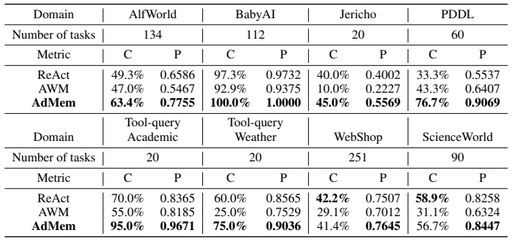
Table 1 : Task completeness (C, the fraction of tasks solved) and average progress (P, the mean of the per-task progress score pi ∈[0,1] ) on the eight AgentBoard domains, using Claude Haiku 4.5 as the backbone for every method. Bold marks the best value in each column. Each domain is a fixed task set of the size given in the second row, so completion counts are recoverable exactly from C (e.g. 63.4% of 134 is 85 tasks); we use those counts for the Fisher exact tests reported in the text. Each configuration is streamed once over the task set in a single lifelong episode. On the three 20-task domains a single task is worth 5.0 points of C, which is why we base per-domain conclusions on the tests rather than on the point differences alone.
Original paper · CC BY 4.0 · Runzhe Wang, Huilin Lu, Shengjie Liu, Li Dong, Zhihuai Zhu · AdMem: Expectation-Grounded Procedural Memory for Long-Horizon Task-Solving Agents · Original paper figure · Extracted the figure area from page 6 of the original PDF.Why more cross-task experience can hurt
The usual design assumption is that an agent should store as much of its past as it can, since more experience looks like more help. The question the paper poses is therefore which experience is worth keeping, rather than how much can be stored.
Plain-text memory makes failures readable, which is what allows the authors to diagnose them, but readability does not by itself decide what should be retained. Earlier textual memory systems already cover writing, consolidation, decay and deletion, but they apply these operations to facts whose value is their correctness. A procedural entry is a recommendation about how to act, and whether it was worth keeping depends on whether following it helped, which cannot be observed at the moment the entry is written.
Where credit lands
Systems that learn from evaluated outcomes usually write one verdict for a whole trajectory or task, so every action inside it shares the same signal. AdMem asks the actor to state, before each action, what the action should accomplish, and the critic compares the realized outcome with that statement once the relevant observations have arrived.
The planning tools define the units the critic waits for: a plan is judged at task end, a sub-goal when its scope closes, and an action after its immediate observation. No environment reward is needed, so the method applies in any environment that returns observations.
Actor, scoped short-term memory and entry types
The long-term store holds semantic, episodic and procedural entries, and the critic writes only the procedural ones on the write path. The actor, the critic and the store run in separate threads, so the actor never waits for the critic.
Inside the actor, environment facts sit in a priority-ranked semantic heap, and event summaries sit in an episodic stack that is read most-recent-first. The short-term memory is a running stack: sub-goal boundaries are scope boundaries, and popping a sub-goal compresses its turns into summaries. Ending a task clears short-term memory, so only what the critic or summarizer wrote to the long-term store carries into the next task.
How one utility drives retrieval and forgetting
Each procedural entry carries a utility in [0,1] that estimates whether following it helps, and the model multiplies it by a similarity between the current context and the stored context. Retrieval ranks entries by that product, so an entry has to be both relevant and previously effective to be returned, and the top n entries are passed to the actor.
The reward is modelled as a noisy-OR over the retrieved entries and a memory-free route with probability p0, so the reward is 1 unless every cause fails. In display form the model gives \[\Pr[r_t=1\mid c_t,\mathcal{M}_t]=1-\prod_{i=0}^{n}(1-q_i)\], where q_i is the per-entry help probability and q_0 is the memory-free rate. A failed action pushes every retrieved entry down, while a successful action gives credit to each entry in proportion to how likely it was to be the cause.
Consolidation merges two procedural entries when they are retrieved together in most of the rounds in which either is retrieved, so the rule scores co-retrieval rather than raw agreement. Forgetting removes an entry from the retrieval index when its retrieval frequency falls below the threshold, so low utility leads to eviction through the retrieval channel.
The implementation fixes these thresholds at 0.01, with eviction eligible only after 500 retrieval rounds and merging after 100.
Streaming setup and baselines
The eight AgentBoard domains span household tasks, grid-world instructions, interactive fiction, symbolic planning, tool calling, web navigation and scientific experimentation. Claude Haiku 4.5 is the backbone for the actor, critic and summarizer in every configuration, decoding is greedy, and each task is capped at 30 environment steps.
Task completeness C is the fraction of tasks solved, and average progress P is the mean per-task progress score. Each domain is a fixed task set, so completion counts can be recovered from C and used directly in the exact tests.
ReAct serves as the control that starts every task from scratch, and AWM is the closest published system, since it induces procedural memory online from the agent's own trajectories. Conversational memory systems were not ported, because adapting them would require defining a memory unit and a query for each environment step. The LTP ablation stands in for a reflection-memory baseline, since it retrieves critic reflections at every step without planning or scoping.
Pooled and per-domain completion results
Because all three methods run over the same tasks, the comparison is paired, and the least favorable McNemar pairing consistent with the margins still gives p = 0.03.
AlfWorld, at 85 of 134 against 66 of 134, is nominally significant with p = 0.03 but does not survive the correction. The authors attribute the PDDL and AlfWorld gains to transferable structure, since tasks in both domains reuse an action schema or household affordances.
On WebShop and ScienceWorld, the completion margins are two tasks each, 104 against 106 of 251 and 51 against 53 of 90, which the authors treat as indistinguishable from zero. AdMem reaches the higher average progress on both, at 0.7645 against 0.7507 and 0.8447 against 0.8258, so the result there is parity on completion with a small edge in progress.
On the two 20-task tool-query domains, the gain on Tool-query Academic is 19 of 20 against 14, with p = 0.09.
Why induction memory falls below ReAct
AWM does win on PDDL, at 43.3% against 33.3%, so its mechanism works where the domain supplies reusable structure.
Which components matter on Jericho
With planning and scoping added, AdMem improves across the three epochs from 9 to 10 to 12 completed tasks of 20, ending 20.0 points above ReAct. The authors read this as the procedural store being useful only inside the planning and scoping structure.
The contrast is between the two halves of the system, so the ablation does not isolate expectation-grounded reward, utility-based eviction or context scoping.
The store as an injection channel
Environment text enters the critic prompt as a realized outcome, becomes a procedural entry, and can be retrieved into the actor's context in a later task. The utility that governs retrieval is produced by an LLM critic reading environment text, and initializing utility at 1 gives a new entry the highest retrieval priority before any evidence exists.
Utility-weighted ranking and frequency-based eviction let entries that do not help decay, provenance traces each entry to its source, and tool-set scoping limits lateral reach. The personal-data safeguard is an instruction to the critic to use placeholders, which depends on compliance and does not cover the summarizer's output. No adversarial evaluation was performed, so the paper makes no robustness claim.
Limits of the evidence
The evidence comes from one run per configuration on one backbone, and no full seed sweep was performed. Because each memory arm is a single coupled stream, its binomial intervals are anti-conservative, so the authors report design effects of 4.2 for the negative AWM result and 5.9 for the PDDL gain.
Fixing p0 at 0 gives the reward model no memory-free route, so credit to retrieved entries on successful rewards is an upper bound. The update is a streaming step rather than convergence to a fixed likelihood, and the similarity is supplied by a frozen embedding model that is not learned. The update conditions on retrieval rather than on use, and it treats retrieved entries as independent causes.
Paper info
- Authors
- Runzhe Wang, Huilin Lu, Shengjie Liu, Li Dong, Zhihuai Zhu
- Venue
- arXiv · Preprint
- First published
- 2026-11-16
- Added
- 2026-11-17
- Updated
- 2026-11-16
- Version
- v1
- arXiv
- 2611.20605
- Category
- cs.AI
- Original paper terms
- CC BY 4.0
- What we show
- Paper info, commentary and permitted figures from the original paper
AI commentary is a separate explanation from the original paper and may contain errors. The original paper and figures follow each source's terms of use and any rights noted separately.
Abstract
An agent that carries memory across tasks is only as good as the entries it keeps. We begin from an observation that is easy to reproduce and uncomfortable for the field: naively accumulating cross-task experience can make an agent \emph{worse} than one with no memory at all. On AgentBoard, a workflow-induction memory solves fewer tasks than a memoryless ReAct agent in seven of eight domains, and a per-step procedural store with no surrounding structure loses half of ReAct's completions on Jericho. We argue that the missing ingredients are per-action credit assignment and an explicit life cycle for stored entries, and present AdMem, which supplies both. Before each action the actor commits to an expected outcome; a concurrently running critic scores the realized outcome against that expectation and writes a procedural entry carrying a binary reward and a reflection, so credit lands on the action that earned it and no environment reward is required. Each entry then carries a scalar utility, updated online under a noisy-OR reward model, that ranks retrieval jointly with context similarity and drives eviction and merging, giving the store a forgetting and consolidation policy instead of unbounded growth. Across 707 tasks in eight AgentBoard domains AdMem solves 441 against 388 for ReAct and 312 for the workflow-induction baseline --- a pooled gain significant under a two-sided Fisher exact test, concentrated in the domains that supply transferable cross-task structure. All memory stays human-readable text, which is what makes the failures above diagnosable --- and, as we discuss, also makes the store an auditable but attackable surface.
Quote from the paper
Runzhe Wang, Huilin Lu, Shengjie Liu, Li Dong, Zhihuai Zhu (2026). AdMem: Expectation-Grounded Procedural Memory for Long-Horizon Task-Solving Agents. arXiv:2611.20605v1. https://arxiv.org/abs/2611.20605v1
BibTeX
@misc{wang2026admem,
  title = {{AdMem: Expectation-Grounded Procedural Memory for Long-Horizon Task-Solving Agents}},
  author = {Runzhe Wang and Huilin Lu and Shengjie Liu and Li Dong and Zhihuai Zhu},
  year = {2026},
  eprint = {2611.20605},
  archivePrefix = {arXiv},
  url = {https://arxiv.org/abs/2611.20605v1}
}