Paper commentary
Invariant-Aware Harness Enforcement to Protect LLM Agents from Silent API Failures
- Problem Silent API failures return HTTP 200 with a plausible but wrong result, and agents often report the wrong count even after a judge flags it.
- Method SilentGuard runs exact invariant checks such as the count identity inside the harness, re-checks a failed result once, withholds values that fail an exact check and only warns on failures of learned checks.
- Results Cut wrong answers under silent faults from 74.0% to 1.7% across 7 open models, with clean accuracy at 84.9%, the same as with no guard.
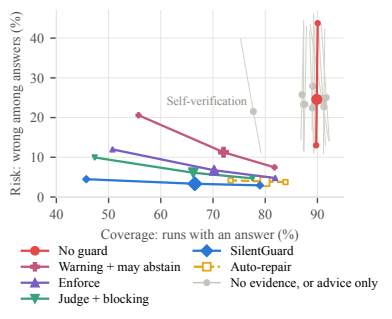
Figure 2 :Risk against coverageon AgentOrchBench with clean and faulted calls mixed. Lower is safer and further right answers more. Each line runs from a 10% fault rate (right end) to 50% (left end, higher risk), with a large marker at 25%. Mean over 7 open models. Gray lines are methods without evidence of the fault, or with advice alone.
Original paper · CC BY 4.0 · Sajib Acharjee Dip, Brian Ouyang, Lala Motlhabi · Invariant-Aware Harness Enforcement to Protect LLM Agents from Silent API Failures · Original paper figure · Extracted the figure area from page 7 of the original PDF.Silent failures that look like success
Typical cases are a filter that is ignored, a condition that is misread or a total that is capped, and nothing in the response marks the fault. The study probed 15 public research APIs, and 11 of them showed at least one such fault, with some counts inflated up to 691 times.
The usual remedies keep the model in charge of spotting the problem: a checklist prompt asks it to inspect each result, a reviewer model checks each call, and Outcome Monitors attach warnings that an LLM judge rates. In these tests each of them left wrong answers near the 74.0% of an unguarded agent.
Why a flagged result still gets answered
The model does notice the problem. A judge that sees the results of the consistency queries flags 82.4% of faulted runs, but it also flags 13.9% of clean runs. Agents then report the flagged count in 77.4% of the runs the judge flagged.
Even so, 64.4% of the runs that received only a warning still reported the flagged count, so a visible flag does not change the answer by itself.
Blocking on the judge's verdict only works once the check's results are shown, which lowers wrong answers to 6.1%.
The effect varies by model, from 0% to 59% wrong, and the same permission without evidence changes little, with a caution prompt giving 73.3%.
How the checks and the release rule work
Learned checks are mined from clean responses and cover field presence and type, positive values, categorical values, linear relations and date order, and they can raise false alarms.
For count queries the central exact check is the count identity. With F the conjunction of conditions C1 to Ck and F<k the filter with its last condition dropped, the harness requires \[ N(F) + N(F_{<k} \wedge \neg C_k) = N(F_{<k}) \] after every filter query. The harness sends the two extra queries itself and repeats the test for every position in the condition list, so an ignored filter is caught wherever it sits.
After one re-check, the action is \[ \pi(r)=\begin{cases}\text{release} & \text{all checks pass}\\ \text{withhold} & \hat{\alpha}_j \le \tau \text{ for a failed } j\\ \text{warn} & \text{otherwise}\end{cases} \] with the cutoff \( \tau = 1\% \).
A result that fails is sent again once, and the new result is released only if it passes. If the failure comes from an exact check, the failed values are withheld, because an exact check's rate is zero and so falls under the cutoff.
Comparison with the published fixes on AgentOrchBench
Outcome Monitors with blocking still left 70.9% wrong. Its contracts fired on only 3.5% of faulted runs and on 6.2% of clean runs, and the authors attribute this to contracts that rarely fire on a wrong count. A silently wrong count therefore gives a detector little to act on, which is why the blocking variant changes so little.
The rows are means over the seven models with standard errors, so differences of a few points between the baselines are small relative to the spread.
Frontier models on AgentOrchBench
Across the three frontier models the no-guard figure averages 70.2% wrong, and SilentGuard brings it to 0.5%.
When the models ran the count check themselves, wrong answers nearly disappeared at 4.5%, but clean accuracy fell from 92.1% to 20.4%, and the authors read this as the models mostly refusing. A warning from the harness was enough for GPT-5.6 Sol, at 11.3% wrong, but not for Terra or Luna, at 35.9% and 45.1% even with permission to abstain.
SilentGuard leaves 0.0–1.4% wrong on the three frontier models, with clean accuracy at 98.1%. On these models Enforce does worse than on the open models, at 33.9% against 8.8%, and the logs of these runs cannot be released, so the figures are answer counts only.
Real APIs and ToolMaze
On nine real public APIs, each given documentation in which one filter name was changed, agents reported a wrong count 89.8% of the time with no guard. With SilentGuard wrong answers fell to 21.3% and correct answers rose from 3.5% to 69.5%.
With the right documentation an unguarded agent was correct 92.1% of the time, and the authors attribute the gain to the spec check rather than the count check. The spec check alone left 21.0% wrong, because it rejects the misnamed filter.
On ToolMaze under silent faults SilentGuard reached 36.0% task success against 32.7% for checklist with Outcome Monitors, a lead on 5 of 7 models with a 95% interval of [1.8, 4.9] points. Its clean success was 4.6 points below Outcome Monitors on the same benchmark.
ToolMaze has only learned checks, so SilentGuard warns there and never withholds. This benchmark therefore tests the re-check rather than enforcement.
Abstaining rather than recovering
Under faults SilentGuard mostly answers that the count cannot be determined, and its correct answers fall from 16.4% to 2.4%.
Correct answers fell from 38.9% to 19.0% over the same six types, so the gain is paid for in answers given.
Auto-repair recovers many true counts on the faults it was designed for, at 57.3% correct.
Limitations
The parameter check cannot detect a filter written inside a query string. A fault that stays consistent with itself, such as prefix matching, and an API that knows the check both pass the count checks. A filter the agent never sends cannot be checked at all.
The count identity assumes two-valued filters, so fields with missing values need a different three-way partition, which this study does not use.
Under faults the method mostly answers cannot be determined, which is safe when no correct count is available but gives the user no number. The frontier runs and the Nemotron-3-Ultra control arms ran on an internal platform, so only answer counts are available and the logs cannot be recounted. Seven models also limit the power of model-level tests.
Learned checks cost some clean success on ToolMaze.
Paper info
- Authors
- Sajib Acharjee Dip, Brian Ouyang, Lala Motlhabi
- Venue
- arXiv · Preprint
- First published
- 2026-11-16
- Added
- 2026-11-17
- Updated
- 2026-11-16
- Version
- v1
- arXiv
- 2611.20595
- Category
- cs.CL
- Original paper terms
- CC BY 4.0
- What we show
- Paper info, commentary and permitted figures from the original paper
AI commentary is a separate explanation from the original paper and may contain errors. The original paper and figures follow each source's terms of use and any rights noted separately.
Abstract
LLM agents answer questions by calling APIs and trusting the results. An API can fail silently. It ignores part of a request, such as a misnamed filter, yet returns HTTP 200 and a plausible but wrong result. Current fixes, such as checklists, reviewer models and LLM judges, ask the model to catch it. But models often see the problem and answer anyway. We present SilentGuard, which moves the decision from the model to the harness running tool calls. It tests each result against invariants that any correct API must satisfy and withholds values that break one. We find silent failures in 11 of 15 public research APIs, with counts inflated up to 691 times. Current fixes leave over 70% of answers wrong, and agents report 77.4% of counts a judge flags. Across 7 open models, SilentGuard cuts wrong answers on its target faults from 74.0% to 1.7%, with no loss on fault-free tasks. On three frontier models they fall from 70.2% to 0.5%. A warning from the same check leaves 70.1% wrong, so enforcement is the key. On new fault types, the harness alone cuts wrong answers from 61.1% to 24.5%. It avoids wrong answers by abstaining rather than recovering.
Quote from the paper
Sajib Acharjee Dip, Brian Ouyang, Lala Motlhabi (2026). Invariant-Aware Harness Enforcement to Protect LLM Agents from Silent API Failures. arXiv:2611.20595v1. https://arxiv.org/abs/2611.20595v1
BibTeX
@misc{dip2026invariant,
  title = {{Invariant-Aware Harness Enforcement to Protect LLM Agents from Silent API Failures}},
  author = {Sajib Acharjee Dip and Brian Ouyang and Lala Motlhabi},
  year = {2026},
  eprint = {2611.20595},
  archivePrefix = {arXiv},
  url = {https://arxiv.org/abs/2611.20595v1}
}