Paper commentary
Guiding AI Agents to Generate Conjectures by Encoding How Theorems Build on One Another
- Problem Choosing a conjecture worth pursuing is harder to judge than whether it is correct, and AI work on mathematics has concentrated mainly on proving open problems. The paper asks whether recording how theorems change from one another gives an agent better candidates to propose.
- Method Agents build a Theorem Evolution Graph by finding theorems in papers reached through backward and forward citation search from a seed paper, recording how each theorem changes from an earlier one, and then proposing a single conjecture from the graph.
- Results Judges preferred the TEG conjecture in 50 of 90 judge-paper pairs, against 29 for the baseline, with 11 ties and a 63% share among non-tied judgments.
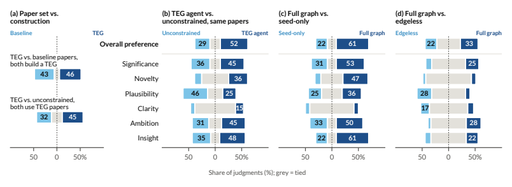
Figure 3 : Effects of paper selection, TEG construction, and graph components. (a) Overall preferences when varying the paper set (both agents build a TEG) or the construction method (both use TEG-selected papers). (b) The original TEG agent compared with an unconstrained agent given its papers. (c, d) Conjectures from the full graph compared with those from seed-only and edgeless graphs. Bars show the share of judgments favoring the TEG side (right), tied (grey), or the alternative (left). Overall preferences count a judge’s choice only if it holds in both presentation orders; criteria count the two orders separately.
Original paper · CC BY 4.0 · Hita Kambhamettu, Daniel Krashen, Lyle Ungar · Guiding AI Agents to Generate Conjectures by Encoding How Theorems Build on One Another · Original paper figure · Extracted the figure area from page 8 of the original PDF.Choosing which conjecture to pursue
Much of the recent work on AI for mathematics is aimed at proving open problems that already have a statement. Deciding which conjecture is worth the effort has received far less attention, and the reason is that there is no clear criterion for what makes a problem good. Correctness alone does not tell whether a conjecture is new, significant, or likely to deepen understanding of a field.
The authors start from the observation that mathematical results are linked: a newer theorem often changes an older one by altering its hypotheses, strengthening its conclusion, or moving it to a new setting. Their bet is that writing these links down in a structure gives an agent a basis for choosing the next conjecture.
A graph of theorem-to-theorem changes
The Theorem Evolution Graph is a directed graph in which each node is one theorem. A node stores the theorem's mathematical setting, its hypotheses, its conclusion and its source paper and theorem number, written as the tuple \( v = (\sigma_v, H_v, \kappa_v, s_v) \). Storing the theorem in this fixed form isolates the parts that can change between two related theorems.
An edge from \( u \) to \( v \) says that theorem \( v \) differs from theorem \( u \) and builds on it, and it carries an annotation \( \delta_{uv} = (\Delta_{uv}, \iota_{uv}) \).
How an agent builds the graph
To identify relevant theorems, the agent queries Semantic Scholar for the references of a paper and for the papers that cite it. It then calls a tool named read_paper, which returns the abstract, introduction and theorem statements of a paper from its full text. Each theorem found is rewritten in the same setting, hypotheses, conclusion and source form, so that theorems from different papers can be compared.
In the compare step, the agent picks pairs of theorems, using citations between papers and the claims a paper makes about earlier results. If it judges that one theorem builds on another, it adds the edge from the earlier theorem to the later one and records the changes in setting, hypotheses and conclusion, together with a description of the idea introduced.
If a matching existing theorem turns up, the candidate is dropped and the agent continues from that theorem, and the loop ends with one final conjecture selected from the remaining candidates.
Test set and agent setup
The test set has 30 seed papers. Eighteen were taken from Math-Graph, each chosen because its full source text is available, it proves at least one original theorem rather than surveying, and its subject is accessible to a graduate reader in computer science or discrete mathematics. The other 12 were written by a collaborating expert mathematician, who selected papers whose follow-up conjectures they felt able to assess.
The agents run on Claude Opus 5.5 inside the OpenHands SDK, and every agent step and its reasoning is logged.
How judges score conjectures
A referee agent grades each final conjecture on clarity, correctness, novelty, difficulty and significance, and raises objections labelled blocking, major or minor. A different model checks each blocking or major objection, and the verdict is fail when a blocking objection is upheld, revise when a major objection is upheld and none is blocking, and pass otherwise.
The first experiment used three judge models, GPT-6.1 Sol, Grok 4.7 and Claude Sonnet 5.5, and the authors chose GPT-6.1 Sol as the sole referee for the later experiments after pilot runs on 10 papers showed similar performance. In the pairwise step, each judge sees two conjectures from the same seed along with the individual assessments, and each pair is judged in both presentation orders.
An overall preference is recorded only when the judge picks the same conjecture in both orders, and otherwise the pair counts as a tie, while each criterion counts the two orders separately.
TEG against unconstrained generation
Across 90 judge-paper pairs, judges chose the TEG conjecture 50 times, the baseline 29 times, and called 11 pairs tied. Among non-tied judgments the TEG conjecture was preferred in 63% of cases, with a 95% CI of [52%, 73%] and a two-sided binomial test p = 0.02, and each judge preferred TEG more often, at 17-9, 17-10 and 16-10.
The authors read this as a trade-off: TEG conjectures carry more perceived mathematical value, but their plausibility is less certain.
The expert mathematician, who did not know which condition produced each conjecture, preferred the TEG conjecture on 8 of 12 seed papers and the baseline on 4, with no ties. That gives a TEG share of 67% with a 95% CI of [39%, 86%], close to the panel's 63%. The expert and the LLM panel's majority agreed on 9 of 12 papers, with Cohen's kappa of 0.47 and Krippendorff's alpha of 0.49.
Where the advantage comes from
Two fixed paper sets were built, one from the papers the TEG agent opened and one from the papers the unconstrained agent opened, and agents could read only the papers in their set. The paper-selection comparison covers 27 seeds with completed outputs, and the construction comparisons cover 28 seeds, since a few runs timed out during conjecture generation and were dropped.
When both agents build a TEG, judges favored the TEG-selected papers in 52% of non-tied judgments, with a 95% Wilson CI of [38%, 66%] and p = 0.89, so the choice of papers alone shows no clear effect. The raw split was 46% for TEG-selected papers, 43% for baseline-selected papers and 11% ties across 54 judge-seed comparisons.
With the same TEG-selected papers, judges favored the agent that built a TEG in 58% of non-tied judgments, with a 95% CI of [43%, 72%], from 25 comparisons against 18 with 13 ties. When the original TEG agent is compared with an unconstrained agent given its own papers, the TEG side wins 64% of non-tied judgments, with a 95% CI of [50%, 77%], from 29 comparisons against 16 with 11 ties, and the two overall tests give p = 0.36 and 0.07, so neither reaches significance.
The authors take both comparisons to favor TEG construction, which suggests a benefit beyond the choice of papers.
At the criterion level, the unconstrained agent given the TEG agent's papers produced conjectures judged less novel, with 73% of novelty judgments favoring TEG (15 against 40 judgments, 95% CI [60%, 83%], p = 0.001). Its conjectures were judged more plausible, with 65% of plausibility judgments favoring the unconstrained side (52 against 28, 95% CI [54%, 75%], p = 0.01), which matches the trade-off seen in the main comparison.
Which graph components matter
Six graph variants were tested on nine randomly chosen seed papers, and each variant received the same papers as the original TEG agent without being able to modify the graph it was given. The Full variant includes edge descriptions, Unannotated keeps the same nodes and directed edges without the descriptions, Shuffled places the same number of edges between random node pairs, Similarity links nodes by TF-IDF textual similarity with at most two links per node, Edgeless removes all edges, and Seed-only keeps only the seed paper's theorem nodes and the described edges among them.
Against Seed-only, Full-graph conjectures were preferred in 11 of 18 comparisons, with 4 for Seed-only and 3 ties, which gives 73% of non-tied judgments favoring the full graph with a 95% Wilson CI of [48%, 89%] and p = 0.12. Full-graph conjectures were judged more novel (17 against 4, 81%, p = 0.007) and more insightful (22 against 8, 73%, p = 0.02), and plausibility did not drop (13 against 9, 59%).
Against Edgeless, the full graph won 6 of 18 comparisons, lost 4, and had 8 ties, giving 60% of non-tied judgments with a 95% CI of [31%, 83%] and p = 0.75. Conjectures generated with edges were judged more ambitious (10 against 2, 83%, p = 0.04), whereas the edgeless-graph conjectures were favored on plausibility (10 against 3, 77%, p = 0.09), and neither the significance result (9 against 4, p = 0.27) nor the plausibility result is significant.
The referee flagged none of the nine Full-condition conjectures as false, but flagged four of the 18 conjectures produced across Unannotated and Shuffled together.
How the two agents searched
Counting the papers each agent opened, excluding the seed, the two agent types opened 149 papers across the 30 seeds, and only 44 of them (30%) were opened by both.
In the first third of a run, computation made up 27% of the baseline agents' actions against 13% for TEG agents, while TEG agents spent 28% of those early actions building the graph.
The baseline agents first wrote a draft at 82% of the way through a run, and TEG agents did so at 87%, with TEG writing later on 23 of 30 seeds. The mean paired difference is 4.4 percentage points with a 95% CI of [1.5, 7.2].
Wythoff Nim case study
The seed paper of Hu et al. (2024) concerns Wythoff Nim, where the losing positions follow a pattern tied to the golden ratio, and it proves that after finitely many positions are relabeled the losing positions match the original pattern up to an integer translation. Both agents tried the same question for m-Wythoff Nim and found that integer translations did not match the simulated losing positions.
The baseline agent treated the mismatch as a boundary of the result, returned to ordinary Wythoff Nim, tested 406 rectangular alterations and proposed a refinement within the seed's setting. The TEG agent recorded the failed candidate and followed references to Larsson (2009), two citation steps from the seed, through Larsson (2010).
The LLM judges preferred this TEG conjecture, and the paper states that none of the conjectures has been proved.
Limitations
The study uses a small, selected set of seed papers and one generation model, which the authors attribute to budget restrictions. Because of this, the findings may not carry over to other mathematical fields or to other models.
Theorem extraction and edge annotations were not checked with experts at scale, so errors in either can carry into the conjectures. Citation traversal favors developments connected through the literature, so conjectures linking distant areas may be underrepresented. The evaluation measures assessed quality and preference, not eventual mathematical value.
The main evaluation relies on LLM referees and judges, and the expert review covers only 12 of the 30 seed papers, with moderate agreement with the panel (kappa 0.47). The judgment-level intervals and tests assume independence across judgments, and in an analysis that treats each seed as one unit, the TEG share is 63% with a 95% CI of [47%, 79%] and p = 0.13.
Paper info
- Authors
- Hita Kambhamettu, Daniel Krashen, Lyle Ungar
- Venue
- arXiv · Preprint
- First published
- 2026-11-14
- Added
- 2026-11-17
- Updated
- 2026-11-14
- Version
- v1
- arXiv
- 2611.19108
- Category
- cs.AI
- Original paper terms
- CC BY 4.0
- What we show
- Paper info, commentary and permitted figures from the original paper
AI commentary is a separate explanation from the original paper and may contain errors. The original paper and figures follow each source's terms of use and any rights noted separately.
Abstract
Recently, LLMs have been making headlines, and headway, in mathematical research. Much of this work focuses on proving existing open conjectures. Deciding what to prove is harder and less studied, because of the lack of a clear criterion for what makes a conjecture worth pursuing. We present a method for conjecture generation that builds on the observation that mathematical theorems build on one another: new theorems can modify the setting or hypotheses of earlier theorems, strengthen their conclusions, or extend their scope. We encode these relationships in a new kind of graph, the Theorem Evolution Graph (TEG), which we instantiate as an online search method for LLM agents. An agent builds a TEG in two steps: (1) identifying relevant theorems from papers found by following citations backward and forward from a seed paper; and (2) comparing those theorems to record how one builds on another. LLM judges and an expert mathematician preferred TEG-generated conjectures over those from an unconstrained baseline. LLM judges favored TEG conjectures for significance, ambition, and insight, and favored baseline conjectures for plausibility. Ablations suggest a benefit from constructing and using a TEG even when the available papers are fixed.
Quote from the paper
Hita Kambhamettu, Daniel Krashen, Lyle Ungar (2026). Guiding AI Agents to Generate Conjectures by Encoding How Theorems Build on One Another. arXiv:2611.19108v1. https://arxiv.org/abs/2611.19108v1
BibTeX
@misc{kambhamettu2026guiding,
  title = {{Guiding AI Agents to Generate Conjectures by Encoding How Theorems Build on One Another}},
  author = {Hita Kambhamettu and Daniel Krashen and Lyle Ungar},
  year = {2026},
  eprint = {2611.19108},
  archivePrefix = {arXiv},
  url = {https://arxiv.org/abs/2611.19108v1}
}