Paper commentary
Ultra-CAN: A Lightweight Blind ISAC Receiver for Chaos-Based Telemetry and Local-Seed Ranging in the Internet of Drones
- Problem Micro-UAV swarms need secure telemetry and obstacle ranging, but separate communication and radar chains do not fit their size, weight, power and cost limits.
- Method A single blind neural receiver runs a shared Conv1D or QKV attention backbone, with a communication head for the telemetry bit and a sensing head for the obstacle lag, and regenerates the radar reference from the node's own seed.
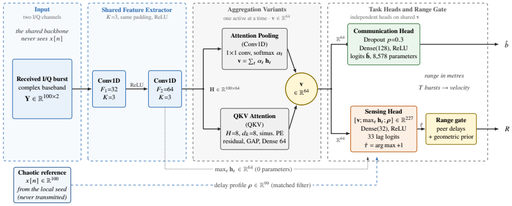
Fig. 1 . Proposed Ultra-CAN dual-mode ISAC receiver: peer-telemetry reception and local-seed monostatic radar share the Conv1D backbone, the two aggregation variants, and the communication, sensing and range-gate heads.
Original paper · CC BY 4.0 · Ettore Caruso, Marco Siino, Giacomo Morabito · Ultra-CAN: A Lightweight Blind ISAC Receiver for Chaos-Based Telemetry and Local-Seed Ranging in the Internet of Drones · Original paper figure · Extracted the figure area from page 5 of the original PDF.Why one receiver for telemetry and ranging
Micro-UAVs in a swarm must keep telemetry secure and resistant to jamming while also sensing obstacles and nearby drones, so that formations hold and collisions are avoided. Their size, weight, power and cost budgets make a second, dedicated radar transceiver hard to justify, which pushes the design toward one platform and one waveform. Integrated sensing and communications is the paradigm that places both functions on one platform and one shared waveform.
The difficulty is that a telemetry receiver has no copy of the transmitter's per-symbol chaotic state, so it has to demodulate blindly, and classical correlators lose accuracy once Doppler and multipath enter the link.
The authors' earlier Ultra-CAN decoder was limited to single-task bit classification in simulation, so the present work adds ranging, a peer-exclusion gate and a measured microcontroller deployment.
One waveform for telemetry and radar
Each burst is a block of 100 samples produced by an iterated map: bit 0 uses the Logistic map with \(\mu = 3.9\), and bit 1 uses the five-branch generalized Bernoulli map, both started from a random per-burst seed. The Logistic update is \(x_{n+1}=\mu x_n(1-x_n)\) with \(\mu\in[3.57,4]\), and the Bernoulli update is \(x_{n+1}=5x_n-\lfloor 5x_n\rfloor\) for \(0\le x_n<1\).
The transmitter draws the seed for each burst and never sends it, so a telemetry receiver cannot use it as a reference. In radar mode the node keeps the seed it drew, rebuilds the same block locally and uses it as the reference, so the echoes it measures are its own reflections.
A flight-controller scheduler selects the mode for each frame. Both modes use the same weights and no mode classifier is needed; the communication head sees only the I/Q samples, while the sensing head also receives the regenerated reference in radar frames. The two modes are time-multiplexed, and the authors leave a cooperative bistatic variant to future work.
The aerial multi-echo channel behind the experiments
The received baseband signal is the sum of a Rician direct path with gain \(h_c\) and normalized Doppler \(f_{D,c}\), K delayed and Doppler-shifted echoes with amplitudes \(\alpha_k\), delays \(\tau_k\) and Doppler shifts \(f_{D,k}\), and additive white Gaussian noise \(w[n]\). The direct path is Rician with a factor of 10 dB, and the scaling keeps the total received power normalized to one.
Shared backbone with two aggregation variants
The shared path is two one-dimensional convolutions with 32 and 64 filters, kernel size 3, same padding and ReLU, mapping the two I/Q channels to a 100 by 64 feature map.
In the Conv1D variant a 1×1 convolution projects the feature map to 64 channels, and each time position receives a score \(e_t\) that is turned into a softmax weight over the burst: \(\alpha_t=\exp(e_t)/\sum_{t'}\exp(e_{t'})\). The 64-dimensional vector is the weighted average \(v=\sum_t \alpha_t h_t\), so positions that carry the echo structure can dominate while noise-only positions are suppressed.
The QKV variant applies scaled dot-product attention with eight heads of key dimension 8, sinusoidal positional encoding and a residual connection, followed by global average pooling and a dense projection to 64 dimensions.
The sensing head receives the shared vector, the max-pooled feature map and the delay-profile descriptor, a 227-dimensional input that passes through a 32-unit ReLU layer to 33 lag logits. The estimated lag is the argmax of the logits plus one.
The descriptor estimates the direct-path term as \(\hat c=\sum_n x[n]y[n]/\sum_n x[n]^2\), subtracts it, and correlates the residual with the reference at each lag from 1 to 33, keeping magnitude, real and imaginary parts for 99 values. The reference never enters the backbone, so the shared feature path sees only what a blind listener sees.
The authors chose \(\lambda\) by a validation sensitivity check: smaller weights underfit the sensing head and larger ones let the sensing term dominate.
Peer-exclusion gate and velocity from a track
The velocity error uses the model-free profile peak rather than the sensing head, because the head is trained for discrete tap identification, while velocity needs sub-sample delay differences.
Telemetry demodulation against classical and learned receivers
The pooled BER averages the per-point BER over SNR points of 5 dB and above, and with the 100-error rule the relative uncertainty of one point is about 10%.
Obstacle identification in peer-laden bursts
The authors attribute the gain to the supervision and the shared representation rather than to the attention mechanism, since the two variants agree within two tenths of a point.
The authors describe the head as learning a geometric signature of the obstacle in the complex profile, such as its position, width and phase relation to the direct path, rather than replacing the profile itself.
Answered fraction against peer reports
When the obstacle and a peer share a range cell, the gate trips in every case, because a single burst cannot separate the two returns.
Out-of-distribution channels and in-domain refitting
The table reports retraining only for the TDL-D link.
Frequency hopping and the mixing law under jamming
The jammer is modeled by four archetypes, barrage, fixed-partial, sweep and a reactive follower, and the jammed fraction f is 1 for barrage, 0.25 for fixed-partial and 0.125 for sweep, while the follower depends on dwell and reaction time.
The authors read the gain as geometric: hopping moves the burst away from an aligned jammer, so the same protection would apply to a classical correlator.
The BER under hopping follows \(\mathrm{BER}_{hop}=f\,\mathrm{BER}_{jam}+(1-f)\,\mathrm{BER}_{clean}\), with \(G\simeq-10\log_{10}f\) as the geometric gain over the aligned case. At JSR +10 dB the predicted and measured BER are 0.400 and 0.401 for fixed-partial, with G of 6.0, and 0.389 and 0.390 for blind sweep, with G of 9.1.
int8 firmware on a 240 MHz microcontroller
The Conv1D variant has 27,620 float32 parameters, 45.6 KiB of int8 weights, a 24.2 KiB activation arena and 16.90 ms latency per burst. The QKV variant has 44,195 parameters, 78.8 KiB of int8 weights, a 185.6 KiB arena and 193.66 ms latency per burst.
The gate is unaffected by quantization because it thresholds a delay profile computed outside the network.
The full 100 kbit/s air rate would need a latency of 10 µs or less, which the authors place on an int8 accelerator rather than a flight controller.
Limits of the evidence
Energy is estimated from datasheet current rather than measured directly. The LSTM-OFDM-DCSK and MC-DLCSK baselines were re-implemented in the same stack, and their microcontroller latency was not measured, because TensorFlow Lite Micro lowers the recurrent layer to a kernel that the ESP-NN int8 set does not accelerate.
Per-point differences below about 10% are not resolved under the 100-error rule, and the single-echo QKV-to-Conv1D ordering is the least certain part of the ranking. Performance on the out-of-distribution channels is poor without retraining, and retraining is reported only for TDL-D. The low-probability-of-intercept advantage holds against narrowband standard modulations, while conventional DSSS is slightly flatter and the security assumes the map parameters stay undisclosed.
Velocity is a radial closing speed from a track, since a single burst cannot resolve the Doppler.
Paper info
- Authors
- Ettore Caruso, Marco Siino, Giacomo Morabito
- Venue
- arXiv · Preprint
- First published
- 2026-11-14
- Added
- 2026-11-17
- Updated
- 2026-11-14
- Version
- v1
- arXiv
- 2611.19529
- Category
- cs.AI
- Original paper terms
- CC BY 4.0
- What we show
- Paper info, commentary and permitted figures from the original paper
AI commentary is a separate explanation from the original paper and may contain errors. The original paper and figures follow each source's terms of use and any rights noted separately.
Abstract
The Internet of Drones (IoD) needs secure telemetry and proximity sensing within the SWaP-C constraints. We show that a single blind neural receiver driven by one chaos-based waveform performs both functions without a separate radar transceiver. In telemetry mode it decodes a peer's burst blindly; in radar mode it regenerates the per-burst chaotic reference locally and ranges the echoes of its own transmission. Ultra-CAN pairs a shared $64$-dimensional representation with two ultra-light backbones, an attention-pooled Conv1D network and a multi-head QKV network ($27.6$k--$44.2$k parameters), feeding communication and sensing heads. Both ship as int8 TensorFlow Lite Micro firmware; the Conv1D receiver decides a burst in $16.9$ ms on a $240$ MHz microcontroller with $24.2$ KiB of activations, a measured energy of $2.2$-$3.4$ mJ per burst, and float-equivalent decisions, sustaining up to $59$ bit/s of telemetry or a $7.4$ Hz range track. The two variants rank first and second among learned demodulators in four aerial swarm scenarios, with a pooled BER down to $4.6 \times 10^{-4}$ on the single-echo link ($2.4 \times 10^{-3}$ with three echoes). Its sensing head identifies true obstacles in $66.8\%$ of peer-laden bursts (vs $42\%$ matched filtering, $44\%$ OFDM-ISAC, $48\%$ peak-picker ceiling). A peer-exclusion gate cuts peer reports from $4.4\%$ to $0.02\%$ of answered bursts, answering $23.5\%$ of total bursts ($75\%$ on the exact tap) with $0.70$ m/s velocity tracking. In-domain refitting recovers telemetry BER by up to three orders of magnitude under 3GPP channels, jamming-aware training restores the link, and frequency agility adds a $6$--$9$ dB margin against partial-band jamming.
Quote from the paper
Ettore Caruso, Marco Siino, Giacomo Morabito (2026). Ultra-CAN: A Lightweight Blind ISAC Receiver for Chaos-Based Telemetry and Local-Seed Ranging in the Internet of Drones. arXiv:2611.19529v1. https://arxiv.org/abs/2611.19529v1
BibTeX
@misc{caruso2026ultra,
  title = {{Ultra-CAN: A Lightweight Blind ISAC Receiver for Chaos-Based Telemetry and Local-Seed Ranging in the Internet of Drones}},
  author = {Ettore Caruso and Marco Siino and Giacomo Morabito},
  year = {2026},
  eprint = {2611.19529},
  archivePrefix = {arXiv},
  url = {https://arxiv.org/abs/2611.19529v1}
}