論文解説
Ultra-CAN: A Lightweight Blind ISAC Receiver for Chaos-Based Telemetry and Local-Seed Ranging in the Internet of Drones
Ultra-CAN:ドローンインターネットにおけるカオスベースのテレメトリとローカルシードによる測距のための軽量ブラインドISAC受信機
- 課題 非協調のカオスリンクで、通信の復調と距離測定を1つの軽量な受信機で処理するのは難しいです。
- 手法 共有Conv1Dバックボーンの上にアテンションプーリングまたはQKV集約を置き、通信ヘッドと遅延分類の検知ヘッドを同時に学習します。
非協調ドローンリンクの問題
小型無人機の群れは、安全なテレメトリと近接検知を同時に必要としますが、SWaP-Cの制約があるため、通信用の受信機とレーダーの回路を別々に載せるのは難しいです。カオス波形は雑音のように見えるため傍受やジャミングに強く、相関ピークを使えば距離測定にも利用できます。しかし、送信機のサンプルごとのカオス状態を共有しない非協調環境では、従来の相関受信機はマルチパスとドップラーに弱いです。学習ベースの復調器は性能が高くても、再帰構造と全結合層のためメモリ使用量が大きく、飛行制御機に載せにくいです。この論文では、ブラインド復調とローカルシードに基づく距離測定を、1つの軽量な受信機で扱うことを研究の範囲としています。
デュアルモード波形と共有バックボーン
送信機は、シードからロジスティックマップ(µ=3.9)または5分岐の一般化ベルヌーイマップによって長さ100のカオスブロックを生成し、ビット0と1をそれぞれ2つのマップに対応させます。シードは送信されません。通信モードでは、受信機はI/Qの2チャネルであるY∈R^{100×2}のみを受け取り、ブラインドで復調します。レーダーモードでは、ノードが自分で選んだシードを使って参照x[n]をローカルに再生成しますが、この参照はバックボーンには入れず、遅延プロファイル記述子の作成にのみ使います。バックボーンは2層のConv1D(F1=32、F2=64、カーネル3、同じパディング、ReLU)で、集約段階でアテンションプーリング(Ultra-CAN、Conv1D変形)または多ヘッドQKVアテンション(Ultra-CAN-QKV)のいずれかを使い、64次元ベクトルvを作ります。
2つの変形は同じバックボーンとヘッドを使い、集約段階だけが異なります。
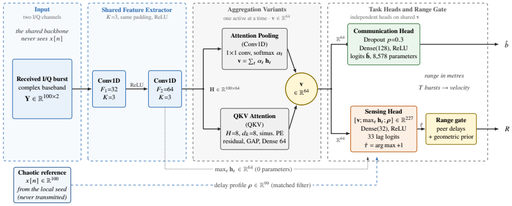
Fig. 1 . Proposed Ultra-CAN dual-mode ISAC receiver: peer-telemetry reception and local-seed monostatic radar share the Conv1D backbone, the two aggregation variants, and the communication, sensing and range-gate heads.
出典 · CC BY 4.0 · Ettore Caruso, Marco Siino, Giacomo Morabito · Ultra-CAN: A Lightweight Blind ISAC Receiver for Chaos-Based Telemetry and Local-Seed Ranging in the Internet of Drones · 論文の図を引用 · 元のPDFの5ページ目から図の部分を抽出しています。検知ヘッドとピア除外ゲート
検知ヘッドは距離を回帰するのではなく、33個の遅延タップを分類します。入力は、共有表現v、最大プーリング特徴max_t h_t、遅延プロファイルρ∈R^99を連結した227次元ベクトルです。遅延プロファイルは、直接経路を最小二乗で推定して差し引いたあと、ローカル参照とτ∈[1,33]で相関をとった値です。学習は幾何学的障害物遅延に対するスパースカテゴリカル交差エントロピーで行われ、このため、レーダーモードでは障害物より強いピアタップを無視するように学習します。距離ゲートは、既知のピア遅延において測定プロファイルが1/d²リンクモデルの予測をガード係数γ以上超えた場合、そのバーストを無音化します。
応答したバーストに対してだけR=cτ̂/(2f_s)を出力し、速度は連続する距離推定値の傾きから得ます。
マルチタスク損失と通信ヘッド
通信ヘッドは、vにドロップアウト(p=0.3)を適用した後、128ユニットのReLU全結合層と2つのビットロジットで構成され、8,578個のパラメータを持ちます。全体の損失はL=L_comm+λL_lagで、λは2に固定されています。著者らは、このλが検証セットでの感度確認によって選ばれたと説明しています。通信の結果は検知タスクと一緒に学習したモデルから得られたものなので、通信専用の変形と比べて、共有学習の妥当性を裏付けるものです。
テレメトリ復調の結果
古典的なベースラインとして、DCSK相関器、2つの公称マップシグネチャに対するマッチドフィルタ、エネルギー検出器を、理想的なリンクで比較しました。学習ベースの受信機では、QKV変形が4つのシナリオで最も低いプーリングBERを記録し、Conv1D変形が2番目でした。
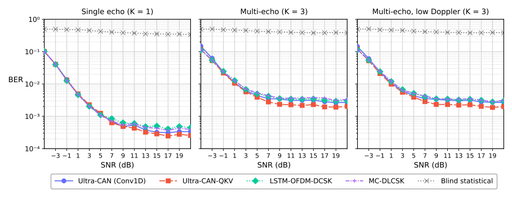
Fig. 2 . BER against SNR over the full grid: (a) single echo, (b) multi-echo, (c) multi-echo, reduced Doppler. The blind statistical receiver is included; the proposed variants are the blue and red curves.
出典 · CC BY 4.0 · Ettore Caruso, Marco Siino, Giacomo Morabito · Ultra-CAN: A Lightweight Blind ISAC Receiver for Chaos-Based Telemetry and Local-Seed Ranging in the Internet of Drones · 論文の図を引用 · 元のPDFの6ページ目から図の部分を抽出しています。障害物識別とピアゲート
このとき、応答した範囲の74.9%が正しい障害物タップに当たりました。
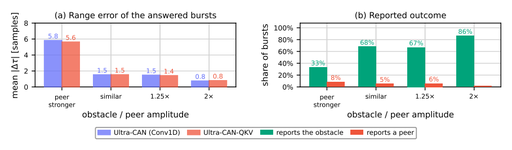
Fig. 3 . Ranging on200,000peer-laden bursts at21dB: (a) mean range error of the answered bursts and (b) reported outcome, against the obstacle-to-peer echo ratio.
出典 · CC BY 4.0 · Ettore Caruso, Marco Siino, Giacomo Morabito · Ultra-CAN: A Lightweight Blind ISAC Receiver for Chaos-Based Telemetry and Local-Seed Ranging in the Internet of Drones · 論文の図を引用 · 元のPDFの9ページ目から図の部分を抽出しています。速度追跡の精度
この値は径方向の接近速度であり、速度ベクトル全体ではありません。8バーストの窓は、100ms間隔で0.7sに相当します。
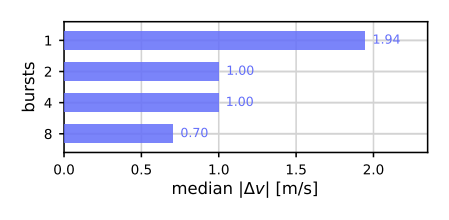
Fig. 4 . Median absolute velocity error of the model-free profile tracker against the number of bursts averaged into the track, over thirty tracks of50bursts.
出典 · CC BY 4.0 · Ettore Caruso, Marco Siino, Giacomo Morabito · Ultra-CAN: A Lightweight Blind ISAC Receiver for Chaos-Based Telemetry and Local-Seed Ranging in the Internet of Drones · 論文の図を引用 · 元のPDFの9ページ目から図の部分を抽出しています。チャネル変化と再学習
2つのバックボーンの差は3–7%に縮まり、収束しました。
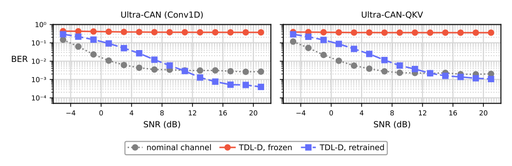
Fig. 5 . Retraining control on the TDL-D link: nominal channel (grey dotted), frozen TDL-D (red solid) and TDL-D retrained on105,000symbols (blue dashed), for the two backbones.
出典 · CC BY 4.0 · Ettore Caruso, Marco Siino, Giacomo Morabito · Ultra-CAN: A Lightweight Blind ISAC Receiver for Chaos-Based Telemetry and Local-Seed Ranging in the Internet of Drones · 論文の図を引用 · 元のPDFの10ページ目から図の部分を抽出しています。ジャミング耐性と周波数ホッピング
ジャミング頑健性の実験では、QKV受信機がCWジャミングに最も頑健でしたが、JSR+10dB付近ではBERがchance levelまで低下しました。
ESP32-S3への実装とSWaP-C
Conv1D変形は、27,620個のパラメータ、int8重み45.6KiB、活性化アリーナ24.2KiB、バーストあたり16.90ms(59 bursts/s)を記録しました。40dB SICは測定値ではなく設計予算であり、実際のRFフロントエンドの残留位相と振幅誤差はモデル化されていません。この点から、フロントエンドとOTA試験については主張しません。
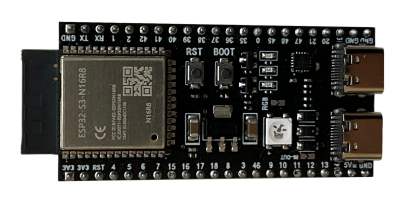
Fig. 6 . Deployment platform: the ESP32-S3-DevKitC-1 (240MHz,512KiB of SRAM, no accelerator) on which both int8 receivers were measured, running TensorFlow Lite Micro with the ESP-NN int8 kernels. The10MS/s I/Q front end that feeds the two input channels is outside this digital accounting.
出典 · CC BY 4.0 · Ettore Caruso, Marco Siino, Giacomo Morabito · Ultra-CAN: A Lightweight Blind ISAC Receiver for Chaos-Based Telemetry and Local-Seed Ranging in the Internet of Drones · 論文の図を引用 · 元のPDFの12ページ目から図の部分を抽出しています。限界と残された課題
単一の10µsバーストでは160–480Hzのエコードップラーを分解できないため、速度は追跡に使える程度の量です。33-sample窓は約500mの単方向範囲を定め、ゲートは群れの幾何学的な事前情報としてピア位置を知っている必要があります。マップパラメータとサンプルごとのシードが公開されないという仮定は、鍵管理の前提として示されています。静的クラッタはゲートを通過する可能性があります。
論文情報
- 著者
- Ettore Caruso, Marco Siino, Giacomo Morabito
- 学会・ジャーナル
- arXiv · プレプリント
- 公開日
- 2026年11月14日
- 登録日
- 2026年11月17日
- 更新日
- 2026年11月14日
- バージョン
- v1
- arXiv
- 2611.19529
- カテゴリ
- cs.AI
- ライセンス
- CC BY 4.0
- 掲載内容
- 論文情報・解説・論文の図
この解説は、Refivuの韓国語解説をAIで翻訳したものです。不正確な翻訳や誤りが含まれる可能性があります。論文と図の利用条件は各出典に従います。
アブストラクト
The Internet of Drones (IoD) needs secure telemetry and proximity sensing within the SWaP-C constraints. We show that a single blind neural receiver driven by one chaos-based waveform performs both functions without a separate radar transceiver. In telemetry mode it decodes a peer's burst blindly; in radar mode it regenerates the per-burst chaotic reference locally and ranges the echoes of its own transmission. Ultra-CAN pairs a shared $64$-dimensional representation with two ultra-light backbones, an attention-pooled Conv1D network and a multi-head QKV network ($27.6$k--$44.2$k parameters), feeding communication and sensing heads. Both ship as int8 TensorFlow Lite Micro firmware; the Conv1D receiver decides a burst in $16.9$ ms on a $240$ MHz microcontroller with $24.2$ KiB of activations, a measured energy of $2.2$-$3.4$ mJ per burst, and float-equivalent decisions, sustaining up to $59$ bit/s of telemetry or a $7.4$ Hz range track. The two variants rank first and second among learned demodulators in four aerial swarm scenarios, with a pooled BER down to $4.6 \times 10^{-4}$ on the single-echo link ($2.4 \times 10^{-3}$ with three echoes). Its sensing head identifies true obstacles in $66.8\%$ of peer-laden bursts (vs $42\%$ matched filtering, $44\%$ OFDM-ISAC, $48\%$ peak-picker ceiling). A peer-exclusion gate cuts peer reports from $4.4\%$ to $0.02\%$ of answered bursts, answering $23.5\%$ of total bursts ($75\%$ on the exact tap) with $0.70$ m/s velocity tracking. In-domain refitting recovers telemetry BER by up to three orders of magnitude under 3GPP channels, jamming-aware training restores the link, and frequency agility adds a $6$--$9$ dB margin against partial-band jamming.
この論文を引用
Ettore Caruso, Marco Siino, Giacomo Morabito (2026). Ultra-CAN: A Lightweight Blind ISAC Receiver for Chaos-Based Telemetry and Local-Seed Ranging in the Internet of Drones. arXiv:2611.19529v1. https://arxiv.org/abs/2611.19529v1
BibTeX
@misc{caruso2026ultra,
  title = {{Ultra-CAN: A Lightweight Blind ISAC Receiver for Chaos-Based Telemetry and Local-Seed Ranging in the Internet of Drones}},
  author = {Ettore Caruso and Marco Siino and Giacomo Morabito},
  year = {2026},
  eprint = {2611.19529},
  archivePrefix = {arXiv},
  url = {https://arxiv.org/abs/2611.19529v1}
}