論文解説
Learned Regularization for Sparse-View CT: Accuracy, Lesion Detectability and Distribution Shift of a Plug-and-Play Prior against Tuned Total Variation
疎視野CTのための学習ベース正則化:チューニング済みのTotal Variationと比べたPlug-and-Playプライアの精度、病変検出性、分布シフト
- 課題 疎視野CT再構成において、学習された事前分布が、PSNRだけでなく分布シフトや病変検出でもチューニング済みのTVより優れるかを検証する問題です。
- 手法 DnCNNデノイザをPnP近接勾配法に組み込み、FBP、Tikhonov、TVと同様に検証データでチューニングした条件で比較しました。
- 結果 実際のCTでは、PSNRはTV-longと同程度でしたが、病変検出のAUCは9つの条件すべてで高くなりました。
疎視野CT再構成と評価方法の課題
疎視野CTの再構成は、投影角度が少ない場合や光子数が少ない場合に逆問題が不安定になるため、事前知識による正則化を入れる必要がある問題です。学習ベースの事前分布は、多くの場合、学習データに近い画像でPSNRにより評価されてきました。この論文は、その評価では分布シフトや病変検出性を十分に捉えられないと考え、チューニングされた従来の正則化と同じ条件で比べる問題に範囲を絞っています。
PnP近接勾配法による再構成
この手法の中心は、DnCNN型のデノイザをPnP近接勾配法の反復における近接演算子の位置に入れることです。各反復では、データ適合の勾配ステップの後にデノイザを適用し、結果を[0,1]にクリップします。デノイザは、ノイズレベルσを入力チャネルとして受け取るように学習されるため、1つのネットワークを複数のノイズ強度で使えます。推論時にはσ_dと反復回数kが検証セットでチューニングされます。著者らは、この構成により学習は1回で済み、同じデータ適合のステップで古典的な正則化と比較できると説明しています。
数字データの分布シフトの結果
MNISTで学習したデノイザは、σ=0.05、20個の角度条件でbox-constrained TVより約3.4 dB高いPSNRを示しました。同じ固定パイプラインをFashion-MNISTとShepp–Loganファントムに適用すると、TVよりそれぞれ約3.1 dBと4.3 dB低くなりました。Fashion-MNISTで学習したデノイザは、同じチューニング手順のもとでFashion-MNISTにおいてTVより2.2 dB高くなりました。この結果から、学習分布と評価分布のずれが結果を左右することがわかります。著者らは、これをPnP手法そのものの失敗ではなく、事前分布の不一致によるものと解釈しています。
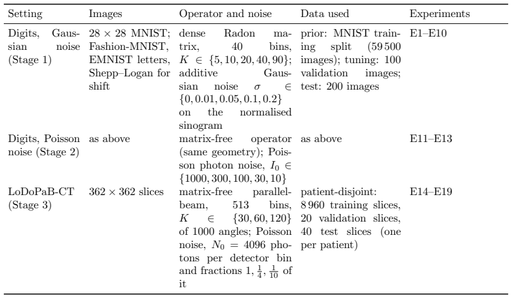
Table 1 : The three settings of the study. Datasets: MNIST [20], Fashion-MNIST [32], EMNIST letters [12], the Shepp–Logan phantom [25] and LoDoPaB-CT [21].
出典 · CC BY 4.0 · Mohammed Abo Oraig · Learned Regularization for Sparse-View CT: Accuracy, Lesion Detectability and Distribution Shift of a Plug-and-Play Prior against Tuned Total Variation · 論文の図を引用 · 元のPDFの6ページ目から図の部分を抽出しています。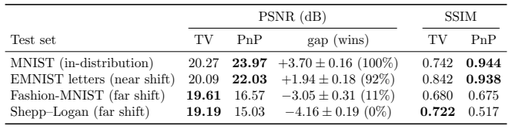
Table 6 : Test PSNR and SSIM under distribution shift with the pipeline frozen at its MNIST values (one MNIST-trained denoiser, TV-ADMM). Gap = PnP−TV PSNR, mean±1.96 standard errors of the paired difference (over images; over noise draws for the phantom); “wins” is the share of test cases in which PnP has the higher PSNR.
出典 · CC BY 4.0 · Mohammed Abo Oraig · Learned Regularization for Sparse-View CT: Accuracy, Lesion Detectability and Distribution Shift of a Plug-and-Play Prior against Tuned Total Variation · 論文の図を引用 · 元のPDFの19ページ目から図の部分を抽出しています。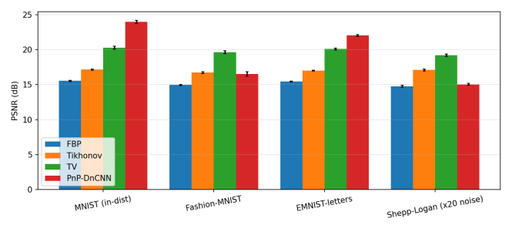
Figure 6 : Test PSNR under distribution shift for the four methods with the pipeline frozen at its MNIST values. PnP-DnCNN leads on MNIST and on EMNIST letters, which share the stroke-like statistics of digits, but is below TV on Fashion-MNIST (−3.0 dB) and on the phantom (−4.2 dB). Against Tikhonov it is 0.2 dB below on Fashion-MNIST and 2.1 dB below on the phantom; against FBP it is 1.6 dB above on Fashion-MNIST and only 0.3 dB above on the phantom. Error bars: mean ±1.96 standard errors; for the phantom they describe 20 noise draws of one image, not variation between images.
出典 · CC BY 4.0 · Mohammed Abo Oraig · Learned Regularization for Sparse-View CT: Accuracy, Lesion Detectability and Distribution Shift of a Plug-and-Play Prior against Tuned Total Variation · 論文の図を引用 · 元のPDFの19ページ目から図の部分を抽出しています。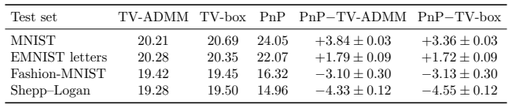
Table 7 : Control with a box-constrained TV (TV-box, 0≤x≤1, 1000 iterations,λtuned on the MNIST validation images). Three independently trained MNIST denoisers (E8), bicubic finer-grid data,σ= 0.05, 20 angles. Mean test PSNR over the three denoisers and gap = PnP−TV, mean± s.d. over denoisers.
出典 · CC BY 4.0 · Mohammed Abo Oraig · Learned Regularization for Sparse-View CT: Accuracy, Lesion Detectability and Distribution Shift of a Plug-and-Play Prior against Tuned Total Variation · 論文の図を引用 · 元のPDFの19ページ目から図の部分を抽出しています。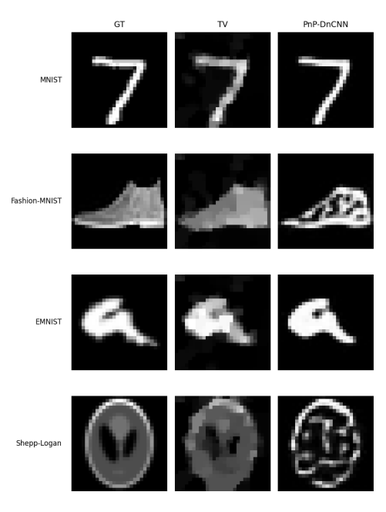
Figure 7 : Reconstructions atσ= 0.05, 20 angles, with the frozen pipeline: the first test image of each set (no selection), one noise draw, TV-ADMM and the single MNIST-trained PnP denoiser of Table 6. On Fashion-MNIST and the phantom the PnP output contains spotted or stroke-like fragments that are absent from the ground truth; in these examples the TV output is blurred and blocky but does not introduce such structure. A TV-box column and PSNR values are not shown.
出典 · CC BY 4.0 · Mohammed Abo Oraig · Learned Regularization for Sparse-View CT: Accuracy, Lesion Detectability and Distribution Shift of a Plug-and-Play Prior against Tuned Total Variation · 論文の図を引用 · 元のPDFの20ページ目から図の部分を抽出しています。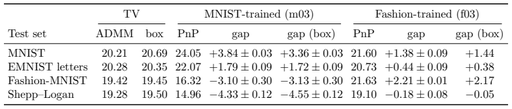
Table 15 : Distribution shift with three denoisers per prior. Mean test PSNR in dB over seeds; gap = PnP−TV, mean±s.d. over seeds, against TV-ADMM and against box-constrained TV (TV- box; m03 and f03 only; for f03 the box gap has no s.d. entry). Bicubic fine-grid data,σ= 0.05, 20 angles; each prior’s pipeline is tuned on the validation set of its own training distribution.
出典 · CC BY 4.0 · Mohammed Abo Oraig · Learned Regularization for Sparse-View CT: Accuracy, Lesion Detectability and Distribution Shift of a Plug-and-Play Prior against Tuned Total Variation · 論文の図を引用 · 元のPDFの29ページ目から図の部分を抽出しています。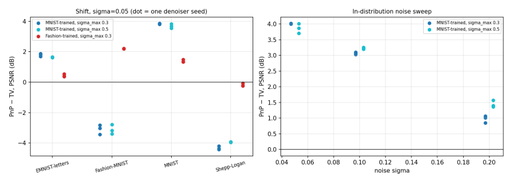
Figure 11 : Left: PnP−TV-ADMM gap for each denoiser seed (dots) on the four test sets, for three priors. Right: gap in the in-distribution noise sweep for MNIST-trained denoisers withσ max = 0.3 and 0.5. Produced bysummarize step4.pyfromresults/step4/.
出典 · CC BY 4.0 · Mohammed Abo Oraig · Learned Regularization for Sparse-View CT: Accuracy, Lesion Detectability and Distribution Shift of a Plug-and-Play Prior against Tuned Total Variation · 論文の図を引用 · 元のPDFの29ページ目から図の部分を抽出しています。実CTスライスの結果
LoDoPaB-CTの実スライスでは、PnP-constとチューニング済みのTV-longを比べると、PSNRの差は−0.93から+0.33 dBの範囲でした。SSIMは9つの条件のうち8つの条件で低くなりました。同じ条件で病変検出のAUCを見ると、9つの条件すべてでTV-longより高く、差は0.03から0.16の範囲でした。PSNRの高いTV-longでも検出AUCはFBP-Hannより低かったため、PSNRと検出性の順位は食い違っています。この点が、この研究の主要な観察です。
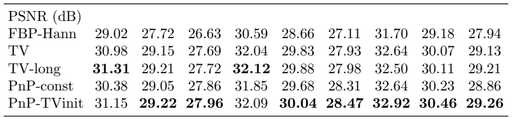
Table 25 : Mean PSNR (dB, upper block) and SSIM (lower block) of the lesion-free reconstructions, 40 patients (best in each condition in bold; ties in bold). Columns:Kangles / dose.
出典 · CC BY 4.0 · Mohammed Abo Oraig · Learned Regularization for Sparse-View CT: Accuracy, Lesion Detectability and Distribution Shift of a Plug-and-Play Prior against Tuned Total Variation · 論文の図を引用 · 元のPDFの45ページ目から図の部分を抽出しています。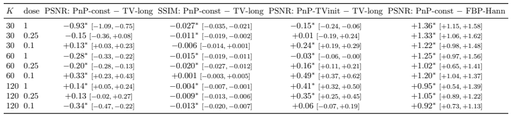
Table 26 : Paired differences over patients (mean, 95% bootstrap interval; ∗ excludes 0), 40 patients.
出典 · CC BY 4.0 · Mohammed Abo Oraig · Learned Regularization for Sparse-View CT: Accuracy, Lesion Detectability and Distribution Shift of a Plug-and-Play Prior against Tuned Total Variation · 論文の図を引用 · 元のPDFの45ページ目から図の部分を抽出しています。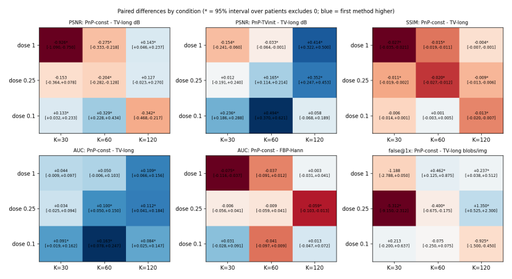
Figure 19 : Paired differences over the nine dose×angle conditions (cell: mean, 95% interval over 40 patients; ∗ excludes 0; blue: the first method is higher). Top row: PSNR (PnP-const and PnP- TVinit against TV-long) and SSIM (E16); bottom row: paired AUC of PnP-const against TV-long and against FBP-Hann (E17), and the difference in false blobs per slice atγ= 1 (E18).
出典 · CC BY 4.0 · Mohammed Abo Oraig · Learned Regularization for Sparse-View CT: Accuracy, Lesion Detectability and Distribution Shift of a Plug-and-Play Prior against Tuned Total Variation · 論文の図を引用 · 元のPDFの47ページ目から図の部分を抽出しています。残る制約
CT研究では、1つの小型デノイザと1回のCT学習実行のみを使いました。そのため、結果をプライア自体の効果とネットワーク設定の効果に分けることは難しいです。また、TV-longとPnP系の変形は、コストやチューニングの自由度で揃えられていません。数字データの実験でも、比較したのは2つの学習分布だけです。
論文情報
- 著者
- Mohammed Abo Oraig
- 学会・ジャーナル
- arXiv · プレプリント
- 公開日
- 2026年11月13日
- 登録日
- 2026年11月17日
- 更新日
- 2026年11月13日
- バージョン
- v1
- arXiv
- 2611.18936
- カテゴリ
- eess.IV · cs.CV · eess.SP
- ライセンス
- CC BY 4.0
- 掲載内容
- 論文情報・解説・論文の図
この解説は、Refivuの韓国語解説をAIで翻訳したものです。不正確な翻訳や誤りが含まれる可能性があります。論文と図の利用条件は各出典に従います。
アブストラクト
Learned image priors are often proposed to replace hand-crafted regularizers in sparse-view computed tomography (CT), yet they are usually judged by PSNR on data resembling their training set. We evaluate one noise-conditioned DnCNN denoiser used as a Plug-and-Play prior against filtered back-projection (FBP), Tikhonov and total-variation (TV) regularization, with every method tuned on validation data and all differences paired. On synthetic 28x28 digit images, the prior beats box-constrained TV by about 3.4 dB at moderate noise (sigma = 0.05, 20 angles), but the advantage shrinks at low noise and reverses under distribution shift: an MNIST-trained prior is 3.1 dB (Fashion-MNIST) and 4.3-4.6 dB (Shepp-Logan phantom) below TV, whereas a Fashion-MNIST-trained prior beats TV by 2.2 dB on Fashion-MNIST, consistent with prior mismatch rather than a failure of PnP itself. In a lesion-insertion test the prior detects lesions worse than TV in distribution despite its higher PSNR, and under mismatch it produces more lesion-like false blobs than box-constrained TV for seven of eight lesion types. On real LoDoPaB-CT slices (patient-disjoint split; 30, 60 and 120 angles; three dose levels; 40 test patients), the prior does not consistently outperform a well-tuned TV in PSNR (-0.93 to +0.33 dB) and has lower SSIM in eight of nine conditions. Its lesion-detection AUC is higher than this TV's in all nine conditions (significant in six) but never significantly higher than that of Hann-filtered FBP, which the PSNR-tuned TV falls below in detection in all nine conditions (seven significant). On non-anatomical phantoms its PSNR falls below TV in all six conditions. PSNR and lesion detectability thus rank the methods differently. Our conclusions concern one small denoiser, and the CT analysis was developed after seeing results, without pre-specified primary comparisons.
この論文を引用
Mohammed Abo Oraig (2026). Learned Regularization for Sparse-View CT: Accuracy, Lesion Detectability and Distribution Shift of a Plug-and-Play Prior against Tuned Total Variation. arXiv:2611.18936v1. https://arxiv.org/abs/2611.18936v1
BibTeX
@misc{oraig2026learned,
  title = {{Learned Regularization for Sparse-View CT: Accuracy, Lesion Detectability and Distribution Shift of a Plug-and-Play Prior against Tuned Total Variation}},
  author = {Mohammed Abo Oraig},
  year = {2026},
  eprint = {2611.18936},
  archivePrefix = {arXiv},
  url = {https://arxiv.org/abs/2611.18936v1}
}