論文解説
LABEL: Literature Asymmetry between Efficacy and Limits in Drug Knowledge and Language Models
LABEL:薬物知識と言語モデルにおける効能と限界の間の文献非対称性
- 課題 コーパスで、薬の禁忌が適応症より少なく言及されているかを、同じ薬の中で検証する必要があります。
- 手法 PrimeKGにある同じ薬の適応症と禁忌を、テキスト上の言及で数え、Mantel-Haenszelのオッズ比で比べます。
- 結果 Wikipediaでは、適応症の言及と禁忌の言及のクロス比は2.43で、FDAラベル全体では1.05でした。
研究課題と問題設定
この論文は、薬の適応症(benefit)と禁忌(contraindication)が一般のテキスト文書にどの程度均等に記録されているかを問います。薬の安全性情報は患者の安全にとって重要です。ただし、WikipediaやPubMedの抄録のような文章で、禁忌が適応症より少なく言及されているかを測るには、薬の知名度の差を統制する必要があります。著者らは、同じ薬の中で二つの関係を比べる方法によって、この交絡を取り除きました。続いて、言語モデルが同じ事実を記憶から答えられるか、また検索された文章があるとき、どの程度改善するかも併せて見ています。
言及の判定とwithin-drugのオッズ比
事実はPrimeKGの薬と疾患のエッジから取り出し、各薬から適応症を3個、禁忌を3個ランダムに選んで均等なサンプルを作ります。上位の疾患名であるファミリーレベル(レベル2)は、言及として数えません。無関係な疾患を同様の方法で揃えた偶然一致の割合を、ベースラインとしてあわせて計算します。統計には、薬ごとの2×2表をMantel-Haenszel法でまとめたオッズ比を用います。この方法では、薬の知名度の差が適応症と禁忌の比較に混ざらないように、薬の内部での対比だけを使います。
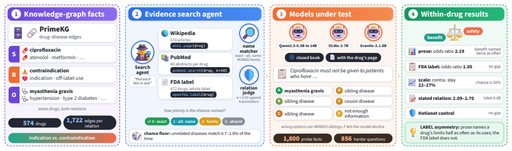
Figure 1 : Overview of our study pipeline. (1) We sample paired benefit facts (indications) and safety facts (contraindications) for the exact same drugs from the PrimeKG knowledge graph. (2) We retrieve text from Wikipedia, PubMed abstracts, and officialFDAdruglabels,andcheckbothwhetherthetextmentionsthetargetdiseaseandwhetherthesentencestatesthecorrect medical relationship. (3) We test language models on the same facts both closed book (from memory alone) and open book (with a retrieved passage). (4) Comparing benefit and safety facts within each drug reveals theLabelasymmetry.
出典 · CC BY 4.0 · S M Rayeed, Charles V. Stewart, Yao Ma · LABEL: Literature Asymmetry between Efficacy and Limits in Drug Knowledge and Language Models · 論文の図を引用 · 元のPDFの2ページ目から図の部分を抽出しています。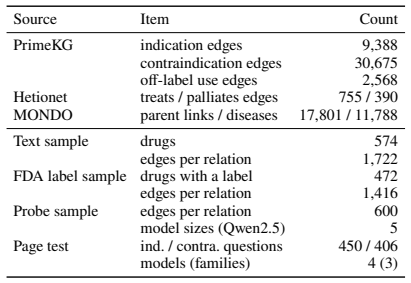
Table 1 : Data in this study. Anedgeis one drug-disease fact inaknowledgegraph.Thelowerblockgivesthesampleswe draw for each test.
出典 · CC BY 4.0 · S M Rayeed, Charles V. Stewart, Yao Ma · LABEL: Literature Asymmetry between Efficacy and Limits in Drug Knowledge and Language Models · 論文の図を引用 · 元のPDFの3ページ目から図の部分を抽出しています。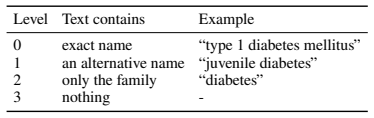
Table 2 : Levels at which a text can name a disease. Levels0 and1count asnamed.
出典 · CC BY 4.0 · S M Rayeed, Charles V. Stewart, Yao Ma · LABEL: Literature Asymmetry between Efficacy and Limits in Drug Knowledge and Language Models · 論文の図を引用 · 元のPDFの4ページ目から図の部分を抽出しています。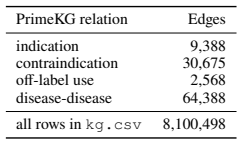
Table11 :PrimeKGrelationsweuse.Thecontraindicationto indication ratio is3.27.
出典 · CC BY 4.0 · S M Rayeed, Charles V. Stewart, Yao Ma · LABEL: Literature Asymmetry between Efficacy and Limits in Drug Knowledge and Language Models · 論文の図を引用 · 元のPDFの14ページ目から図の部分を抽出しています。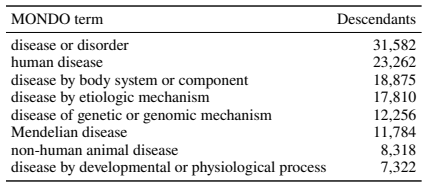
Table12 :ThebroadestMONDOterms,allremovedasfamily names by the cut at400descendants.
出典 · CC BY 4.0 · S M Rayeed, Charles V. Stewart, Yao Ma · LABEL: Literature Asymmetry between Efficacy and Limits in Drug Knowledge and Language Models · 論文の図を引用 · 元のPDFの14ページ目から図の部分を抽出しています。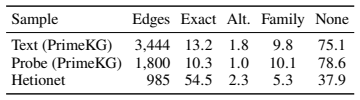
Table 13 : Naming level of every sampled edge in Wikipedia (%), both relations together.
出典 · CC BY 4.0 · S M Rayeed, Charles V. Stewart, Yao Ma · LABEL: Literature Asymmetry between Efficacy and Limits in Drug Knowledge and Language Models · 論文の図を引用 · 元のPDFの15ページ目から図の部分を抽出しています。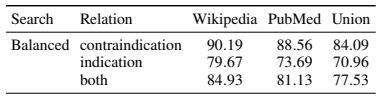
Table 14 : Share of facts (%) that a corpus does not name (level above1),1,722edges per relation.
出典 · CC BY 4.0 · S M Rayeed, Charles V. Stewart, Yao Ma · LABEL: Literature Asymmetry between Efficacy and Limits in Drug Knowledge and Language Models · 論文の図を引用 · 元のPDFの15ページ目から図の部分を抽出しています。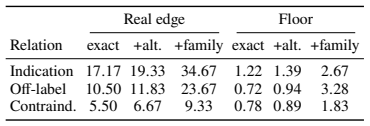
Table 15 : Cumulative match rate (%) in Wikipedia for real edges and for three unrelated diseases per edge,600edges per relation. Each column adds a set of names to the one before.
出典 · CC BY 4.0 · S M Rayeed, Charles V. Stewart, Yao Ma · LABEL: Literature Asymmetry between Efficacy and Limits in Drug Knowledge and Language Models · 論文の図を引用 · 元のPDFの16ページ目から図の部分を抽出しています。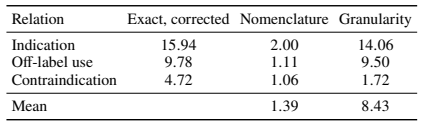
Table16 :Floor-correctednamingrate(%)attheexactlevel, and the floor-corrected gain (points) from alternative names and from family names up to two levels.
出典 · CC BY 4.0 · S M Rayeed, Charles V. Stewart, Yao Ma · LABEL: Literature Asymmetry between Efficacy and Limits in Drug Knowledge and Language Models · 論文の図を引用 · 元のPDFの16ページ目から図の部分を抽出しています。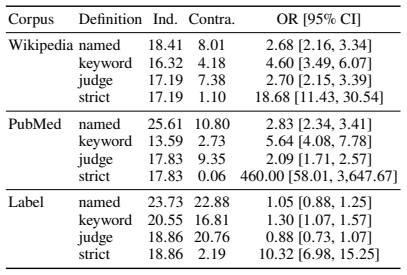
Table34 :Shareoffacts(%)countedasstatedundereachdef- inition,andthewithin-drugoddsratiowithRobins-Breslow- Greenland intervals.1,722edges per relation for Wikipedia and PubMed,1,416for the label.
出典 · CC BY 4.0 · S M Rayeed, Charles V. Stewart, Yao Ma · LABEL: Literature Asymmetry between Efficacy and Limits in Drug Knowledge and Language Models · 論文の図を引用 · 元のPDFの24ページ目から図の部分を抽出しています。抄録コーパスの言及の格差
PubMedの抄録は、均衡のとれた検索を使っても26.31%と11.44%で、オッズ比は2.77でした。二つのコーパスを合わせた場合も、29.04%と15.91%、オッズ比は2.19でした。禁忌側の差は、薬の中の事実数が少ない区間でより大きく現れました。著者らは、この差は測定方法によるものではなく、文章の性質から生じると解釈しています。
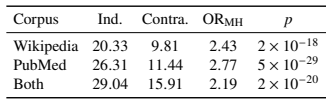
Table3 :Shareoffacts(%)thattextnames,within-drugodds ratio of indication against contraindication and its Cochran- Mantel-Haenszel (𝑝): 574 drugs, 1722 edges per relation.
出典 · CC BY 4.0 · S M Rayeed, Charles V. Stewart, Yao Ma · LABEL: Literature Asymmetry between Efficacy and Limits in Drug Knowledge and Language Models · 論文の図を引用 · 元のPDFの5ページ目から図の部分を抽出しています。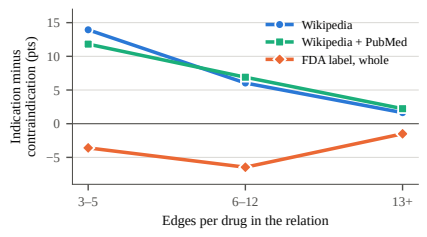
Figure 3 : Coverage gap (indication minus contraindication namingrate,inpoints)groupedbythedrug’snumberoffacts inthatrelation.Positivebarsmeanthetextfavorsindications. Prose favors indications in every group, whereas the FDA label does not.
出典 · CC BY 4.0 · S M Rayeed, Charles V. Stewart, Yao Ma · LABEL: Literature Asymmetry between Efficacy and Limits in Drug Knowledge and Language Models · 論文の図を引用 · 元のPDFの5ページ目から図の部分を抽出しています。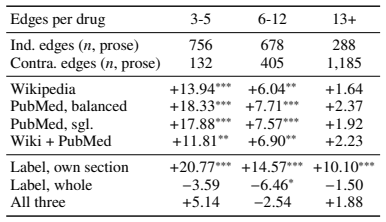
Table 20 : Indication minus contraindication naming rate (points) within strata of the drug’s edge count.∗𝑝 <0.05, ∗∗
出典 · CC BY 4.0 · S M Rayeed, Charles V. Stewart, Yao Ma · LABEL: Literature Asymmetry between Efficacy and Limits in Drug Knowledge and Language Models · 論文の図を引用 · 元のPDFの19ページ目から図の部分を抽出しています。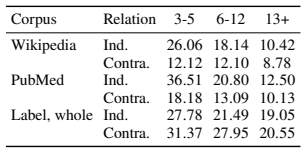
Table 21 : Naming rate (%) by relation within strata of the drug’s edge count.
出典 · CC BY 4.0 · S M Rayeed, Charles V. Stewart, Yao Ma · LABEL: Literature Asymmetry between Efficacy and Limits in Drug Knowledge and Language Models · 論文の図を引用 · 元のPDFの19ページ目から図の部分を抽出しています。閉じた本の質問と難しい選択肢
言語モデルの実験では、事実を5択の設問に変えて評価します。正解の疾患と無作為に選んだ疾患4個を選択肢に置き、各選択肢のトークン対数確率の平均が最も高いものを選びます。より難しい設定では、誤答を正解のMONDOの兄弟疾患で埋め、答えない選択肢を追加しました。評価したモデルは、Qwen2.5-0.5B、Qwen2.5-7B、OLMo-2-7B、Granite-3.1-8Bです。
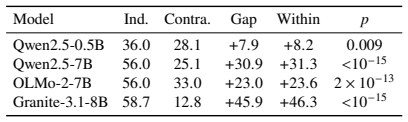
Table6 :Closed-bookaccuracy(%)withwrongoptionsfrom the answer’s MONDO neighborhood and aNot enough in- formationoption;450indication and406contraindication questions.Withinisthegapcomputedwithingroupsofques- tions whose page names the answer, its family or nothing. The𝑝-value tests this within-group gap.
出典 · CC BY 4.0 · S M Rayeed, Charles V. Stewart, Yao Ma · LABEL: Literature Asymmetry between Efficacy and Limits in Drug Knowledge and Language Models · 論文の図を引用 · 元のPDFの7ページ目から図の部分を抽出しています。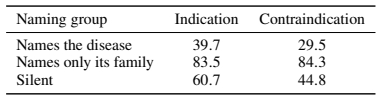
Table 28 : Share of questions (%) whose four wrong options are all MONDO siblings of the answer.
出典 · CC BY 4.0 · S M Rayeed, Charles V. Stewart, Yao Ma · LABEL: Literature Asymmetry between Efficacy and Limits in Drug Knowledge and Language Models · 論文の図を引用 · 元のPDFの21ページ目から図の部分を抽出しています。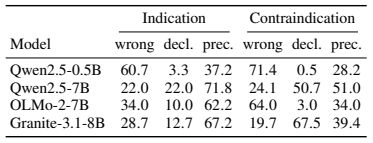
Table 30 : How models fail closed book with harder wrong options (%).Decl.is the share of questions answeredNot enough information;prec.is the accuracy on the questions the model answers.
出典 · CC BY 4.0 · S M Rayeed, Charles V. Stewart, Yao Ma · LABEL: Literature Asymmetry between Efficacy and Limits in Drug Knowledge and Language Models · 論文の図を引用 · 元のPDFの22ページ目から図の部分を抽出しています。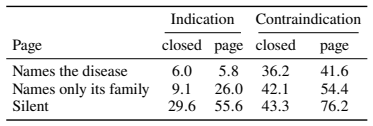
Table 33 : Share of questions answeredNot enough informa- tion(%), closed book and with the drug’s page, averaged over Qwen2.5-7B, OLMo-2-7B and Granite-3.1-8B.
出典 · CC BY 4.0 · S M Rayeed, Charles V. Stewart, Yao Ma · LABEL: Literature Asymmetry between Efficacy and Limits in Drug Knowledge and Language Models · 論文の図を引用 · 元のPDFの23ページ目から図の部分を抽出しています。モデルサイズと禁忌の正答率
難しい選択肢では、Granite-3.1-8Bの適応症と禁忌の差が45.9点、OLMo-2-7Bは23.0点でした。検索された文章を使った実験では、疾患名を直接含む文章が、禁忌の質問の正答率を14.2点、適応症の質問の正答率を11.1点引き上げました。同じ実験では、言及のない文章は正答率を下げ、ファミリー名だけの文章は適応症の正答率を8.2点下げました。
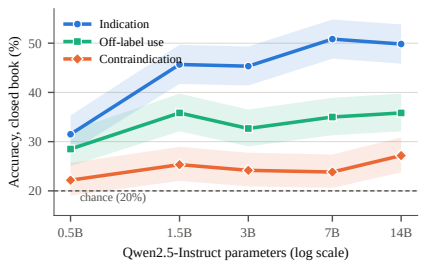
Figure 5 : Closed-book five-choice accuracy (%) across five Qwen2.5 sizes (0.5B to14B) on600facts per relation. Shadedbandsshow95%intervals,andthedashedlinemarks the20%chancerate.Scaleimprovesaccuracyonindications but leaves contraindications near chance.
出典 · CC BY 4.0 · S M Rayeed, Charles V. Stewart, Yao Ma · LABEL: Literature Asymmetry between Efficacy and Limits in Drug Knowledge and Language Models · 論文の図を引用 · 元のPDFの7ページ目から図の部分を抽出しています。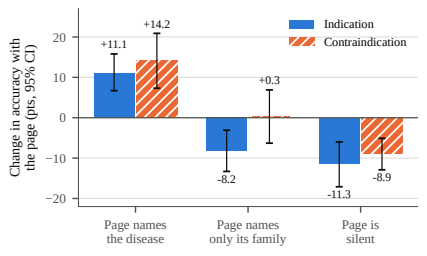
Figure7 :Changeinaccuracy(points)whenaretrievedprose passage is added to the prompt, averaged over Qwen2.5-7B, OLMo-2-7B and Granite-3.1-8B, grouped by whether the passage names the disease, names only its MONDO family, orissilent.Whenthepassagenamesthedisease,modelsgain as much on safety limits (+14.2) as on benefits (+11.1).
出典 · CC BY 4.0 · S M Rayeed, Charles V. Stewart, Yao Ma · LABEL: Literature Asymmetry between Efficacy and Limits in Drug Knowledge and Language Models · 論文の図を引用 · 元のPDFの8ページ目から図の部分を抽出しています。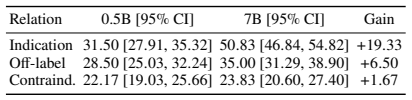
Table 26 : Probe accuracy (%) of Qwen2.5-0.5B and Qwen2.5-7B, and the paired gain between them (points), on600edges per relation. Indication gain minus contraindi- cation gain:+17.67[12.68,22.70],𝑝=4.8×10 −12.
出典 · CC BY 4.0 · S M Rayeed, Charles V. Stewart, Yao Ma · LABEL: Literature Asymmetry between Efficacy and Limits in Drug Knowledge and Language Models · 論文の図を引用 · 元のPDFの20ページ目から図の部分を抽出しています。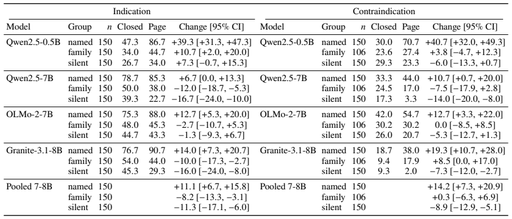
Table 31 : Accuracy (%) closed book and with the drug’s page, and the change (points) with a95% bootstrap interval over questions, by what the page says about the answer. The pooled rows average each question over Qwen2.5-7B, OLMo-2-7B and Granite-3.1-8B first. In the named group, the indication change minus the contraindication change is−3.1[−11.6,+5.1] points pooled, so a written safety fact helps at least as much as a written benefit fact.
出典 · CC BY 4.0 · S M Rayeed, Charles V. Stewart, Yao Ma · LABEL: Literature Asymmetry between Efficacy and Limits in Drug Knowledge and Language Models · 論文の図を引用 · 元のPDFの23ページ目から図の部分を抽出しています。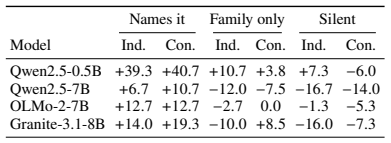
Table 32 : Change in accuracy (points) from closed book to thedrug’spage,bywhatthepagesaysabouttheanswer.Each cell has150questions, except106family-only contraindica- tion questions.
出典 · CC BY 4.0 · S M Rayeed, Charles V. Stewart, Yao Ma · LABEL: Literature Asymmetry between Efficacy and Limits in Drug Knowledge and Language Models · 論文の図を引用 · 元のPDFの23ページ目から図の部分を抽出しています。限界
主な指標は、テキストに疾患名が現れるかどうかを測るため、事前学習データに事実がどの程度含まれていたかは直接追跡しません。著者らは、PrimeKGの細分化された下位疾患が、テキストに出る上位の疾患名と異なる可能性があると考えています。PubMedの分析は抄録だけを使っているため、文献全体の下限に当たります。多肢選択式の評価は正解の疾患を見分ける力を測るもので、自由形式の想起能力と同じではありません。
論文情報
- 著者
- S M Rayeed, Charles V. Stewart, Yao Ma
- 学会・ジャーナル
- arXiv · プレプリント
- 公開日
- 2026年11月14日
- 登録日
- 2026年11月17日
- 更新日
- 2026年11月14日
- バージョン
- v1
- arXiv
- 2611.19166
- カテゴリ
- cs.AI · cs.IR
- ライセンス
- CC BY 4.0
- 掲載内容
- 論文情報・解説・論文の図
この解説は、Refivuの韓国語解説をAIで翻訳したものです。不正確な翻訳や誤りが含まれる可能性があります。論文と図の利用条件は各出典に従います。
アブストラクト
Every medication comes with two types of medical facts: indications, which describe what conditions the drug treats (benefits), and contraindications, which describe who must avoid it to prevent serious harm (safety limits). Although contraindications are critical for patient safety and FDA regulations require listing them as rigorously as indications, we find that contraindications are far less documented than indications in general prose. In this paper, we measure how often these texts contain both facts across 574 drugs from PrimeKG by comparing a drug's indications against its own contraindications. Across Wikipedia articles and PubMed abstracts, we find that reference prose names a drug's benefits about twice as often as its safety limits (within-drug odds ratio 2.19). We call this documentation gap LABEL (Literature Asymmetry between Efficacy and Limits). Language models mirror this gap. As we scale Qwen2.5 from 0.5B to 14B, accuracy on indications rises by 18.3 points, whereas accuracy on contraindications remains flat near random guessing. However, when we provide models with a retrieved passage that states the answer, they use safety facts just as effectively as benefits. Furthermore, routing safety questions to official FDA labels boosts accuracy by 15.8 points whenever the label states the fact. Overall, our findings show that models fail on medication safety not because they cannot reason about risk, but because free-text corpora lack safety facts. Clinical AI systems should therefore route medication-safety questions to official regulatory labels and structured databases rather than relying on general public records. Code and data are available at https://github.com/SMRayeed/LABEL.
この論文を引用
S M Rayeed, Charles V. Stewart, Yao Ma (2026). LABEL: Literature Asymmetry between Efficacy and Limits in Drug Knowledge and Language Models. arXiv:2611.19166v1. https://arxiv.org/abs/2611.19166v1
BibTeX
@misc{rayeed2026label,
  title = {{LABEL: Literature Asymmetry between Efficacy and Limits in Drug Knowledge and Language Models}},
  author = {S M Rayeed and Charles V. Stewart and Yao Ma},
  year = {2026},
  eprint = {2611.19166},
  archivePrefix = {arXiv},
  url = {https://arxiv.org/abs/2611.19166v1}
}