論文解説
Deep Latents, Long Memory: Latent persistence explains temporal correlations in transformer activations
深い潜在表現、長いメモリ:潜在持続性がTransformer活性値の時間的相関を説明する
- 課題 Transformerの層が深くなるほど活性値の自己相関の裾が長くなる現象が見られますが、その原因は明らかになっていません。
- 手法 活性値の内積によって位置間の自己相関を定義し、潜在変数の持続的な符号化へ分解したうえで、合成データと自然言語データで検証します。
- 結果 Gemma 2 9Bなど複数のモデルで、深い層ほどSAE特徴の持続時間と積分自己相関がともに大きくなり、持続特徴を除去すると自己相関が減少しました。
層の深さによる自己相関の増加
この論文は、Transformerの隠れ層が深くなるほど抽象的な表現を担うという考えを、定量的に検証しようとしています。抽象化の動作上の定義がなければこの主張を検証するのは難しいため、著者らは活性値そのものの位置間相関を観測の対象としました。自己相関関数は、層の活性値において時間遅れτだけ離れた2つの文脈位置の平均内積として定義され、深い層ほど遅れが長くても緩やかに減衰する裾が大きくなることが観測されました。この裾がなぜ生じるのかが、以降の議論の出発点です。
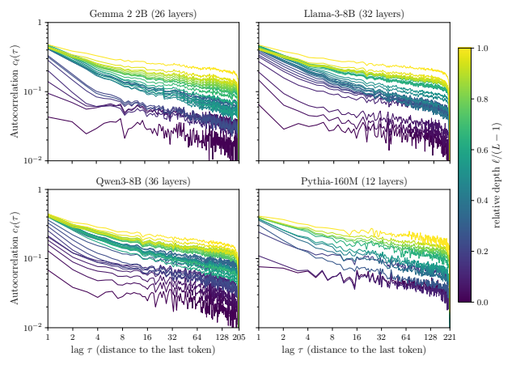
Figure 18 : Autocorrelationc ℓ(τ)against the lagτfor every layer of Gemma 2 2B, Llama-3-8B, Qwen3-8B and Pythia-160M on The Pile, one curve per layer colored by relative depthℓ/(L−1)(a shared color scale, as the layer counts differ), same vertical range in all panels. The corresponding panel for Gemma 2 9B is Fig. 1b.
出典 · CC BY 4.0 · Francesco Cagnetta, Santiago Acevedo · Deep Latents, Long Memory: Latent persistence explains temporal correlations in transformer activations · 論文の図を引用 · 元のPDFの32ページ目から図の部分を抽出しています。自己相関と潜在変数の持続性の関係
著者らは、活性値を標準化したうえで、位置tとt−τの内積の平均として自己相関cℓ(τ)を定義します。ワンホットのトークン表現では、この値はトークンの同時出現確率の中心化した形になります。線形表現仮説の下では、同じ潜在変数が2つの位置で同じ方向に符号化されているとき、その変数が寄与します。活性値を潜在変数のコードと残差の和として最小二乗回帰すると、自己相関は同じノードが2つの位置で保たれる項、ノード間の交差項、残差項に分かれます。ここで同一ノードの項が持続性を表します。
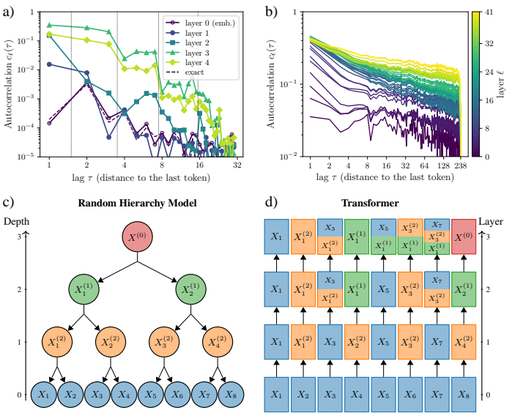
Figure 1 :Neural autocorrelationsc ℓ(τ)(Eq. 1) develop with depth due to persistently encoded abstract latent features. a) 5-block transformer trained on the Random Hierarchy Model (RHM)and evaluated on RHM sentences (dashed: exact token-level curve; dotted: span ends of the latents governing the next token, cf. panel d).b) Pre-trained Gemma 2 9B(Gemma Team et al., 2024) evaluated on The Pile. In both a) and b), deep layers show a slower decay with the lag. c), d)illustrate the relationship between long-range autocorrelations and the persistent encoding of abstract latent features.c)shows our idealised representation of the latent hierarchical structure of natural language data: pairs of adjacent input tokens (blue) are generated by a single, latent parent variable (orange); pairs of adjacent parent variables are generated by a single latent grandparent (green), and so on. Deep latent variables correspond to abstract concepts and influence large portions of the input.d)Deep learning methods reconstruct the data structure layer by layer (Cagnetta et al., 2024; Cagnetta & Wyart, 2024), here illustrated schematically in a deep autoregressive transformer. Each row represents the variables encoded by the activations in a given layer, assuming that layerℓ can only compute latent variables of depthℓ—see the main text for a detailed breakdown. Deeper latent variables emerge in later layers, and persist for longer across context positions: E.g., depth-1 (orange) variables persist for two slots in layers2and3, whereas depth-2variables (green) persist for4slots, but only in layer3. This scheme implies a specific pattern of decay ofc ℓ(τ), highlighted with dotted lines in panel a) and approximately respected by the measured autocorrelations.
出典 · CC BY 4.0 · Francesco Cagnetta, Santiago Acevedo · Deep Latents, Long Memory: Latent persistence explains temporal correlations in transformer activations · 論文の図を引用 · 元のPDFの2ページ目から図の部分を抽出しています。RHMにおける分解と学習段階
合成データとして用いたランダム階層モデルでは潜在変数がすべて既知なので、分解を直接検証できます。5ブロックのGPT-2形式のTransformerを、v=32、m=8、深さ5の条件で学習し、系列長T=32で測定しました。4層の自己相関は、深さ3と4付近の潜在変数の同一ノードの項によって大部分説明され、学習損失が段階ごとの平坦な区間を通過するたびに、自己相関の段差が1つずつ現れました。これは、潜在変数を学習した時点で該当する遅れ区間の相関が現れるという解釈と整合しています。
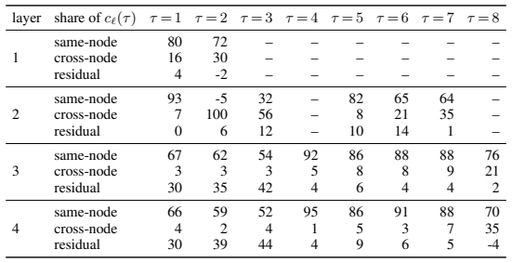
Table 6 :Composition of the autocorrelations of layers 1–4 at lags 1–8.Same-node, cross-node and residual parts of Eq. 7, in percent of the measuredc ℓ(τ)(the three rows of each layer sum to 100). Cells are left blank where the measured value lies within 20 noise floors (Appendix A), as at lag4of layer2, where the terms cancel. The code part is computed from the regression atP= 2 18 and the measurement atP= 2 25.
出典 · CC BY 4.0 · Francesco Cagnetta, Santiago Acevedo · Deep Latents, Long Memory: Latent persistence explains temporal correlations in transformer activations · 論文の図を引用 · 元のPDFの30ページ目から図の部分を抽出しています。自然言語におけるSAE持続時間と相関
自然言語では潜在変数を直接知ることができないため、スパースオートエンコーダ(SAE)の特徴を代理変数として用いました。Gemma 2 2Bと9B、Pythia-160M、Llama-3-8B、Qwen3-8BをWikiTextとThe Pileで測定し、特徴の発火エピソード長ψの中央値と積分自己相関χℓのあいだのピアソン相関は、モデルごとに0.67から0.93の範囲でした。深さとともに2つの値は概ね共に増加しましたが、頻度効果を除外するため、著者らはシーケンスシャッフルと平均トークン除去の実験も行いました。
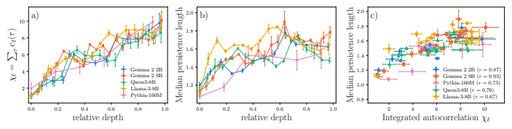
Figure 4 :Panel a): Layer dependence of the integrated autocorrelation for different models (see Eq. 8).Panel b): Layer dependence of the median of the distribution of per-latent persistenciesψ (see Sec. 4).Panel c): Median persistence against the integrated autocorrelationχ ℓ, one point per layer;ris the per-model Pearson correlation. In all panels, error bars show one standard deviation computed from results on the Wikitext and The Pile datasets.
出典 · CC BY 4.0 · Francesco Cagnetta, Santiago Acevedo · Deep Latents, Long Memory: Latent persistence explains temporal correlations in transformer activations · 論文の図を引用 · 元のPDFの8ページ目から図の部分を抽出しています。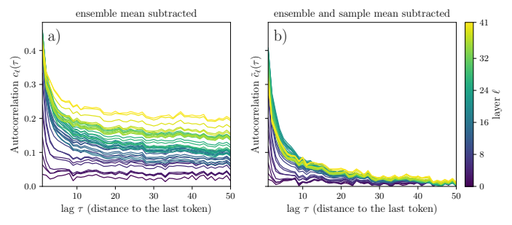
Figure 19 : Autocorrelation of every layer of Gemma 2 9B on The Pile over the first 50 lags, on linear axes, with the position-wise mean over samples subtracted as in Eq. 1 (a) and with the mean token of each sample subtracted as well (b). One curve per layer, same vertical range in both panels, with the vertical axis starting at zero for readability.
出典 · CC BY 4.0 · Francesco Cagnetta, Santiago Acevedo · Deep Latents, Long Memory: Latent persistence explains temporal correlations in transformer activations · 論文の図を引用 · 元のPDFの33ページ目から図の部分を抽出しています。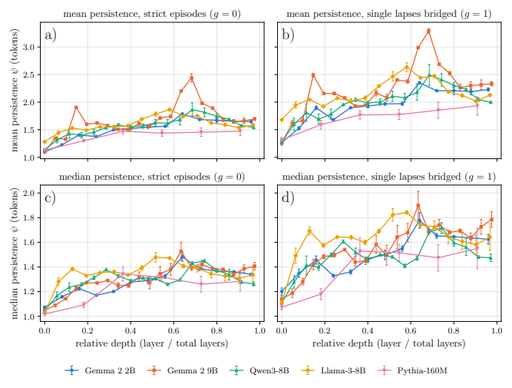
Figure 22 : SAE-latent persistenceψas a function of relative depth for the five models: mean (a, b) and median (c, d) over the 1000 most active latents of each layer, for strict firing episodes (g= 0; a, c) and with single inactive tokens bridged (g= 1; b, d). Markers are the average of The Pile and WikiText, error bars half the difference between the two corpora.
出典 · CC BY 4.0 · Francesco Cagnetta, Santiago Acevedo · Deep Latents, Long Memory: Latent persistence explains temporal correlations in transformer activations · 論文の図を引用 · 元のPDFの36ページ目から図の部分を抽出しています。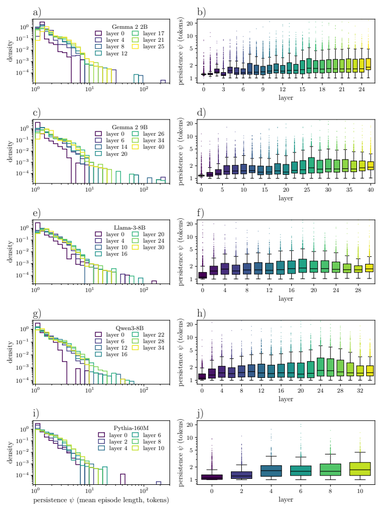
Figure 23 : Distribution of the per-latent persistenceψon The Pile with single inactive tokens bridged (g= 1), over the 1000 most active latents of each layer of Gemma 2 2B (a, b), Gemma 2 9B (c, d), Llama-3-8B (e, f), Qwen3-8B (g, h) and Pythia-160M (i, j). Left column: density on log-log axes at seven layers spread over the depth of each model (layers in the legend). Right column: box plots at every layer of the sweep (median line, interquartile box, whiskers at1.5interquartile ranges, individual dots beyond), with a logarithmic vertical axis cut at 25 tokens. Layers are colored by relative depth on the same scale in both columns.
出典 · CC BY 4.0 · Francesco Cagnetta, Santiago Acevedo · Deep Latents, Long Memory: Latent persistence explains temporal correlations in transformer activations · 論文の図を引用 · 元のPDFの37ページ目から図の部分を抽出しています。持続特徴の除去実験
著者らは、持続的なSAE特徴のデコーダ方向を活性値から射影除去したうえで、発火エピソード内での自己相関の平均変化Δを測定しました。すべての活性特徴を除去しても、ベースラインの相関は完全には消えませんでしたが、著者らはこれをSAEの再構成が不完全であるためと説明しています。
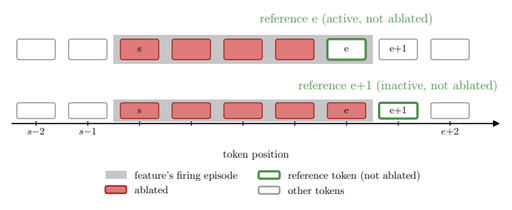
Figure 5 : Scheme of the intervention experiment: In the gray areas, a given SAE-feature of interest is firing.sandedenote the starting and ending token positions of the firing episode. In the upper row, we measure the mean autocorrelations inside the feature’s firing episode, taking as reference the last token of the firing episode, signaled with a green box. Then, we ablate SAE-features of the tokens colored in red using different protocols, and recompute the mean autocorrelation, to quantify how the ablation of SAE-features influences the autocorrelation. Results are reported in Table 1. In the bottom row, we show an example of a control experiment in which the reference token is outside the firing episode, for which the decrease in autocorrelations generated by ablating SAE-features is smaller, since the feature is not active in it.
出典 · CC BY 4.0 · Francesco Cagnetta, Santiago Acevedo · Deep Latents, Long Memory: Latent persistence explains temporal correlations in transformer activations · 論文の図を引用 · 元のPDFの9ページ目から図の部分を抽出しています。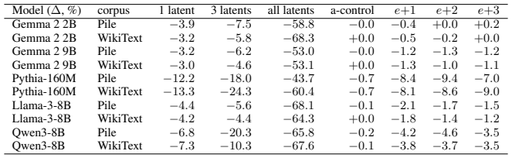
Table 1 : Change∆(Eq. 10) of the mean integrated autocorrelations generated by the ablation of SAE-features, across models and two different corpora, and expressed as a percentage of the value of the baseline correlations in each model. See Fig. 5 for a scheme of the ablation setup, and Sec. 4.2 for the full discussion about the experiment. Columns: the chosen persistent latent; it plus its two most persistent co-active latents; every active feature latent using the SAE’s intermediate representation; an active but non-persistent latent (a-control); and the latent itself with the reference moved toe+1,e+2ande+3token positions, where the latent of interest was not found to be active.
出典 · CC BY 4.0 · Francesco Cagnetta, Santiago Acevedo · Deep Latents, Long Memory: Latent persistence explains temporal correlations in transformer activations · 論文の図を引用 · 元のPDFの10ページ目から図の部分を抽出しています。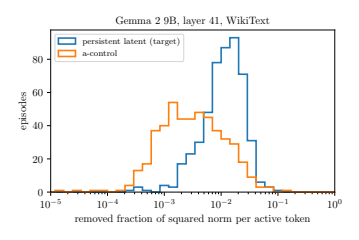
Figure 26 : Removed fraction of squared norm, Eq. 24, averaged over the ablated positions at which the latent is active, for the persistent latent and the a-control of Table 1. Gemma 2 9B, layer 41, WikiText, 500 episodes; activations centred by the layer mean, as in the ablation experiment.
出典 · CC BY 4.0 · Francesco Cagnetta, Santiago Acevedo · Deep Latents, Long Memory: Latent persistence explains temporal correlations in transformer activations · 論文の図を引用 · 元のPDFの39ページ目から図の部分を抽出しています。残された課題
論文が述べているとおり、自己相関は活性値の幾何学的な観測であり、出力機能を直接測定するものではありません。また、SAE特徴は潜在変数の不完全な代理であり、再構成の説明分散は0.7以上ですが、完全ではありません。合成実験は単一の文法と単一の学習実行で得られた結果であり、自然言語実験はSAEが提供されている5つのモデルに限られます。著者らは、自己相関と入力摂動に対する線形応答の関係はまだ確立されていないと考えています。
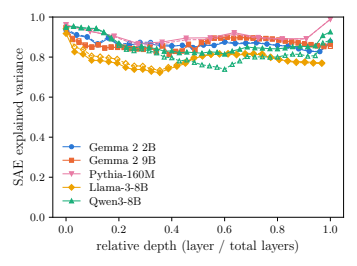
Figure 24 : SAE explained variance, Eq. 23, as a function of relative depth for the five models, on The Pile (filled markers, solid lines) and WikiText (hollow markers, dashed lines), 300 samples per corpus, massive-activation tokens excluded as described in the text.
出典 · CC BY 4.0 · Francesco Cagnetta, Santiago Acevedo · Deep Latents, Long Memory: Latent persistence explains temporal correlations in transformer activations · 論文の図を引用 · 元のPDFの38ページ目から図の部分を抽出しています。論文情報
- 著者
- Francesco Cagnetta, Santiago Acevedo
- 学会・ジャーナル
- arXiv · プレプリント
- 公開日
- 2026年11月13日
- 登録日
- 2026年11月16日
- 更新日
- 2026年11月13日
- バージョン
- v1
- arXiv
- 2611.18089
- カテゴリ
- cs.LG · cs.CL
- ライセンス
- CC BY 4.0
- 掲載内容
- 論文情報・解説・論文の図
この解説は、Refivuの韓国語解説をAIで翻訳したものです。不正確な翻訳や誤りが含まれる可能性があります。論文と図の利用条件は各出典に従います。
アブストラクト
The hidden layers of Large Language Models (LLMs) are believed to encode representations of the data whose abstraction increases with depth. However, in the absence of an operational notion of abstraction, this statement is hard to test quantitatively. Here, we propose an alternative view, building on the principle that the correlations of a sequence reflect the structure of the process that generated it. We define the autocorrelation function of a layer as the average dot product between its activations at two context positions separated by a lag. Latent variables encoded persistently along the context create slowly decaying tails in the autocorrelation, and we find these tails to grow across layers in both synthetic and natural data. In synthetic data with controlled hierarchical latent structure, this growth stems from the encoding of abstract latent variables, which govern long stretches of the input. Indeed, the persistence of latent codes predicts the qualitative structure of autocorrelations and accounts for most of the empirical measures. In real text, we take sparse-autoencoder features as proxies for latent variables, and find that their persistence correlates strongly with the magnitude of autocorrelations across datasets and LLMs. In particular, the persistence time increases with depth, as do autocorrelations, implying that deeper latent features persist for longer context spans. We complement this analysis by explicitly ablating the persistent sparse-autoencoder features and observing a consequent decrease in the autocorrelations.
この論文を引用
Francesco Cagnetta, Santiago Acevedo (2026). Deep Latents, Long Memory: Latent persistence explains temporal correlations in transformer activations. arXiv:2611.18089v1. https://arxiv.org/abs/2611.18089v1
BibTeX
@misc{cagnetta2026deep,
  title = {{Deep Latents, Long Memory: Latent persistence explains temporal correlations in transformer activations}},
  author = {Francesco Cagnetta and Santiago Acevedo},
  year = {2026},
  eprint = {2611.18089},
  archivePrefix = {arXiv},
  url = {https://arxiv.org/abs/2611.18089v1}
}