論文解説
Agent-as-a-Judge
- 課題 固定された文脈だけを見るLLM判定者は、外部の状態や事実の証拠が必要な評価では限界があります。
- 手法 判定の過程に検査と結果の利用を組み込み、多エージェント協業、ツール統合、メモリ、計画の4つの軸で設計空間を整理しています。
- 結果 RM-Benchでは、TIR-Judgeだけが非エージェント型の推論報酬モデルを明確に上回りました。JudgeBenchでは、強い非エージェント型モデルが最良のエージェント型の項目と同等か、わずかに高い結果でした。
固定文脈による判定の限界
LLM-as-a-Judgeは、評価対象と与えられた文脈だけを読んで、スコアや選好、批評を出します。エージェントの軌跡やコード実行結果のように、判定に必要な証拠が入力の外にある環境の状態に置かれている場合、こうした受動的な判定者はその証拠を直接得られません。また、判定者のパラメータ知識にない事実の主張は、外部の参照なしでは確かめにくいです。本論文では、このような状況で判定者が証拠を探し、判定の根拠を更新する仕組みをAgent-as-a-Judgeとして整理しています。
本論文は、この概念の範囲を、評価を目的とした検査の作業と、その結果を判定に使う手続きに限定しています。複数のペルソナが同じスコアを繰り返したり、投票だけを行ったりする構成は、この定義には含まれません。
4つの設計軸
本論文は、Agent-as-a-Judgeの設計空間を、多エージェント協業、ツール統合、メモリ、計画の4つの軸に分けています。多エージェント協業では、検査の作業と判定の権限を複数の評価者に分け、討論や並列検証の後に結果をまとめます。ツール統合は、実行、検索、視覚モデルなどのインターフェースを通じて、判定に使う観測を得ます。
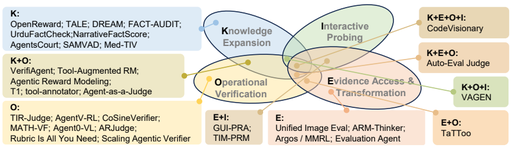
Figure 7 :Functional view of tool use inAgent-as-a-Judge. Four overlapping regions show that judges can chain multiple tool roles within one evaluation.
出典 · CC BY 4.0 · Runyang You, Hongru Cai, Caiqi Zhang, Qiancheng Xu, Meng Liu, Tiezheng Yu, Yongqi Li, Wenjie Li · Agent-as-a-Judge · 論文の図を引用 · 元のPDFの8ページ目から図の部分を抽出しています。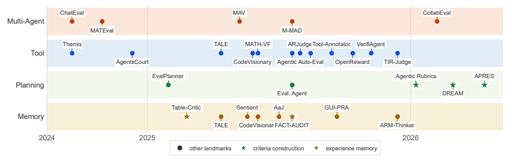
Figure 10 :Representative adoption timeline of the four methodological mechanisms inAgent-as-a-Judge. A method may appear in more than one lane when it instantiates multiple mechanisms. Stars mark two sparse patterns discussed in the text: rubric construction on Planning and experience memory on Memory.
出典 · CC BY 4.0 · Runyang You, Hongru Cai, Caiqi Zhang, Qiancheng Xu, Meng Liu, Tiezheng Yu, Yongqi Li, Wenjie Li · Agent-as-a-Judge · 論文の図を引用 · 元のPDFの11ページ目から図の部分を抽出しています。メモリは、評価の状態を書き込み、管理し、読み出すという循環として説明されています。計画では、何を検査するか、どの経路で証拠を集めるかを明示します。本論文は、この4つの軸を互いに組み合わせられると考えています。
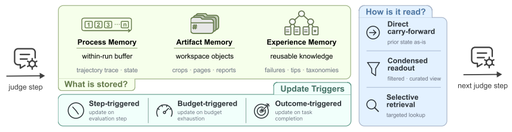
Figure 8 :Memory inAgent-as-a-Judgecan be analyzed as a write–manage–read loop over evaluation state. The stored state may take the form of process memory, artifact memory, or experience memory. Later judgments either receive this state directly, access a filtered or summarized form, or target specific artifacts, failures, or templates through retrieval.
出典 · CC BY 4.0 · Runyang You, Hongru Cai, Caiqi Zhang, Qiancheng Xu, Meng Liu, Tiezheng Yu, Yongqi Li, Wenjie Li · Agent-as-a-Judge · 論文の図を引用 · 元のPDFの9ページ目から図の部分を抽出しています。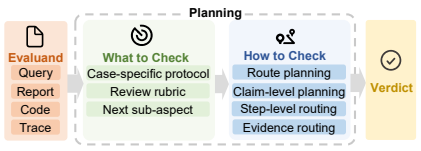
Figure9 :Planning inAgent-as-a-Judgesystems can externalize either what to check or how to gather proof before the verdict.
出典 · CC BY 4.0 · Runyang You, Hongru Cai, Caiqi Zhang, Qiancheng Xu, Meng Liu, Tiezheng Yu, Yongqi Li, Wenjie Li · Agent-as-a-Judge · 論文の図を引用 · 元のPDFの10ページ目から図の部分を抽出しています。報酬モデルのベンチマーク比較
本論文では、RewardBench、RM-Bench、JudgeBenchにおけるエージェント型判定者と非エージェント型の推論報酬モデルの公開スコアを集めて比較しています。本論文によると、多くの原論文は3つのベンチマークすべてを評価していないため、欠けている項目は公開されているソースコードで再現しました。
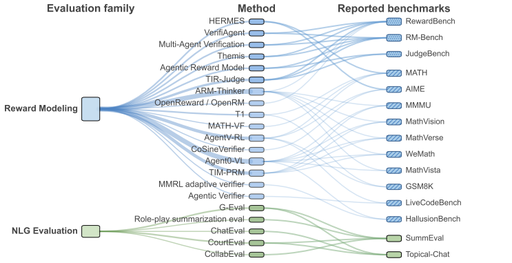
Figure 11 :Evaluation–benchmark coverage map. Links indicate that a method reports results on, or is explicitly evaluated on, a reported benchmark. Right-node fill and pattern encode benchmark artifact type:••• fixed response or judgment sets packaged for direct comparison; /// task problems whose reported results require candidate generation before judging; and green nodes, NLG evaluation datasets.
出典 · CC BY 4.0 · Runyang You, Hongru Cai, Caiqi Zhang, Qiancheng Xu, Meng Liu, Tiezheng Yu, Yongqi Li, Wenjie Li · Agent-as-a-Judge · 論文の図を引用 · 元のPDFの12ページ目から図の部分を抽出しています。RM-Benchでは、TIR-Judgeだけが非エージェント型の推論報酬モデルを明確に上回りました。JudgeBenchでは、強い非エージェント型モデルが最良のエージェント型の項目と同等か、わずかに高い結果でした。多くのエージェント型判定者はそれより低い結果にとどまりました。著者らは、この結果は固定された応答ペアに対する選好および推論中心の報酬学習の効果とも関係すると解釈しています。
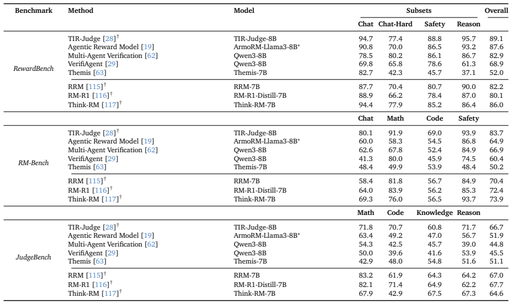
Table 3 :Local reward-model results on shared judge-quality benchmarks.
出典 · CC BY 4.0 · Runyang You, Hongru Cai, Caiqi Zhang, Qiancheng Xu, Meng Liu, Tiezheng Yu, Yongqi Li, Wenjie Li · Agent-as-a-Judge · 論文の図を引用 · 元のPDFの14ページ目から図の部分を抽出しています。固定ベンチマーク比較の限界
本論文は、このような固定アーティファクトのベンチマーク比較では、テスト時の選択、下流タスクの学習、証拠探索それぞれの寄与を十分に切り分けられないと説明しています。ベンチマークの点数が高くても、テスト時の選択や下流での学習性能の向上を予測できない場合がある点も示しています。そのため、能動的な証拠探索の信頼性を確かめるには専用の評価が必要だと、本論文は主張しています。
論文情報
- 著者
- Runyang You, Hongru Cai, Caiqi Zhang, Qiancheng Xu, Meng Liu, Tiezheng Yu, Yongqi Li, Wenjie Li
- 学会・ジャーナル
- arXiv · プレプリント
- 公開日
- 2026年11月13日
- 登録日
- 2026年11月16日
- 更新日
- 2026年11月13日
- バージョン
- v1
- arXiv
- 2611.18067
- カテゴリ
- cs.CL
- ライセンス
- CC BY 4.0
- 掲載内容
- 論文情報・解説・論文の図
この解説は、Refivuの韓国語解説をAIで翻訳したものです。不正確な翻訳や誤りが含まれる可能性があります。論文と図の利用条件は各出典に従います。
アブストラクト
Artificial intelligence has progressed from task-specific systems toward general models spanning perception, generation, reasoning, and autonomous interaction, making reliable evaluation essential for comparison, deployment, and post-training feedback. At scale, modern evaluation pipelines increasingly rely on LLM-as-a-Judge to produce scores, preferences, and critiques; in its fixed-context setting, the judge relies on the supplied evaluand and evaluation materials. Yet a reliable verdict may require evidence beyond the supplied evaluand and context---either because critical environmental states remain unrecorded in the static execution log, or because controversial factual claims require external verification. Passive judges cannot obtain that missing evidence before deciding, especially when evaluating agent trajectories, executable artifacts, or domain-specific reports. Recent work therefore develops active evaluators that seek missing evidence and update their grounds for judgment before deciding. We bring these advances together through Agent-as-a-Judge, focusing on how evaluators construct and control checking processes within the broader LLM-based judging landscape. We define the scope through evaluation-directed checks and the use of their results, covering both structured workflows and observation-driven control. We organize the design space by multi-agent collaboration, tool integration, memory, and planning, and show how these mechanisms supply the checks and evidence on which a verdict rests. We consolidate published scores and reproduce missing entries for key agentic judges; the comparison reveals uneven agentic gains and motivates dedicated agentic evaluation. We conclude by characterizing application demands and open challenges in cost, reliability, safety, and governance that condition trusted deployment of agentic judges at scale.
この論文を引用
Runyang You, Hongru Cai, Caiqi Zhang, Qiancheng Xu, Meng Liu, Tiezheng Yu, Yongqi Li, Wenjie Li (2026). Agent-as-a-Judge. arXiv:2611.18067v1. https://arxiv.org/abs/2611.18067v1
BibTeX
@misc{you2026agent,
  title = {{Agent-as-a-Judge}},
  author = {Runyang You and Hongru Cai and Caiqi Zhang and Qiancheng Xu and Meng Liu and Tiezheng Yu and Yongqi Li and Wenjie Li},
  year = {2026},
  eprint = {2611.18067},
  archivePrefix = {arXiv},
  url = {https://arxiv.org/abs/2611.18067v1}
}