論文解説
Explanations that Transfer: Interpreting Medical Retrieval with Sparse AutoEncoders
説明が転移するとき:Sparse AutoEncoderによる医療検索の解釈
- 課題 医療検索の埋め込みは内部が不透明で、特定のデータに合わせたファインチューニングは新しいコーパスへ移しにくいです。
- 手法 固定した埋め込みの上にTopK Sparse AutoEncoderを学習し、再構成損失にInfoNCEの対照損失を加えます。
- 結果 CUREでは、BGEの元の埋め込みの53.06を、dense SAEで61.87まで高めました。スパース設定は、分布外のR2MEDでおおむねdenseより低くなりませんでした。
医療検索のブラックボックス問題
医療AIが質問に答えるには、大規模な文書集合から知識を検索する必要があります。埋め込みモデルを医療データでファインチューニングすると検索の関連性を高められますが、その結果を生む密な埋め込みは、ほとんどの場合解釈が困難です。また、特定の医療データセットに合わせたモデルは、新しい臨床コーパスに移すと性能が落ちるおそれがあります。この論文はこの2つの問題を合わせて扱い、密なテキスト埋め込みにスパースオートエンコーダを適用することで、検索性能を保ちながら意味を読める特徴を得ようとしています。
TopKスパースオートエンコーダと対照損失
手法は、固定された埋め込みモデルが作った質問と文書の埋め込みを入力として受け取るところから始まります。SAEのエンコーダは入力をより大きな次元の潜在ベクトルに変換し、TopKで値の大きいk個のニューロンだけを残して、スパースなコードを作ります。学習目標は、再構成損失L_recとInfoNCE損失L_NCEを重み付き和にしたL=L_rec+λL_NCEです。InfoNCEは、質問と関連文書のスパースコードを近づけ、無関係な文書を遠ざけます。そのため、再構成だけでは失われやすい検索の関連性を保ちやすくなります。検索時には、質問を同じ手順で符号化し、文書のスパースコードとのコサイン類似度で順位を付けます。
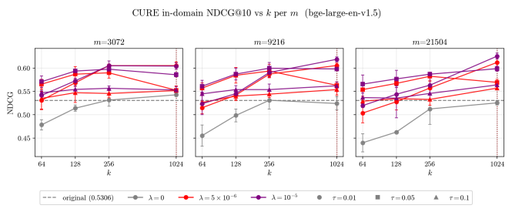
Figure 3 : CURE performance across hyperparameters - BGE embeddings. Retrieval performance (NDCG@10) is shown for different contrastive loss weightsλand InfoNCE temperaturesτ.
出典 · CC BY 4.0 · Bouchacourt, Diane, Brison, Gaëtan · Explanations that Transfer: Interpreting Medical Retrieval with Sparse AutoEncoders · 論文の図を引用 · 元のPDFの13ページ目から図の部分を抽出しています。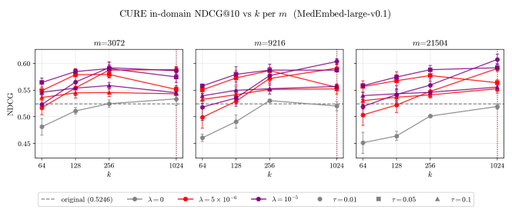
Figure 4 : CURE performance across hyperparameters - MedEmbed embedder. Retrieval performance (NDCG@10) is shown for different contrastive loss weightsλand InfoNCE temperaturesτ.
出典 · CC BY 4.0 · Bouchacourt, Diane, Brison, Gaëtan · Explanations that Transfer: Interpreting Medical Retrieval with Sparse AutoEncoders · 論文の図を引用 · 元のPDFの14ページ目から図の部分を抽出しています。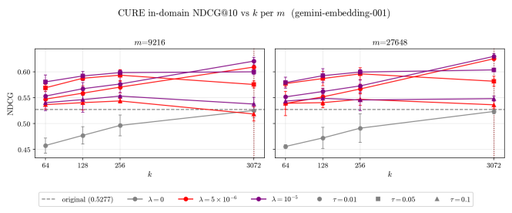
Figure 5 : CURE performance across hyperparameters - Gemini embedder. Retrieval performance (NDCG@10) is shown for different contrastive loss weightsλand InfoNCE temperaturesτ.
出典 · CC BY 4.0 · Bouchacourt, Diane, Brison, Gaëtan · Explanations that Transfer: Interpreting Medical Retrieval with Sparse AutoEncoders · 論文の図を引用 · 元のPDFの14ページ目から図の部分を抽出しています。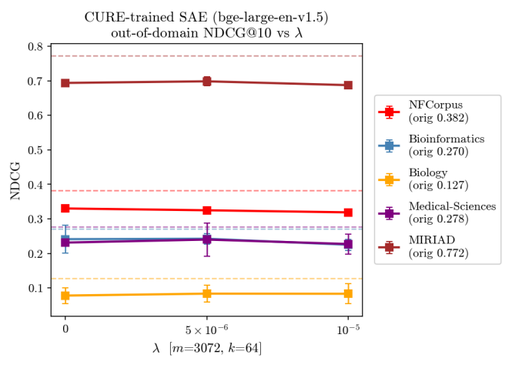
Figure 8 : OOD performance, fixedk= 64, comparing the effect ofλ- BGE embeddings.
出典 · CC BY 4.0 · Bouchacourt, Diane, Brison, Gaëtan · Explanations that Transfer: Interpreting Medical Retrieval with Sparse AutoEncoders · 論文の図を引用 · 元のPDFの16ページ目から図の部分を抽出しています。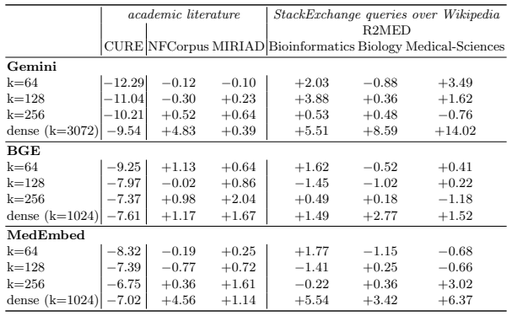
Table 8 : NDCG@10 (%) withλ= 0 minus that of the val-selectedλof Table 1, both means over seeds. Negative:λ= 0 is worse.k: active SAE latents;dense:kequals the embedding’s native dimension.
出典 · CC BY 4.0 · Bouchacourt, Diane, Brison, Gaëtan · Explanations that Transfer: Interpreting Medical Retrieval with Sparse AutoEncoders · 論文の図を引用 · 元のPDFの19ページ目から図の部分を抽出しています。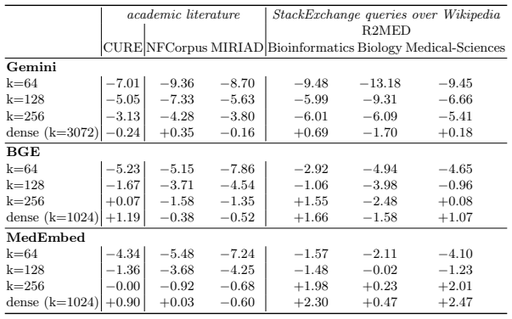
Table 9 : NDCG@10 (%) withλ= 0 minus the original embedding’s, means over seeds. Positive: the SAE beats the original.k: active SAE latents;dense:kequals the embedding’s native dimension.
出典 · CC BY 4.0 · Bouchacourt, Diane, Brison, Gaëtan · Explanations that Transfer: Interpreting Medical Retrieval with Sparse AutoEncoders · 論文の図を引用 · 元のPDFの19ページ目から図の部分を抽出しています。CUREでの学習と分布外評価
CUREのコーパスでSAEを学習し、MIRIAD、NFCorpus、R2MEDの3つの部分集合を、学習に使わなかった分布外データセットとして評価しました。埋め込みモデルはbge-large-en-v1.5、MedEmbed-large-v0.1、gemini-embedding-001の3つを比較し、指標はNDCG@10です。複数のシードの平均と95%信頼区間もあわせて報告しています。実験では、スパース性の度合いを表すkと潜在次元mを変えて結果を比べました。
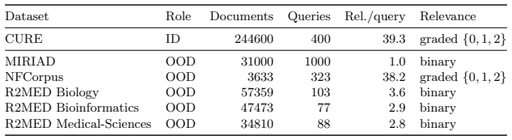
Table 4 : Our benchmark datasets.Documentsdenotes the number of distinct documents in the corpus; Queriesrefers to the number of queries andRel./querythe number of relevant documents per query. ID = in- domain (the SAE is trained on this corpus), whereas OOD = held out. All queries are English.
出典 · CC BY 4.0 · Bouchacourt, Diane, Brison, Gaëtan · Explanations that Transfer: Interpreting Medical Retrieval with Sparse AutoEncoders · 論文の図を引用 · 元のPDFの13ページ目から図の部分を抽出しています。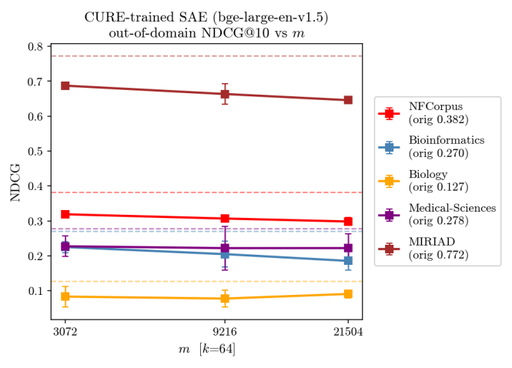
Figure 7 : OOD performance, fixedk= 64, comparing the effect ofm- BGE embeddings.
出典 · CC BY 4.0 · Bouchacourt, Diane, Brison, Gaëtan · Explanations that Transfer: Interpreting Medical Retrieval with Sparse AutoEncoders · 論文の図を引用 · 元のPDFの15ページ目から図の部分を抽出しています。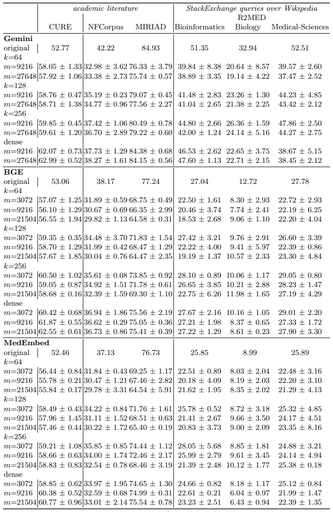
Table 7 : NDCG@10 (%), mean±95% CI over seeds, for every (k,m) pair.dense:kequals the embedding’s native dimension. Remaining hyperparameters are chosen per cell by the best average validation NDCG@10.
出典 · CC BY 4.0 · Bouchacourt, Diane, Brison, Gaëtan · Explanations that Transfer: Interpreting Medical Retrieval with Sparse AutoEncoders · 論文の図を引用 · 元のPDFの18ページ目から図の部分を抽出しています。スパース性と検索性能の関係
CUREでは、BGEの元の埋め込みが53.06、dense SAEが61.87でした。すべての埋め込みモデルで、k=128と256はCUREにおけるdense性能の少なくとも94%を達成しました。一方、R2MEDの3つの部分集合では、dense側の容量が多くの場合利益をもたらさず、スパースモデルが同等かそれ以上になることが多くありました。GeminiのCUREでは、dense(k=3072)が62.07で、元の52.77を上回りました。著者らは、この結果を、大きな容量は学習ドメインにはよく合うものの、遠く離れたコーパスへの汎化を損なうおそれがある結果と解釈しています。
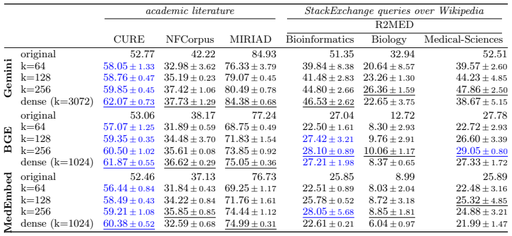
Table 1 : NDCG@10 (%), mean±95% CI over seeds.k: active SAE latents per embedding.dense:kequals the embedding’s native dimension. Bestkunderlined. Blue: beats the original embedding.
出典 · CC BY 4.0 · Bouchacourt, Diane, Brison, Gaëtan · Explanations that Transfer: Interpreting Medical Retrieval with Sparse AutoEncoders · 論文の図を引用 · 元のPDFの6ページ目から図の部分を抽出しています。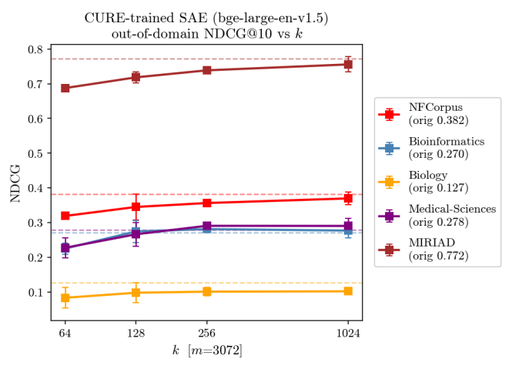
Figure 6 : OOD performance, fixedm= 3072, comparing the effect ofk- BGE embeddings.
出典 · CC BY 4.0 · Bouchacourt, Diane, Brison, Gaëtan · Explanations that Transfer: Interpreting Medical Retrieval with Sparse AutoEncoders · 論文の図を引用 · 元のPDFの15ページ目から図の部分を抽出しています。ニューロン解釈の転移
ニューロンの解釈は、CUREだけで作ったTF-IDFの用語、Interpreter LLMの説明、スニペットの3種類です。この解釈を変更せずに分布外のテキストに適用し、Activation Prediction LLMにニューロンが活性化する確率を予測させました。BGEベースのSAE(k=64)では、TF-IDFのPearson相関はCUREで0.439、Interpreter LLMは0.440で、分布外でも正の相関が保たれました。活性予測の性能と検索のNDCG@10の相関は、5つの分布外コーパスで0.69から0.94の範囲でした。
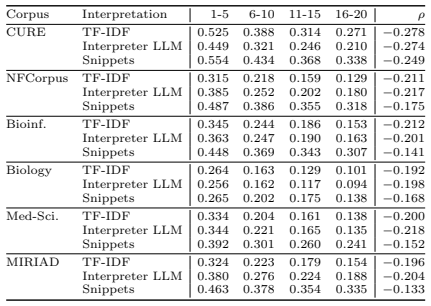
Table 13 : Mean predicted probability onpositive evaluation texts, split by the neuron’s activation rank on the scored text, for the BGE-trained SAE. Every text here is labelled positive (the neuron is among the text’s 20 strongest features); the Activation Pre- dictor is shown neither the rank nor any activation value for that text.ρ: Spearman between rank and predicted probability, negative because rank 1 is the strongest.
出典 · CC BY 4.0 · Bouchacourt, Diane, Brison, Gaëtan · Explanations that Transfer: Interpreting Medical Retrieval with Sparse AutoEncoders · 論文の図を引用 · 元のPDFの25ページ目から図の部分を抽出しています。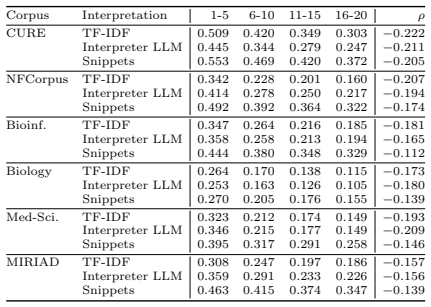
Table 14 : As Table 13, for the Gemini-trained SAE.
出典 · CC BY 4.0 · Bouchacourt, Diane, Brison, Gaëtan · Explanations that Transfer: Interpreting Medical Retrieval with Sparse AutoEncoders · 論文の図を引用 · 元のPDFの25ページ目から図の部分を抽出しています。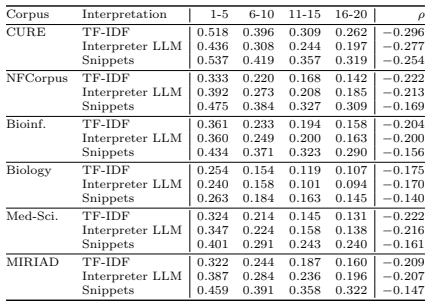
Table 15 : As Table 13, for the MedEmbed-trained SAE.
出典 · CC BY 4.0 · Bouchacourt, Diane, Brison, Gaëtan · Explanations that Transfer: Interpreting Medical Retrieval with Sparse AutoEncoders · 論文の図を引用 · 元のPDFの26ページ目から図の部分を抽出しています。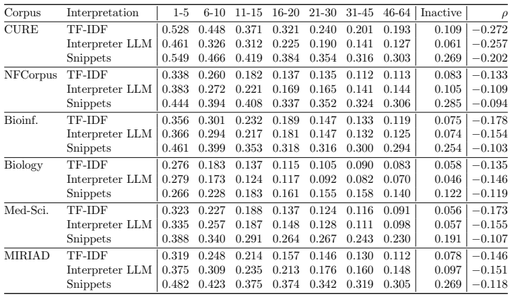
Table 16 : As Table 13, on all ranks 1-64.
出典 · CC BY 4.0 · Bouchacourt, Diane, Brison, Gaëtan · Explanations that Transfer: Interpreting Medical Retrieval with Sparse AutoEncoders · 論文の図を引用 · 元のPDFの27ページ目から図の部分を抽出しています。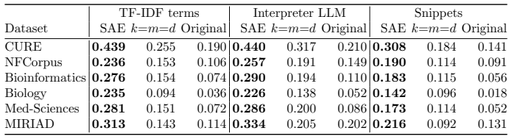
Table 17 : Activation prediction results results to gauge interpretability ofk=m=dand original embed- dings baselines, versus SAE for the BGE embeddings. Pearson correlations between LLM probability and groundtruth (positive or negative).
出典 · CC BY 4.0 · Bouchacourt, Diane, Brison, Gaëtan · Explanations that Transfer: Interpreting Medical Retrieval with Sparse AutoEncoders · 論文の図を引用 · 元のPDFの27ページ目から図の部分を抽出しています。専門家による評価結果
5人の医療専門家が、30個のニューロンとテキストの組を4段階の尺度で評価しました。平均予測と実際の活性ラベルのPearson相関は0.81、AUROCは0.92で、27件のテキストを正しく分類しました。この評価は小規模であり、著者らも大規模な臨床医による注釈研究が今後の課題だと述べています。
スパース表現の限界
スパース表現は、すべてのデータセットでdense検索性能と一致しませんでした。CUREでファインチューニングしたモデルは、分布外コーパスの多くで元の埋め込みより性能が下がりました。解釈評価はLLMに依存するため、バイアスや較正誤差がある可能性があり、複数のLLMで確認しました。専門家評価の規模も小さいです。
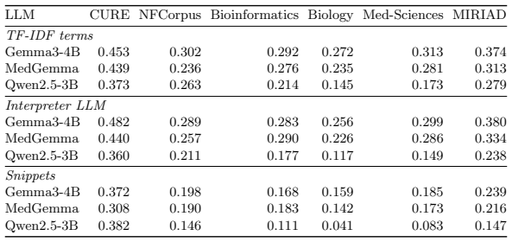
Table 18 : Activation Prediction with three LLMs (Gemma3-4B, MedGemma, Qwen2.5-3B):ris the Pearson correlation of the predicted probability with the ground truth (positive/negative), averaged over the neurons every interpretation type scored.
出典 · CC BY 4.0 · Bouchacourt, Diane, Brison, Gaëtan · Explanations that Transfer: Interpreting Medical Retrieval with Sparse AutoEncoders · 論文の図を引用 · 元のPDFの28ページ目から図の部分を抽出しています。論文情報
- 著者
- Bouchacourt, Diane, Brison, Gaëtan
- 学会・ジャーナル
- arXiv · プレプリント
- 公開日
- 2026年11月13日
- 登録日
- 2026年11月16日
- 更新日
- 2026年11月13日
- バージョン
- v1
- arXiv
- 2611.18179
- カテゴリ
- cs.IR · cs.LG
- ライセンス
- CC BY 4.0
- 掲載内容
- 論文情報・解説・論文の図
この解説は、Refivuの韓国語解説をAIで翻訳したものです。不正確な翻訳や誤りが含まれる可能性があります。論文と図の利用条件は各出典に従います。
アブストラクト
Medical AI systems that answer users' queries rely on retrieving medical knowledge from large document collections. In this context, finetuning general models on medical datasets can improve retrieval relevance. Yet the dense embeddings underlying modern retrieval systems remain largely opaque, making it difficult to understand the mechanics behind their results. Moreover, adapting to a specific medical dataset risks losing transferability to new clinical corpora. In this work, we tackle these issues by applying Sparse Autoencoders (SAEs) to medical information retrieval, transforming dense text embeddings into semantically interpretable representations. To do so, our model combines a reconstruction objective with an InfoNCE contrastive loss that directly preserves query-document relevance. We evaluate three embedding models across six medical retrieval datasets, both in-domain and out-of-domain. Trained on a medical corpus, our sparse codes improve in-domain retrieval over the original embeddings, and lose less out-of-domain performance than their dense counterparts, especially when the target corpus is distant from the training one. Importantly, our experiments show that the method yields interpretable features whose semantic content can be inferred from the queries and documents that activate them most strongly. The interpretation of these features sheds light on why a particular document was retrieved, and transfers beyond the training distribution.
この論文を引用
Bouchacourt, Diane, Brison, Gaëtan (2026). Explanations that Transfer: Interpreting Medical Retrieval with Sparse AutoEncoders. arXiv:2611.18179v1. https://arxiv.org/abs/2611.18179v1
BibTeX
@misc{diane2026explanations,
  title = {{Explanations that Transfer: Interpreting Medical Retrieval with Sparse AutoEncoders}},
  author = {Bouchacourt, Diane and Brison, Gaëtan},
  year = {2026},
  eprint = {2611.18179},
  archivePrefix = {arXiv},
  url = {https://arxiv.org/abs/2611.18179v1}
}