논문 해설
Explanations that Transfer: Interpreting Medical Retrieval with Sparse AutoEncoders
전이되는 설명: Sparse AutoEncoder로 의료 검색 해석하기
- 연구 문제 의료 검색 임베딩은 내부가 불투명하고 특정 데이터에 맞춘 미세 조정은 새로운 코퍼스로 옮겨 가기 어렵습니다.
- 연구 방법 TopK 희소 오토인코더를 고정 임베딩 위에 학습하고, 재구성 손실에 InfoNCE 대조 손실을 더합니다.
- 주요 결과 CURE에서 BGE 기준 원본 53.06을 dense SAE 61.87로 높였고, 희소 설정은 분포 외 R2MED에서 대체로 dense보다 떨어지지 않는 결과를 보였습니다.
의료 검색의 블랙박스 문제
의료 AI가 질문에 답하려면 대규모 문서 모음에서 지식을 검색해야 합니다. 임베딩 모델을 의료 데이터로 미세 조정하면 검색 관련성을 높일 수 있지만, 그 결과를 만드는 밀집 임베딩은 대부분 해석하기 어렵습니다. 또한 특정 의료 데이터셋에 맞춘 모델은 새로운 임상 코퍼스로 옮겨 갈 때 성능이 떨어질 위험이 있습니다. 이 논문은 이 두 문제를 함께 다루며, 희소 오토인코더를 밀집 텍스트 임베딩에 적용하여 검색 성능을 유지하면서 의미를 읽을 수 있는 특징을 얻으려 합니다.
TopK 희소 오토인코더와 대조 손실
방법은 고정된 임베딩 모델이 만든 질의와 문서 임베딩을 입력으로 받는 것에서 시작합니다. SAE 인코더는 입력을 더 큰 차원의 잠재 벡터로 바꾸고 TopK로 값이 큰 k개의 뉴런만 남겨 희소 코드를 만듭니다. 학습 목표는 재구성 손실 L_rec와 InfoNCE 손실 L_NCE를 가중합한 L=L_rec+λL_NCE입니다. InfoNCE는 질의와 관련 문서의 희소 코드를 가깝게 하고 관련 없는 문서를 밀어내므로, 재구성만 할 때 잃기 쉬운 검색 관련성을 보존하도록 돕습니다. 검색 시에는 질의를 같은 방식으로 인코딩한 뒤 문서 희소 코드와 코사인 유사도로 순위를 매깁니다.
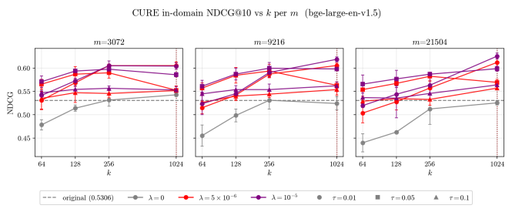
Figure 3 : CURE performance across hyperparameters - BGE embeddings. Retrieval performance (NDCG@10) is shown for different contrastive loss weightsλand InfoNCE temperaturesτ.
원문 · CC BY 4.0 · Bouchacourt, Diane, Brison, Gaëtan · Explanations that Transfer: Interpreting Medical Retrieval with Sparse AutoEncoders · 원문 그림 인용 · 원본 PDF 13쪽에서 그림 영역을 추출했습니다.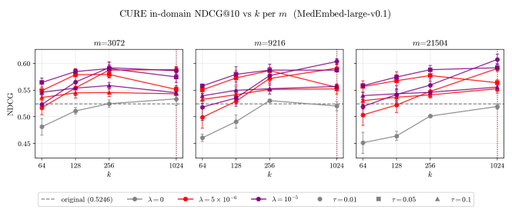
Figure 4 : CURE performance across hyperparameters - MedEmbed embedder. Retrieval performance (NDCG@10) is shown for different contrastive loss weightsλand InfoNCE temperaturesτ.
원문 · CC BY 4.0 · Bouchacourt, Diane, Brison, Gaëtan · Explanations that Transfer: Interpreting Medical Retrieval with Sparse AutoEncoders · 원문 그림 인용 · 원본 PDF 14쪽에서 그림 영역을 추출했습니다.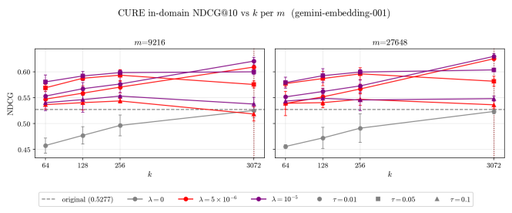
Figure 5 : CURE performance across hyperparameters - Gemini embedder. Retrieval performance (NDCG@10) is shown for different contrastive loss weightsλand InfoNCE temperaturesτ.
원문 · CC BY 4.0 · Bouchacourt, Diane, Brison, Gaëtan · Explanations that Transfer: Interpreting Medical Retrieval with Sparse AutoEncoders · 원문 그림 인용 · 원본 PDF 14쪽에서 그림 영역을 추출했습니다.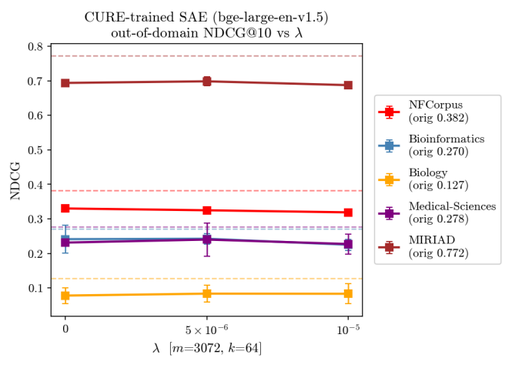
Figure 8 : OOD performance, fixedk= 64, comparing the effect ofλ- BGE embeddings.
원문 · CC BY 4.0 · Bouchacourt, Diane, Brison, Gaëtan · Explanations that Transfer: Interpreting Medical Retrieval with Sparse AutoEncoders · 원문 그림 인용 · 원본 PDF 16쪽에서 그림 영역을 추출했습니다.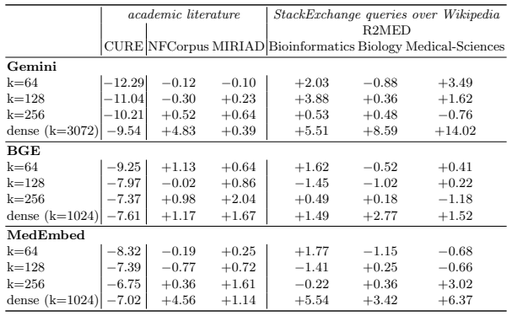
Table 8 : NDCG@10 (%) withλ= 0 minus that of the val-selectedλof Table 1, both means over seeds. Negative:λ= 0 is worse.k: active SAE latents;dense:kequals the embedding’s native dimension.
원문 · CC BY 4.0 · Bouchacourt, Diane, Brison, Gaëtan · Explanations that Transfer: Interpreting Medical Retrieval with Sparse AutoEncoders · 원문 그림 인용 · 원본 PDF 19쪽에서 그림 영역을 추출했습니다.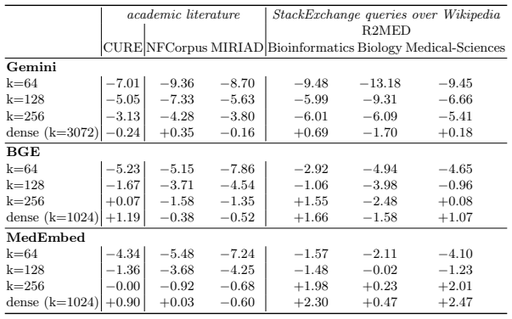
Table 9 : NDCG@10 (%) withλ= 0 minus the original embedding’s, means over seeds. Positive: the SAE beats the original.k: active SAE latents;dense:kequals the embedding’s native dimension.
원문 · CC BY 4.0 · Bouchacourt, Diane, Brison, Gaëtan · Explanations that Transfer: Interpreting Medical Retrieval with Sparse AutoEncoders · 원문 그림 인용 · 원본 PDF 19쪽에서 그림 영역을 추출했습니다.CURE 학습과 분포 외 평가
CURE 코퍼스로 SAE를 학습하고, MIRIAD, NFCorpus, R2MED의 세 부분집합을 학습에 쓰지 않은 분포 외 데이터셋으로 평가했습니다. 임베더는 bge-large-en-v1.5, MedEmbed-large-v0.1, gemini-embedding-001 세 가지를 비교했고, 지표는 NDCG@10입니다. 여러 시드의 평균과 95% 신뢰구간을 함께 보고했습니다. 실험에서는 희소 정도를 나타내는 k와 잠재 차원 m을 바꾸며 결과를 비교했습니다.
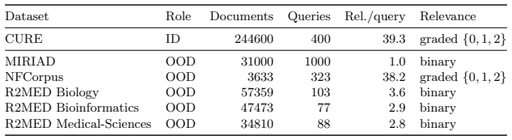
Table 4 : Our benchmark datasets.Documentsdenotes the number of distinct documents in the corpus; Queriesrefers to the number of queries andRel./querythe number of relevant documents per query. ID = in- domain (the SAE is trained on this corpus), whereas OOD = held out. All queries are English.
원문 · CC BY 4.0 · Bouchacourt, Diane, Brison, Gaëtan · Explanations that Transfer: Interpreting Medical Retrieval with Sparse AutoEncoders · 원문 그림 인용 · 원본 PDF 13쪽에서 그림 영역을 추출했습니다.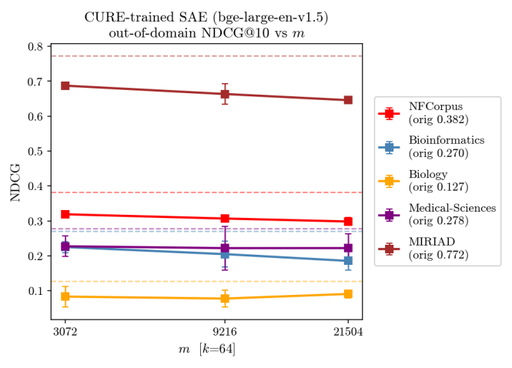
Figure 7 : OOD performance, fixedk= 64, comparing the effect ofm- BGE embeddings.
원문 · CC BY 4.0 · Bouchacourt, Diane, Brison, Gaëtan · Explanations that Transfer: Interpreting Medical Retrieval with Sparse AutoEncoders · 원문 그림 인용 · 원본 PDF 15쪽에서 그림 영역을 추출했습니다.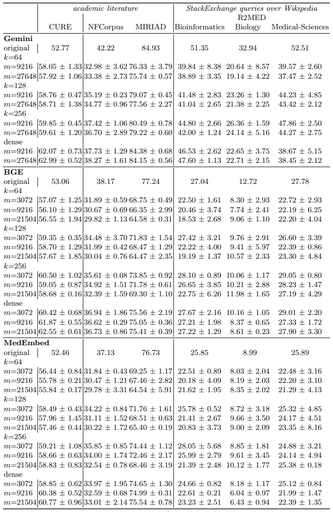
Table 7 : NDCG@10 (%), mean±95% CI over seeds, for every (k,m) pair.dense:kequals the embedding’s native dimension. Remaining hyperparameters are chosen per cell by the best average validation NDCG@10.
원문 · CC BY 4.0 · Bouchacourt, Diane, Brison, Gaëtan · Explanations that Transfer: Interpreting Medical Retrieval with Sparse AutoEncoders · 원문 그림 인용 · 원본 PDF 18쪽에서 그림 영역을 추출했습니다.희소성과 검색 성능의 관계
CURE에서 BGE 기준 원본 임베딩은 53.06, dense SAE는 61.87을 기록했습니다. 모든 임베더에서 k=128과 256은 CURE의 dense 성능의 최소 94%를 달성했습니다. 반면 R2MED의 세 부분집합에서는 dense 용량이 대부분 이득을 주지 못했고, 희소 모델이 같거나 더 나은 경우가 많았습니다. Gemini의 CURE에서는 dense(k=3072)가 62.07로 원본 52.77보다 높았습니다. 저자들은 이를 큰 용량이 학습 도메인에는 잘 맞지만 멀리 떨어진 코퍼스에는 일반화를 해칠 수 있는 결과로 해석합니다.
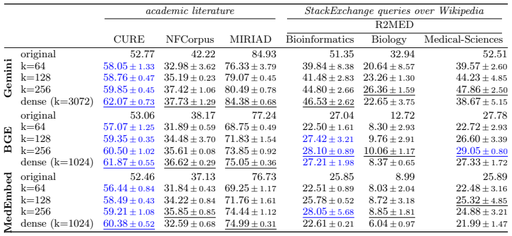
Table 1 : NDCG@10 (%), mean±95% CI over seeds.k: active SAE latents per embedding.dense:kequals the embedding’s native dimension. Bestkunderlined. Blue: beats the original embedding.
원문 · CC BY 4.0 · Bouchacourt, Diane, Brison, Gaëtan · Explanations that Transfer: Interpreting Medical Retrieval with Sparse AutoEncoders · 원문 그림 인용 · 원본 PDF 6쪽에서 그림 영역을 추출했습니다.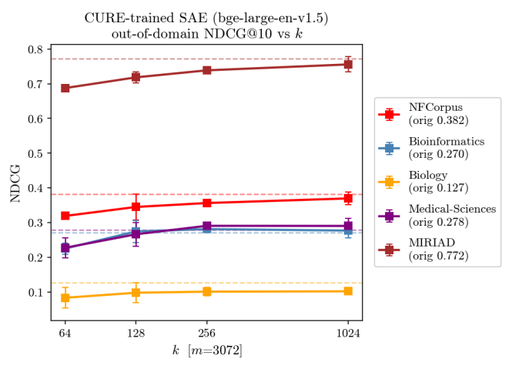
Figure 6 : OOD performance, fixedm= 3072, comparing the effect ofk- BGE embeddings.
원문 · CC BY 4.0 · Bouchacourt, Diane, Brison, Gaëtan · Explanations that Transfer: Interpreting Medical Retrieval with Sparse AutoEncoders · 원문 그림 인용 · 원본 PDF 15쪽에서 그림 영역을 추출했습니다.뉴런 해석의 전이
뉴런 해석은 CURE에서만 만든 TF-IDF 용어, Interpreter LLM 설명, 스니펫 세 가지입니다. 이 해해석을 분포 외 텍스트에 변경 없이 적용하고, Activation Prediction LLM이 뉴런이 활성화될 확률을 예측하게 했습니다. BGE 기반 SAE(k=64)에서 TF-IDF의 Pearson 상관은 CURE에서 0.439, Interpreter LLM은 0.440이었으며 분포 외에서도 양의 상관이 유지되었습니다. 활성 예측 성능과 검색 NDCG@10의 상관은 다섯 분포 외 코퍼스에서 0.69에서 0.94 사이였습니다.
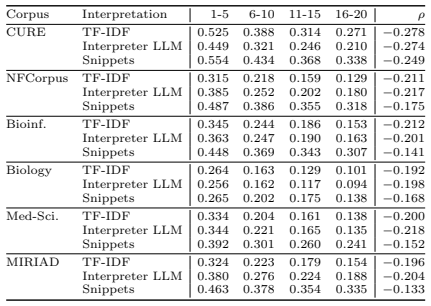
Table 13 : Mean predicted probability onpositive evaluation texts, split by the neuron’s activation rank on the scored text, for the BGE-trained SAE. Every text here is labelled positive (the neuron is among the text’s 20 strongest features); the Activation Pre- dictor is shown neither the rank nor any activation value for that text.ρ: Spearman between rank and predicted probability, negative because rank 1 is the strongest.
원문 · CC BY 4.0 · Bouchacourt, Diane, Brison, Gaëtan · Explanations that Transfer: Interpreting Medical Retrieval with Sparse AutoEncoders · 원문 그림 인용 · 원본 PDF 25쪽에서 그림 영역을 추출했습니다.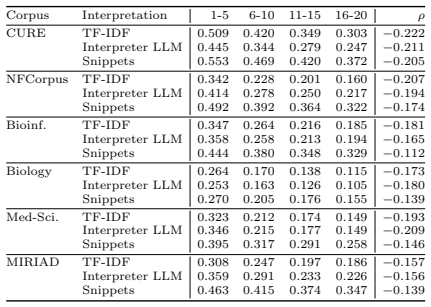
Table 14 : As Table 13, for the Gemini-trained SAE.
원문 · CC BY 4.0 · Bouchacourt, Diane, Brison, Gaëtan · Explanations that Transfer: Interpreting Medical Retrieval with Sparse AutoEncoders · 원문 그림 인용 · 원본 PDF 25쪽에서 그림 영역을 추출했습니다.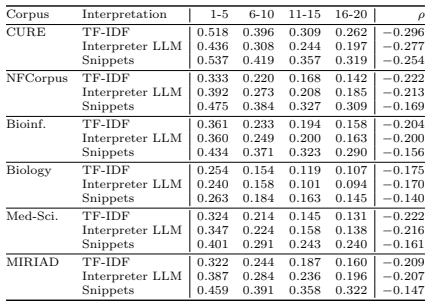
Table 15 : As Table 13, for the MedEmbed-trained SAE.
원문 · CC BY 4.0 · Bouchacourt, Diane, Brison, Gaëtan · Explanations that Transfer: Interpreting Medical Retrieval with Sparse AutoEncoders · 원문 그림 인용 · 원본 PDF 26쪽에서 그림 영역을 추출했습니다.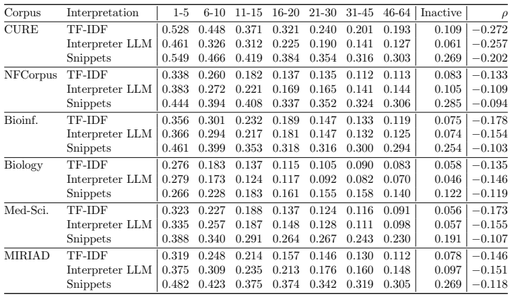
Table 16 : As Table 13, on all ranks 1-64.
원문 · CC BY 4.0 · Bouchacourt, Diane, Brison, Gaëtan · Explanations that Transfer: Interpreting Medical Retrieval with Sparse AutoEncoders · 원문 그림 인용 · 원본 PDF 27쪽에서 그림 영역을 추출했습니다.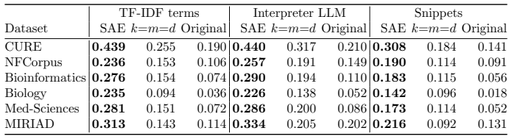
Table 17 : Activation prediction results results to gauge interpretability ofk=m=dand original embed- dings baselines, versus SAE for the BGE embeddings. Pearson correlations between LLM probability and groundtruth (positive or negative).
원문 · CC BY 4.0 · Bouchacourt, Diane, Brison, Gaëtan · Explanations that Transfer: Interpreting Medical Retrieval with Sparse AutoEncoders · 원문 그림 인용 · 원본 PDF 27쪽에서 그림 영역을 추출했습니다.전문가 평가 결과
다섯 명의 의료 전문가가 30개 뉴런과 텍스트 쌍을 네 단계 척도로 평가했습니다. 평균 예측과 실제 활성 라벨의 Pearson 상관은 0.81, AUROC는 0.92였고 27개 텍스트를 맞게 분류했습니다. 이 평가는 소규모이며, 저자들도 대규모 임상의 주석 연구가 향후 과제라고 밝힙니다.
희소 표현의 한계
희소 표현은 모든 데이터셋에서 dense 검색 성능과 일치하지 않았습니다. CURE에서 미세 조정된 모델은 대부분 분포 외 코퍼스에서 원본 임베딩보다 낮은 성능을 보였습니다. 해석 평가는 LLM에 의존하므로 편향과 보정 오류가 있을 수 있어 여러 LLM으로 점검했습니다. 전문가 평가 규모도 작습니다.
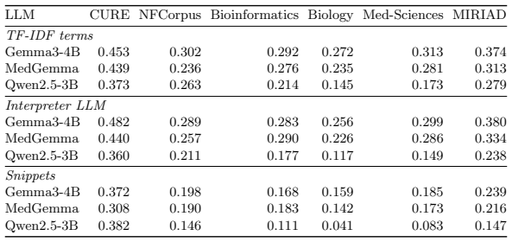
Table 18 : Activation Prediction with three LLMs (Gemma3-4B, MedGemma, Qwen2.5-3B):ris the Pearson correlation of the predicted probability with the ground truth (positive/negative), averaged over the neurons every interpretation type scored.
원문 · CC BY 4.0 · Bouchacourt, Diane, Brison, Gaëtan · Explanations that Transfer: Interpreting Medical Retrieval with Sparse AutoEncoders · 원문 그림 인용 · 원본 PDF 28쪽에서 그림 영역을 추출했습니다.논문 정보
- 저자
- Bouchacourt, Diane, Brison, Gaëtan
- 학회·저널
- arXiv · 프리프린트
- 최초 공개일
- 2026년 11월 13일
- 등록일
- 2026년 11월 16일
- 수정일
- 2026년 11월 13일
- 버전
- v1
- arXiv
- 2611.18179
- 분류
- cs.IR · cs.LG
- 원문 이용 조건
- CC BY 4.0
- 제공 범위
- 논문 정보, 해설, 허용된 원문 그림
AI 해설은 논문 원문과 별개의 설명이며 오류가 있을 수 있습니다. 원문과 그림은 각 출처의 이용 조건과 따로 표시된 권리를 따릅니다.
초록
Medical AI systems that answer users' queries rely on retrieving medical knowledge from large document collections. In this context, finetuning general models on medical datasets can improve retrieval relevance. Yet the dense embeddings underlying modern retrieval systems remain largely opaque, making it difficult to understand the mechanics behind their results. Moreover, adapting to a specific medical dataset risks losing transferability to new clinical corpora. In this work, we tackle these issues by applying Sparse Autoencoders (SAEs) to medical information retrieval, transforming dense text embeddings into semantically interpretable representations. To do so, our model combines a reconstruction objective with an InfoNCE contrastive loss that directly preserves query-document relevance. We evaluate three embedding models across six medical retrieval datasets, both in-domain and out-of-domain. Trained on a medical corpus, our sparse codes improve in-domain retrieval over the original embeddings, and lose less out-of-domain performance than their dense counterparts, especially when the target corpus is distant from the training one. Importantly, our experiments show that the method yields interpretable features whose semantic content can be inferred from the queries and documents that activate them most strongly. The interpretation of these features sheds light on why a particular document was retrieved, and transfers beyond the training distribution.
원문 인용
Bouchacourt, Diane, Brison, Gaëtan (2026). Explanations that Transfer: Interpreting Medical Retrieval with Sparse AutoEncoders. arXiv:2611.18179v1. https://arxiv.org/abs/2611.18179v1
BibTeX
@misc{diane2026explanations,
  title = {{Explanations that Transfer: Interpreting Medical Retrieval with Sparse AutoEncoders}},
  author = {Bouchacourt, Diane and Brison, Gaëtan},
  year = {2026},
  eprint = {2611.18179},
  archivePrefix = {arXiv},
  url = {https://arxiv.org/abs/2611.18179v1}
}