論文解説
Maximizing Capacity Utilization of LoRA Adapters for Mitigating the Learning-Forgetting Trade-off
学習と忘却のトレードオフを緩和するためのLoRAアダプタの容量活用の最大化
- 課題 標準LoRAは、設定したランクの分だけ容量を使いきれず、学習適合度と事前学習分布の忘却のあいだのバランスが悪くなります。
- 手法 スペクトルエントロピーに基づく有効ランクを、SVDを使わずに近似するRényi-2ペナルティを言語モデリング損失に加え、学習中の更新の実効容量を高めます。
- 結果 混合ドメインのランクスイープでは、λ=0.01のペナルティがランク16以上のすべての比較点で、ペナルティなしのLoRAより平均Wiki PPLを下げました。Qwen2.5-0.5B、r=896ではλ=0.1により平均erankが360.537から887.772に上がり、平均Wiki PPLは19.601から14.648に下がりました。
標準LoRAの実際の容量活用
LoRAは設定したランクr分の容量を、常に使い切るわけではありません。著者らはRoy–Vetterli有効ランクerank(∆W)をrで割った活用率を測定し、複数のランクスイープでこの値がrの増加とともに下がることを確認しました。これは、設定ランクが実際に使える容量の信頼できる指標ではないことを意味します。同じ考え方で、学習と忘却のトレードオフは、更新のエネルギーが各方向にどう分布するかに依存すると著者らは考えています。
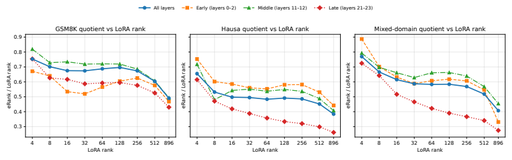
Figure 1 : Effective-rank utilization of standard LoRA adapters across LoRA ranks, decomposed by depth. Each curve reports the mean utilization quotient erank(∆W)/r averaged over the adapted MLP down_proj layers in that group (all 24 layers; early layers 0–2; middle layers 11–12; late layers 21–23), for GSM8K (left), Hausa (center), and mixed-domain continual-learning (45% GSM8K, 10% WMT19 Czech–English, 45% Aya Hausa; right) training sweeps. Line styles denote depth groups: all layers use solid circles, early layers dashed squares, middle layers dash-dot triangles, and late layers dotted diamonds. The aggregate curve falls at high rank because realized effective rank grows sublinearly in r; depth groups reveal that underutilization is not uniform—late layers often fall below early and middle layers.
出典 · CC BY 4.0 · Tomohiro Sawada, Kartik Goyal · Maximizing Capacity Utilization of LoRA Adapters for Mitigating the Learning-Forgetting Trade-off · 論文の図を引用 · 元のPDFの3ページ目から図の部分を抽出しています。Rényi-2ペナルティとSVDを使わない計算
提案手法の中心は、言語モデリング損失に −λ log erank2(∆W) 項を加えることです。erank2(∆W)はRényi-2エントロピーの指数として定義され、フロベニウスノルムの4乗をTr((∆W⊤∆W)²)で割った値と等しくなります。この式は特異値を直接求めないため、SVDの特異値間隔の分母の問題を避けられます。実装では∆Wを明示的に作らず、低ランク因子A、Bの Gram項から計算します。ペナルティの重みλは、開始ステップSと線形ランプWに従って適用されます。さらに著者らは、NB-LoRA経路で作用素ノルムの上限を強制する方法も示しています。
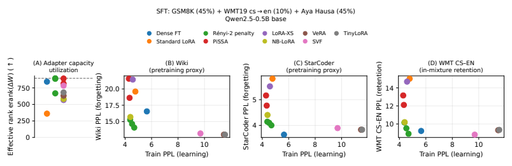
Figure 2 : Dense FT denotes dense down-projection fine-tuning. Mixed-domain continual-learning baselines on Qwen2.5-0.5B (base, not Instruct; rank r=896 unless noted). Each point represents a method–penalty configuration; the legend maps dot colors to adapter type. Points show multi-run means or single-run endpoints; sample SDs are reported in Appendix Table 5.(A)Effective rank erank(∆W) shown as a vertical strip from 0 to nominal rank 896 (horizontal dashed line), with horizontal offsets only for visibility; higher indicates fuller adapter capacity utilization.(B–D)Learning–forgetting trade-offs: Train PPL (mixture learning) versus Wiki PPL, StarCoder PPL (pretraining proxies), and WMT CS–EN PPL (in-mixture translation retention); lower-left is better. The three Rényi-2 penalty points use different regularization weights λ. Unpenalized PiSSA and LoRA-XS have the highest Wiki perplexities; VeRA, SVF, and TinyLoRA limit forgetting with weaker mixture fit. NB-LoRA approaches the λ= 0.01 learning–retention trade-off. Unpenalized PiSSA uses two runs after excluding one resumed execution with apparent data replay; the other multi-run points use three executions. Dense FT, LoRA at λ= 1 , and penalized PiSSA at λ= 0.1 are single runs. Full numeric values and the PiSSA exclusion are documented in Appendix Table 5 and its accompanying text.
出典 · CC BY 4.0 · Tomohiro Sawada, Kartik Goyal · Maximizing Capacity Utilization of LoRA Adapters for Mitigating the Learning-Forgetting Trade-off · 論文の図を引用 · 元のPDFの6ページ目から図の部分を抽出しています。混合ドメインのランクスイープにおける保持効果
この設定では、λ=0.01のペナルティにより、Qwen2.5-0.5B、Qwen2.5-3B-Instruct、Llama-3.2-3B-Instructのランク16以上のすべての点で、ペナルティなしのLoRAより平均Wiki PPLが下がりました。Qwen2.5-0.5Bのr=896では、標準LoRAの平均erankは360.537でした。λ=0.1にすると887.772に上がり、平均Wiki PPLは19.601から14.648に下がりました。平均学習PPLは多くの場合、同じか改善しています。Qwen2.5-3B-Instructのr=16でλ=0.01のときだけ、4.211から4.524に増えました。
著者らはこれを一貫した保持の利得と見ていますが、両方の目標で普遍的な改善とは考えていません。
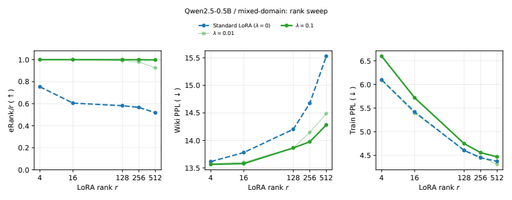
Figure 3 : LoRA rank sweep on Qwen2.5-0.5B on the mixed-domain continual-learning proxy setup (aggregated metrics in Appendix Table 9). The panels show effective-rank utilization, Wiki perplexity, and training perplexity. Points use the table’s means across three seeds per setting, with repeated executions averaged within each seed first; effective-rank utilization divides the eRank mean by r. Colors indicate penalty weight λ. At r = 256, λ = 0.1, the reported means of both Train PPL and Wiki PPL are lower than for standard LoRA at r = 128.
出典 · CC BY 4.0 · Tomohiro Sawada, Kartik Goyal · Maximizing Capacity Utilization of LoRA Adapters for Mitigating the Learning-Forgetting Trade-off · 論文の図を引用 · 元のPDFの8ページ目から図の部分を抽出しています。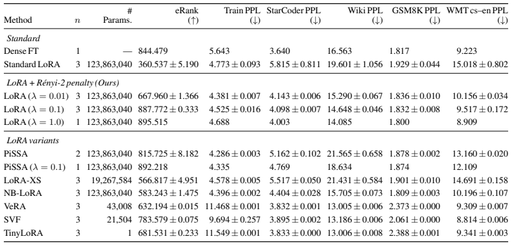
Table 5 : Dense FT denotes dense down-projection fine-tuning. Mixed-domain results for Qwen2.5-0.5B corre- sponding to Figure 2, with MLP down-projection adapters (r= 896 , α= 1792 ) trained on the GSM8K/WMT19 Czech–English/Aya Hausa mixture. Rows with n >1 report the mean ± sample standard deviation over n training executions. Rows with n= 1 report a single run. PiSSA (n= 2 ) excludes one resumed execution with apparent data replay, as discussed in the text. All rows use Qwen2.5-0.5B (base, not Instruct); for Dense FT this is taken from the job launch records.
出典 · CC BY 4.0 · Tomohiro Sawada, Kartik Goyal · Maximizing Capacity Utilization of LoRA Adapters for Mitigating the Learning-Forgetting Trade-off · 論文の図を引用 · 元のPDFの20ページ目から図の部分を抽出しています。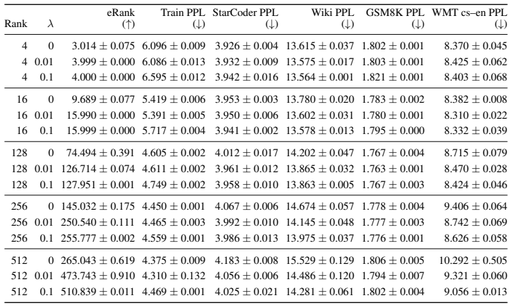
Table 9 : Mixed-domain LoRA results for Qwen2.5-0.5B at the reported rank and penalty settings.
出典 · CC BY 4.0 · Tomohiro Sawada, Kartik Goyal · Maximizing Capacity Utilization of LoRA Adapters for Mitigating the Learning-Forgetting Trade-off · 論文の図を引用 · 元のPDFの21ページ目から図の部分を抽出しています。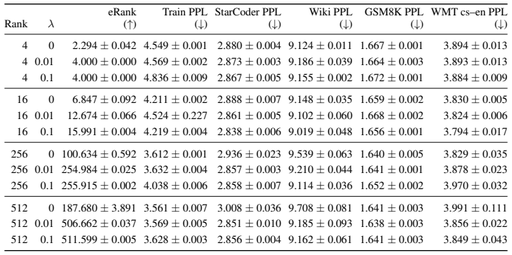
Table 10 : Mixed-domain LoRA results for Qwen2.5-3B-Instruct at the reported rank and penalty settings.
出典 · CC BY 4.0 · Tomohiro Sawada, Kartik Goyal · Maximizing Capacity Utilization of LoRA Adapters for Mitigating the Learning-Forgetting Trade-off · 論文の図を引用 · 元のPDFの22ページ目から図の部分を抽出しています。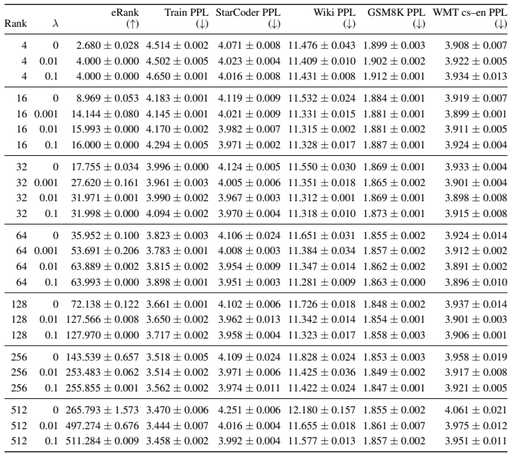
Table 11 : Mixed-domain LoRA results for Llama-3.2-3B-Instruct at the reported rank and penalty settings.
出典 · CC BY 4.0 · Tomohiro Sawada, Kartik Goyal · Maximizing Capacity Utilization of LoRA Adapters for Mitigating the Learning-Forgetting Trade-off · 論文の図を引用 · 元のPDFの22ページ目から図の部分を抽出しています。単一タスクとLoRA変種への適用
単一タスクのGSM8K設定では、PiSSAとLoRA-XSに同じペナルティを適用しました。ただし、この改善も標準LoRAにRényi-2ペナルティを適用した結果には及びませんでした。この実験は、Qwen2.5-0.5B、r=896、α=1792の設定に限られます。
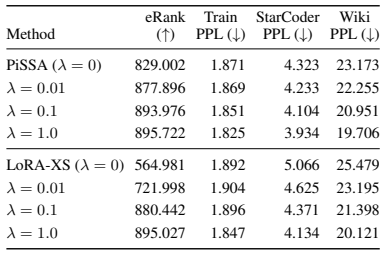
Table 2 : PiSSA and LoRA-XS penalty-weight compar- isons on single-task GSM8K adaptation for Qwen2.5- 0.5B, targeting MLP down-projection matrices ( r= 896, α= 1792 ). Train PPL measures GSM8K fit; Star- Coder and Wiki PPL are held-out retention probes. For both methods, the penalty ramps from step0, with width W= 200for all nonzero penalty weights shown.
出典 · CC BY 4.0 · Tomohiro Sawada, Kartik Goyal · Maximizing Capacity Utilization of LoRA Adapters for Mitigating the Learning-Forgetting Trade-off · 論文の図を引用 · 元のPDFの7ページ目から図の部分を抽出しています。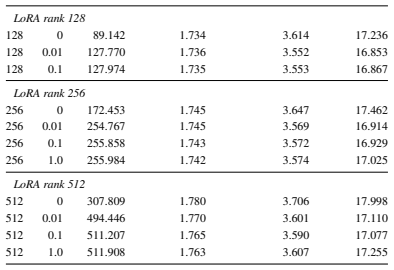
Table 24 : LoRA rank and penalty-weight sweep on GSM8K for Qwen2.5-0.5B.
出典 · CC BY 4.0 · Tomohiro Sawada, Kartik Goyal · Maximizing Capacity Utilization of LoRA Adapters for Mitigating the Learning-Forgetting Trade-off · 論文の図を引用 · 元のPDFの27ページ目から図の部分を抽出しています。ペナルティ開始時点の影響
短いAya Hausaの実験で、著者らはペナルティの開始ステップSを変えました。すべてのペナルティ設定は、標準LoRAよりStarCoderとWiki PPLを下げました。一方、S=0では学習PPLが22.604から24.737に悪化し、S=400では22.410となって、ベースラインと同程度まで戻りました。著者らは、これはペナルティが初期の軌道で損失の分岐に入る過程を妨げるためだと解釈しており、0付近で勾配が大きくなりうるという分析も示しています。この解釈は著者らの仮説であり、直接示された仕組みではありません。
適用範囲と残された調整の課題
著者らが挙げた限界は2つです。1つ目は、ペナルティの重みλを学習目標に応じて調整する必要があり、目標が意図的な過小適合や非常に狭いドメインへの強い保持である場合には適さないかもしれないことです。2つ目は、研究がLoRA系と近いスペクトル変種に集中しており、他のPEFT系や全パラメータのファインチューニングに同じ目標を広げる実験は行っていないことです。
論文情報
- 著者
- Tomohiro Sawada, Kartik Goyal
- 学会・ジャーナル
- arXiv · プレプリント
- 公開日
- 2026年11月12日
- 登録日
- 2026年11月14日
- 更新日
- 2026年11月12日
- バージョン
- v1
- arXiv
- 2611.17191
- カテゴリ
- cs.LG · cs.CL
- ライセンス
- CC BY 4.0
- 掲載内容
- 論文情報・解説・論文の図
この解説は、Refivuの韓国語解説をAIで翻訳したものです。不正確な翻訳や誤りが含まれる可能性があります。論文と図の利用条件は各出典に従います。
アブストラクト
Low-Rank Adaptation (LoRA) often underperforms full fine-tuning, especially in heterogeneous and continual-learning settings in which substantial forgetting occurs. In general, it suffers from an undesirable learning-forgetting trade-off across diverse fine-tuning settings. We identify a potential contributor: LoRA adapters, especially high-rank ones, frequently fail to realize the available capacity afforded by the configured rank. Specifically, we find that standard LoRA updates have effective rank far below their configured rank, limiting how broadly the update energy is distributed. Therefore, we propose training mechanisms that optimize the original objective while maximizing adapter effective rank. Our main method adds a simple, stable, differentiable, and SVD-free Rényi-2 effective-rank regularizer to the language-modeling loss. We also connect capacity maximization to norm-bounded updates. In mixed-domain rank sweeps on three models evaluated with multiple random seeds, a penalty weight of $λ=0.01$ lowers mean Wiki perplexity at every tested rank of at least $16$ relative to unpenalized LoRA. Mean training perplexity improves or increases by at most $0.02$ in all but one model-rank comparison. Single-task and scheduling experiments further show that the balance between learning and retention depends on the configuration. We also observe that several LoRA variants in the literature also suffer from the identified capacity issue, and our approach provides a complementary axis of improvement to LoRA-based parameter-efficient fine-tuning. These results suggest that effective rank is not only a post-hoc diagnostic of adapter quality, but a trainable objective for improving the learning-forgetting frontier. Our code is available at https://github.com/tomohiro-sawada/lora-capacity-utilization
この論文を引用
Tomohiro Sawada, Kartik Goyal (2026). Maximizing Capacity Utilization of LoRA Adapters for Mitigating the Learning-Forgetting Trade-off. arXiv:2611.17191v1. https://arxiv.org/abs/2611.17191v1
BibTeX
@misc{sawada2026maximizing,
  title = {{Maximizing Capacity Utilization of LoRA Adapters for Mitigating the Learning-Forgetting Trade-off}},
  author = {Tomohiro Sawada and Kartik Goyal},
  year = {2026},
  eprint = {2611.17191},
  archivePrefix = {arXiv},
  url = {https://arxiv.org/abs/2611.17191v1}
}