논문 해설
Maximizing Capacity Utilization of LoRA Adapters for Mitigating the Learning-Forgetting Trade-off
학습-망각 상충 완화를 위한 LoRA 어댑터의 용량 활용 극대화
- 연구 문제 표준 LoRA는 설정한 랭크만큼 용량을 충분히 쓰지 못해 학습 적합도와 pre-training 분포 망각 사이의 절충이 나쁩니다.
- 연구 방법 스펙트럼 엔트로피 기반 유효 랭크를 SVD 없이 근사하는 Rényi-2 페널티를 언어모델링 손실에 더해 학습 중 업데이트의 실현 용량을 높입니다.
- 주요 결과 혼합 도메인 랭크 스윕에서 λ=0.01 페널티는 랭크 16 이상의 모든 비교 지점에서 비페널티 LoRA보다 평균 Wiki PPL을 낮췄고, Qwen2.5-0.5B r=896에서 λ=0.1은 평균 erank를 360.537에서 887.772로 올리고 평균 Wiki PPL을 19.601에서 14.648로 낮췄습니다.
표준 LoRA의 실제 용량 활용
LoRA는 설정한 랭크 r만큼의 용량을 항상 쓰지 않습니다. 저자들은 Roy–Vetterli 유효 랭크 erank(∆W)를 r로 나눈 활용률을 측정했고, 여러 랭크 스윕에서 이 값이 r이 커질수록 낮아지는 것을 확인했습니다. 이는 설정 랭크가 실제로 쓸 수 있는 용량의 믿을 만한 지표가 아님을 뜻합니다. 같은 맥락에서 학습과 망각의 절충은 업데이트 에너지가 방향들에 어떻게 분포하는지에 달려 있다고 봅니다.
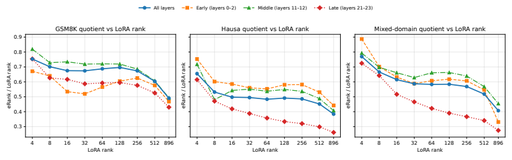
Figure 1 : Effective-rank utilization of standard LoRA adapters across LoRA ranks, decomposed by depth. Each curve reports the mean utilization quotient erank(∆W)/r averaged over the adapted MLP down_proj layers in that group (all 24 layers; early layers 0–2; middle layers 11–12; late layers 21–23), for GSM8K (left), Hausa (center), and mixed-domain continual-learning (45% GSM8K, 10% WMT19 Czech–English, 45% Aya Hausa; right) training sweeps. Line styles denote depth groups: all layers use solid circles, early layers dashed squares, middle layers dash-dot triangles, and late layers dotted diamonds. The aggregate curve falls at high rank because realized effective rank grows sublinearly in r; depth groups reveal that underutilization is not uniform—late layers often fall below early and middle layers.
원문 · CC BY 4.0 · Tomohiro Sawada, Kartik Goyal · Maximizing Capacity Utilization of LoRA Adapters for Mitigating the Learning-Forgetting Trade-off · 원문 그림 인용 · 원본 PDF 3쪽에서 그림 영역을 추출했습니다.Rényi-2 페널티와 SVD 없는 계산
제안하는 핵심 방법은 언어모델링 손실에 −λ log erank2(∆W) 항을 더하는 것입니다. erank2(∆W)는 Rényi-2 엔트로피의 지수로 정의되며, 프로베니우스 노름의 네제곱을 Tr((∆W⊤∆W)²)로 나눈 값과 같습니다. 이 식은 특이값을 직접 구하지 않으므로 SVD의 특이값 간격 분모 문제를 피합니다. 실제 구현에서는 ∆W를 명시적으로 만들지 않고 저랭크 인자 A, B의 Gram 항으로 계산합니다. 페널티 가중치 λ는 시작 스텝 S와 선형 램프 W에 따라 적용됩니다. 또한 저자들은 NB-LoRA 경로로 연산자 노름 상한을 강제하는 방식도 함께 제시했습니다.
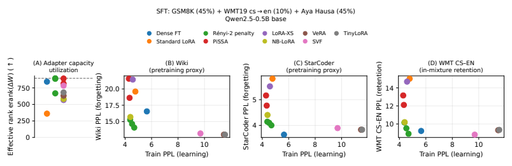
Figure 2 : Dense FT denotes dense down-projection fine-tuning. Mixed-domain continual-learning baselines on Qwen2.5-0.5B (base, not Instruct; rank r=896 unless noted). Each point represents a method–penalty configuration; the legend maps dot colors to adapter type. Points show multi-run means or single-run endpoints; sample SDs are reported in Appendix Table 5.(A)Effective rank erank(∆W) shown as a vertical strip from 0 to nominal rank 896 (horizontal dashed line), with horizontal offsets only for visibility; higher indicates fuller adapter capacity utilization.(B–D)Learning–forgetting trade-offs: Train PPL (mixture learning) versus Wiki PPL, StarCoder PPL (pretraining proxies), and WMT CS–EN PPL (in-mixture translation retention); lower-left is better. The three Rényi-2 penalty points use different regularization weights λ. Unpenalized PiSSA and LoRA-XS have the highest Wiki perplexities; VeRA, SVF, and TinyLoRA limit forgetting with weaker mixture fit. NB-LoRA approaches the λ= 0.01 learning–retention trade-off. Unpenalized PiSSA uses two runs after excluding one resumed execution with apparent data replay; the other multi-run points use three executions. Dense FT, LoRA at λ= 1 , and penalized PiSSA at λ= 0.1 are single runs. Full numeric values and the PiSSA exclusion are documented in Appendix Table 5 and its accompanying text.
원문 · CC BY 4.0 · Tomohiro Sawada, Kartik Goyal · Maximizing Capacity Utilization of LoRA Adapters for Mitigating the Learning-Forgetting Trade-off · 원문 그림 인용 · 원본 PDF 6쪽에서 그림 영역을 추출했습니다.혼합 도메인 랭크 스윕의 보존 효과
이 설정에서 λ=0.01 페널티는 Qwen2.5-0.5B, Qwen2.5-3B-Instruct, Llama-3.2-3B-Instruct의 랭크 16 이상 모든 지점에서 비페널티 LoRA보다 평균 Wiki PPL을 낮췄습니다. Qwen2.5-0.5B의 r=896에서는 표준 LoRA의 평균 erank가 360.537이었고, λ=0.1에서 887.772로 올랐으며 평균 Wiki PPL은 19.601에서 14.648로 내려갔습니다. 평균 학습 PPL은 대부분 같거나 개선되었고, Qwen2.5-3B-Instruct의 r=16에서 λ=0.01일 때만 4.211에서 4.524로 증가했습니다. 저자들은 이를 일관된 보존 이득으로 보지만 두 목표 모두에서 보편적 개선은 아니라고 봅니다.
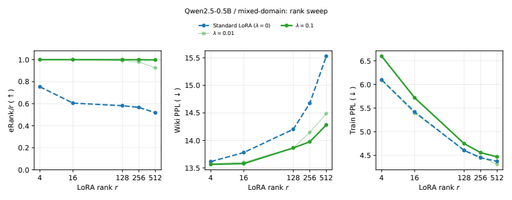
Figure 3 : LoRA rank sweep on Qwen2.5-0.5B on the mixed-domain continual-learning proxy setup (aggregated metrics in Appendix Table 9). The panels show effective-rank utilization, Wiki perplexity, and training perplexity. Points use the table’s means across three seeds per setting, with repeated executions averaged within each seed first; effective-rank utilization divides the eRank mean by r. Colors indicate penalty weight λ. At r = 256, λ = 0.1, the reported means of both Train PPL and Wiki PPL are lower than for standard LoRA at r = 128.
원문 · CC BY 4.0 · Tomohiro Sawada, Kartik Goyal · Maximizing Capacity Utilization of LoRA Adapters for Mitigating the Learning-Forgetting Trade-off · 원문 그림 인용 · 원본 PDF 8쪽에서 그림 영역을 추출했습니다.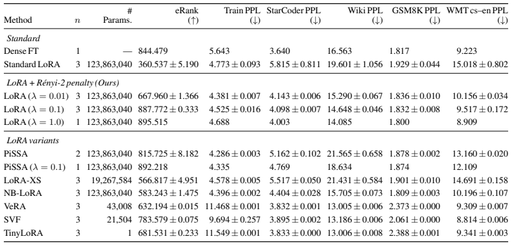
Table 5 : Dense FT denotes dense down-projection fine-tuning. Mixed-domain results for Qwen2.5-0.5B corre- sponding to Figure 2, with MLP down-projection adapters (r= 896 , α= 1792 ) trained on the GSM8K/WMT19 Czech–English/Aya Hausa mixture. Rows with n >1 report the mean ± sample standard deviation over n training executions. Rows with n= 1 report a single run. PiSSA (n= 2 ) excludes one resumed execution with apparent data replay, as discussed in the text. All rows use Qwen2.5-0.5B (base, not Instruct); for Dense FT this is taken from the job launch records.
원문 · CC BY 4.0 · Tomohiro Sawada, Kartik Goyal · Maximizing Capacity Utilization of LoRA Adapters for Mitigating the Learning-Forgetting Trade-off · 원문 그림 인용 · 원본 PDF 20쪽에서 그림 영역을 추출했습니다.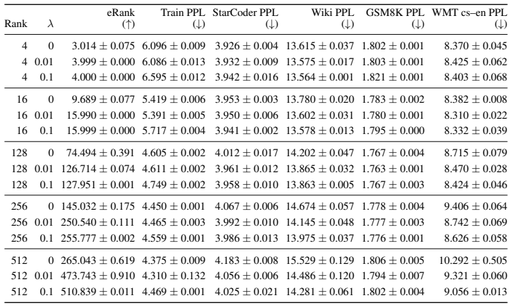
Table 9 : Mixed-domain LoRA results for Qwen2.5-0.5B at the reported rank and penalty settings.
원문 · CC BY 4.0 · Tomohiro Sawada, Kartik Goyal · Maximizing Capacity Utilization of LoRA Adapters for Mitigating the Learning-Forgetting Trade-off · 원문 그림 인용 · 원본 PDF 21쪽에서 그림 영역을 추출했습니다.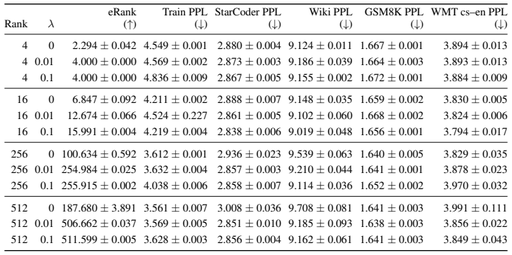
Table 10 : Mixed-domain LoRA results for Qwen2.5-3B-Instruct at the reported rank and penalty settings.
원문 · CC BY 4.0 · Tomohiro Sawada, Kartik Goyal · Maximizing Capacity Utilization of LoRA Adapters for Mitigating the Learning-Forgetting Trade-off · 원문 그림 인용 · 원본 PDF 22쪽에서 그림 영역을 추출했습니다.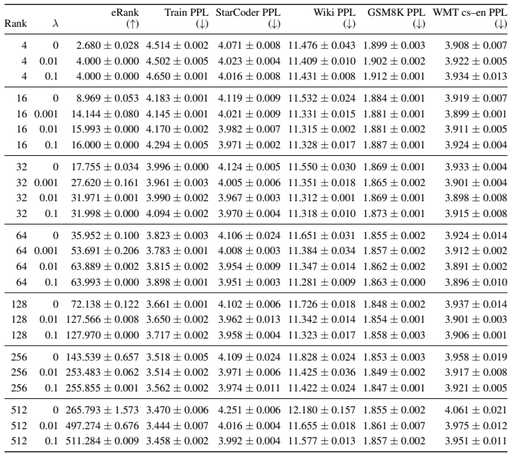
Table 11 : Mixed-domain LoRA results for Llama-3.2-3B-Instruct at the reported rank and penalty settings.
원문 · CC BY 4.0 · Tomohiro Sawada, Kartik Goyal · Maximizing Capacity Utilization of LoRA Adapters for Mitigating the Learning-Forgetting Trade-off · 원문 그림 인용 · 원본 PDF 22쪽에서 그림 영역을 추출했습니다.단일 과제와 LoRA 변형에 대한 적용
단일 과제 GSM8K 설정에서 PiSSA와 LoRA-XS에 같은 페널티를 적용했습니다. 다만 이 개선도 표준 LoRA에 Rényi-2 페널티를 적용한 결과에는 미치지 못했습니다. 이 실험은 Qwen2.5-0.5B, r=896, α=1792 설정에 한정됩니다.
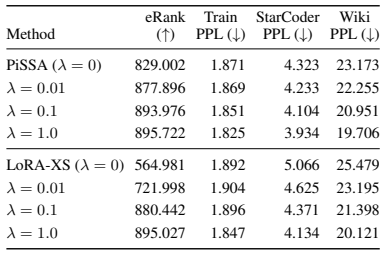
Table 2 : PiSSA and LoRA-XS penalty-weight compar- isons on single-task GSM8K adaptation for Qwen2.5- 0.5B, targeting MLP down-projection matrices ( r= 896, α= 1792 ). Train PPL measures GSM8K fit; Star- Coder and Wiki PPL are held-out retention probes. For both methods, the penalty ramps from step0, with width W= 200for all nonzero penalty weights shown.
원문 · CC BY 4.0 · Tomohiro Sawada, Kartik Goyal · Maximizing Capacity Utilization of LoRA Adapters for Mitigating the Learning-Forgetting Trade-off · 원문 그림 인용 · 원본 PDF 7쪽에서 그림 영역을 추출했습니다.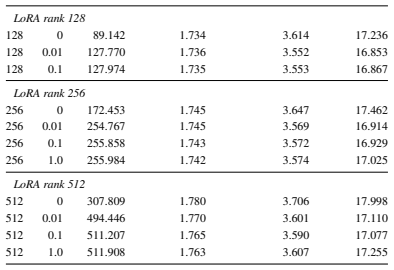
Table 24 : LoRA rank and penalty-weight sweep on GSM8K for Qwen2.5-0.5B.
원문 · CC BY 4.0 · Tomohiro Sawada, Kartik Goyal · Maximizing Capacity Utilization of LoRA Adapters for Mitigating the Learning-Forgetting Trade-off · 원문 그림 인용 · 원본 PDF 27쪽에서 그림 영역을 추출했습니다.페널티 시작 시점의 영향
짧은 Aya Hausa 실험에서 저자들은 페널티 시작 스텝 S를 바꾸었습니다. 모든 페널티 설정은 표준 LoRA보다 StarCoder와 Wiki PPL을 낮췄습니다. 반면 S=0에서 Train PPL은 22.604에서 24.737로 악화되었고, S=400에서는 22.410으로 기준선 수준을 회복했습니다. 저자들은 이를 페널티가 초기 궤적에서 손실 분지에 들어가는 과정을 방해하기 때문이라고 해석하며, 0 근처에서 그래디언트가 커질 수 있다는 분석을 함께 제시합니다. 이 해석은 저자들의 가설이며 직접 증명된 메커니즘이 아닙니다.
적용 범위와 남은 조정 문제
저자들이 밝힌 한계는 두 가지입니다. 첫째, 페널티 가중치 λ는 학습 목표에 따라 조정해야 하며, 목표가 의도적 과소적합이거나 아주 좁은 도메인의 강한 보존이면 적합하지 않을 수 있습니다. 둘째, 연구는 LoRA 계열과 밀접한 스펙트럼 변형에 집중했고, 다른 PEFT 계열이나 전체 fine-tuning으로 같은 목표를 확장하는 실험은 하지 않았습니다.
논문 정보
- 저자
- Tomohiro Sawada, Kartik Goyal
- 학회·저널
- arXiv · 프리프린트
- 최초 공개일
- 2026년 11월 12일
- 등록일
- 2026년 11월 14일
- 수정일
- 2026년 11월 12일
- 버전
- v1
- arXiv
- 2611.17191
- 분류
- cs.LG · cs.CL
- 원문 이용 조건
- CC BY 4.0
- 제공 범위
- 논문 정보, 해설, 허용된 원문 그림
AI 해설은 논문 원문과 별개의 설명이며 오류가 있을 수 있습니다. 원문과 그림은 각 출처의 이용 조건과 따로 표시된 권리를 따릅니다.
초록
Low-Rank Adaptation (LoRA) often underperforms full fine-tuning, especially in heterogeneous and continual-learning settings in which substantial forgetting occurs. In general, it suffers from an undesirable learning-forgetting trade-off across diverse fine-tuning settings. We identify a potential contributor: LoRA adapters, especially high-rank ones, frequently fail to realize the available capacity afforded by the configured rank. Specifically, we find that standard LoRA updates have effective rank far below their configured rank, limiting how broadly the update energy is distributed. Therefore, we propose training mechanisms that optimize the original objective while maximizing adapter effective rank. Our main method adds a simple, stable, differentiable, and SVD-free Rényi-2 effective-rank regularizer to the language-modeling loss. We also connect capacity maximization to norm-bounded updates. In mixed-domain rank sweeps on three models evaluated with multiple random seeds, a penalty weight of $λ=0.01$ lowers mean Wiki perplexity at every tested rank of at least $16$ relative to unpenalized LoRA. Mean training perplexity improves or increases by at most $0.02$ in all but one model-rank comparison. Single-task and scheduling experiments further show that the balance between learning and retention depends on the configuration. We also observe that several LoRA variants in the literature also suffer from the identified capacity issue, and our approach provides a complementary axis of improvement to LoRA-based parameter-efficient fine-tuning. These results suggest that effective rank is not only a post-hoc diagnostic of adapter quality, but a trainable objective for improving the learning-forgetting frontier. Our code is available at https://github.com/tomohiro-sawada/lora-capacity-utilization
원문 인용
Tomohiro Sawada, Kartik Goyal (2026). Maximizing Capacity Utilization of LoRA Adapters for Mitigating the Learning-Forgetting Trade-off. arXiv:2611.17191v1. https://arxiv.org/abs/2611.17191v1
BibTeX
@misc{sawada2026maximizing,
  title = {{Maximizing Capacity Utilization of LoRA Adapters for Mitigating the Learning-Forgetting Trade-off}},
  author = {Tomohiro Sawada and Kartik Goyal},
  year = {2026},
  eprint = {2611.17191},
  archivePrefix = {arXiv},
  url = {https://arxiv.org/abs/2611.17191v1}
}