논문 해설
AeroZoo: A Benchmark of Well-Posed Flow Problems for Foundation Models of Aerodynamics
AeroZoo: 공기역학 기반 모델을 위한 well-posed 유동 문제 벤치마크
- 연구 문제 기존 CFD 대리모델 데이터셋은 한 설계 계열과 고정된 흐름 영역에 머물러 형상·외피·경계 조건의 일반화를 측정하기 어렵습니다.
- 주요 결과 GeoTransolver는 경계 토큰을 넣자 중앙값 εU가 0.769에서 0.084로 낮아졌고, ISLA는 중앙값 εU 0.053을 기록했습니다.
기존 데이터셋이 가리는 일반화 문제
기존 3D CFD 데이터셋은 대개 한 설계 계열을 한 흐름 영역과 고정된 경계 조건에서 바꾸어 만들어집니다. 이런 데이터로 학습한 대리모델은 새 형상이나 새 외피에서 얼마나 잘 맞는지 제대로 측정되지 않습니다. 이 논문은 형상, 외피 구성, 경계 조건, 레이놀즈 수가 함께 바뀌는 상황을 측정할 벤치마크가 필요하다고 봅니다. 이를 위해 경계 문제를 잘 정의된(well-posed) 샘플로 다시 정의합니다.
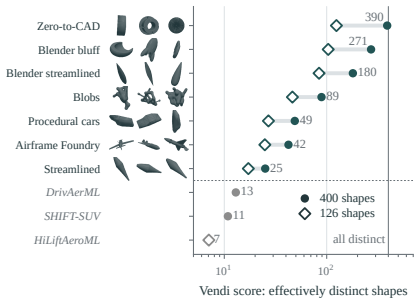
Figure 4 .Every AeroZoo geometry family (three example bodies shown at left) exceeds the shape diversity of single-design sweeps (gray). Vendi scores (Friedman & Dieng, 2023) at 400 shapes (dots) and 126 shapes (diamonds, matching HiLiftAeroML; Ap- pendix I).
원문 · CC BY 4.0 · Peter Sharpe, Carmelo Gonzales, Corey Adams, Mehdi Ataei, Sanjay Choudhry · AeroZoo: A Benchmark of Well-Posed Flow Problems for Foundation Models of Aerodynamics · 원문 그림 인용 · 원본 PDF 4쪽에서 그림 영역을 추출했습니다.입력으로 경계 조건과 유체 성질 명시
이 논문은 학습 과제가 입력으로 목표를 결정할 때 well-posed라고 보고, 비압축성 RANS 문제에서는 경계 영역, 각 경계 부위의 조건 유형과 규정된 값, 밀도와 동점성계수가 입력이 되어야 한다고 설명합니다. 샘플은 경계 메시를 조건 유형별로 묶어 저장하며, 전역 입력으로는 동점성계수와 밀도만 허용합니다. 기준 길이와 속도 같은 스케일은 채점에만 쓰고 입력에서 뺍니다. 이렇게 하면 모델이 형상만으로 유동을 추측하는 것을 막을 수 있습니다.
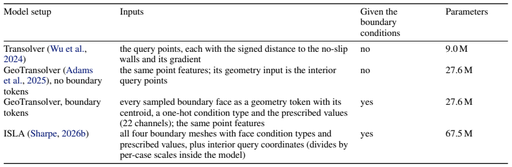
Table 13 .What each model setup of Table 3 is given. Transolver and GeoTransolver also take one global input: the viscosity in SI units and the Reynolds number in per-case scales; ISLA takes that Reynolds number.
원문 · CC BY 4.0 · Peter Sharpe, Carmelo Gonzales, Corey Adams, Mehdi Ataei, Sanjay Choudhry · AeroZoo: A Benchmark of Well-Posed Flow Problems for Foundation Models of Aerodynamics · 원문 그림 인용 · 원본 PDF 25쪽에서 그림 영역을 추출했습니다.3,815개 샘플과 안정성 라벨
AeroZoo는 일곱 기하 계열과 여덟 외피 구성에 걸쳐 3,815개 샘플을 담습니다. 각 샘플은 Langtry–Menter 전이 SST 모델을 쓰는 비정상 RANS 해의 시간 평균입니다. 격자는 snappyHexMesh로 만들고 OpenFOAM으로 풉니다. 두 반 구간 평균의 차이가 기준 이하이면 mean_stable로 표시하며, 이 라벨이 붙은 2,816개가 표준 벤치마크를 이룹니다. 라벨은 해에서 계산되므로 모델은 입력만으로 채점 대상을 알 수 없습니다.
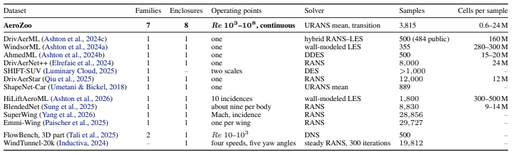
Table 1 .AeroZoo spans seven geometry families and eight enclosure configurations, whereas most public 3D CFD datasets vary one design family and several use costlier scale-resolving solvers (Appendices A and I; –: not stated).
원문 · CC BY 4.0 · Peter Sharpe, Carmelo Gonzales, Corey Adams, Mehdi Ataei, Sanjay Choudhry · AeroZoo: A Benchmark of Well-Posed Flow Problems for Foundation Models of Aerodynamics · 원문 그림 인용 · 원본 PDF 3쪽에서 그림 영역을 추출했습니다.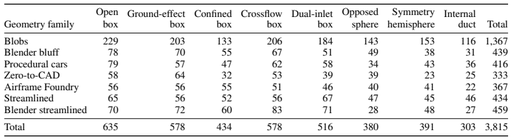
Table 8 .Released samples by geometry family and enclosure configuration. The planned counts in each row follow the configuration weights; the shortfalls are failed and timed-out cases. By count the shortfall is largest in the confined box, which has the most cells (183 of 617 planned cases, 29.7%, 167 of them timed out), and by share in the internal duct (135 of 438, 30.8%, 121 of them failed). The internal-duct column includes the 161 body-free ducts, each counted under the family of the body drawn for it.
원문 · CC BY 4.0 · Peter Sharpe, Carmelo Gonzales, Corey Adams, Mehdi Ataei, Sanjay Choudhry · AeroZoo: A Benchmark of Well-Posed Flow Problems for Foundation Models of Aerodynamics · 원문 그림 인용 · 원본 PDF 15쪽에서 그림 영역을 추출했습니다.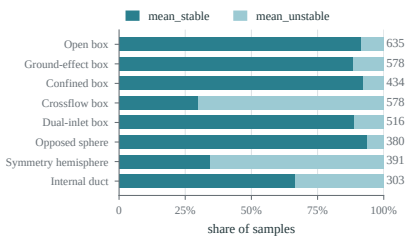
Figure 8 .Crossflow boxes and symmetry hemispheres are mostly mean_unstable; five configurations are about 90% stable. Share of released samples labeled mean_stable, by enclosure configuration, with the number of samples at the right. The label records whether the finite-window mean had settled; samples with either label passed the solver’s checks.
원문 · CC BY 4.0 · Peter Sharpe, Carmelo Gonzales, Corey Adams, Mehdi Ataei, Sanjay Choudhry · AeroZoo: A Benchmark of Well-Posed Flow Problems for Foundation Models of Aerodynamics · 원문 그림 인용 · 원본 PDF 15쪽에서 그림 영역을 추출했습니다.경계 토큰과 단위 스케일의 효과
full 분할에서 Transolver, GeoTransolver, ISLA를 학습하고 515개 테스트 샘플에서 평가했습니다. GeoTransolver는 per-case 스케일에서 경계 토큰을 넣으면 중앙값 εU가 0.769에서 0.084로 내려갔습니다. ISLA는 중앙값 εU 0.053을 기록했고, 자유 흐름 기준보다 낮은 샘플 비율은 98%였습니다. 경계 토큰이 없는 모델은 SI 단위에서 압력을 거의 학습하지 못했습니다. ISLA의 random split 오차 5.3%는 격자 1.5배 세분화에 따른 속도 변화 1.2%의 약 4배였습니다.
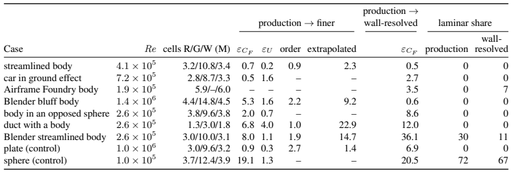
Table 9 .Grid study by case: the Reynolds number; cells of the production (R), finer (G) and wall-resolved (W) meshes; the change from the production mesh to the finer one in force and velocity; where the coarser, production and finer meshes converge monotonically, the observed order of CF and the production mesh’s force error relative to the Richardson extrapolation; the change from the production mesh to the wall-resolved one in force; and the laminar share of the body’s boundary layer on those two meshes. Changes, errors and shares in percent; “–”: not defined or not run. A released body with no enclosure named is in an open box.
원문 · CC BY 4.0 · Peter Sharpe, Carmelo Gonzales, Corey Adams, Mehdi Ataei, Sanjay Choudhry · AeroZoo: A Benchmark of Well-Posed Flow Problems for Foundation Models of Aerodynamics · 원문 그림 인용 · 원본 PDF 18쪽에서 그림 영역을 추출했습니다.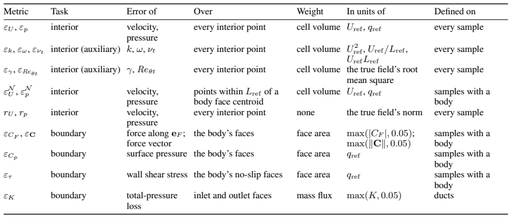
Table 11 . Every metric: the quantity whose error it measures, the points or faces it covers, its weight, its unit and the test samples on which it is defined.
원문 · CC BY 4.0 · Peter Sharpe, Carmelo Gonzales, Corey Adams, Mehdi Ataei, Sanjay Choudhry · AeroZoo: A Benchmark of Well-Posed Flow Problems for Foundation Models of Aerodynamics · 원문 그림 인용 · 원본 PDF 21쪽에서 그림 영역을 추출했습니다.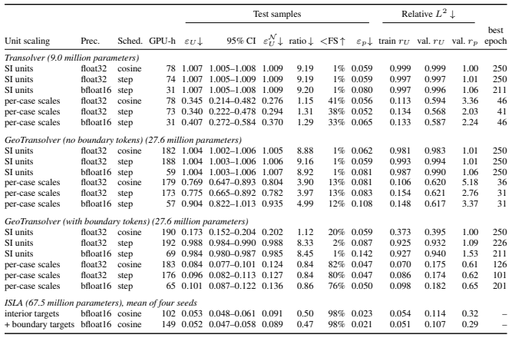
Table 14 .Every row behind Table 3: three model setups in two unit scalings on full, each trained with three settings, one seed each, and ISLA’s two rows, the means of four seeds, whose first column gives the training targets. Table 3 prints the float32 row with the cosine schedule of each of those three setups. GPU-hours are per run, and ISLA keeps only its final checkpoint. Errors are medians over the 515 canonical test samples, and the near-field error over those with a body. The ratio is the median over samples of εU over the free-stream reference’s εU on the same sample, and <FS counts the samples where that ratio is below 1. The interval is a 95% bootstrap interval of the median over the test samples (reference: 0.094–0.134). The last four columns are the relative L2 errors at the last epoch (predicting zero scores 1), on the training and validation samples, and the epoch of lowest validation loss.
원문 · CC BY 4.0 · Peter Sharpe, Carmelo Gonzales, Corey Adams, Mehdi Ataei, Sanjay Choudhry · AeroZoo: A Benchmark of Well-Posed Flow Problems for Foundation Models of Aerodynamics · 원문 그림 인용 · 원본 PDF 27쪽에서 그림 영역을 추출했습니다.
Table 18 .Controlled boundary-token ablation of GeoTransolver on full (per-case scales, bfloat16, warm-up plus cosine decay at 10−3, epoch 250, 515 canonical test samples). The middle two rows keep the full model and random draws with selected token channels zeroed; the last row removes boundary tokens and ball-query branches and passes the area-weighted mean inlet velocity beside Re as a global input.
원문 · CC BY 4.0 · Peter Sharpe, Carmelo Gonzales, Corey Adams, Mehdi Ataei, Sanjay Choudhry · AeroZoo: A Benchmark of Well-Posed Flow Problems for Foundation Models of Aerodynamics · 원문 그림 인용 · 원본 PDF 29쪽에서 그림 영역을 추출했습니다.DrivAerML 스케일링 바닥 추정
학습 케이스 수를 늘리면 오차가 계속 줄었습니다. 적합된 바닥 추정 L_irr은 0.0309이며, 400 케이스에서 기록된 최선 오차 0.0393보다 21% 낮습니다. 이 값은 적합된 추정치이므로 이 데이터셋의 바닥을 확정한 것으로 읽지 않습니다.
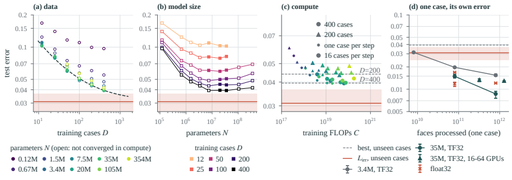
Figure 13 .At 200 and 400 training cases, the test error of Transolver on DrivAerML changes by a few percent with more parameters (b) and more training compute (c), and each doubling of cases still lowers it by about 12% (a); a single case is fitted to 0.28 times the floor Lirr (d). In every panel an open marker is a grid cell not converged in compute, and the red line and band are Lirr and its 95% interval. (a, b) Test error of every grid cell against the number of training cases and the number of parameters. The dashed line in (a) is the fit Lirr +b(D/100) −β to the converged cells of the 20- and 35-million-parameter models. (c) Test error against training FLOPs for every finished run at D= 400 (circles) and D= 200 (triangles), colored by model size as in (a). Larger markers are runs with more cases per step (1 or 16, and 4 in one run); the dashed lines are the fit’s value at each D. (d) Error on every face of a single training case at the end of training, against the faces processed (steps times faces per step), for the 3.4- and 35-million-parameter models (mean over three cases, bars from the lowest to the highest); triangles are runs on 16 and 64 GPUs, crosses strict float32 training. This is the error on the case the model trained on, so it can fall below Lirr, which bounds the error on cases the model has not seen; the dashed gray line is the best error on those cases.
원문 · CC BY 4.0 · Peter Sharpe, Carmelo Gonzales, Corey Adams, Mehdi Ataei, Sanjay Choudhry · AeroZoo: A Benchmark of Well-Posed Flow Problems for Foundation Models of Aerodynamics · 원문 그림 인용 · 원본 PDF 32쪽에서 그림 영역을 추출했습니다.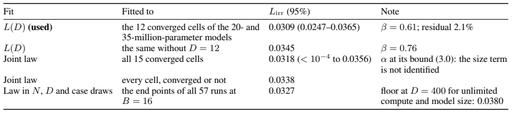
Table 22 .Estimates of the floor Lirr. The text uses the first, fitted to the converged cells of two models whose validation errors agree within the spread between seeds. The joint law isL(N, D) =L irr +a(N/10 6)−α +b(D/100) −β.
원문 · CC BY 4.0 · Peter Sharpe, Carmelo Gonzales, Corey Adams, Mehdi Ataei, Sanjay Choudhry · AeroZoo: A Benchmark of Well-Posed Flow Problems for Foundation Models of Aerodynamics · 원문 그림 인용 · 원본 PDF 33쪽에서 그림 영역을 추출했습니다.논문 정보
- 저자
- Peter Sharpe, Carmelo Gonzales, Corey Adams, Mehdi Ataei, Sanjay Choudhry
- 학회·저널
- arXiv · 프리프린트
- 최초 공개일
- 2026년 11월 12일
- 등록일
- 2026년 11월 14일
- 수정일
- 2026년 11월 12일
- 버전
- v1
- arXiv
- 2611.17152
- 분류
- cs.LG · cs.CE · physics.flu-dyn
- 원문 이용 조건
- CC BY 4.0
- 제공 범위
- 논문 정보, 해설, 허용된 원문 그림
AI 해설은 논문 원문과 별개의 설명이며 오류가 있을 수 있습니다. 원문과 그림은 각 출처의 이용 조건과 따로 표시된 권리를 따릅니다.
초록
Neural surrogates for computational fluid dynamics (CFD) are trained and ranked on datasets that each vary one design family in one flow domain. Such datasets cannot test the least that an aerodynamic foundation model must do: predict CFD-quality incompressible flow in seconds for new shapes in new enclosures. On DrivAerML, larger models and longer training barely lower Transolver's error; doubling the training cases cuts it by about 12% up to 400 cases, exhausting the dataset. We introduce AeroZoo, a benchmark and training corpus of 3,815 time-mean solutions to the unsteady Reynolds-averaged Navier--Stokes (RANS) equations with a transition model, across seven geometry families, eight enclosure configurations and Reynolds numbers from $10^3$ to $10^8$. Each sample poses a well-posed PDE problem in the form a solver receives it: the boundary meshes grouped by condition type, the prescribed values and the fluid properties. The 2,816 samples with a stable time mean form the canonical benchmark: two tasks, engineering metrics and 22 frozen splits, disjoint in geometry, that hold out geometry families, enclosures, boundary-condition layouts and Reynolds ranges. On the random split, boundary-condition tokens cut GeoTransolver's median velocity error from 76.9% to 8.4% of the inlet speed in single-seed runs (uniform inlet flow: 11.0%). ISLA, a transformer for boundary-driven PDEs, reaches 5.3% over four seeds, about 4 times the change from a finer mesh. On the same test samples, a held-out geometry family barely changes ISLA's error relative to uniform flow, and a held-out enclosure or boundary-condition layout raises it 2.4 to 9.2 times. The data and the scoring code will be released.
원문 인용
Peter Sharpe, Carmelo Gonzales, Corey Adams, Mehdi Ataei, Sanjay Choudhry (2026). AeroZoo: A Benchmark of Well-Posed Flow Problems for Foundation Models of Aerodynamics. arXiv:2611.17152v1. https://arxiv.org/abs/2611.17152v1
BibTeX
@misc{sharpe2026aerozoo,
  title = {{AeroZoo: A Benchmark of Well-Posed Flow Problems for Foundation Models of Aerodynamics}},
  author = {Peter Sharpe and Carmelo Gonzales and Corey Adams and Mehdi Ataei and Sanjay Choudhry},
  year = {2026},
  eprint = {2611.17152},
  archivePrefix = {arXiv},
  url = {https://arxiv.org/abs/2611.17152v1}
}